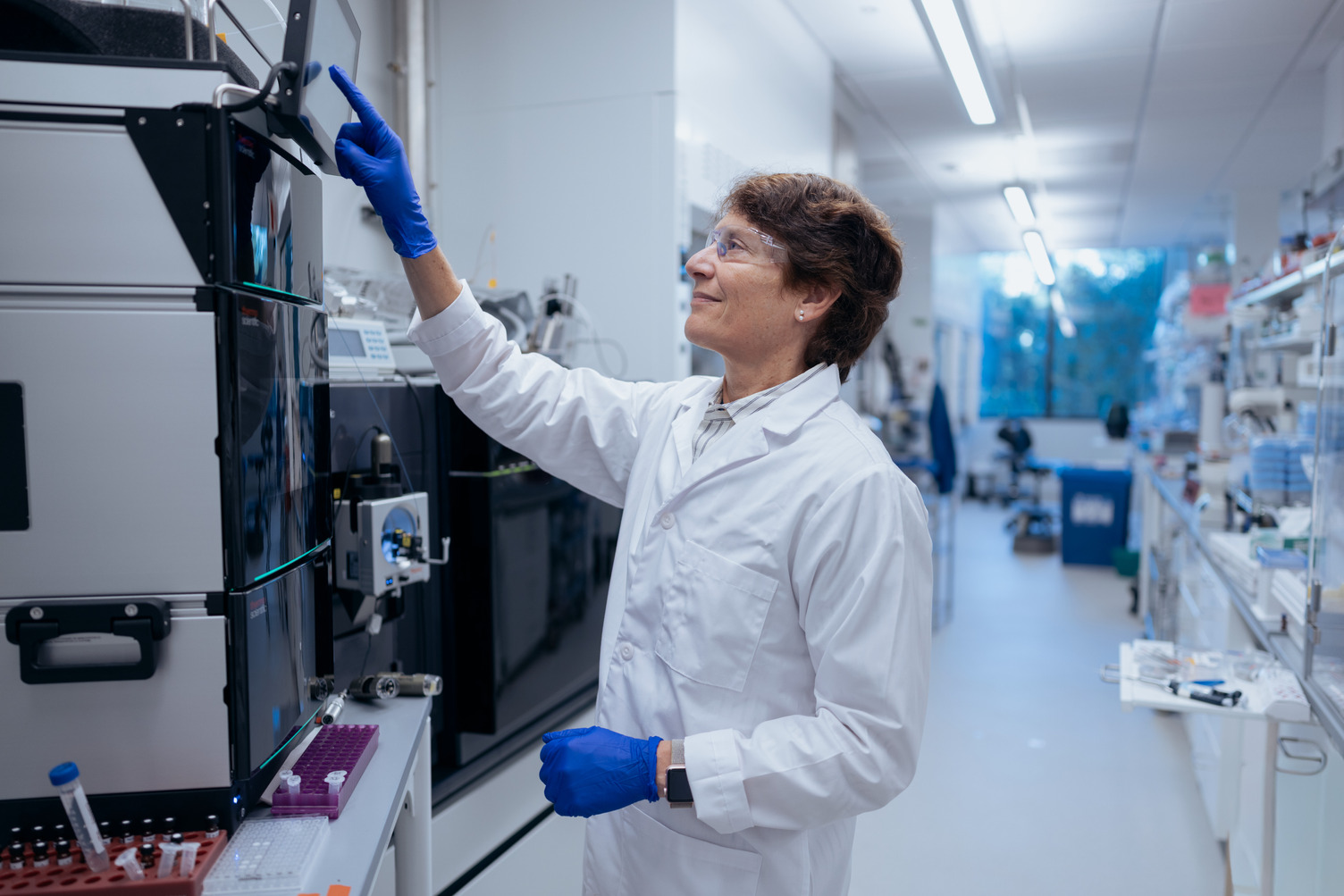
Growing up in Venezuela, Isabella Romero Yusti had little exposure to science careers and could not have envisioned herself as a scientist. But just before enrolling at the University of Nevada, she picked up a book about Jennifer Doudna, PhD, the Nobel Prize-winning co-inventor of CRISPR. The riveting story of Doudna’s life as a biochemist and how an arcane discovery in bacteria led to a gene-editing revolution was a revelation, Romero Yusti recalled, that science could be a creative and purposeful career.
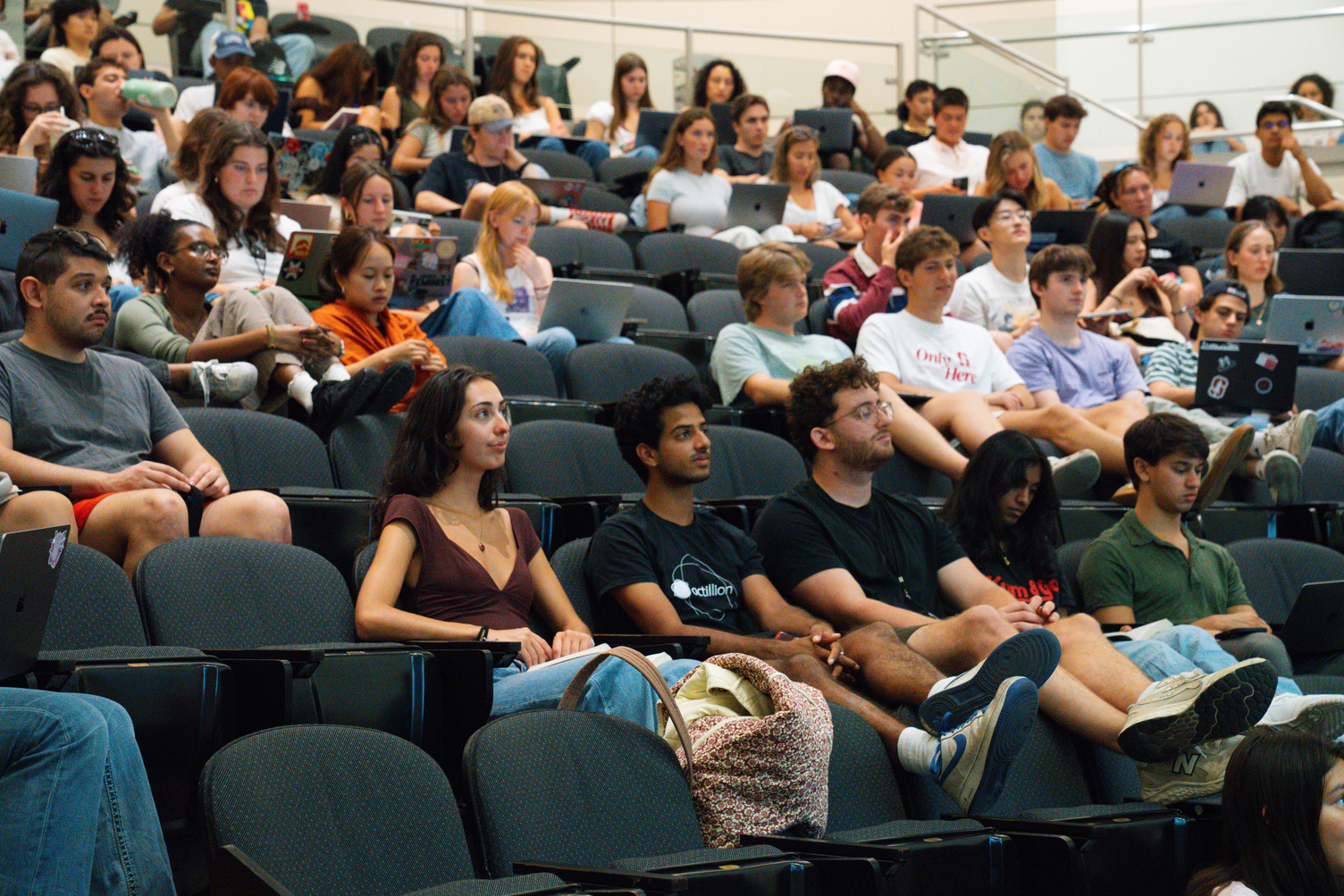
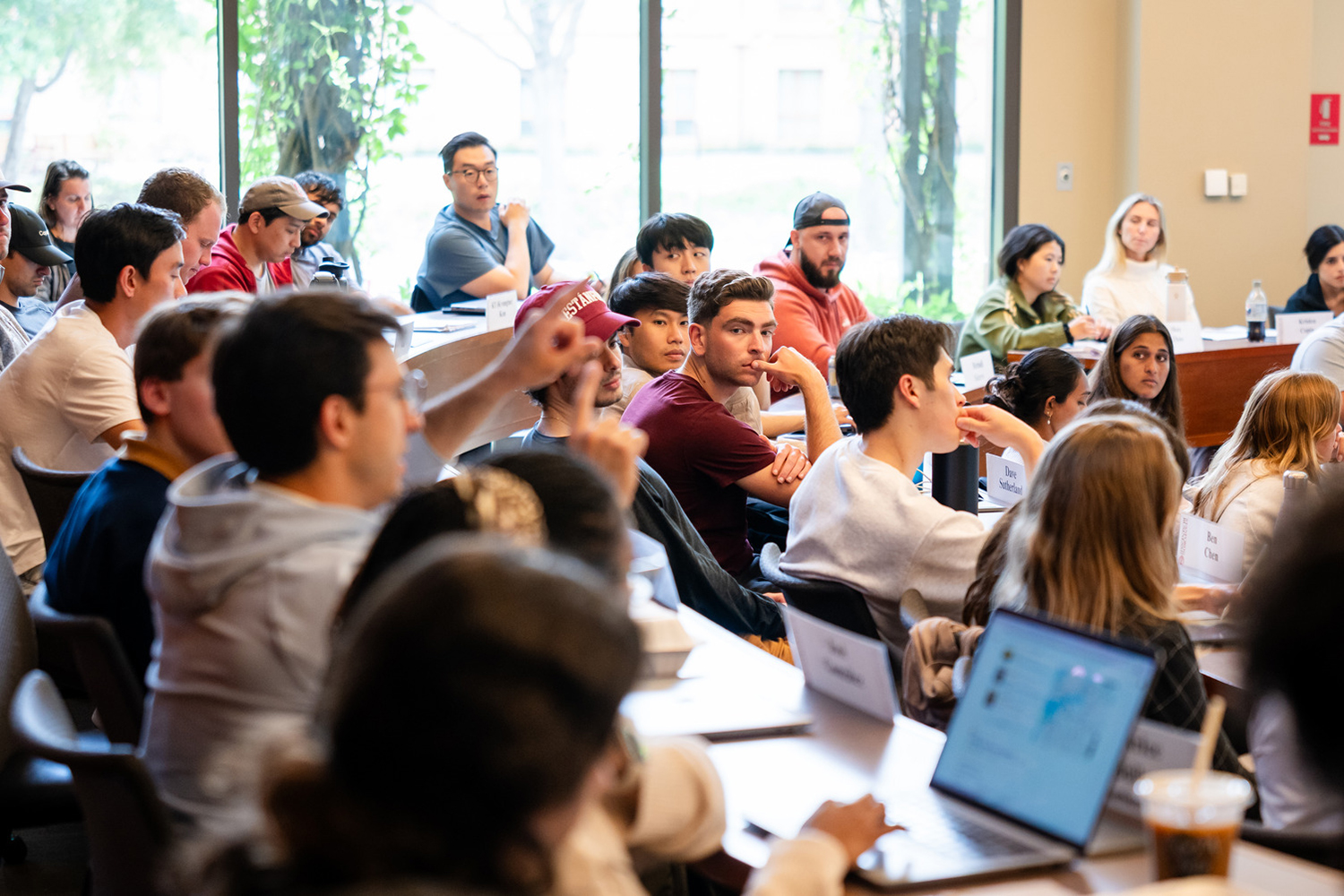
On Wednesday afternoon, Romero Yusti joined 117 fellow students in an orientation and lab coat ceremony for incoming Stanford Medicine PhD students, a symbolic kickoff for their scientific careers. Beaming in virtually to the Li Ka Shing Center for Learning and Knowledge to address the new students was none other than Doudna.
“It felt like a very full circle experience having a role model actually give you your welcome talk,” said Romero Yusti, who is studying chemical and systems biology.
During the ceremony, Lloyd Minor, MD, the Carl and Elizabeth Naumann Dean of the Stanford School of Medicine and vice president for medical affairs at Stanford University, held a fireside chat with Doudna, the Li Ka Shing Chancellor’s Chair of biomedical and health sciences at the University of California, Berkeley. He asked her about the milestones in her own career, concerns over responsible science raised by the gene-editing revolution, parallels with artificial intelligence and advice for the next generation of bioscience researchers.
“Graduate school is a wonderful time to really spread your wings and swing for the fences,” Doudna told the students. “Try something hard. Do something a little bit wild. Try something that you’re excited about, but you’re not sure if it’s going to work.”
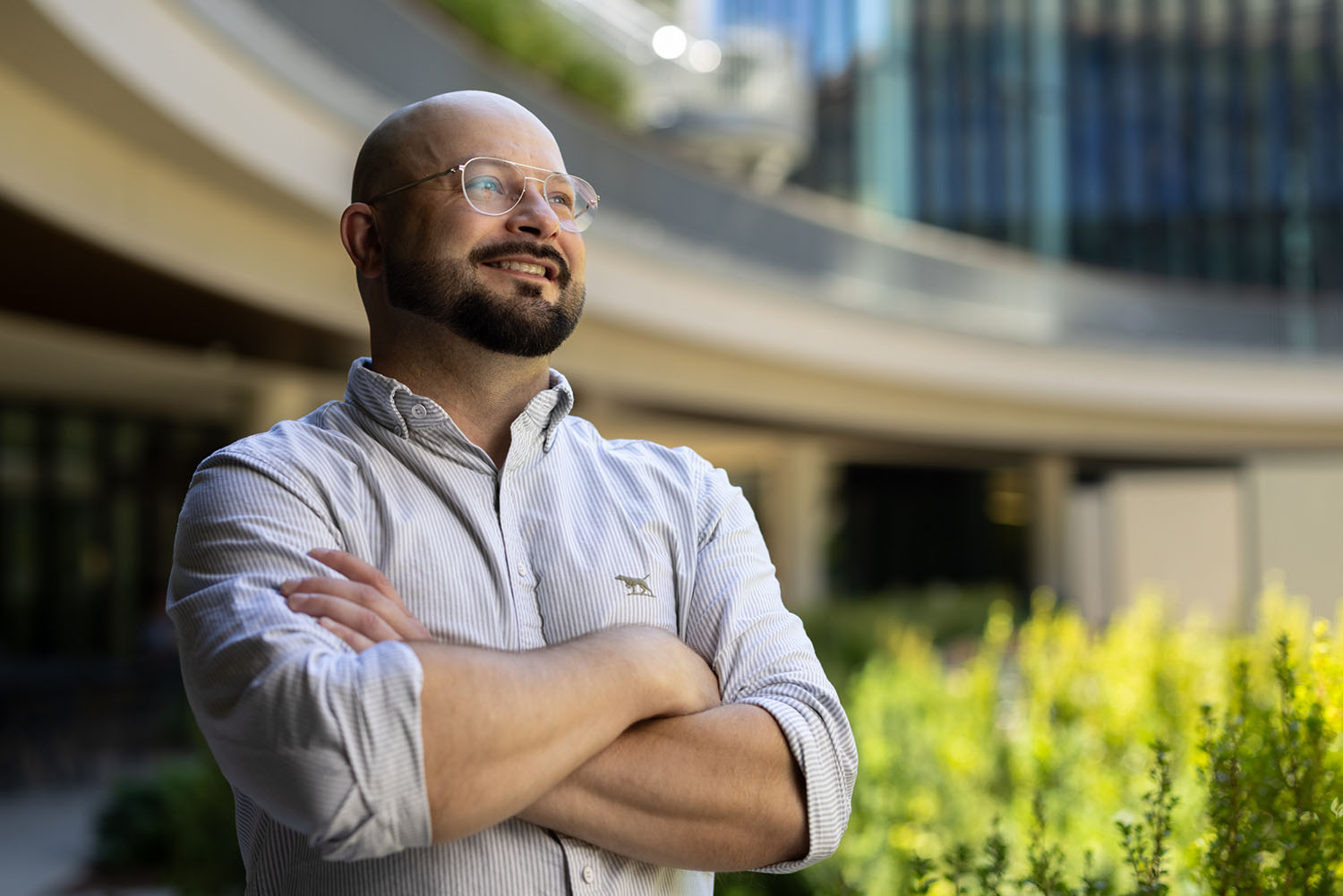
For Donovan Baker, who is pursuing a PhD in neuroscience, that “pie in the sky idea” is finding better ways to rewire brain circuits damaged by injury or disease, whether through neurostimulation, psychedelics, or technologies yet to come. “What draws me to neuroscience research is how much is still unknown about how the brain rewires itself and how much of that could translate into real interventions,” he said.
Baker’s open-minded approach to science is informed by his upbringing in a military family that moved often, with stints on both coasts, in the South, and in Okinawa, Japan. “Restarting that many times, in various environments, sparked curiosity and a habit of asking questions without assumptions,” he said. “I carry that habit into how I approach science.”
The best and worst of times
Doudna and Minor acknowledged both the unparalleled opportunities available to bioscientists and an uncertain climate around scientific research.
“In a way, it’s a bit like a tale of two cities: the best of times and the worst of times,” Minor said. “It’s the best of times in terms of the pace of discovery in biological sciences. And yet, the rhetoric is challenging.”
“You’re coming into the beginning of your professional career at truly an exciting moment in biology when there are so many technologies coming to the fore,” Doudna said. “Not only CRISPR, not only AI, but also molecular imaging; immunology; the ability to translate fundamental science into real clinical applications; and many, many other directions that are just happening so quickly.”
She emphasized the benefits of collaboration and the need for scientists to communicate the value of their work to the general public. After all, taxpayers fund much of science in the United States. “It’s your generation that will help shape that future,” she reminded the students.
Hearing directly from Doudna resonated for Jonathan Perera, who worked in a cancer immunotherapy lab after college, experiencing firsthand how CRISPR could crack open new discoveries. “I had the chance to see how incredible tools like CRISPR gene editing allow us to explore why certain cancers are resistant to treatment and identify therapeutic strategies that may work for patients in the future,” said Perera, who is a Knight-Hennessy Scholar pursuing a PhD in genetics and an MD. “It was so inspirational to see Doudna and have her speak to us – it was a really cool way to start the PhD.”
New lab coats
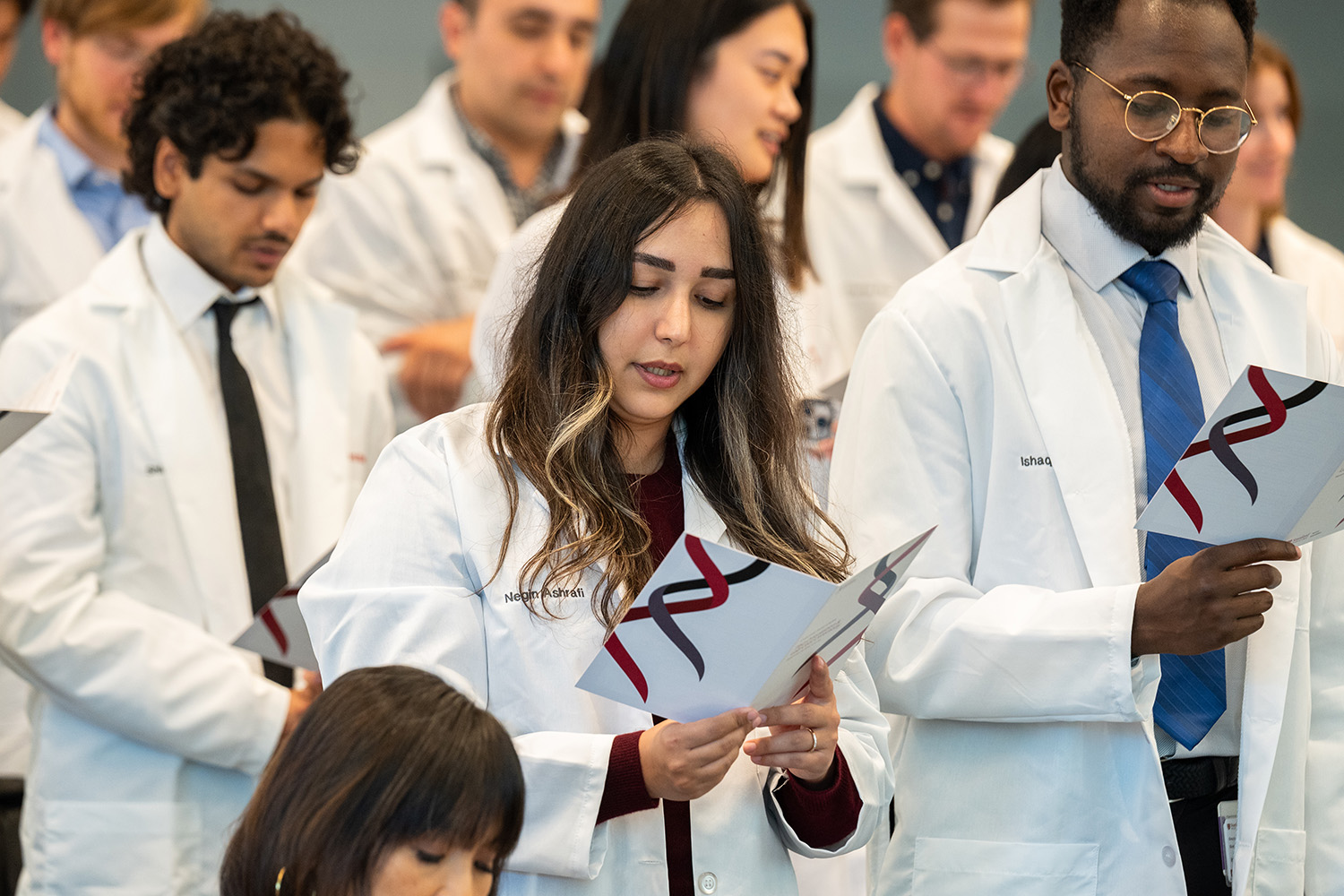
Each of the 16 departmental cohorts – in alphabetical order, from biochemistry to structural biology – was then called up to the stage. A faculty member from each department read the names of the students, who donned crisp white lab coats embroidered with their names.
The students had begun their journeys from around the world and around the country. (Perera, who grew up in Sri Lanka, said his first scientific fixation was sharks, which the local fisherman would save for him to dissect.)
“When I first moved to the United States, I could not have imagined that I would one day be pursuing a PhD at Stanford,” Romero Yusti said. “Receiving a lab coat makes that journey feel tangible.”
“It was nice to see every individual recognized, all the different tracks, and get a sense of all the amazing scientists that are around you,” Baker said.
Alicia Levey, PhD, a board member of the Stanford Medicine Alumni Association, who received her PhD in cancer biology from Stanford Medicine more than two decades ago, told the students that the road to a PhD may seem long now, but it flies by.
“The density of scientific talent in this place, the belief that hard problems are worth attacking, the freedom to chase those big questions, and the genuine optimism about what science and technology can do – that combination doesn’t exist in quite the same way anywhere else,” she said. “You won’t fully appreciate it until you’ve left, so while you’re here, take full advantage of it – the science and especially each other.”
To cap off the ceremony, the dean led the students and faculty in reciting the Stanford Biosciences Affirmation, pledging scientific integrity, compassion, and working toward the benefit of all humanity.
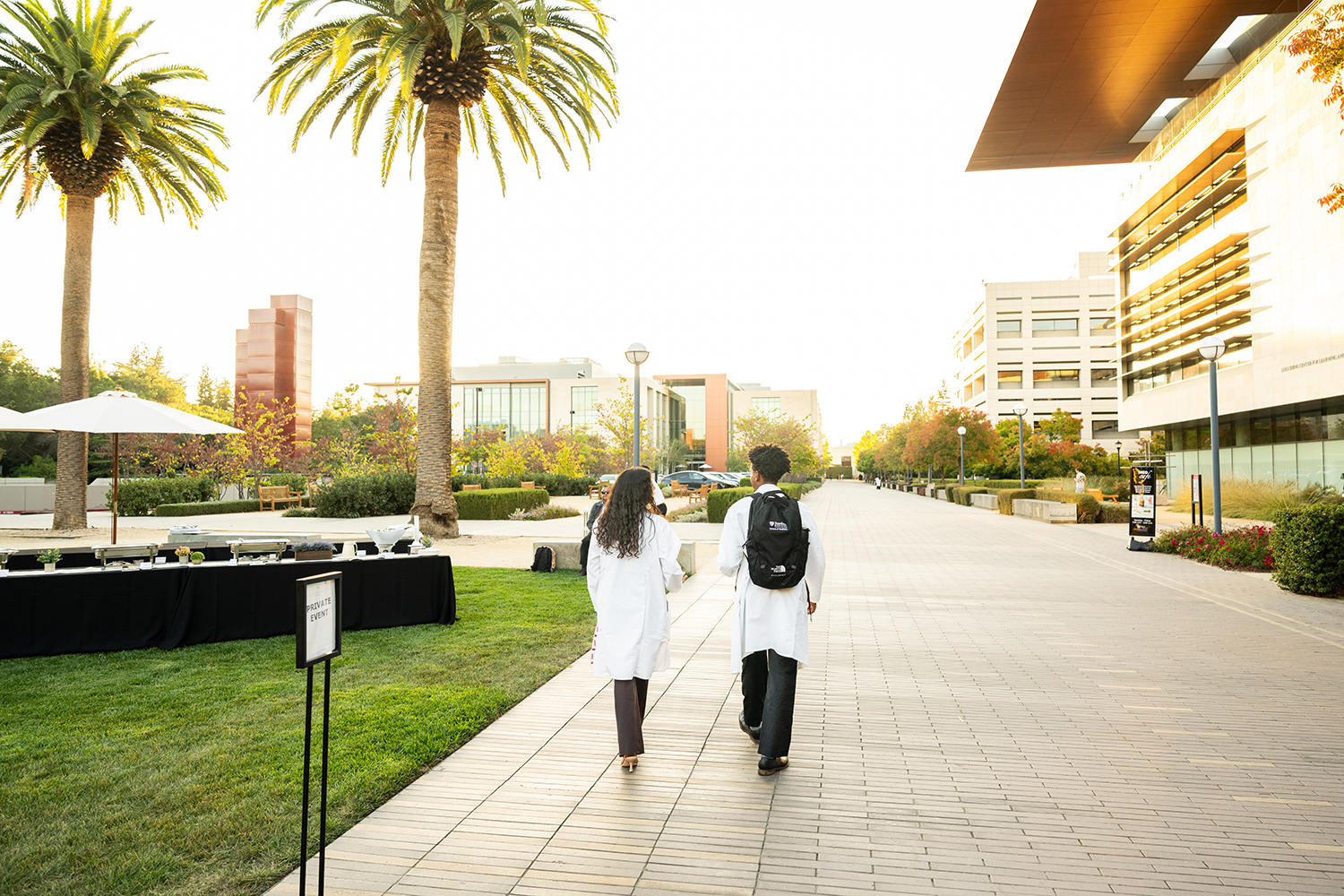
A pair of students leave the ceremonies, ready to start their doctoral studies. | Kevin Meynell
Right time, right place
For Bryan Castillo-Rojas, who is pursuing a PhD in microbiology and immunology, the lab coat symbolizes belonging. Coming from a working-class Latino community in Southern California, he has often fought imposter syndrome in his academic journey – “feeling alternative to what a scientist is supposed to look like,” he said.
Doudna, too, was once a fledgling graduate student uncertain of her future in science. She recounted when, during her second year of graduate school, her mentor sought her opinion on a new idea he was unsure of. “It made such a huge impression on me,” she said. “It really started me on that path of thinking, ‘Huh, if my adviser trusts me, maybe I should trust myself a bit more.’”
She told the students that one of the most important things to take away from their graduate education was “gaining a sense of yourself as a scientist and learning to trust yourself as a scientist.”
Castillo-Rojas already had a taste of that, being among the students who began their lab rotations in the summer. After the ceremony, as the students enjoyed an outdoor dinner reception in the warm Palo Alto evening, he felt a new sense of confidence and optimism. “I’m able to see myself among my peers. I’m able to see myself at the bench,” he said. “I realize that I’m at the right time, the right place.”
For more information
This story was originally published by Stanford Medicine.
Media contact:
Nina Bai, Stanford Medicine: 650-724-2763, nina.bai@stanford.edu
Writer
Nina Bai