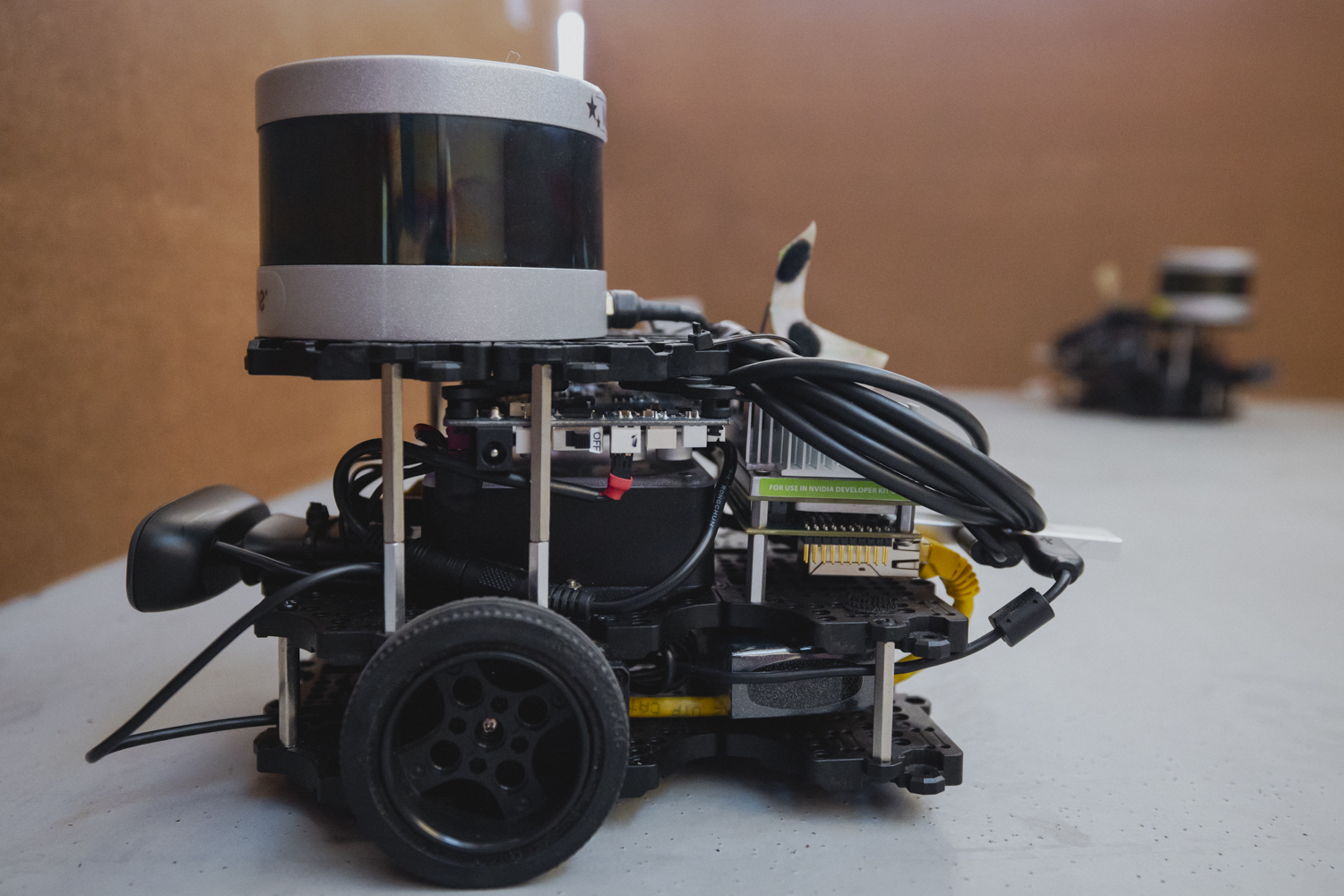
Even wonder what it’s like to learn about autonomous robotics at Stanford? Now you can find out.
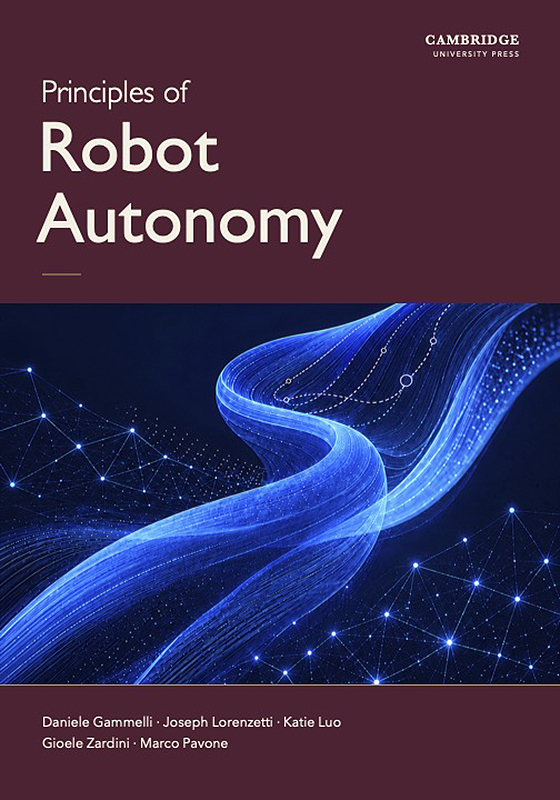
Principles of Robot Autonomy (PoRA) is a new textbook inspired by a course series by the same name, which has been taught at Stanford since 2017. This textbook reflects the recent evolution of autonomous robotics from lab prototypes to real-world technologies, and it addresses the specific intersection of robotics and autonomy – two disciplines that are becoming increasingly integrated.
“I truly believe that the mission of a university is sharing knowledge. Autonomous robotics is one of the generational technologies out there, and so it behooves us to share it with the public,” said Marco Pavone, professor of aeronautics and astronautics in the School of Engineering, co-author of the textbook, and creator and instructor of the Principles of Robot Autonomy courses.
PoRA is much more than a textbook. Published in print by Cambridge University Press, it is also freely available online. The PoRA website complements the book with free access to Pavone’s courses on robot autonomy, optimal control, and learning-based control, including video lectures, lecture slides, open-source code, exercises, homework assignments, and other hands-on materials designed to support everyone from individual learners to instructors teaching courses on robot autonomy. The authors also developed “Ask the Book,” an AI study assistant integrated throughout the book that answers questions, explains derivations, clarifies notation, and helps readers connect ideas across the material.
“This is a focused effort to make cutting-edge robot autonomy available to anyone who wants to learn, build, or contribute to the field,” said co-author Daniele Gammelli, a former postdoctoral scholar in Pavone’s lab and, now, research director at the Italian Institute of Artificial Intelligence.
In addition to Gammelli and Pavone, the textbook’s co-authors include three former members of Professor Pavone’s lab: Joseph Lorenzetti, PhD ’21, now a software engineer at Zoox; Katie Luo, a former postdoctoral scholar in the lab, now at Waymo; and Gioele Zardini, a former postdoctoral scholar in the lab, now an assistant professor at the Massachusetts Institute of Technology.
Changing with the times
The cross-cutting way in which PoRA covers robotic autonomy is rather unique, according to the authors. They have found that traditional robotics textbooks primarily focus on individual subjects, such as control, motion planning, and state estimation, while AI and machine learning books tend to devote less attention to the dynamics and control methods essential for operating physical systems. PoRA aims to bridge this divide, bringing classical robotics and modern AI together in a unified framework that connects foundational theory with the practical challenges of deploying autonomous robots and physical AI in the real world.
“To be an effective autonomy engineer, it’s important to understand how the entire robot brain works as a whole,” said Pavone. “That was the main motivation behind creating the Principles of Robot Autonomy courses, which ultimately led to this textbook.”
One significant AI-driven shift in autonomous robotics that inspired the authors is the transition from predominantly model-based approaches to increasingly data-driven methods. For example, developing software for autonomous vehicles traditionally involved hand-engineering individual components for tasks such as object detection, tracking, planning, control, and decision-making, then integrating them into a cohesive autonomy stack. Today, larger data-driven models can combine multiple capabilities and learn more directly from large-scale driving data, including demonstrations from human drivers.
At the same time, the authors emphasize that classical robotics remains essential. Its foundational principles provide the tools to understand and reason about modeling, control, motion planning, and other aspects of autonomous systems. Decades of advances in classical robotics also offer valuable methods for verifying, guiding, and augmenting data-driven approaches. Recognizing that these classical and modern approaches are increasingly intertwined, the authors bring them together throughout the textbook, reflecting the integrated nature of today’s autonomous systems.
“Although there have been a lot of advancements in terms of methodologies and how the stack is architected, classical methods do not become less relevant,” said Gammelli. “Classical and data-driven methods often work together within robotics and autonomy stacks. Classical methods can also generate training data for learning-based approaches and provide complementary ways to validate their robustness. Combining these philosophies is essential to building reliable autonomous systems.”
A broader reach for robot autonomy
Although the authors began working on the textbook years ago, it is far from their first effort to make this material accessible to a broader audience. What started as a graduate-level course provided the foundation for a dedicated undergraduate course, short summer programs for college students from outside Stanford, and a specialized course for the U.S. Air Force Test Pilot School.
“The plan was to publish the book a couple of years ago, but it was a moving target because there was always a new chapter to add. That was a blessing in disguise because robotics is so topical right now,” said Pavone.
The timing also meant that the researchers benefited from recent advances in AI as an educational tool, which enabled them to create a more interactive experience – “virtual Marco, available 24-7,” joked Pavone. Aside from being an additional layer of learning, responsive exercises and the “Ask the Book” AI reflect the reality that robot autonomy is a practical discipline that requires creating, breaking, and observing the actions produced by algorithms.
Through the combination of text, lecture videos, code, homework assignments, presentations, and interactive virtual instruction, the authors hope they have made this education as accessible as possible.
“We made this book for developers who have already been working in robotics for years who want to learn more about the state-of-the-art in autonomy and for people who are just starting in AI who are excited about applying it to physical systems,” said Pavone. “Like the course, the book is made to be accessible by a very wide audience.”
Sharing knowledge, supporting students
The authors worked with Cambridge University Press to allow for the publishing of a preprint of the book, so that people can download it for free. The authors of Principles of Robot Autonomy agreed among themselves that any revenue from the print version of the book will be used to sponsor fellowships for students pursuing education in the field of robot autonomy.
For more information
Pavone is also a professor, by courtesy, of computer science and of electrical engineering, director of the Autonomous Systems Laboratory and the Sustainable Mobility Center, a senior fellow at the Precourt Institute for Energy, a faculty affiliate of the Institute for Human-Centered Artificial Intelligence (HAI), and a member of the Institute for Computational and Mathematical Engineering (ICME). Outside Stanford, he leads research in autonomous systems and physical AI at NVIDIA.
The Sustainable Mobility Center is an industrial affiliate program. Stanford industrial affiliate programs are funded by membership fees from companies. View current Stanford Doerr School of Sustainability affiliate members.
Writer
Taylor Kubota