In brief
- Most everyday light sources, such as light bulbs, produce incoherent light. Unlike laser light, their light waves do not maintain a fixed relationship with one another. When different light contributions overlap, separating them into their underlying components has long been a challenge.
- Combining advanced light-based chips and a sorting algorithm, the researchers created a device that produced separated, pure incoherent beams from a mix of incoherent or partially coherent light sources. They were able to do this with two and three input lights.
- By allowing researchers to distinguish between different light sources, this advance could help extract more information from light to improve many technologies, such as cameras, microscopes, and telescopes.
Stanford engineers and colleagues designed a chip that can take a muddled mixture of light from multiple lasers and output clean beams of light.
It’s the first time researchers have demonstrated a device that can take in mixed, or partially coherent, light and sort its photons into a clear set of separate beams. The finding, published Oct. 30 in Nature Photonics, grounds long-theorized physics while unlocking a unique way of observing the world around us, with potential uses in microscopy, astronomy, and more fields.
“We’re experimentally demonstrating stuff that was thought of originally in the 1980s for the first time,” said co-lead author Annie Kroo, a PhD student in electrical engineering. “This work has a huge bearing on a whole bunch of different applications because it allows us to think about things in a totally new way.”
Dancing photons
A light bulb is an incoherent light source and a laser is a coherent one, explained Kroo. Point a laser through a mesh and the light on the opposing surface forms a speckled pattern. Hold a light bulb to the same mesh, and a softer, more diffuse grid emerges. The photons in the laser are all oscillating together, said Kroo, leading to sharper shapes on the wall because in some areas the light adds together and in others it cancels itself out. The light bulb’s photons, by contrast, are bumping around out of sync, leading to a fuzzy pattern.
Researchers want to untangle the different rhythms contained in light bulb-style light to enable new types of communication, computing, and sensing. “We see a new opportunity in optics, which is to exploit the true nature of light, which is partially coherent, and to use it for various applications,” said co-author Charles Roques-Carmes, an assistant professor at the Institute of Science and Technology Austria and former Stanford Science Fellow. “To do this, you have to decompose it into buckets of light that are mutually incoherent, or statistically uncorrelated.”
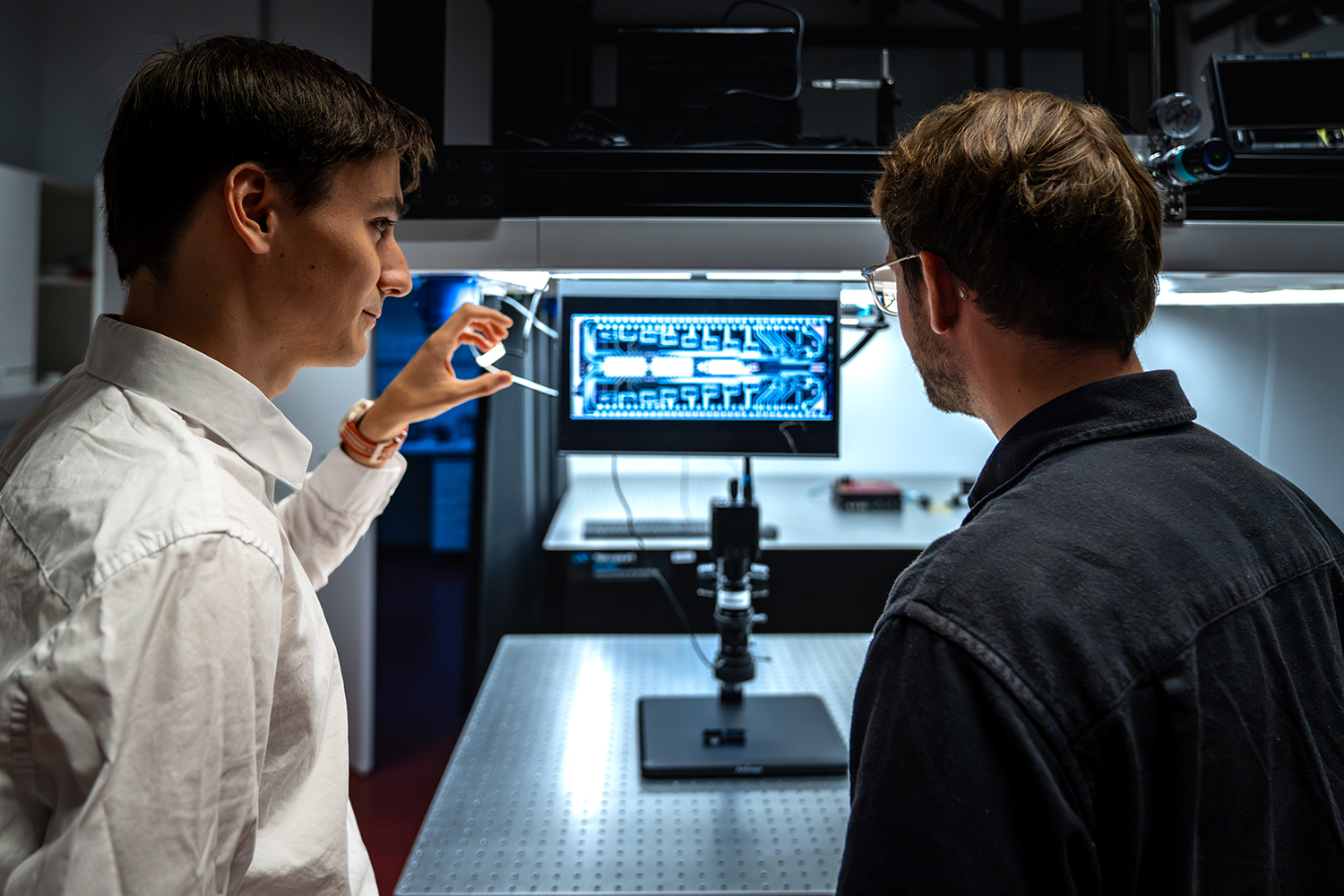
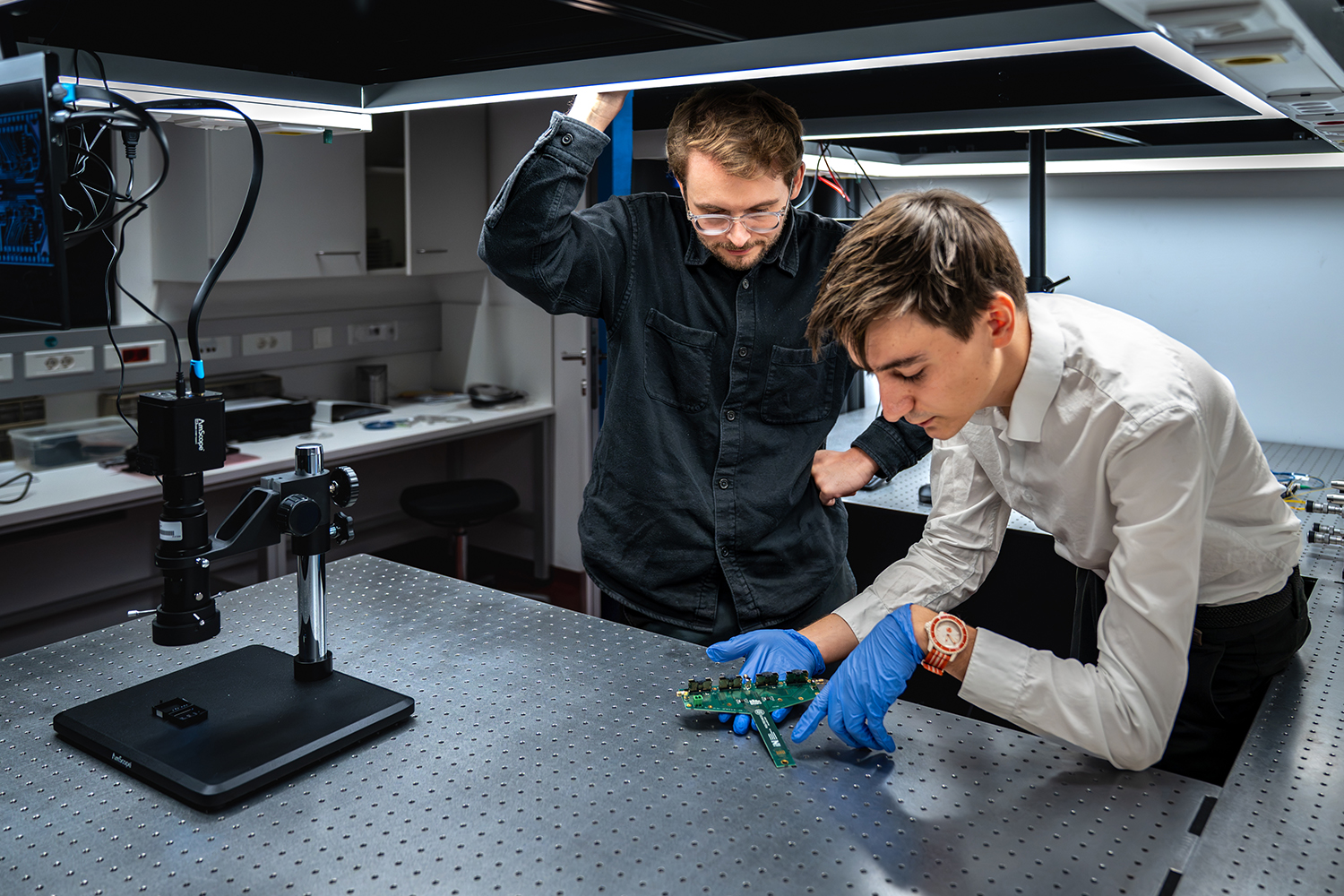
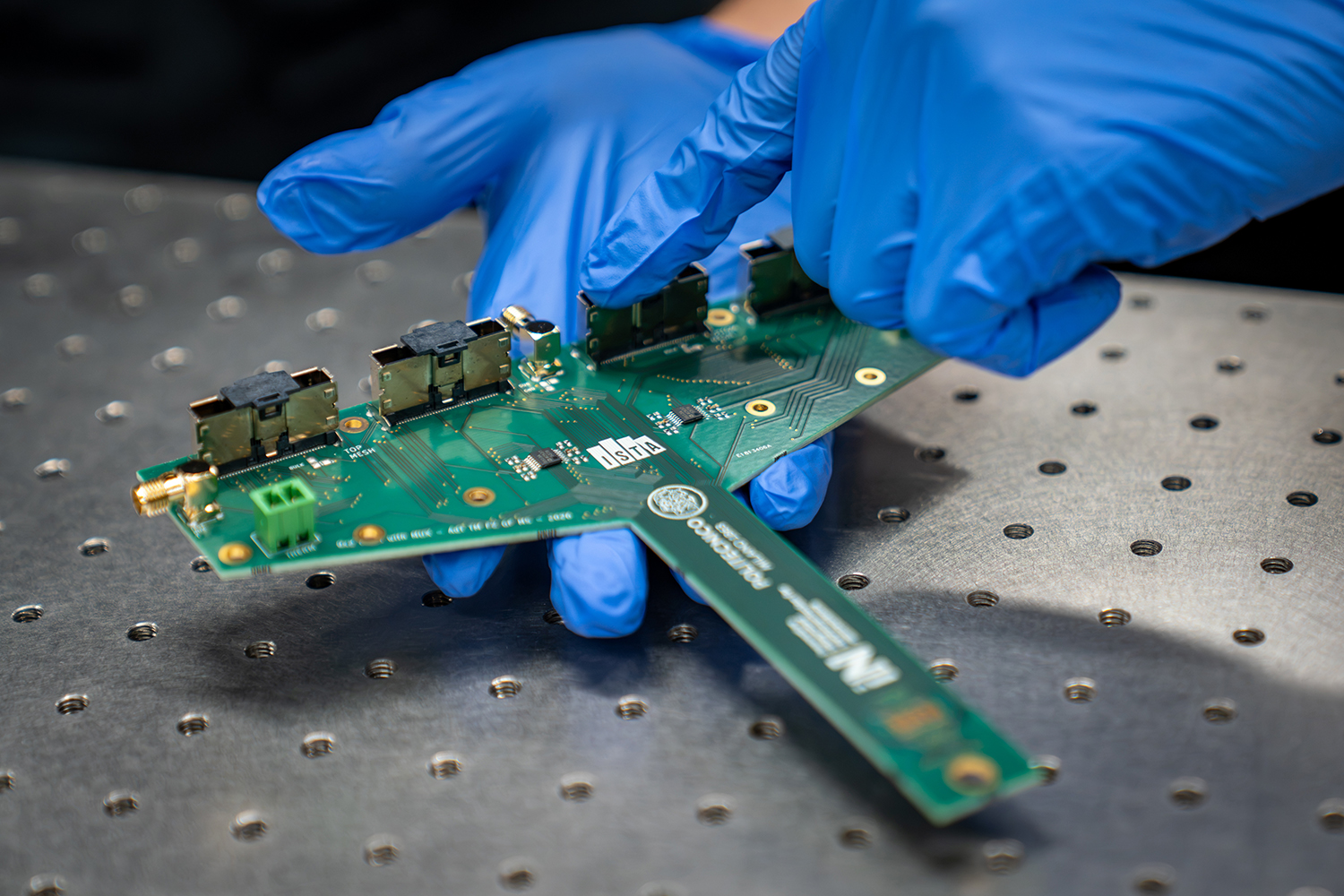
To test this possibility, the team used a photonic chip the size of a fingernail. Photonic chips channel photons for data processing similarly to how the microchips in laptops and cellphones use electrons. While these light-based chips have grown smaller and more powerful in recent years, wrangling the particles inside is still a challenge. “You can make better optics by putting them on a chip, just like you can make better electronics by putting them on a chip,” said co-author Olav Solgaard, the Audrey S. Hancock Professor of Engineering at Stanford.
We see a new opportunity in optics, which is to exploit the true nature of light, which is partially coherent, and to use it for various applications.Charles Roques-CarmesAssistant Professor, Institute of Science and Technology Austria
Mixing and matching light
In their experiment, the researchers pointed two infrared lasers into the chip, mixing the light sources. The combined light was partially coherent, meaning the photons’ oscillations lined up for a short period but ultimately fell out of step. Inside, the chip’s algorithms and architectures automatically sorted the light based on its sources.
Then, the chip produced the separated light beams. The researchers directed these beams through a device that mixed them together to see if they would add together in intensity, but the two beams would not sync up, demonstrating they were independent, mutually completely incoherent beams of light. Encouraged, the team added a third laser to the input. Even then, the chip was able to sort out the mixture into pure beams. “If you look at the outputs, they are completely out of sync; there’s absolutely no correlation anymore,” said co-lead author Paul-Alexis Mor, academic visitor at the Institute of Science and Technology Austria and engineering student at Corps des Mines, France.
The algorithms inside the chip determined the unique signatures within the partially coherent light, allowing it to sort out the coherent components, said co-author David Miller, Stanford’s W. M. Keck Professor of Electrical Engineering, Emeritus.
“Our chip learns the underlying coherence modes of an unknown light field and physically directs them into separate outputs,” said co-author Shanhui Fan, the Joseph and Hon Mai Goodman Professor at Stanford. “That gives us a way to analyze the light’s spatial coherence while keeping the separated light available for further processing.”
Seeing the full picture
Separating mixed light into its coherent ingredients could allow researchers to extract more information from light compared to even the most sophisticated cameras. When rendered into a camera’s two-dimensional image, overlapping light sources tend to get lumped together.
“In a camera, we throw away the depth information,” said Miller. “By doing this separation of light, we know everything knowable about it. We can get whatever depth information there is.”
For example, under a microscope, if two fluorescent particles are overlapping, they might appear as one in traditional imaging. But this photonic chip-based method could, in principle, distinguish between the light from the different sources. “Even though they’re spatially overlapping, the information contained in the light is indicating there are different sources of light,” said Kroo.
Miller, Solgaard, and Kroo are now collaborating with NASA to see if the new technology could probe light from distant galaxies. Light that appears as a single blob in a telescope might actually contain distinct strands emitted from separate stars and exoplanets, for instance.
“A lot of the information in our world is in light form,” said Kroo. “Light is a beautiful medium for measuring things in the environment.”
For more information
Stanford PhD graduates Carson Valdez, Zhanghao Sun, and former postdoctoral researcher Aviv Karnieli are also co-authors. The authors also include researchers Gabriele Cavicchioli and Vittorio Grimaldi from Politecnico di Milano in Italy, and postdoctoral researcher Marko Simic of the University of Graz in Austria.
David Miller is also a professor, by courtesy, of applied physics. Solgaard is also a professor of electrical engineering, a member of Bio-X, the Precourt Institute for Energy, and the Stanford Cancer Institute, and an affiliate at Stanford Woods Institute for the Environment. Fan is also a professor of electrical engineering and, by courtesy, applied physics, a senior fellow at the Precourt Institute for Energy, and a member of Bio-X.
Funders of the research include the Air Force Office of Scientific Research; the Stanford Science Fellowship; the Institute of Science and Technology, Austria; the Austrian Federal Ministry of Labour and Economy; the Austrian National Foundation for Research, Technology and Development; the Christian Doppler Research Association; and the University of Graz.
Media contact:
Jill Wu: School of Engineering, jillwu@stanford.edu
Writer
Ula Chrobak