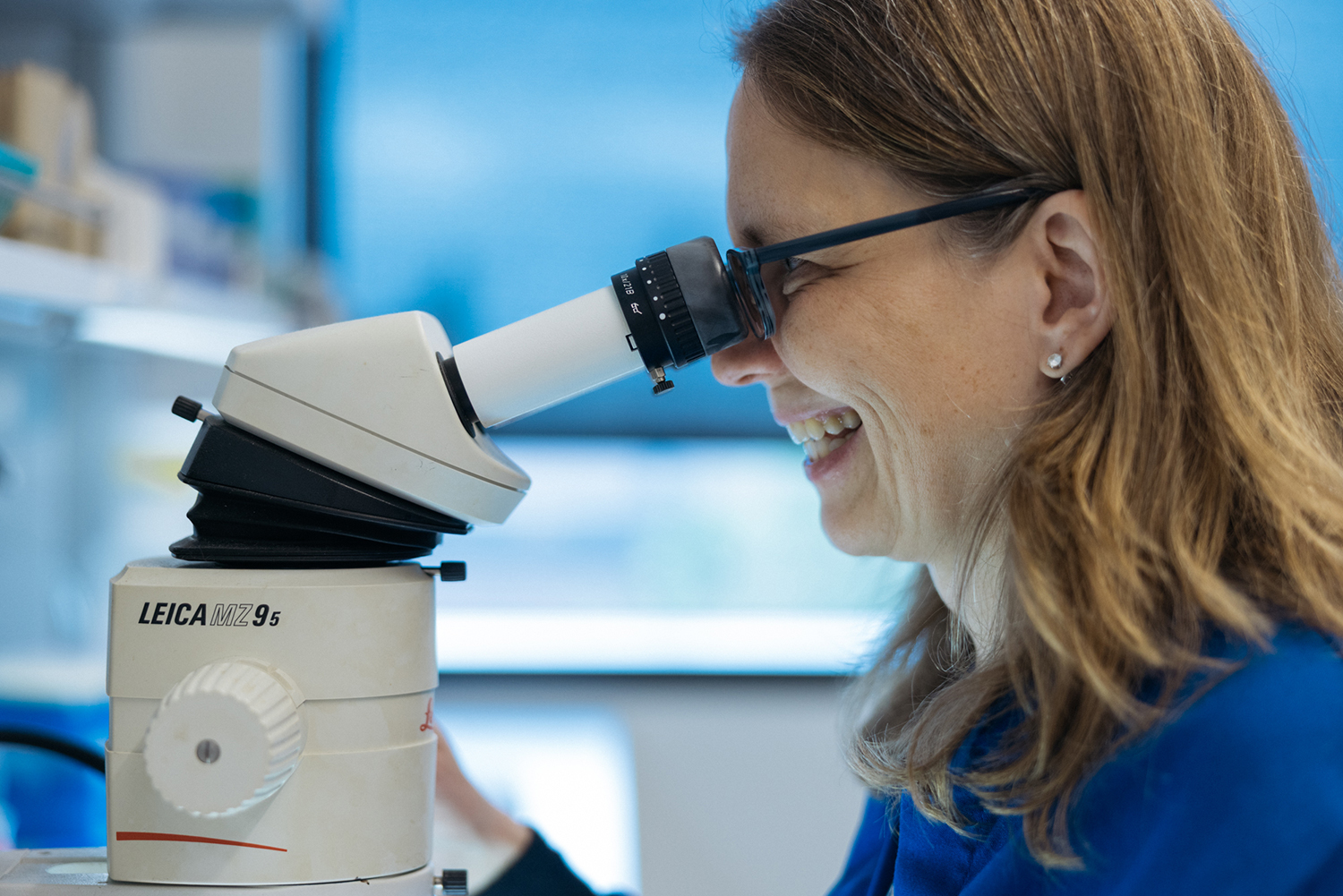
Julia Kaltschmidt was many years into her scientific career in New York investigating the spinal circuits responsible for walking and running before she ever started thinking about the gut. But a particular moment during a research presentation – a striking image, in fact – got her excited about the subject and on the way to a new chapter in her research, the Wu Tsai Neurosciences Institute faculty scholar and professor of neurosurgery at Stanford Medicine said.
Kaltschmidt’s path to Wu Tsai Neuro and the gut began in Lüneburg, a medieval town outside of Hamburg, Germany, where she grew up. Her father, a medical doctor, had done postdoctoral work studying ribosomal proteins at the University of Wisconsin-Madison.
“For me, growing up, I knew about this time that my parents had spent in the United States for my dad’s postdoctoral work, and all the stories that I heard about their life there fascinated me,” Kaltschmidt said. “You know those unopened moving boxes that we often carry around with us? Well, we had several in our basement, and one day, I opened one of those boxes from Wisconsin. In it, I found The Double Helix, a book about the discovery of the structure of DNA, and that was one of the first books I read in English. From then on, I started reading every other book related to that subject, and with it came this fascination about wanting to study abroad.”
Kaltschmidt went on to study at the University of Wisconsin-Madison herself, focusing on molecular biology and biochemistry but also entertaining a longstanding interest in painting. For a time, she considered moving back to Germany to study art in Berlin before deciding to pursue graduate school in developmental biology – perhaps ultimately a more familiar path, she said – at the University of Cambridge in the United Kingdom, where she studied the fruit fly nervous system as a graduate student in Andrea Brand’s lab and with Alfonso Martinez Arias.
During her postdoc at Columbia University, Kaltschmidt switched to studying spinal cord circuits underlying locomotion in mice. “I loved the fruit fly nervous system and was keen to stay within the neural circuitry field. But I also wanted to work with a vertebrate model system,” Kaltschmidt said. She continued this line of work as a lab head at the Sloan Kettering Institute in New York, where a fortuitous encounter with a “beautiful” image of gut neurons set her on a new path.
Now, as a faculty scholar at Wu Tsai Neuro, she’s working with colleagues across the university on outside-the-box ideas in gut biology, including an effort to map the nervous system of the gut and a Big Ideas in Neuroscience project to understand how our brains and guts conspire to keep us in bed when we’re sick.
We sat down with Kaltschmidt to talk about that fateful image and how it led her to study the many ways our guts influence our health.
I’ve been curious about this for a while: You were on the other side of the country, getting grants and doing great science – and then you changed your research direction. How did that happen?
My first lab was at the Sloan Kettering Institute in the Developmental Biology Program. I was then and still am really interested in understanding the neural circuits within the spinal cord that are involved in locomotion. A few years into running my lab, I served on the dissertation committee for a PhD student, Faranak Fattahi, who now runs a lab at UCSF. As a graduate student in Lorenz Studer’s lab, she was studying the enteric nervous system – the nervous system of the gut – and Hirschsprung’s disease. This is a birth defect where the far end of the colon is devoid of nerve cells and children have dysfunctional colons.
During one of Faranak’s presentations, I saw for the first time images of enteric neurons, and they are beautiful. I became obsessed with these neurons, which I had known about but never looked at. I always challenge my trainees – if you can’t stop thinking about something, then that is a good basis on which to work on a project. And I guess in this case it was me, who couldn’t stop thinking about the enteric nervous system.
You used the word “beautiful” to describe gut neurons, and it reminds me that you once thought seriously about becoming an artist.
Yeah. I loved painting. I loved the immersive aspect of it. I was primarily doing watercolors, and there was a time when I was thinking about going to paint in Berlin. I had a very artistic upbringing. My family spent weekends in artists’ studios or visiting museums, or we would go to Hamburg harbor and see what art came off the ships. Actually, during my postdoc, I started painting again, and it was very helpful because sometimes experiments don’t work, and painting was my creative escape.
Why did you choose science?
It was very much a rational decision. I thought it would be too difficult to make a living as an artist. And I had this parallel interest in science. Maybe there is an appreciation for deep observation that connects my love for art and science. One of my favorite things to do with my lab members is seeing and discussing their data, which we project onto a big TV screen in my office. There is a lot that we can learn from close observation.
I always challenge my trainees – if you can’t stop thinking about something, then that is a good basis on which to work on a project.
Tell me about coming to Stanford and taking on this new area of research. That must have felt risky. Did it feel like starting your career over?
Yeah, it did a little bit. We had just gotten a new R01 grant on the spinal cord when I moved to Stanford, so I felt that I had a backup plan, but I knew this idea of changing directions mid-career to work on the enteric nervous system was risky. I am extremely grateful to Wu Tsai Neuro and the Neurosurgery Department because the early funding that I got from them and other institutes around campus really made it possible for my lab to produce the preliminary data on the enteric nervous system that I then used to get NIH grants. That support is really what allowed me to take a risk on a different research subject.
Big picture, what is the thing that you want to understand about the gut? What’s the big question that’s motivating you?
I want to understand how the enteric neuronal circuits are built during development and how they malfunction in disease. There are neurodevelopmental, neurodegenerative, and traumatic illnesses that are associated with gut dysfunction. Colonic dysmotility and constipation might be a predictor of Parkinson’s disease. Autism is associated with gastrointestinal (GI) problems, and addressing constipation remains the highest priority of patients with spinal cord injury.
So from the perspective of disease, understanding the enteric nervous system, how it works, and how we could leverage this understanding to regain GI function is a huge motivation behind our research. At the same time, I am also interested in understanding the basic neurobiology of enteric neural networks, which is still relatively poorly mapped out. If we understand that, then we can begin to evaluate the structural and functional parallels between the gut’s nervous system and that of the brain.
Was there a moment that really got you hooked on studying the gut?
It was our first finding – I absolutely loved it. One of the ideas in the field at the time was that the neurons within the GI tract are not necessarily organized. Coming from spinal cord and central nervous system research, I was used to thinking about structure, how regions are organized, and how that organization influences function. So I was really curious about whether there was any structure within the enteric nervous system. And it turned out there was.
We zoomed out from looking at individual neurons and took a bird’s-eye view of the organization of the enteric nervous system, and there you could see that these neurons are organized into stripes or rings along the entire length of the GI tract. I immediately thought, “That means something,” and I had lots of different questions. What neuronal subtypes are within the stripes? How do they interconnect? Are the stripes different in the small intestine and the colon? How do they develop? If we manipulate stripe organization, what does it do to gut motility?
The first time when we saw the enteric stripes was wonderful. I still get goose bumps thinking about it.
What are a couple of questions that you’re asking right now that you’re particularly excited about?
From a developmental perspective, we would love to understand more about how these enteric neuronal stripes get organized. Periodic patterns are widespread in nature. Zebras have stripes; cat coats can be stripy. And it turns out that there is a gene called Taqpep, which influences these stripes, so if you mutate it, you get a patchy cat coat. In collaboration with Greg Barsh’s lab here at Stanford, we asked whether Taqpep could be playing a similar role in the periodic neuronal patterning in the gut, which it turned out to do. In addition to these intrinsic signals, we are also interested in extrinsic influences, such as different effects of breast milk versus formula and risks from maternal stresses, drug and alcohol consumption.
Then we are interested in circuits. One thing we can do is use optogenetics to selectively activate neurons that express a gene of interest. In one of our recent papers, we took pieces of gut and put them in a solution that sustains the life of the neurons, enabling us to watch peristalsis, the propulsion of the feces through the gut. And what we saw was that if we activated certain neurons, peristalsis was accelerated.
Now we want to understand how that works. What do these neurons look like? Whom do they interconnect with? And then we want to know what role these neurons play in the propulsion of the fecal pellet. We see these neurons as a potential target for treatment – could you activate them and address GI transit issues?
You’re a faculty scholar with Wu Tsai Neuro. How has that shaped your work?
I am very honored and grateful to be a Wu Tsai Neuro faculty scholar. It has given me the financial support and structure to do the research that we do, and it has given me and the lab an opportunity to ask questions that we would usually not be able to ask. Being in the Neurosciences Building brings us very close to faculty from different disciplines, including two other faculty scholars, Guosong Hong and Todd Coleman, with whom we have collaborated. Together with Guosong, we have used his tissue transparency method to visually access the gut in a live mouse. My interactions with Guosong and Todd have really enabled research that we can not do by ourselves.
And then there is a tremendous encouragement to formulate new ideas that might otherwise be too risky to pursue. Wu Tsai Neuro hosted a retreat in 2024, where the institute hosted a session that encouraged faculty to think about opportunities for the next Big Ideas in Neuroscience project, a large, collaborative grant program run by the institute. I ended up at the same table with Luis de Lecea, who studies brain circuits involved in sleep, and together with Christoph Thaiss, an expert in the gut-brain axis, we came up with this idea of studying the bidirectional interaction between body and brain in the context of fatigue. We now have a fabulous interdisciplinary team, which brings together different expertises in gut neuronal circuitry, brain circuits of sleep, and gut-brain interaction to ask this broader question. And again, there are very important medical implications of this research for long COVID or chronic fatigue, which can be debilitating and not something that is usually talked about.
You’ve got a lot going on.
I do. I love it.
For more information
This story was originally published by Wu Tsai Neurosciences Institute.
Writer
Nathan Collins