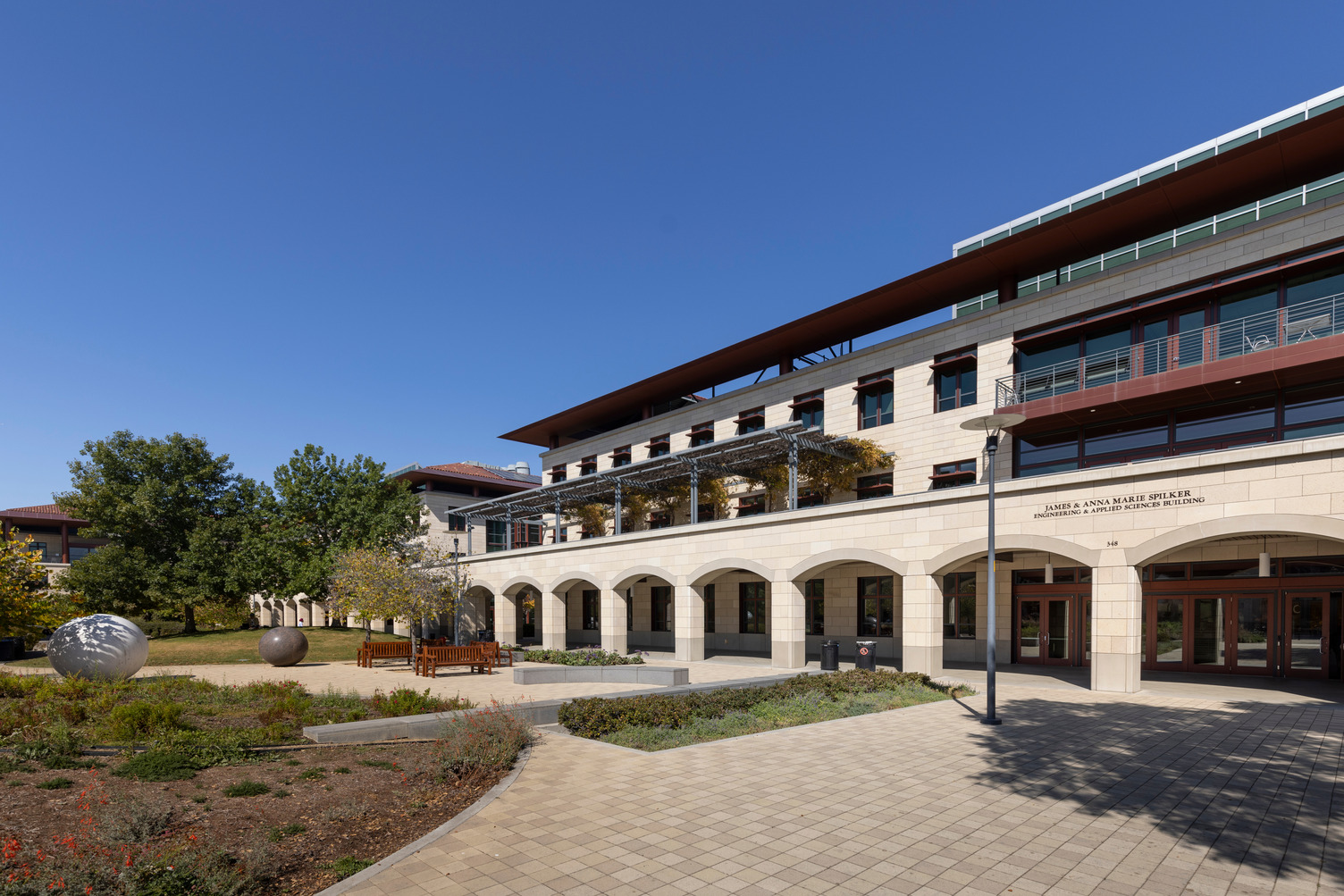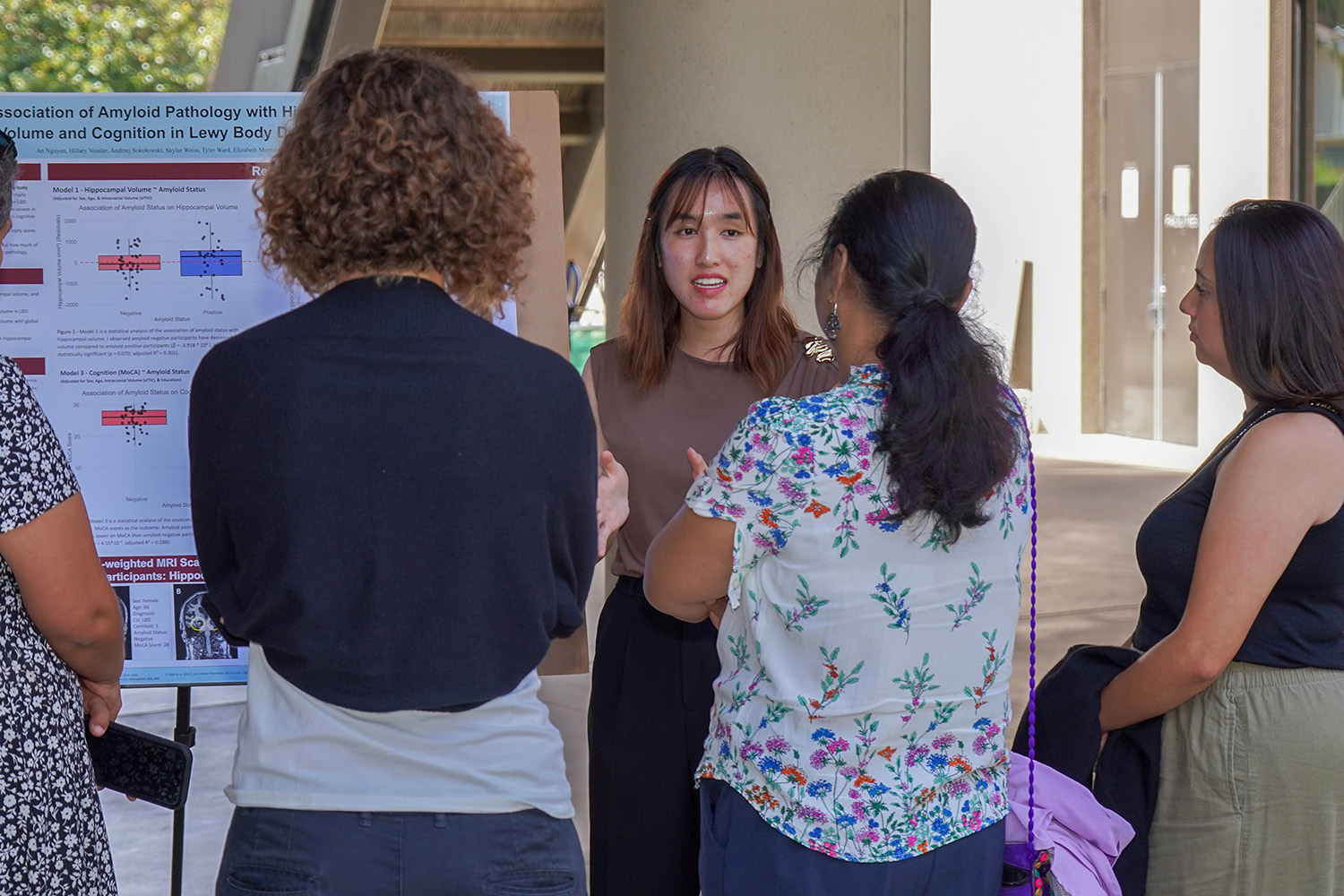
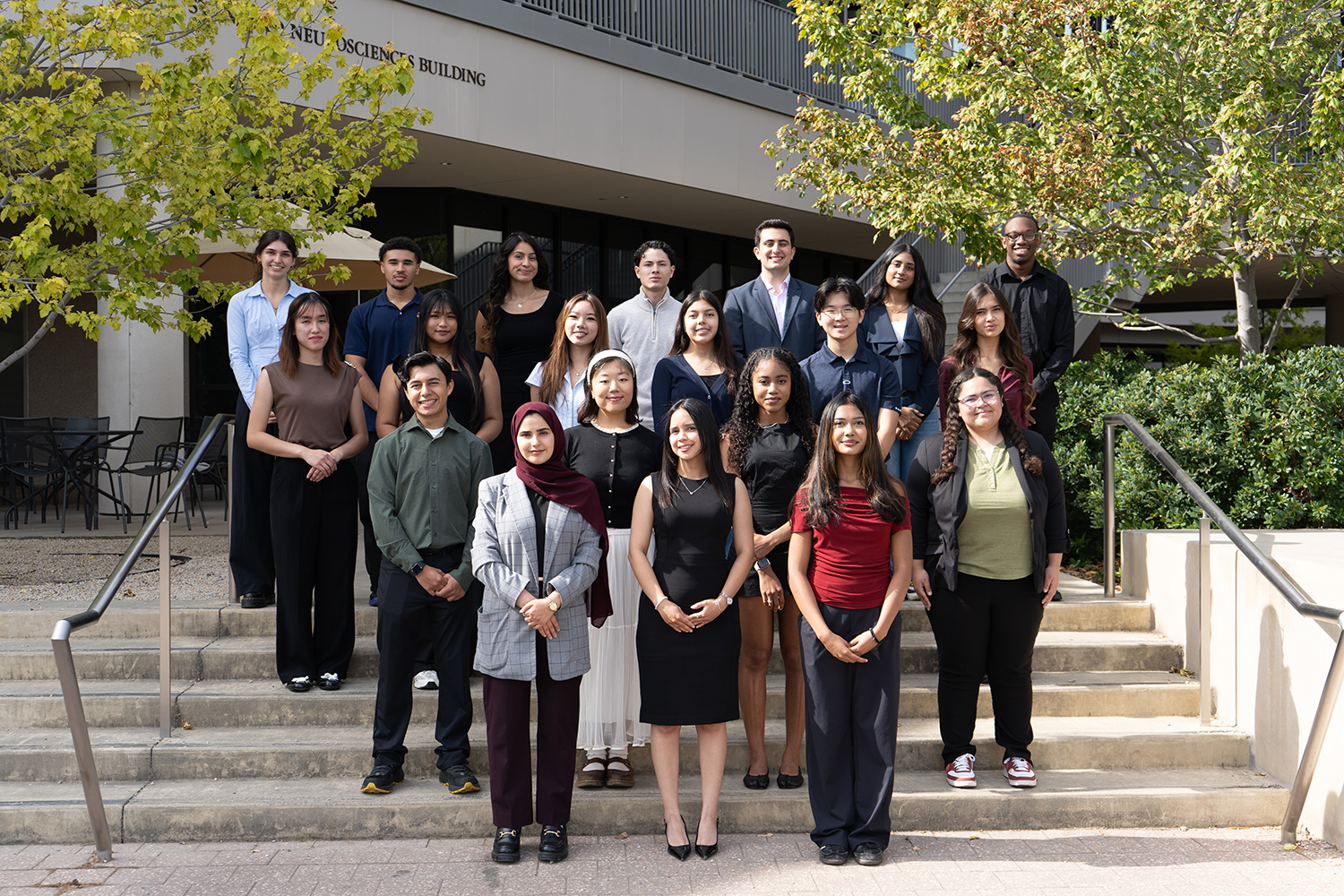
The courtyard of the Stanford Neurosciences Building was encircled one August morning by scientific posters on topics from neurodegeneration and sleep deprivation to gut-brain interactions and eating disorders. As the morning fog burned off and the sun emerged, the courtyard filled with members of the research community engaging the authors on the details of their work.
But unlike most such gatherings, the presenting scientists were 20 Stanford undergraduates and community college students. For many, it was their first experience conducting and presenting research – an opportunity created through the Wu Tsai Neurosciences Institute’s Neuroscience Undergraduate Research Opportunity (NeURO) programs.
Designed for students with little to no prior research experience, NeURO offers Stanford undergraduates a five-month research experience during the spring and summer, while a parallel program – NeURO-CC – provides students from De Anza, Foothill, and Mission community colleges with an eight-week summer research opportunity. Both programs place fellows in Wu Tsai Neuro labs, where they work closely with research mentors, and also include scientific and professional development workshops to teach fellows about the unspoken rules of science.
“This was a great opportunity,” said Lorenzo Channel, a biology major at Foothill College who spent his summer in the Mormino Lab. “I found it really interesting and challenging.”
Jennifer Shadrach, a research scientist in the Kaltschmidt Lab in the Department of Neurosurgery, served as a mentor in the program and said the experience reminded her how important summer research opportunities had been in her own career.
“I’m only here because I did a summer research project like this when I was in undergrad,” Shadrach said. Now a mentor herself, she reflected on what the students bring to the research experience: “They bring such enthusiasm and love for science. It’s really satisfying to see them learn and grow.”
Embracing the unknown
Ozomatli Santana, a Mission College neuroscience student, worked with mentor David Au, a Wu Tsai Neuro Interdisciplinary postdoctoral scholar in the Baccus Lab in the Department of Neurobiology. Santana worked to improve the lab’s data collection, supporting research on how physiological states such as sleep deprivation can influence visual perception.
“Something that surprised me specifically was the fact that there’s so much we just don’t know,” Santana said. “As much as we think that we have science down, there are so many questions that haven’t been answered.”
His advice to other students interested in research: “Embrace the unknown.”
A similar attitude led Stanford undergraduate Jamie Kwon to an unexpected opportunity. She studied how microorganisms in the gut may influence the enteric nervous system, sometimes called the “second brain,” in the Howitt Lab in the departments of Pathology and Microbiology and Immunology. While learning to use a new machine learning analysis toolbox for her project, Kwon reached out to the tool’s creator with questions.
“I didn’t think he would respond because I’m just an undergrad,” Kwon said – but he did, and their conversations eventually led Kwon to help him test and improve updates to the toolbox.
Kwon said her initiative was essential to her success, as was staying optimistic when research doesn’t produce an immediate result.
“A majority of the time, research yields no groundbreaking discoveries,” Kwon said. “True research is about sustained inquiry. It requires the grit to ask the hard questions, and the resilience to see them through.”
Sometimes people just entering the field come in with questions you’ve never thought about.Julia KaltschmidtProfessor of Neurosurgery
Leaning into new territory
A number of students ended the summer hoping to continue research throughout their careers.
Mission College student Alisson Navarro Rodriguez worked with mentor Moss Zhao in the Steinberg Lab in the Department of Neurosurgery. Her project explored whether they could use smaller amounts of radioactive tracers in brain scans while still producing useful images.
The experience introduced Navarro Rodriguez to new coding and imaging tools and helped her become more comfortable asking questions in the lab, she said. Before leaving, she planned to create a manual documenting what she had learned to help future students working on the project, and she said she hopes to continue research after transferring to UC Davis in the fall.
Stanford biology major Joshua Barsoian spent his summer in the George Lab in the Department of Neurology and Neurological Sciences working on how to improve treatments for stroke based on neural progenitor cells. While he initially thought of research as part of his preparation for medical school, Barsoian said his time in the lab led him to seriously consider becoming a physician-scientist.
“Research is a very long road, but you keep coming in day to day because you know someday your work could have a serious impact on a person’s life,” Barsoian said. “It all starts at the bench.”
Fostering the next generation
For the past three years, Wu Tsai Neuro staff have led workshops for NeURO and NeURO-CC mentors covering evidence-based research on effective mentoring, scientific communication, and ways to enhance students’ learning experiences.
Hillary Vossler, a clinical research coordinator in the Mormino Lab in the Department of Neurology, said the two-day training helped her think more intentionally about mentorship. “It’s really good to have the support of the program and actually learn how to be a good mentor,” Vossler said.
Building on that success, institute staff Valerie Vargas-Zapata, Zulema Garibo Gonzalez, and Chiara Bertipaglia developed a parallel training plan designed to explicitly teach undergraduates who are new to scientific research practical tools and strategies to thrive in the lab. Workshops covered the basic structure of a lab, how to make sure mentees understand their own research, and how to develop self-confidence as a young scientist. They also taught effective strategies to communicate scientific research – as students showcased at the August poster session that capped off the program.
Such skills ultimately pay off for everyone involved, said Wu Tsai Neuro Faculty Scholar Julia Kaltschmidt, a professor of neurosurgery at Stanford Medicine.
“Sometimes people just entering the field come in with questions you’ve never thought about,” Kaltschmidt said. “It’s important for them to build the courage to ask those questions, and for those of us who’ve been in the field a long time to hear those fresh perspectives.”
For more information
This story was originally published by Wu Tsai Neurosciences Institute.
Writer
Julia Diaz