In brief
- In pursuit of a new low-power communication system, researchers turned to thermal noise, background static produced from the vibrations of electrons in electrical conductors.
- An experimental setup successfully sent signals between a transmitter and receiver, but how those signals could be distinguished from background thermal noise when both devices and their surroundings were at room temperature remained a mystery.
- The researchers determined that switching between two types of electrical circuits in the transmitter creates noise frequencies that appear “hotter” and “colder” to the receiver, allowing them to produce a binary code signal.
- The team hopes this could lead to new low-power, wireless options for communications systems that send small amounts of data.
Stanford researchers recently revealed how a seemingly physics-defying wireless communication technology works.
The new technology, called thermal noise communication, harnesses background static that normally is the bane of radio, cellular, and other wireless signals. In a new study published in Proceedings of the National Academy of Sciences, the team showed how a transmitter could deliver data to a receiver without any actively produced signal by manipulating tiny oscillations in voltage.
The findings describe how the system works at a fundamental level, opening the door to improving the communication mode and determining real-world applications for it. “We’ve built a system that others could very easily implement,” said senior author Zerina Kapetanovic, an assistant professor of electrical engineering.
A physics mystery
In her previous research at the University of Washington, Kapetanovic studied agricultural sensing technologies, which inspired her to pursue low-power modes of relaying data like soil moisture levels. She wondered if it may be possible to create a device similar to the radio-frequency identification (RFID) window tags that are used for highway tolls in cars – without requiring an energy-intensive radio signal to ping.
She ran an initial test of manipulating thermal noise, a ubiquitous background static produced from the vibrations of electrons in electrical conductors. Depending on temperature, the particles oscillate faster or slower, creating variations that sensitive equipment can pick up. Astronomers can, for instance, use thermal noise emitted from distant planets and stars to study them.
Kapetanovic’s experiment was successful – information from the transmitter made its way to the receiver. But, curiously, it worked even though the entire system was at room temperature. She wondered: how are distinctive noise patterns produced without temperature differences, seemingly defying physics?
She brought that question to Stanford, where she was joined by her graduate students – Geneva Ecola and Jida Zhang, co-first authors on the paper – and Joseph Kahn, a professor of electrical engineering.
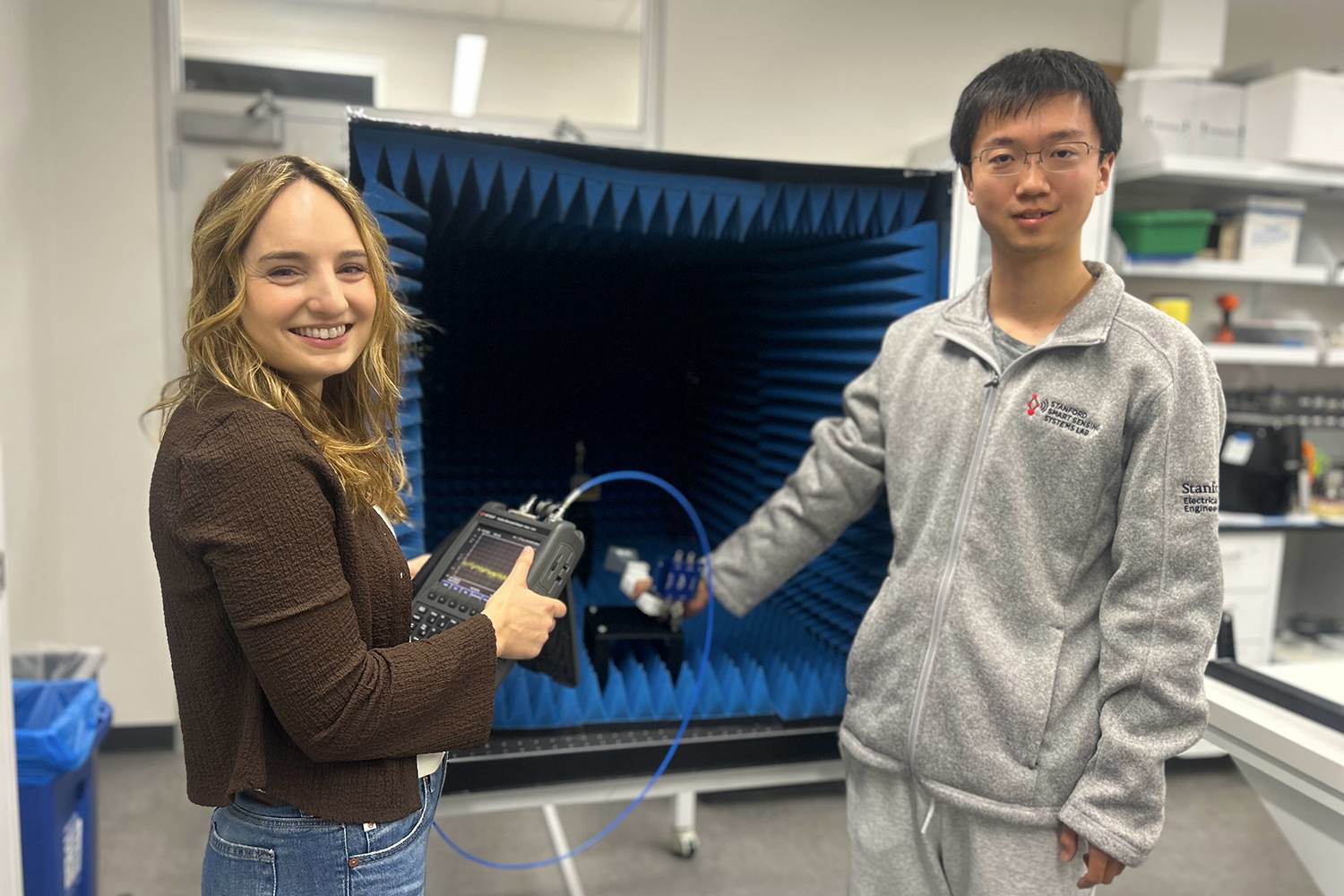
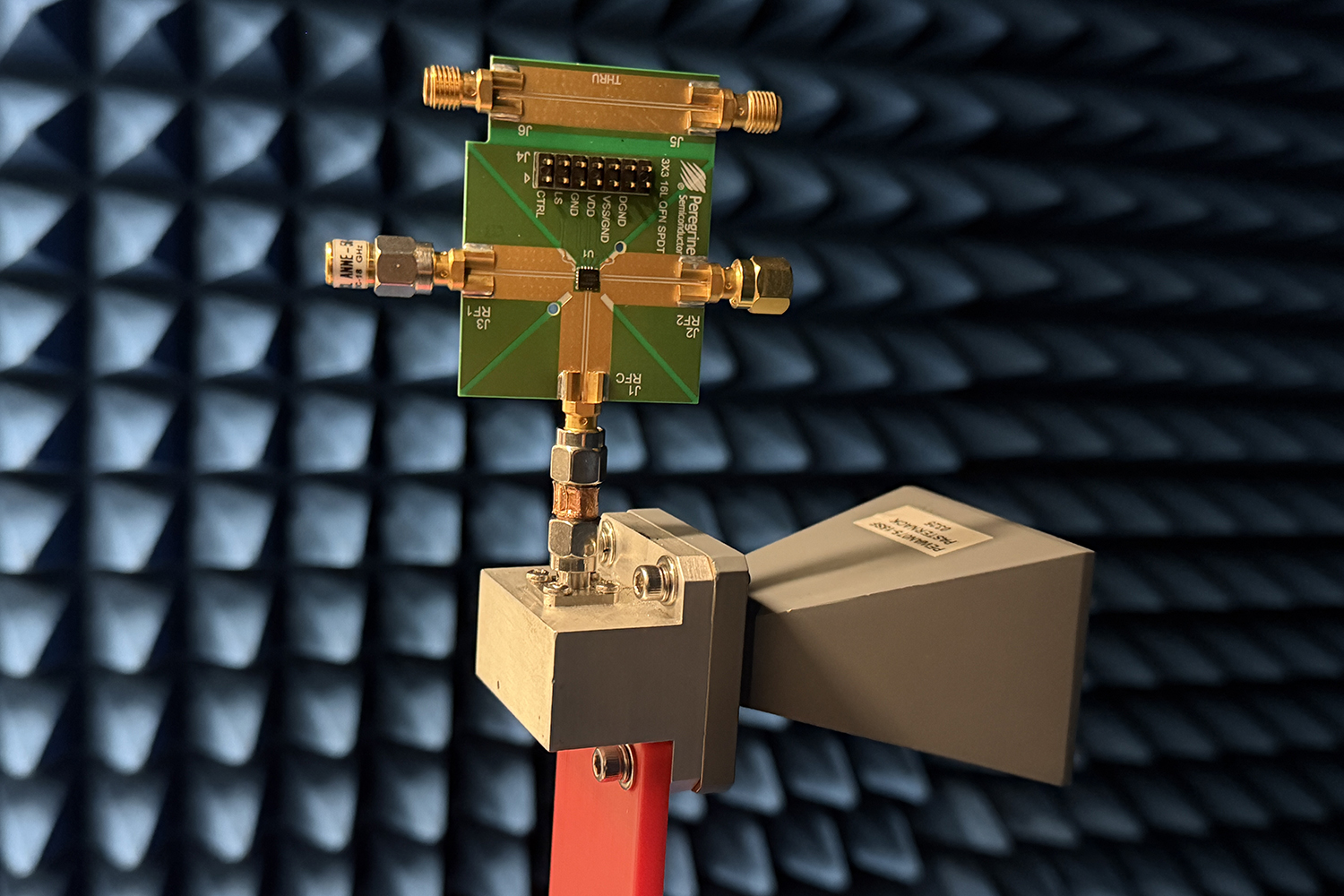
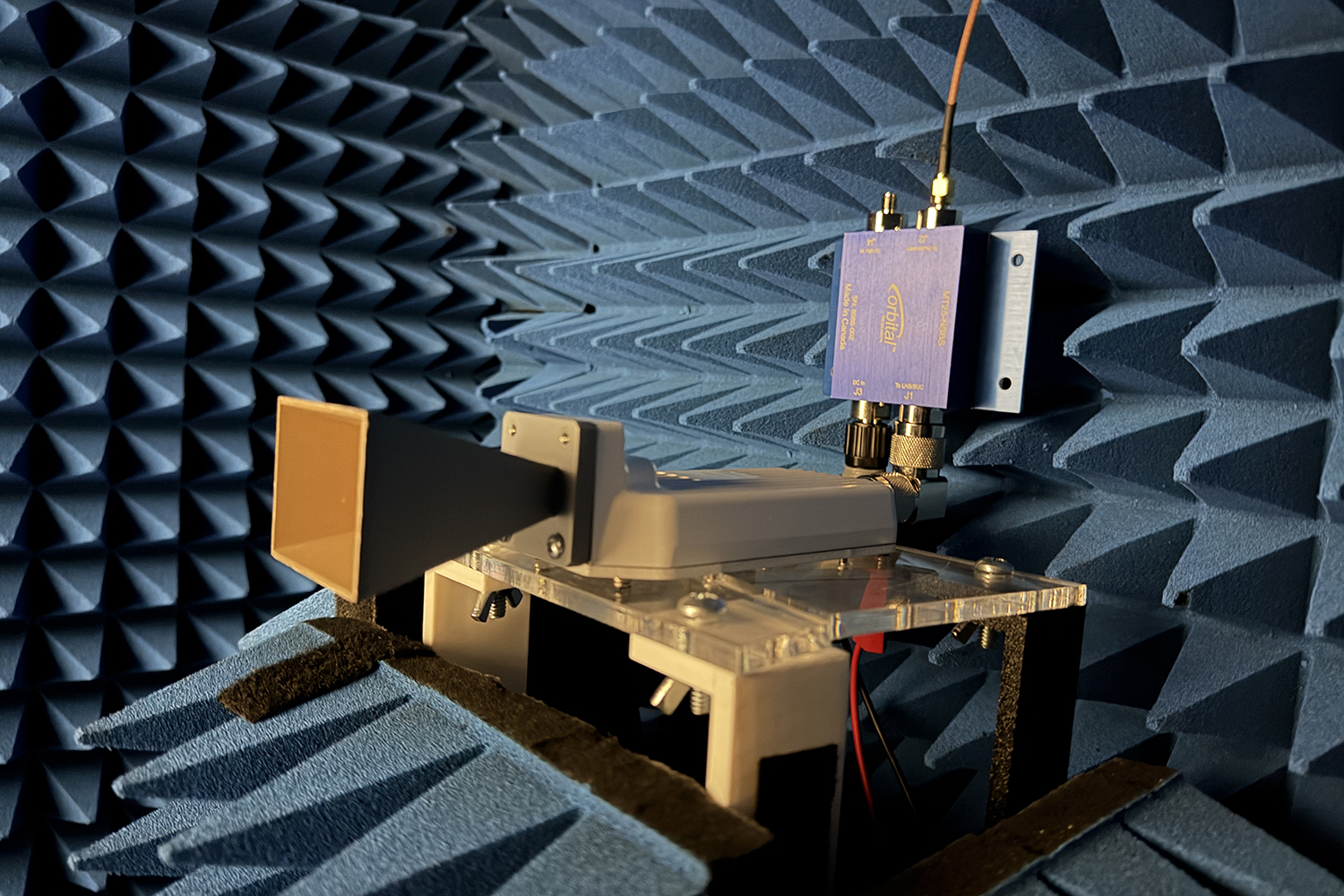
Together, they built an experimental setup to answer that question. The researchers assembled a densely insulated chamber that other signals could not penetrate. Inside, they placed a transmitter and a receiver on a testbed that could adjust the distance between the two, allowing the researchers to test how quickly the system can send information.
The transmitter, outfitted with an antenna, switched between two types of electrical circuits – an open circuit and a short circuit. One circuit was correlated with the number one, the other with zero, the fundamental bits of computing information. The receiver amplified the thermal noise reflecting off the antenna to “see” the information.
We’re hoping that this unconventional communication system can unlock wireless communication where it hasn’t been able to go before.Geneva Ecola
The missing link: an electron refrigerator
The experiments showed the system creates noise frequencies that appear “hotter” and “colder” to the receiver, without actual temperature differences, allowing the information to be distinguished as zeros and ones. At the receiver end, the amplifier functions like an electron refrigerator, slowing them down and making the thermal noise appear colder. Meanwhile, the transmitter shifts between absorbent and reflective states coinciding with the two circuits. Depending on which state the transmitter is, the noise the antenna reflects back to the receiver looks hotter or cooler.
“The transmitter is able to modulate a signal between colder and hotter, but it does that without cooling anything down,” said Kahn. “It’s just a reflector.” The activity is analogous to a castaway on a deserted island using a hand mirror to reflect light to send a signal, he added.
Through testing assumptions with the experiments, the team derived an equation called a channel model that defines the fundamental variables governing the system. Channel models are used in all forms of wireless communication for designing systems such as networks of cell towers. “You need them for any type of wireless system in order to understand and optimize the system,” said Kapetanovic. “Once you really understand how a system works, you can fully optimize it and achieve the upper bounds of its performance.”
That’s just what the team did next. They made adjustments to the setup based on the model and improved their rate of data transfer by 100 times.
The researchers are now testing how to link multiple transmitters into a network and how to ensure the signal doesn’t get lost in noisier environments outside the insulated box.
Energy-efficient communication
The system could be an attractive option anywhere relatively small amounts of data transfer are needed and power is limited. A transmitter relying on radio frequencies uses up to 1,000 times as much energy to send information compared to a transmitter using only thermal noise. “Generating an active signal is very power-consuming, and in some environments you don’t want interference caused by that active signal,” said Zhang.
Thermal noise communication could be used alongside equipment sensitive to electromagnetic radiation, such as medical devices or astronomy observatories, or for environmental sensing.
“We’re hoping that this unconventional communication system can unlock wireless communication where it hasn’t been able to go before,” said Ecola.
For more information
Kapetanovic is also an assistant professor, by courtesy, in computer science and a member of Stanford Bio-X and Wu Tsai Human Performance Alliance. Kahn is also a member of Bio-X.
Media contact:
Jill Wu, School of Engineering:
jillwu@stanford.edu
Writer
Ula Chrobak