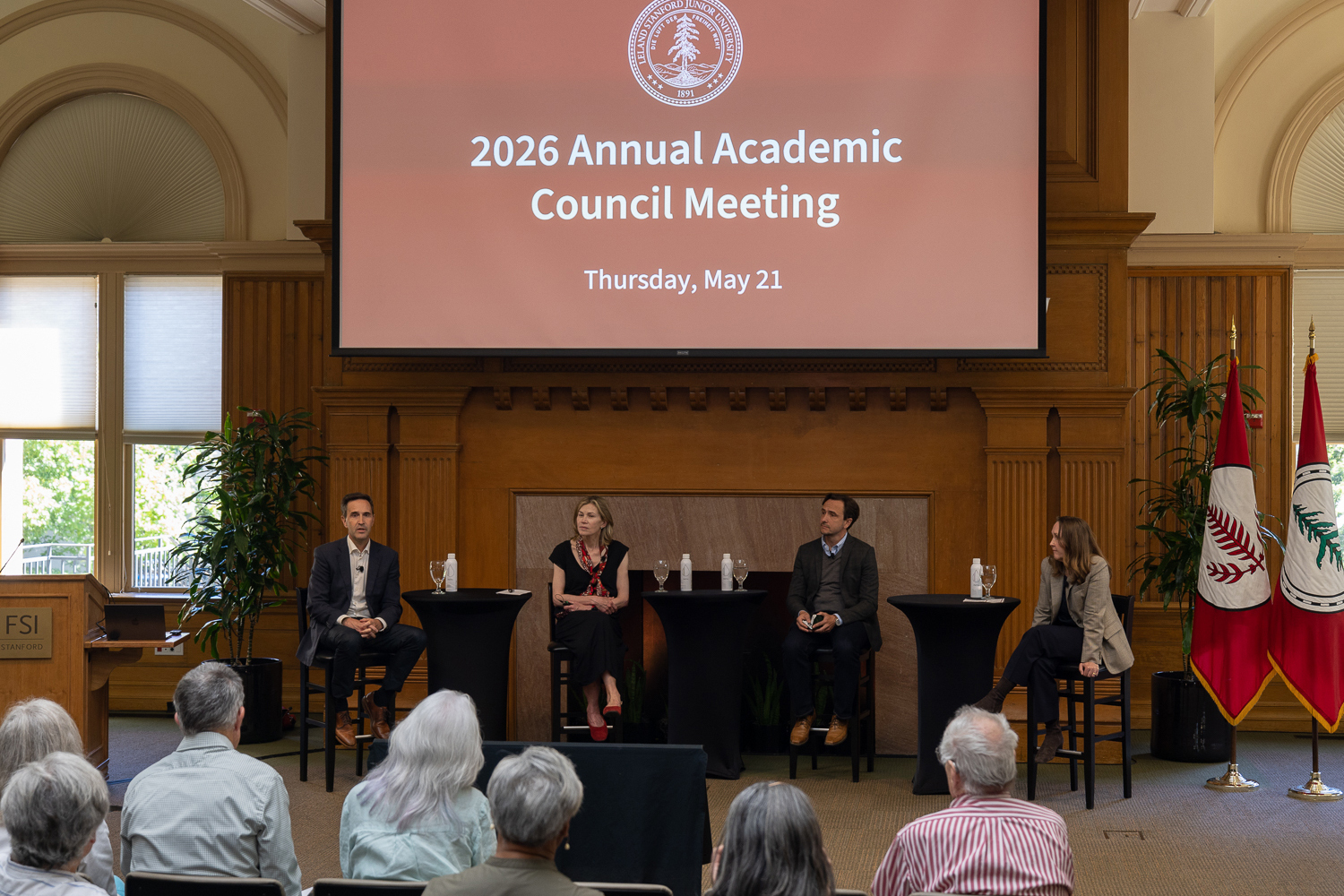
Stanford’s world-class education and research uniquely position it to navigate a pivotal time of rapid technological change and evolving public opinion, said President Jonathan Levin during the 2025-26 Annual Meeting of the Academic Council on Thursday.
“I am optimistic about our future. I believe that a great liberal arts education will have enduring value, whatever happens with machine intelligence,” Levin said. “I believe that university research is irreplaceable in illuminating the world, and providing a foundation for longer lives, stronger institutions, and increased standards of living.”

The annual meeting included a Faculty Senate chair’s report on the senate’s work this academic year, a question-and-answer session, and microlectures from the Stanford Open Minds tour.
Leading undergraduate education
A Stanford education offers “an unmatched breadth of excellence” in science and engineering, humanities, arts, and social sciences, elite athletics, and professional schools, with “unparalleled freedom to explore” through research, overseas study, clubs, communities, and a strong culture of openness and optimism, Levin said.
“At Stanford, we are curious and ask questions,” Levin said. “We are forward-looking, and we work together to solve problems.”
Constructive dialogue and civic education are top priorities for Levin and the provost, supported through programs like the ePluribus Stanford initiative, Civic, Liberal, and Global Education (COLLEGE) first-year program, and Stanford Civics Initiative.
The Stanford Institute for Human-Centered AI (HAI) and the Stanford Accelerator for Learning bring together scholars, students, and practitioners from across disciplines to explore and discuss AI with a human-centered approach.
The Office of the Vice Provost for Undergraduate Education has launched the AI Meets Education at Stanford (AIMES) initiative to address the needs of campus classrooms and the Promoting Academic Communities and Engagement (PACE) initiative to promote intellectual engagement and rigor. PACE will look at issues ranging from classroom attendance and device use to grading and accommodations.
“We have the capacity to tackle AI in distinctive ways, and others will follow our lead,” Levin said.
Sustaining research
Universities are the foundation of the U.S. research ecosystem and a key reason why the U.S. leads the world in innovation, Levin said.
While companies must show economic returns, “universities pursue a very broad range of research, usually at a much lower cost, and they pursue projects that may be years from application, or sometimes simply serve to illuminate the world,” Levin said.
A federal partnership is essential to this complementary model, Levin said. “Congress this year did maintain the federal budget for research, but some fields have been cut, and the pace of grants is unpredictable,” he added.
In positive outcomes, dozens of Stanford faculty have won major research awards, and many schools and departments hold top rankings. Federal funding to Stanford remains roughly constant overall, despite reductions in some areas.


“Nonfederal sponsored research funding is up nearly 50%. I think that is a testament to the entrepreneurial nature of the Stanford faculty,” Levin said. “Remarkably, nonfederal funding may exceed federal grants this year – that is a massive shift in the composition of our research support at Stanford.”
Stanford has largely maintained faculty hiring and the number of incoming graduate students, and the university also sees strong philanthropic support.
Further, Stanford has worked closely with peer schools to strengthen support in Congress, which has led to bipartisan backing for the federal research budget, Levin said.
Still, the research ecosystem faces challenges as AI rapidly transforms work across disciplines.
“Unlike prior eras when broad swaths of research opened up, this one is not being funded by the government,” Levin said. “It’s being funded by the private sector, so all these developments are going to require us to be nimble and strategic, to develop partnerships, and to make investments that can support an exciting new era for research.”
This spring, the HAI and Stanford Data Science were unified into a single hub to support interdisciplinary work on AI and data-driven discovery.
Other campus milestones include a new Graduate School of Education building, ongoing plans for a comprehensive cancer center in the School of Medicine, a Sustainability Forum at the Doerr School of Sustainability, a top Law School ranking, and centennial celebrations at the School of Engineering and the Graduate School of Business.
A year of milestones
This year, the Faculty Senate discussed the rapid rise of AI and a new research environment, the undergraduate curriculum, research policies, and faculty governance, said Faculty Senate Chair Anna Grzymala-Busse, the Michelle and Kevin Douglas Professor of International Studies and senior fellow at the Freeman Spogli Institute for International Studies.
Senators voted to affirm that the Faculty Senate does not have the power to condemn or rebuke individuals, while retaining its right to a no-confidence vote. The vote came after years of debate related to a 2020 censure.
The Faculty Senate rejected a proposed academic authorship policy, citing varied authorship standards across disciplines, and approved an amendment to the Open Access Policy that aligns with existing practice.
The senate also heard from the Faculty Task Force on Renewing Public Support for Universities, which is developing strategies to strengthen support for higher education, and Stanford in particular.
In two major curriculum changes, the senate voted to extend the COLLEGE program, and to allow proctoring. Additionally, the senate approved policy changes for non-matriculated graduate study.
The senate also heard a presentation on AI in education, which Grzymala-Busse described as “bracing.”
Grzymala-Busse thanked the senate, its vice chair, committees, faculty, student groups, and the Academic Secretary’s Office and extended best wishes to the incoming senate, which will contend with matters related to research policies, IT policies, admissions, undergraduate majors, and more.
The senate “is an integral part of faculty governance and university autonomy,” Grzymala-Busse said. “And we need to take those obligations and rights more seriously than ever.”
Q&A time
University and senate leadership also took several audience questions.
Brian Conrad, professor of mathematics, asked about the university’s plans regarding grade inflation, and Levin said it’s one of the issues the PACE initiative will consider within a broader examination of intellectual engagement and rigor.
One audience member asked about how the university is addressing some government officials’ skepticism of universities.
Many in Congress have affirmed their support for federal research funding, as reflected in their votes, Levin said. However, the university must do a better job of building support, which is a focus of the Faculty Task Force on Renewing Public Support for Universities.
Another audience member asked why the university didn’t take a higher endowment payout rate – 5.3% instead of 4.9% – to avoid the $140 million in cuts last year. Provost Jenny Martinez, who will present the university’s budget to the senate in a couple of weeks, said the “extremely painful” cuts were necessary to absorb the ongoing impact of the endowment tax increase from 1.4% to 8%, which will cost Stanford roughly $250 million a year for the foreseeable future.
“Because we took the cuts last summer, we put Stanford in a really solid position now, where you can see many other universities are still engaged in the process of budget cutting,” Martinez said.
Open Minds
The meeting included microlectures from the Stanford Open Minds tour, a nationwide speaker series for alumni.
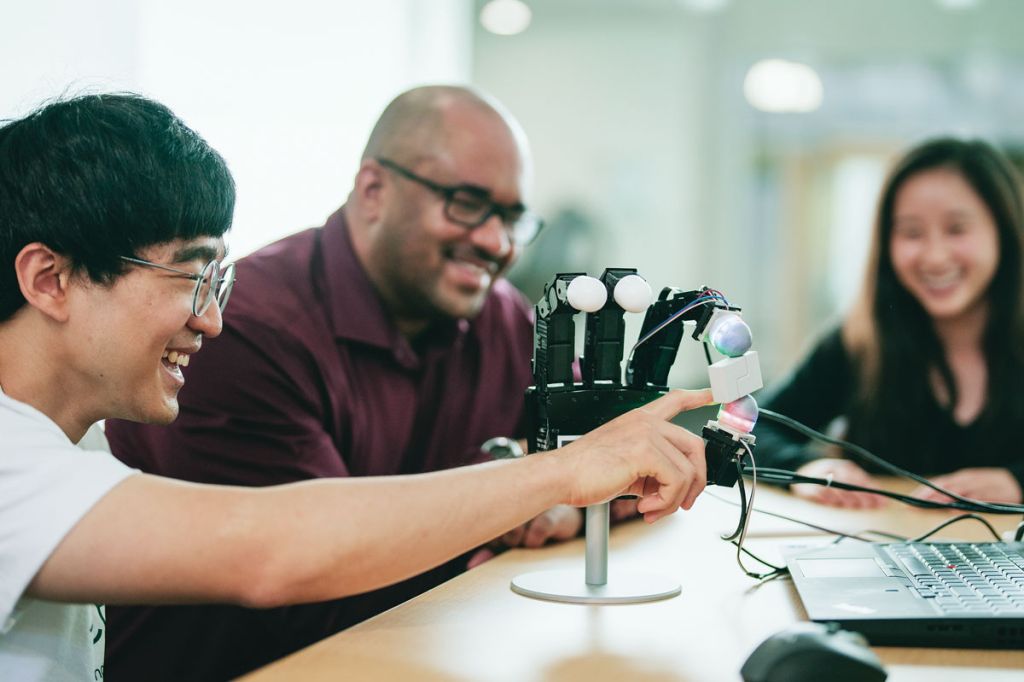
Allison Okamura, the Richard W. Weiland Professor of Engineering and professor of mechanical engineering, discussed how soft robotics benefits humanity through tools like minimally invasive surgical instruments and vine robots that grow like plants to navigate difficult environments.
Emanuele Lugli, associate professor of art and art history and director of the Public Humanities initiative, discussed his research on two remarkable but lesser-known Italian Renaissance artists, Sofonisba Anguissola and Lavinia Fontana.
Lugli discovered a new painting by Anguissol and wrote a children’s book, Lavinia’s Wondrous Portraits, to popularize Fontana’s work – a project made possible by the Public Humanities initiative, which helps faculty write op-eds, articles, trade books, and more.
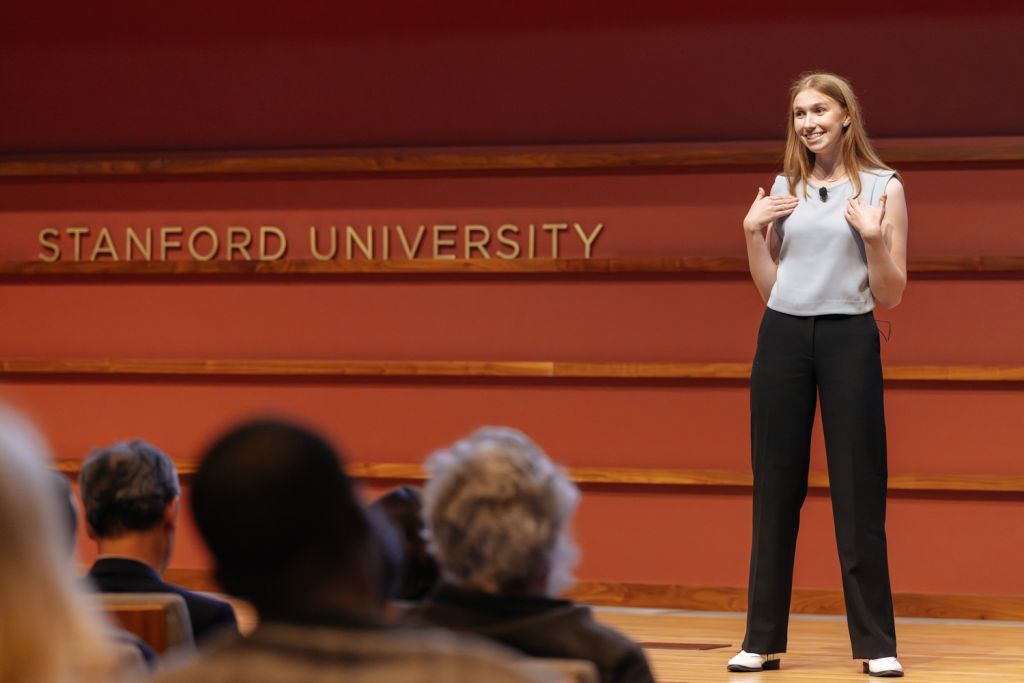
The microlectures also featured two finalists from Stanford’s second 3 Minute Thesis (3MT) competition held earlier this spring. Ibukun Ajifolokun, a PhD candidate in materials science and engineering, won both second place and the People’s Choice award for her presentation on how injectable hydrogels improve the delivery of combination vaccines.
Anuj Amin, a religious studies PhD candidate, shared his research on incantation bowls.
“These artifacts blur the lines that we usually use to separate religious traditions today, reminding us that belief has always moved across boundaries, shaping the world we’ve inherited today,” Amin said.
Writer
Chelcey Adami