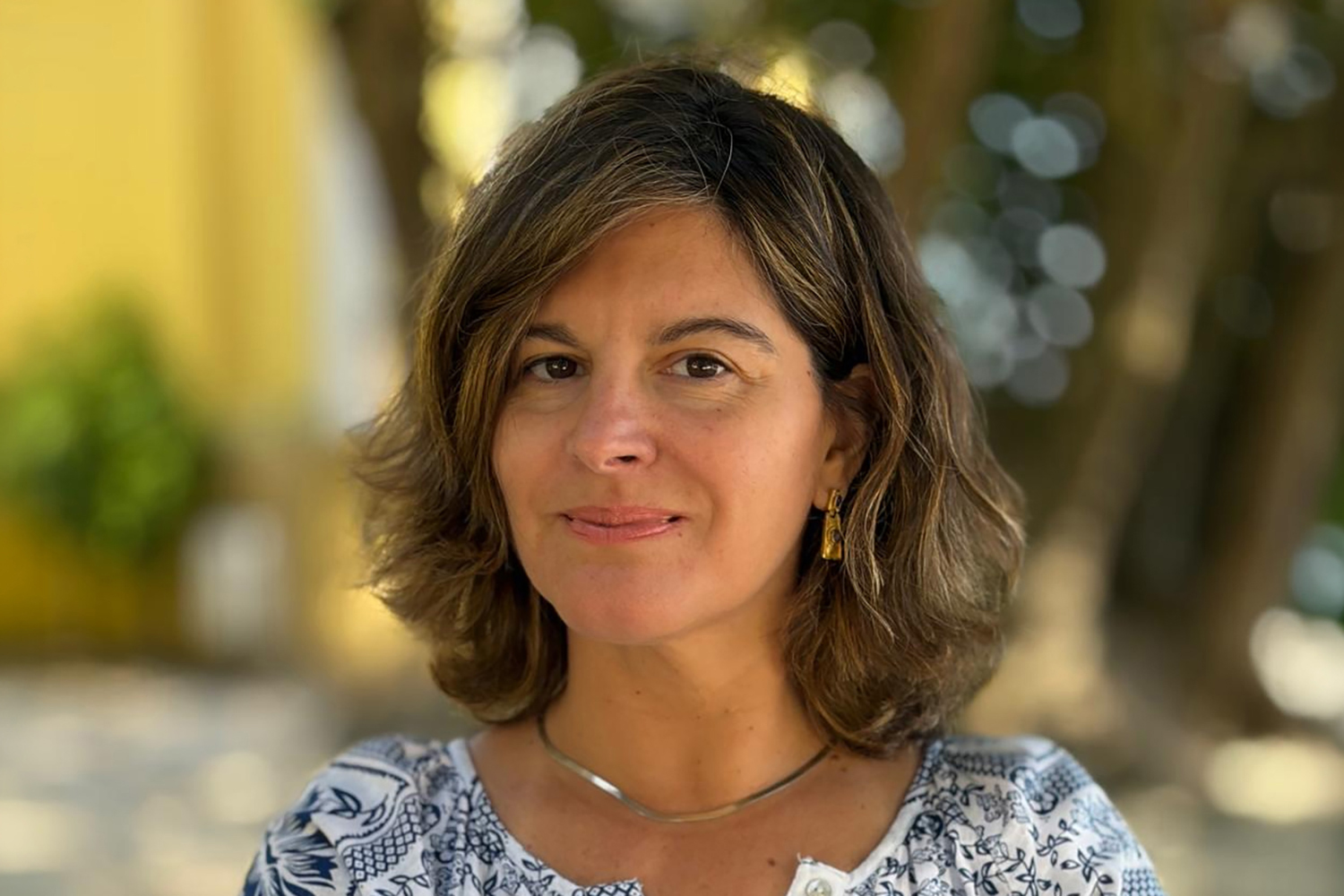
Inês Azevedo, professor at the Stanford Doerr School of Sustainability, has been named the next Perry L. McCarty Director of the Stanford Woods Institute for the Environment.
A senior fellow of the Woods Institute since 2019, Azevedo’s research focuses on system issues related to the environment, climate change, air pollution, and energy, using interdisciplinary and holistic approaches. Her scholarship has informed major national and international assessments: she served as a lead author on the Energy Systems chapter of the IPCC’s “Sixth Assessment Report,” as a contributing author on the Mitigation chapter of the “Fifth U.S. National Climate Assessment,” and as an author on several National Academy of Sciences reports.
Azevedo said she sees Woods as the connective tissue linking environmental research across Stanford’s seven schools.
“Woods has spent more than twenty years proving that the hardest environmental problems get solved faster when people with different expertise and experiences are working together,” she said. “My goal is to keep doing exactly that: to support the Woods community in turning rigorous, cross-disciplinary research into solutions that decision-makers can use and to provide leaders and professionals with the skills to address the most pressing environmental challenges in the world.”
Azevedo will take on her new responsibilities Sept. 1.
Her appointment was announced this week by Arun Majumdar, Chester Naramore Dean of the Stanford Doerr School of Sustainability. “Inês’ work is devoted to the environment and sits at the intersection of engineering, economics, and public policy,” said Majumdar. “She has a proven ability to bring people from very different disciplines together around a shared problem. That is precisely the spirit Woods was built on, and precisely what it will need for its next chapter.”
Azevedo will succeed climate scientist Chris Field, Melvin and Joan Lane Professor of Interdisciplinary Environmental Studies, who led Woods for a decade and will step down on Sept. 1, 2026, to return to full-time research and teaching.
“Inês has exactly the instincts a director needs: she moves fluidly between hard technical questions and the policy realities that determine whether good ideas get adopted,” Field said. “She has also been deeply engaged as a senior fellow, and already understands the unique combination of approach, personality, and resources that make Woods work. I’m looking forward to watching her steer the institute into the future.”
Majumdar selected Azevedo from candidates recommended by a faculty search committee spanning the past six months and led by Deborah Sivas, Luke W. Cole Professor of Environmental Law, director of the Stanford Environmental Law Clinic, and senior fellow at the Woods Institute, and Oliver Fringer, professor of civil and environmental engineering and of oceans. Ten additional professors representing 14 departments and nine interdisciplinary institutes on campus served on the committee. “I am deeply grateful for the search committee and look forward to the Institute’s ongoing success under her direction,” said Majumdar.
“I’m thrilled by Inês’ appointment,” said Sivas. “She thrives in the role of bringing people together and building institutions to solve today’s wicked hard sustainability challenges. The committee heard a lot of ideas about how Woods can build on its success, and Inês has the vision to make it happen.”
Azevedo earned a PhD in engineering and public policy from Carnegie Mellon University, where she later rose to full professor before joining Stanford. Her honors include the C3E Women in Clean Energy Research Award, the Terman Fellow Award and Gabilan Faculty Fellow Award at Stanford, and recognition as a World Economic Forum Young Scientist Under 40. She was inducted as a member of Sigma Xi, the Scientific Research Honor Society, in 2026.
Would you like to learn more about the Woods Institute for the Environment?
Launched in 2004, the Stanford Woods Institute for the Environment and its hosted centers and programs work to advance global sustainability through new knowledge and solutions to the world’s most pressing environmental challenges. Woods provides a combination of funding resources, convening mechanisms, and education and leadership programs that support researchers and students from all seven schools at Stanford and beyond.
For more information
Azevedo also holds courtesy appointments in civil and environmental engineering, Earth systems science, and the Stanford Linear Accelerator Center (SLAC) and is a senior fellow at the Precourt Institute for Energy. At the Doerr School of Sustainability, she also serves on the executive committee for E-IPER and in the advisory committee for the Sustainability Science and Practice (SUST) program, and she is an affiliated faculty member with the Sustainable Societies Initiative. She also currently serves on the Stanford Faculty Senate.
Writer
Chris Black