Amid national debate over higher education, Stanford has undertaken an effort to understand public views of universities, from cost to culture to value.
The Future of Universities initiative combines research on public attitudes across the campus and the country, an upcoming series of convenings, and support for broader faculty engagement with the public.
Guiding the initiative is a task force created by President Jonathan Levin and Provost Jenny Martinez.
The effort has a straightforward premise: Questions about access, affordability, campus culture, and the value of research, teaching, and a college diploma have been building for years – and universities need to better understand these trends and take informed, pragmatic steps to address them.
The initiative and the task force’s work have three pillars:
- Research and surveys on public attitudes
- Convenings that gather an array of perspectives on tough, foundational questions
- Ongoing engagement and communication, including support for faculty who want to reach the public more effectively
In November, the task force will kick off a three-part series of convenings. First up is a daylong discussion of research investment and the public interest. Scholars, policymakers, and business, community, and nonprofit leaders will assess and challenge data and attitudes on the value of university research, funding and governance of research, questions of openness and public trust, and the future of discovery in the era of artificial intelligence.
Leading the task force are:
- Russ Altman – Kenneth Fong Professor of Bioengineering, Genetics, Medicine, Biomedical Data Science, and professor, by courtesy, of computer science. Senior Fellow, Stanford Institute for Human-Centered AI
- Brandice Canes-Wrone – Jodi and Wayne Cooperman Professor of Political Science, Maurice R. Greenberg Senior Fellow at the Hoover Institution and professor, by courtesy, of political economy at the Graduate School of Business
- Kathryn Ann “Kam” Moler – Marvin Chodorow Professor and professor of applied physics, of physics, and of energy science and engineering, and former vice provost and dean of research
In a Q&A with Stanford Report, the co-chairs of the initiative discussed their approach, plans, and what they have learned so far.
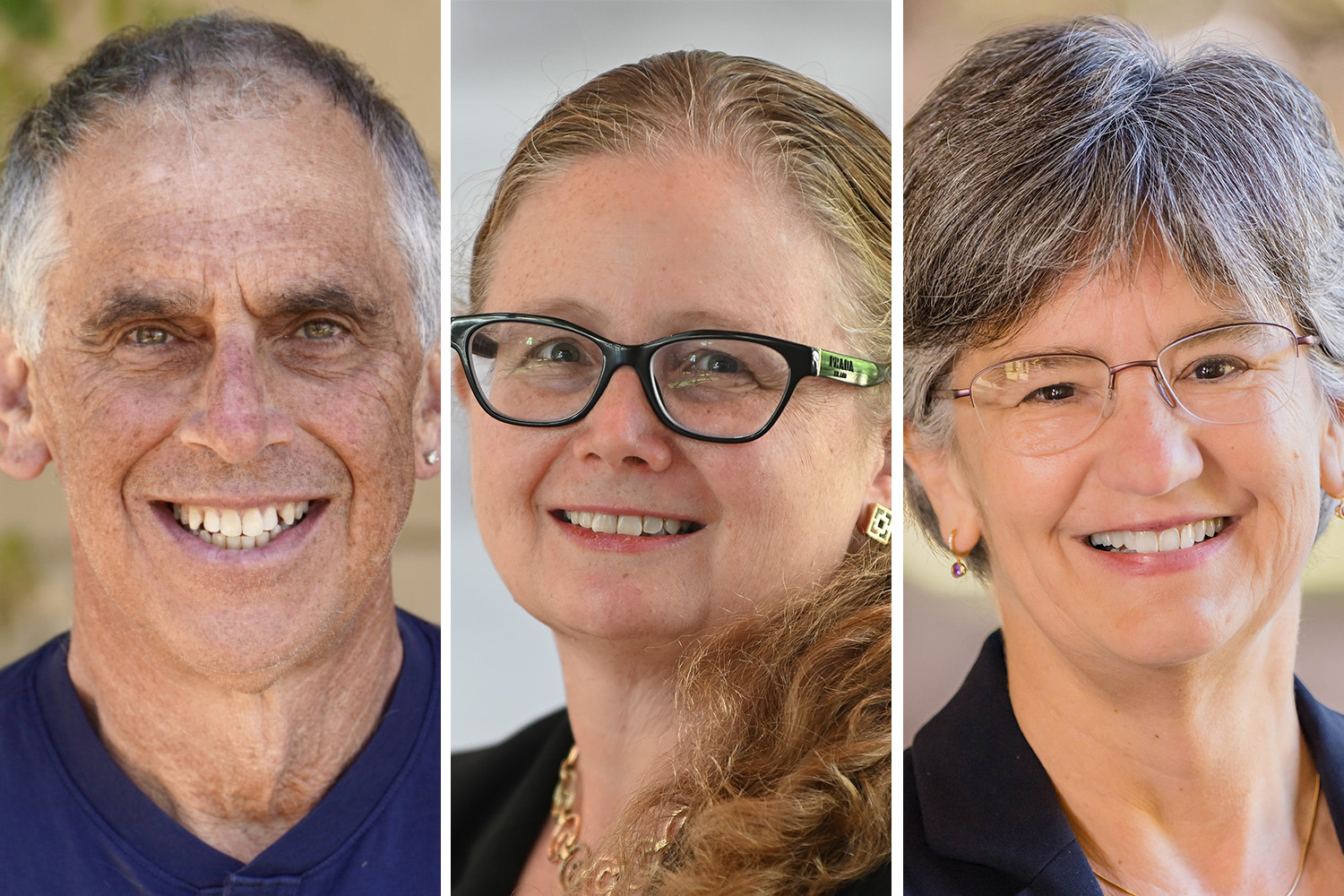
Leading the Future of Universities task force are Russ Altman, Brandice Canes-Wrone, and Kathryn Ann “Kam” Moler. | Stanford Medicine archives; Rod Searcey; Harrison Truong
How is the task force using research to understand the public’s views of higher education?
Canes-Wrone: Most of the debate about declining trust in universities runs on theories, such as why it’s happening and what might fix it. We wanted evidence. Our Stanford colleague Neil Malhotra and I led a team of scholars to conduct a national survey asking how Americans see the U.S. higher education system as a whole, not just our campus in particular. We asked about a variety of issues, including affordability, research funding, global comparisons, politicization, and the importance of universities for U.S. competitiveness. We wanted to allow the same individuals to recognize areas where they believe universities are succeeding and ones where they are coming up short.
The survey paired closed- and open-ended questions with experiments that test whether and how learning information about some of the most salient issues may shift attitudes. Because young adults as a cohort are particularly affected by contemporary university issues, we oversampled adults ages 18 to 24. Our goals were straightforward: to ground a more thoughtful conversation about what universities are facing and to assess whether the actions universities take can meaningfully shift attitudes.
What are you learning?
Canes-Wrone: We’ll publish a full report later this fall. But in the meantime, some key findings indicate two things at once – strong support in some areas and real concern in others. Majorities across party lines consider great universities important to U.S. competitiveness, and they oppose cuts to research funding. They consistently point to educating students, preparing the workforce, and advancing research and innovation as important contributions that universities make.
At the same time, there are a variety of concerns. Affordability worries almost everyone. Views on political bias split by party affiliation. And many people say that American universities aren’t necessarily among the world’s best, despite believing that universities are very important for global competitiveness. So attitudes look messier than any single trust number suggests. People value what universities do. They also have some important concerns that deserve careful consideration.
Why does this discussion matter?
Moler: By design, university scholarship is driven by curiosity. Wanting to understand the world is part of human nature. But practical impact also inspires many scholars, and government, corporate, and philanthropic funders of research tend to support research with applications. University research creates economic growth, improved health, and societal well-being, as well as foundational knowledge and a clearer picture of the world. The ground is shifting fast. Money is tighter. The value of openness is questioned. People have nuanced and differing views of what constitutes value creation. And AI is changing how discovery happens.
All of that calls for an honest conversation. How does university research matter? Who pays for it? How do its benefits reach people? Our convenings will bring together people from academia, communities, government, industry, and nonprofits to work through these questions. We’re not defending the status quo – we are asking how research universities can best serve the public interest effectively in the modern world.
What questions will guide the convenings you’re planning?
Moler: We start with the value proposition. Beyond education, how has society actually benefited from university research? Should taxpayers, philanthropists, companies, and governments keep investing, and if so, what would make that investment go further? We want to take the critiques seriously, including being honest about which ones hold up and which reflect a misunderstanding of how research actually works and the importance of foundational research.
From there we take up the economics and structure of the enterprise: whether the current funding model is sustainable, what happens if federal support declines or changes focus, what would be lost, and how the research enterprise would evolve. That pulls in questions researchers feel daily: how much time goes into chasing funding, whether review panels reward safe proposals over risky ones, and who pays for the shared instruments, data, and computing everyone depends on.
We’ll also look at openness, access, intellectual property, and public trust: what is driving the decline in trust, where legitimate priority-setting ends and interference begins, and how to keep international collaboration productive while managing genuine security risks. Openness is what makes discovery work, and it is under pressure. Some research genuinely should not be open, and each university decides for itself whether it wishes to conduct secret research. Public discourse can improve understanding of the value of open research. Universities, and those who support us, need to continually improve our understanding of the risks and our practices to balance appropriate security with appropriate openness.
We will also build on the work of HAI and others by looking at discovery in the age of AI, which could accelerate scientific work dramatically but raises hard questions.
We will close by asking which of the tensions that emerge can be acted on now and which need more study.
(Note: Due to space restrictions, attendance for the fall plenary sessions is reserved for invited participants from the Stanford community.)
How can faculty deepen the public’s understanding of the role of universities?
Altman: We have no stronger credibility with the public than through our faculty’s deep expertise across many areas of knowledge. Whether it’s clinical work, research, or teaching, our faculty can demonstrate in concrete terms what universities do for society.
But engagement isn’t one-size-fits-all. We have spoken to colleagues at other universities and nongovernmental organizations about their approaches to these challenges. Our task force has sought to understand perspectives from faculty, staff, students, parents, and alums at Stanford. We need to ensure that the university’s mission is clearly stated, and that the public has appropriate access to Stanford expertise, experience, and knowledge.
So we’re looking at practical support for faculty who want to share their work more broadly and effectively. That can mean tools and training, and opportunities to meet with communities, journalists, policymakers, and others, in settings and formats that work best for these groups. We want informed, respectful dialogue, not institutional promotion, so we will make clear the line between explaining scholarship and arguing a position.
Where could this work lead?
Altman: I hope it helps us all to listen harder to what people tell us and to speak more plainly about the value that teaching and research provide to the local community, the state, the country, and the world.
We hear questions about cost and return on investment, free speech and academic freedom, political bias, and whether research really serves the public. None of these has a simple answer, and no single effort or initiative will rebuild trust all on its own. But if we take concerns seriously, speak candidly about our own challenges, and explain our work in ways that are meaningful to people’s lives, we can make real progress.
Learn more about this work at Stanford’s Future of Universities initiative website.