

Stanford’s Future of Universities initiative brought together leaders from government, higher education, and industry Nov. 9 to examine how university research can best serve the public amid shifts in funding, changes in technology, and heightened public scrutiny.
The daylong forum, “Research Investment and the Public Interest: Sustaining Discovery, Innovation, and Trust in an Era of Change,” examined the value of continued investment in research.
Leading voices from Stanford and beyond, drawn from the federal government, business, and academia, considered the choices universities face in fostering discovery and innovation while preserving openness and strengthening public trust.
The questions raised at the convening are central to the Future of Universities initiative, created by President Jonathan Levin and Provost Jenny Martinez, and chaired by Professors Russ Altman, Brandice Canes-Wrone, and Kam Moler. The task force is charged with examining public views of universities and raising awareness of the contributions they make to society.
“Our goal is not to defend the existing model or presume that we have the answers,” Professor Amit Seru, who co-chaired the convening with Professors Moler and William Chueh, told participants in the opening session. “Rather, we want to hear different perspectives, challenge assumptions, and identify the most important tensions, areas of agreement and disagreement, and possible paths forward.”
The daylong event began with discussions on the public value of university research, continued with roundtables on changes in the research enterprise, openness, and trust, and concluded with panels on the potential of AI to transform discovery and the choices facing research universities.
Research and the public good
The opening session began with Ethan Klein, U.S. chief technology officer and associate director of the White House Office of Science and Technology Policy, who stressed the importance of universities translating fundamental research into progress that “makes a difference for average Americans.”
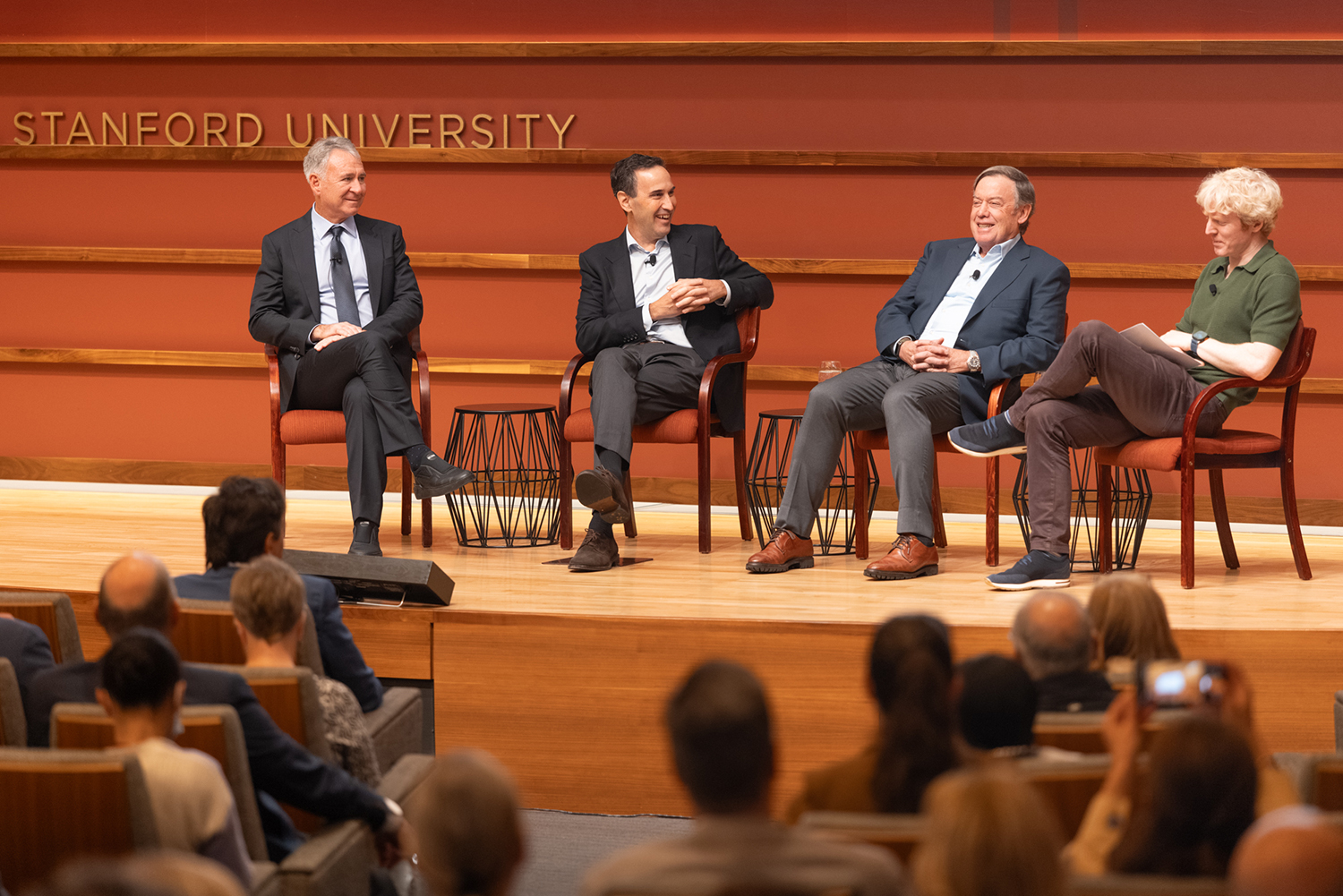
A panel of academic and business leaders then discussed what society has gained from university research and how universities can offer such benefits to more people.
The impact can be lasting and wide-ranging, Stanford President Levin said, citing the late Stanford economist Kenneth Arrow, who founded the field of thinking about social choice. “He changed the way people think,” Levin said, “and that’s the measure, actually, of a lot of great research.”
For most people, universities and the research we’re doing is an extremely distant thing – and if you can bring it to people’s kitchen tables, it’ll help a lot.Sally KornbluthPresident, MIT
Arizona State University has created wider paths to engineering degrees and the opportunities that accompany them. ASU President Michael Crow described ways his university attracted students from schools lacking calculus courses or strong math instruction and developed learning technologies to help them catch up and be competitive. “They leave with an outstanding understanding of engineering that they gain along the way, and in the market they perform as well and are compensated as well as anybody else,” he said.
Beyond expanding educational opportunity, panelists discussed what attracts researchers to academia and what keeps them there in a session moderated by Stripe CEO Patrick Collison.
The United States needs to find ways to make research-focused careers more desirable, said Ken Griffin, founder and CEO of the investment firm Citadel. He encouraged universities to support early-career researchers so they stay in academia and remain engaged in “the problems of our time,” and to “increase the porousness between our academic realm and our commercial realm.”
The two university presidents also addressed how faculty shape an institution.
“Faculty enjoy incredible individual freedom,” Levin said, “and part of the role of the university leadership is to protect that and to make sure the faculty can work on the things they work on.” Crow stressed the value of having distinct faculty governance structures across higher education rather than a single model: “You want them to be different cultures. You want as much differentiation as you can possibly put in place.”
A new era of discovery
A panel on the Future of Discovery in the Era of AI explored how universities must change, from infrastructure to doctoral training.
Because of their disciplinary expertise and scientific infrastructure, universities are well-positioned to guide the development of AI, said Darío Gil, undersecretary for science at the U.S. Department of Energy. He cited two key priorities: “Give it purpose and make it safe.”
Northwestern University President Mung Chiang, who earned three degrees from Stanford, noted the opportunities linking universities, national laboratories, and industry. “I see the potential trend line, one being more fluidity and the other being shorter duration,” he said.
Gil also pointed to support from the federal Genesis Mission fellowship program for faster training and innovation. “We’ve got to approach it with humility and we’ve got to approach it experimentally and empirically,” he said, “but we should have a bias toward action.”
Roundtables earlier in the day with Stanford academic leaders and guests from government, peer institutions, and the private sector framed the agenda for the concluding panel, Challenges and Choices for the Research Enterprise. Provost Jenny Martinez moderated the discussion with MIT President Sally Kornbluth and Hopi Hoekstra, dean of Harvard’s Faculty of Arts and Sciences, asking “what must be preserved” and “what should be reimagined” in university research.
Hoekstra stressed the continuing importance of human expertise and involvement. “As powerful as AI is,” she said, “at least at this moment in time there’s still room for that judgment, taste, and the deep disciplinary knowledge to sift through what comes out on the other end.”
Higher education should show people why discovery matters to them and their communities, a connection Kornbluth said should grow stronger: “For most people, universities and the research we’re doing is an extremely distant thing – and if you can bring it to people’s kitchen tables, it’ll help a lot.”
For more information
The convening was the first of three planned gatherings that form one component of the Future of Universities initiative. The other two components focus on researching public attitudes and helping faculty share research and ideas with the public more effectively. Additional convenings are planned for winter and spring 2027.
Writer
Chris Peacock