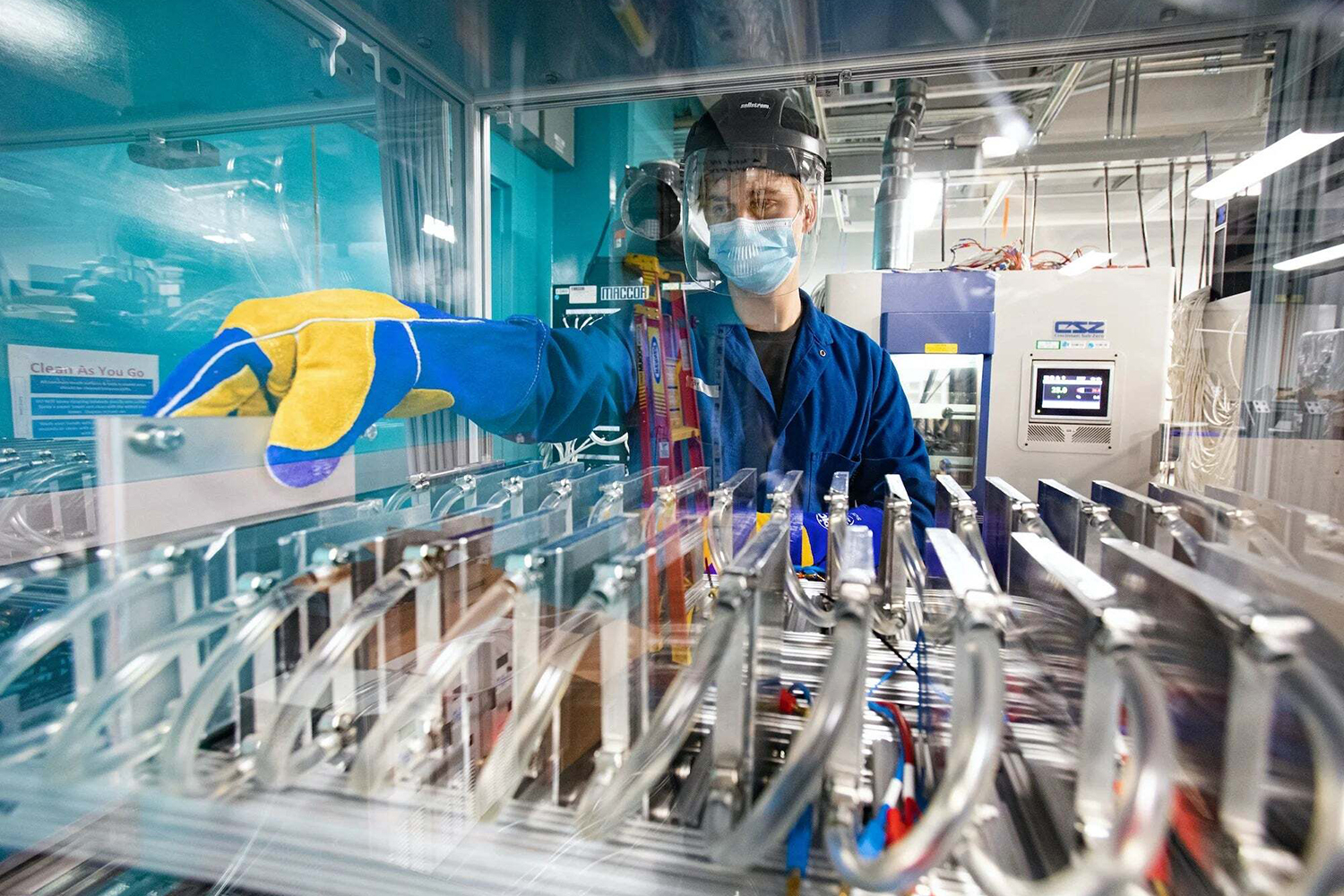
Stanford and the U.S. Department of Energy’s SLAC National Accelerator Laboratory will lead six Genesis Mission projects that will harness AI to accelerate advances in critical areas including battery waste, understanding the evolution of the universe, and plant genetics. In addition, Stanford and SLAC scientists will partner with other national labs, universities, and industry leaders on 11 other Genesis Mission projects.
The funding awards, announced on July 22 at the Genesis Mission Summit in Washington, D.C., represent the first of two phases of awards from the Genesis Mission: Transforming Science and Energy with AI.
The Genesis Mission is a historic national initiative led by the U.S. Department of Energy, which aims to build the world’s most powerful integrated science discovery platform. By uniting government, industry, academia, and philanthropy, it will accelerate breakthroughs in energy, scientific discovery, and national security through a new platform that combines AI, supercomputing, quantum systems, and advanced scientific instruments.
“Key discoveries made here at Stanford underpin modern artificial intelligence,” said David Studdert, vice provost and dean of research. “Thanks to the Genesis Mission’s ambitious agenda, research teams here can continue to contribute to how this technology is refined and deployed to advance science.”
The DOE sought interdisciplinary teams who would leverage novel AI models and frameworks to address more than 20 national challenges spanning advanced manufacturing, biotechnology, critical materials, nuclear energy, and quantum information science. Dozens of researchers from multiple Stanford schools and institutes, and SLAC, will be leaders or co-investigators on the selected projects.
“SLAC’s role as a leading collaborator across a range of technologies positions us to advance AI’s transformative role in scientific discovery,” said SLAC Lab Director John Sarrao. “We appreciate the commitment of the Department of Energy in addressing these national challenges.”
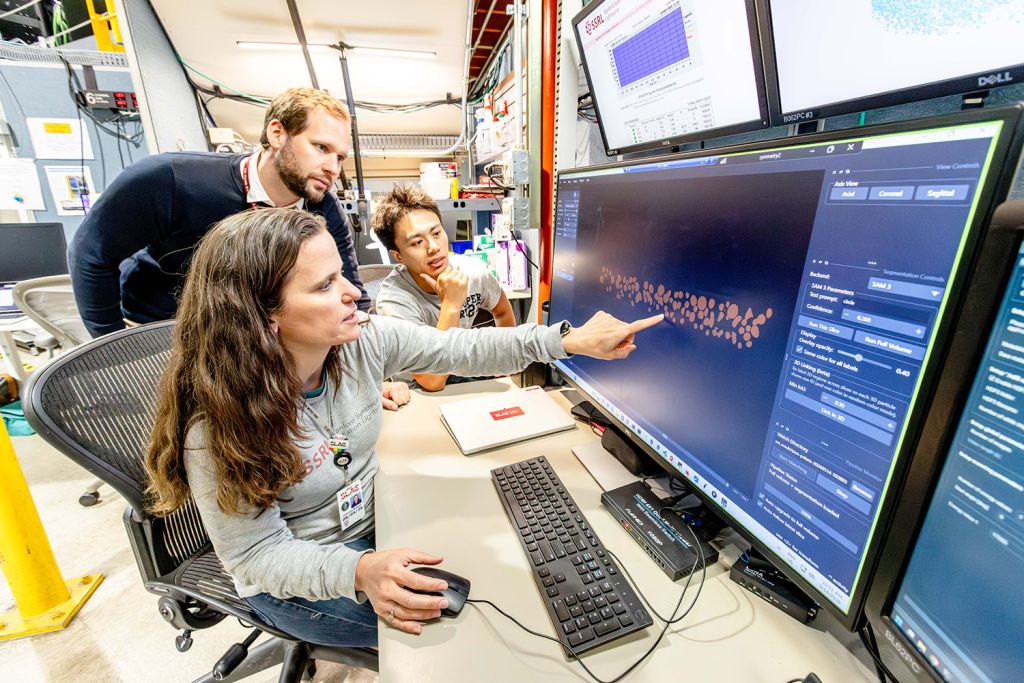
The following projects will be led by Stanford or SLAC National Accelerator Laboratory:
Genetic programming for better plants
AI-Driven Design of Gene Expression Programs in Plants Using Foundation Models and High-Throughput DNA Synthesis
Current methods for genetic programming in plants are slow and unreliable. This project will build an AI foundation model for plant gene regulation. The team will build the training data, determine additional data and computation needs, and apply the resulting AI model to sorghum, a widely grown feedstock for bioenergy and critical minerals, to refine the model. The trained model, benchmarks, and software interfaces will be released openly through the Department of Energy’s Genesis Mission capability catalog, where scientists and engineers in academia, national laboratories, and industry can use them to design plants for the domestic production of valuable chemicals and materials, for recovering critical minerals from U.S. land, and for agriculture that withstands drought and heat.
Lead investigator: Jennifer Brophy, an assistant professor of bioengineering in the schools of Engineering and Medicine (Stanford Medicine and Stanford Engineering)
Stanford coinvestigators: Anshul Kundaje, an associate professor of genetics at Stanford Medicine and computer science at Stanford Engineering
Understanding matter and antimatter in the early universe
ORACLE: Observatory for Reasoning, Anomaly Detection, and Causal Learning in Experiments
This team is developing an AI system to help scientists analyze data from DUNE, an international experiment investigating one of physics’ deepest puzzles: The early universe should have contained almost equal amounts of matter and antimatter, which destroy each other when they meet, yet enough matter survived to form every star, planet, and person. DUNE will search for subtle differences between neutrinos and antineutrinos that could explain how this imbalance arose, while also looking for proton decay and neutrinos from exploding stars. Stanford’s system will combine the reasoning capabilities of large language models with knowledge from vast scientific literature to test new ideas against DUNE’s complex detector data and accelerate discovery.
Lead investigator: Eric Darve, a professor of mechanical engineering at Stanford Engineering
SLAC and Stanford coinvestigators: Kazuhiro Terao, senior scientist in the Fundamental Physics Directorate at SLAC; Hirohisa Tanaka, a professor of particle physics and astrophysics at SLAC and Stanford; Patrick Tsang, staff scientist in the Fundamental Physics Directorate at SLAC; and Gianluca Petrillo, staff scientist in the Fundamental Physics Directorate at SLAC
Recovering critical minerals from battery waste
A Multi-Agent AI Framework for Discovering Chemical Drivers of Selective Critical Metal Recovery from Complex Battery Waste
Recovery of metals such as cobalt, nickel, and manganese from spent lithium-ion batteries could help secure the U.S. supply of critical minerals, but current methods of extraction require large amounts of chemicals and extensive trial and error. This project will assemble multiple AI agents to evaluate strategies across diverse fields, ranging from biochemistry to geology, to propose specific pathways for separating out the metals, testing new approaches, and learning from experiments. Over nine months, researchers aim to recover target metals at 80% purity or better, while benchmarking this approach against conventional literature search and recovery methods.
Lead investigator: Ahamed Irshad Maniyanganam, associate scientist at the SLAC-Stanford Battery Center
SLAC and Stanford coinvestigators: Frank Abild-Pedersen, co-director of the SUNCAT Center for Interface Science and Catalysis and senior staff scientist at SLAC, and Jagjit Nanda, executive director of the SLAC-Stanford Battery Center and distinguished scientist at SLAC
Modeling the behavior of electrons at quantum scale
AI-Driven Transport Optimization of Metallic and Interfacial Quantum Materials (ATOMIQ)
As electrical conductors become smaller and smaller in modern technologies, defects and irregularities in the shape of the channel impede the flow of electric current. This creates heat and significantly degrades performance. Understanding the processes leading to this decreased conductivity and identifying new materials to mitigate these effects is a challenging problem. AI techniques will be combined with fundamental physics modeling of the behavior of electrons and experimental studies of materials only a few atoms in width.
Lead investigator: Felipe Jornada, an assistant professor of materials science and engineering at Stanford Engineering and a principal investigator at the Stanford PULSE Institute (PULSE)
SLAC and Stanford coinvestigators: Tony Heinz, a professor of applied physics in the School of Humanities and Sciences and of photon science at SLAC, and a principal investigator at PULSE
Understanding underground rock fractures
Composable Agent Framework for Expert Fracture Design and Uncertainty Quantification
Researchers will develop a team of specialized AI agents to help engineers understand and control rock fractures deep underground, a key challenge for tapping geothermal heat and other energy sources. The AI agents will run complex simulations, verify results against the laws of physics, and flag uncertainties for human experts to review. The goal is to transform analyses that can take months or years into near-real-time guidance, making energy development within Earth’s crust more reliable and efficient.
Lead investigator: Hamdi Tchelepi, the Max Steineke Professor and a professor of energy science and engineering in the Stanford Doerr School of Sustainability
Stanford co-investigators: Eric Darve; Louis Durlofsky, the Otto N. Miller Professor and a professor of energy science and engineering in the Stanford Doerr School of Sustainability; and Søren Taverniers, a physical research scientist at Stanford Engineering
Predicting atmospheric rivers
Generative models and new observations for improved subseasonal-to-seasonal prediction of atmospheric rivers
Atmospheric rivers are narrow bands of moisture-laden air that bring heavy rain and snow to the U.S. West Coast, sometimes triggering floods and power outages. The research team will use generative AI to better estimate the probability of rare, extreme storms and extend forecasts from a few days to several weeks in advance. They will also test whether atmospheric rivers can be detected in faint ground vibrations caused by continuous interactions among the ocean, atmosphere, and Earth’s surface, potentially adding a new data source to improve forecasts.
Lead investigator: Da Yang, an assistant professor of geophysics in the Stanford Doerr School of Sustainability
Stanford co-investigators: Greg Beroza, the Wayne Loel Professor of Earth Science and a professor of geophysics in the Stanford Doerr School of Sustainability; Ching-Yao Lai, an assistant professor of geophysics in the Stanford Doerr School of Sustainability; and Noah Diffenbaugh, the William Wrigley Professor and Kimmelman Family Senior Fellow and a professor of Earth system science in the Stanford Doerr School of Sustainability
For more information
Brophy is also a member of Stanford Bio-X. Darve is also a member of Bio-X and the director of the Institute for Computational and Mathematical Engineering (ICME) at Stanford Engineering. Diffenbaugh is also a senior fellow at the Stanford Woods Institute for the Environment(Stanford Woods), and an affiliate of the Precourt Institute for Energy (Stanford Energy). Durlofsky is also an affiliate of Stanford Woods and Stanford Energy. Heinz is also director of Stanford’s Edward L. Ginzton Laboratory and a principal investigator at Stanford Institute for Materials and Energy Sciences. Kundaje is also a member of Bio-X, the Wu Tsai Human Performance Alliance, Maternal & Child Health Research Institute (MCHRI), and the Wu Tsai Neurosciences Institute, and faculty affiliate of the Institute for Human-Centered Artificial Intelligence (HAI). Lai is also a member of ICME. Tchelepi is also a senior fellow at Stanford Energy, and a member of ICME.