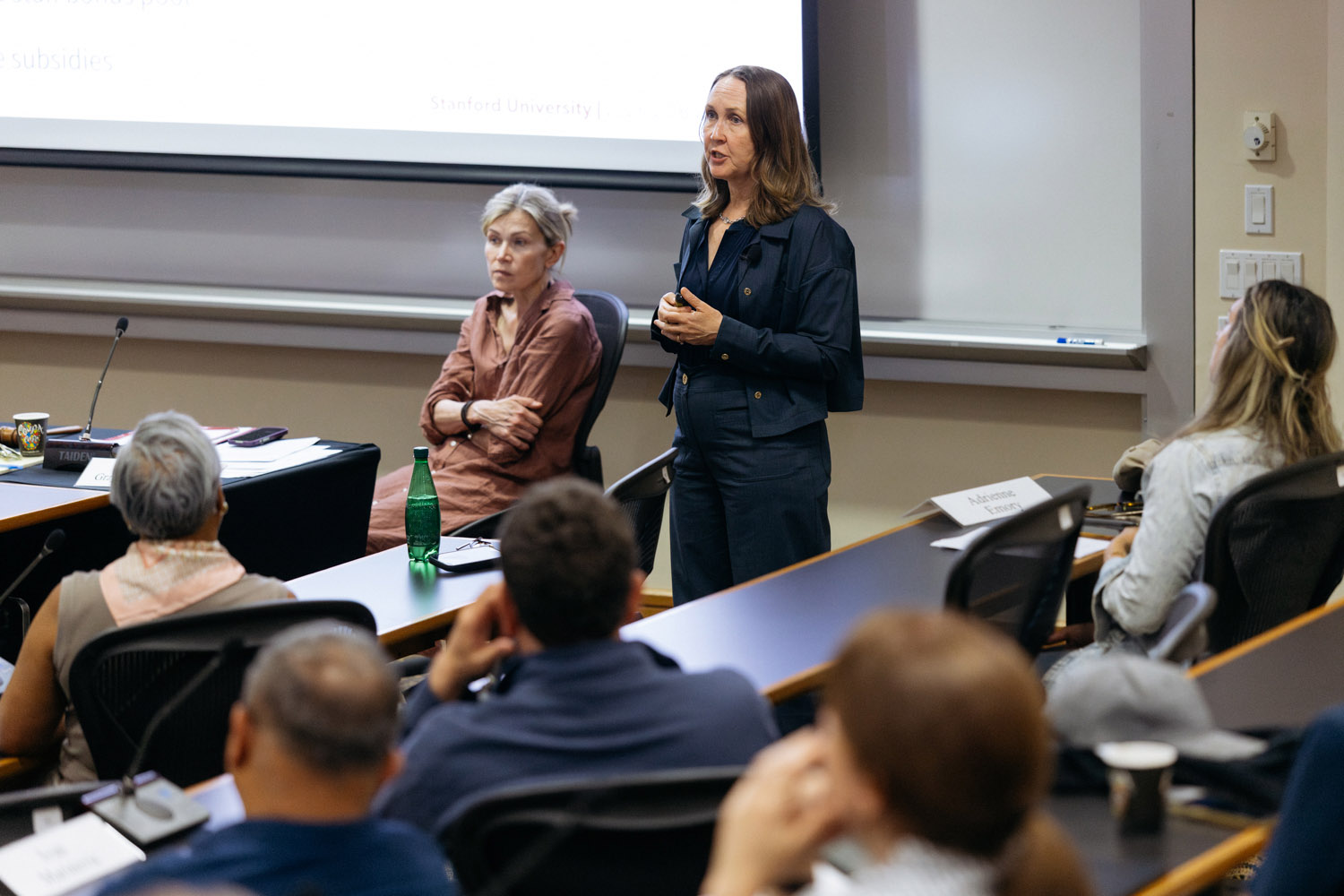
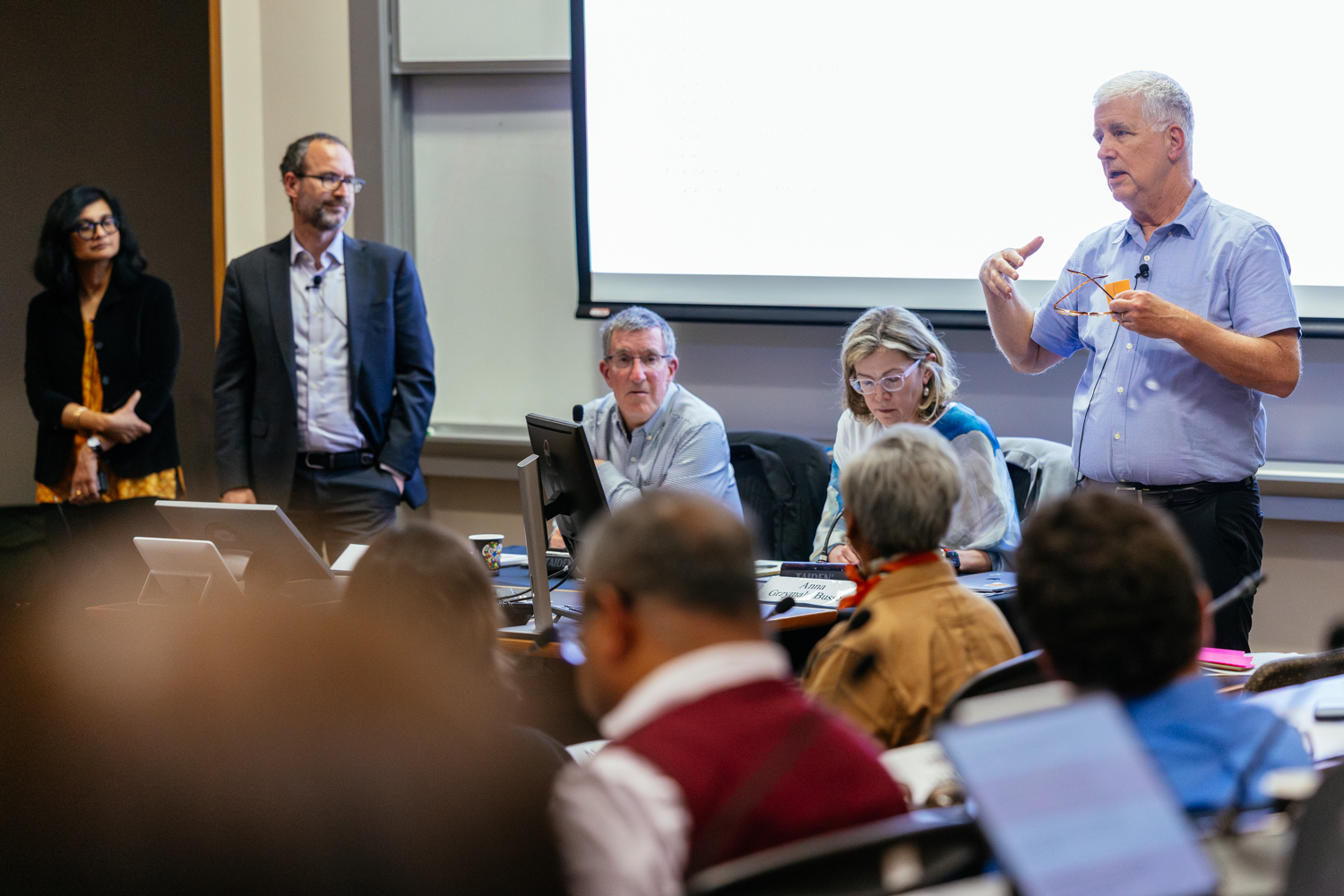
The Faculty Senate decided that it does not have the power to condemn or rebuke individuals, while clarifying that it retains the right to a no-confidence vote on senior leadership during its Thursday meeting.
The vote followed years of debate and review stemming from the senate’s 2020 censure of Scott Atlas, a Hoover Institution fellow who advised President Trump on COVID-19 policy. That censure raised broader questions about academic freedom, due process, and the senate’s role in formal condemnation or rebuke.
As senators revisited the issue, many agreed that the body needed to clarify its authority.
In voting to approve the motion, some senators emphasized the importance of institutional neutrality, warned against chilling debate, or noted that existing mechanisms already allow for faculty discipline and individual expression.
“I view our values of academic freedom and diversity of thought as being paramount to how we come together as a university, and when we disagree with one another, which we should do frequently and vigorously, then we respond by arguing with one another and by educating our students, our peers, and potentially the public,” said Sarah Heilshorn, the Rickey/Nielsen Professor in the School of Engineering and professor, by courtesy, of bioengineering and of chemical engineering.
Former President Richard Saller, the Kleinheinz Family Professor of European Studies in the School of Humanities and Sciences (H&S), professor of classics, and professor, by courtesy, of history, said it’s critical for the university to maintain open debate, even for unpopular views. “I think there are other venues that are actually more powerful for criticism [such as] signed letters with names and credentials to convey the expertise of the people registering the view,” Saller added.
Others argued that clarifying the senate’s limits would help protect Stanford from outside pressures. “If the government [pressures] us to criticize one of our colleagues or sanction one of our colleagues in some way, it would be much easier [if] we can say we never do this,” said Richard Taylor, the Barbara Kimball Browning Professor in H&S.
Opposing senators expressed concern that removing this power would limit the senate in unforeseen circumstances. They argued that the senate should retain its right to deliberate and formalize a fair process to take action in rare, extraordinary circumstances.
The senate has exercised this power only twice in its history – proof that it can exercise self-restraint, said James Landay, the Anand Rajaraman and Venky Harinarayan Professor, and Denning Co-Director and senior fellow at the Stanford Institute for Human-Centered AI.
Keith Winstein, associate professor of computer science and, by courtesy, of electrical engineering, argued that the senate’s ability to condemn or rebuke is a natural extension of its advisory role, and that removing this ability would make its positive statements less meaningful. “It seems axiomatic that this senate has the power to express advisory opinions … we congratulate and laud and we can equally condemn or rebuke,” Winstein said. “... We will not constrain future senates or even ourselves from condemning or rebuking, even if we adopt this motion.”
Other matters
The Faculty Senate also voted to approve an interim election for the 2026-27 senate chair, which is needed to implement the senate’s previous decision to replace the vice chair role with a chair-elect role.
Separately, senators applauded the announcement by Vice Provost of Undergraduate Education Jay Hamilton of this year’s Bass Education Fellows, which recognizes faculty for extraordinary contributions to undergraduate education.

President Jonathan Levin announced that three faculty members will take leadership roles in a new initiative to help in restoring public support for higher education: Russ Altman, the Kenneth Fong Professor and professor of bioengineering, of genetics, of medicine, of biomedical data science, a senior fellow at the Stanford Institute for HAI, and professor, by courtesy, of computer science; Brandice Canes-Wrone, professor of political science, Hoover Institution senior fellow; and Kathryn Moler, the vice president of the SLAC National Accelerator Laboratory, the Marvin Chodorow Professor, and professor of applied physics, of physics, and of energy science engineering.
Levin also commended the new location for the Martin Luther King, Jr. Research and Education Institute, which was inaugurated last week to a packed crowd, as well as the opening of the newly renovated Graduate School of Education.
In memory
The Faculty Senate also heard three memorial resolutions. Economics Professor Emeritus Paul Allan David, 87, conducted influential research on technology diffusion. He died on Jan. 23, 2023.
Bryan Myers, 86, was professor emeritus of nephrology at the School of Medicine and trained generations of nephrologists while chief of the Division of Nephrology for nearly 20 years. He died Jan. 27, 2023.
Helmut Wiedemann, 82, was professor emeritus of applied physics and died on Sept. 23, 2020. Wiedemann left an indelible mark on high-energy physics, synchrotron radiation science, and accelerator education during his long career.
Writer
Chelcey Adami