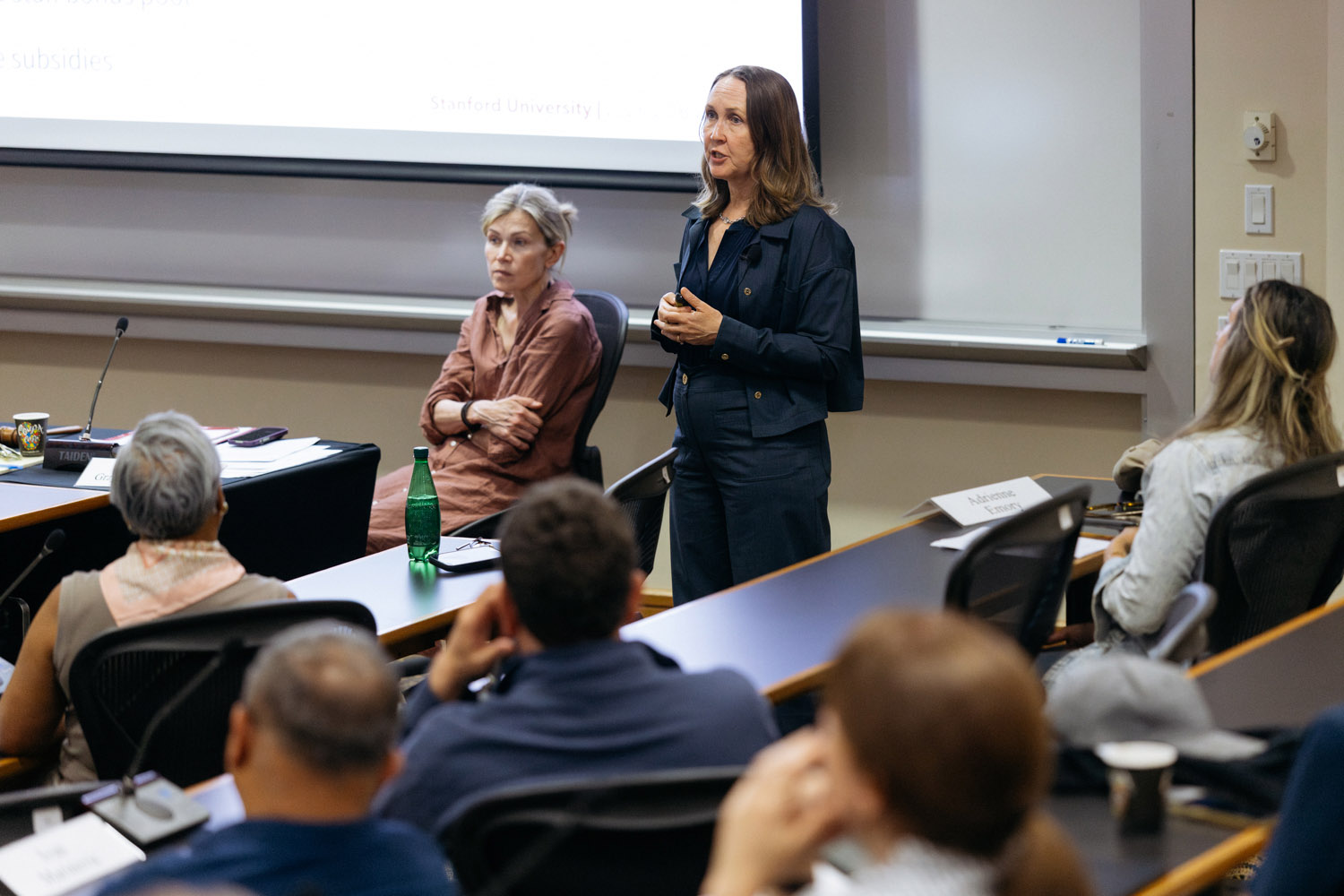
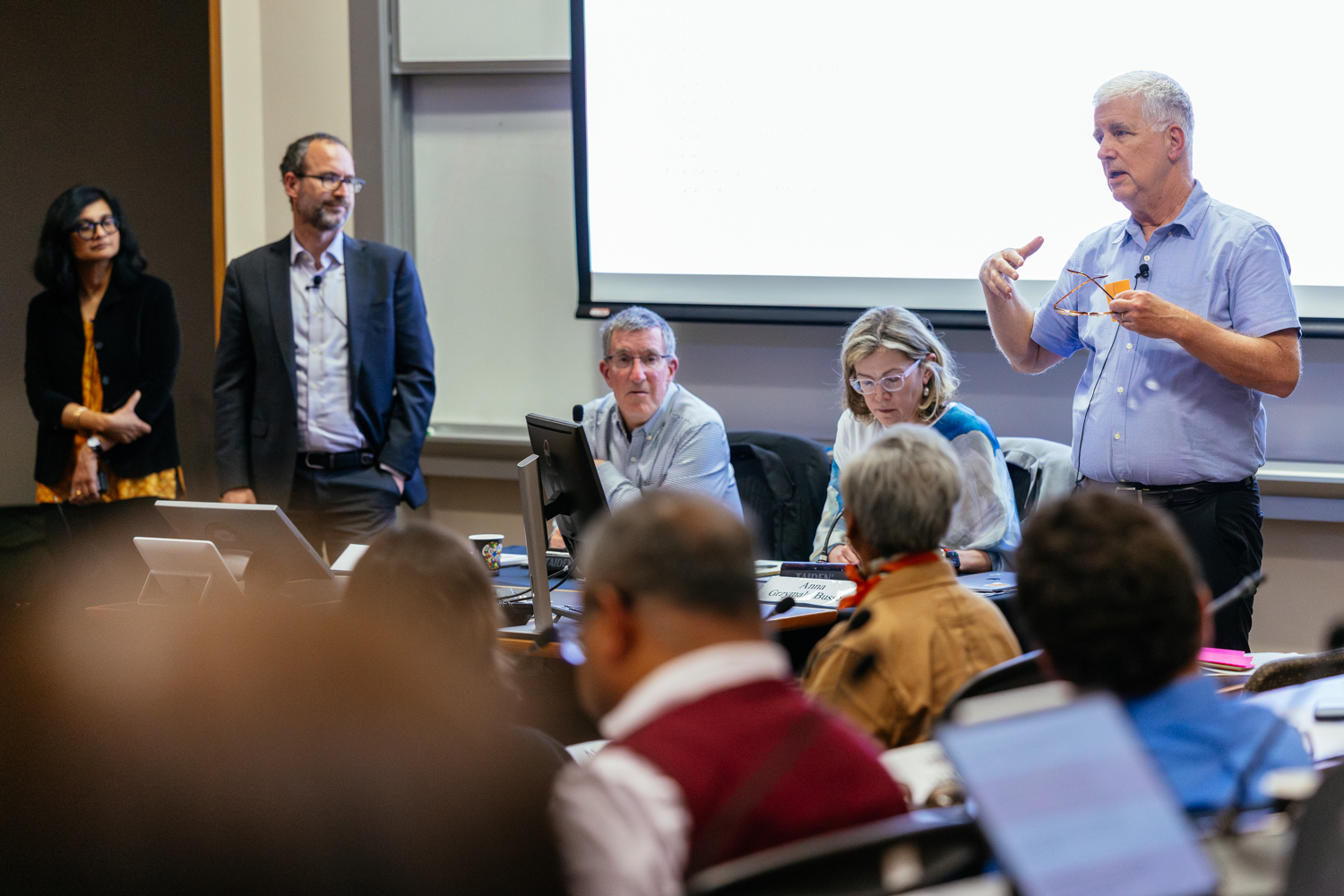
The Faculty Senate heard a presentation on the first-year Civic, Liberal, and Global Education (COLLEGE) requirement and approved policy changes for non-matriculated graduate study during its meeting on Thursday.
In 2020, the senate authorized COLLEGE for a five-year pilot period, which concludes this academic year. In the spring, the Committee on Undergraduate Standards and Policy (C-USP) will bring legislation to the senate to decide the program’s future.
“The choices we make about how to teach frosh students are among the most profound choices that we make as a faculty,” said Jim Campbell, C-USP chair and the Edgar E. Robinson Professor of United States History. “Not only do these choices shape the trajectories of our students for the next four years and beyond, they also provide us with an opportunity to clarify and articulate our own institutional values.”
Since 2022-23, all first-year students have been required to take COLLEGE courses in two out of three quarters. The Office of the Vice Provost for Undergraduate Education (VPUE) and the First-Year Requirement Governance Board (FYGB) recommend expanding COLLEGE to a full three-quarter requirement.
COLLEGE aims to provide first-year students with a shared intellectual experience and skills needed in critical thinking and civic responsibility, said Jay Hamilton, the Freeman-Thornton Chair for the Vice Provost for Undergraduate Education, Hearst Professor of Communication, and senior fellow at the Stanford Institute for Economic Policy Research.
The program includes an autumn course preparing students to make informed decisions about their education; a winter course teaching students how to engage in a pluralistic society; and a spring course encouraging reflection on global issues.
Student feedback has been overwhelmingly positive, with students saying that they find it valuable to reflect on their educational journey, develop civic skills, and approach issues with a global perspective, said Dan Edelstein, the William H. Bonsall Professor in French, and professor, by courtesy, of history and of political science.
“What we’re really proud of is that our instructors have created an environment in the classroom where students really feel comfortable sharing their views, even on hot topic issues,” Edelstein added.
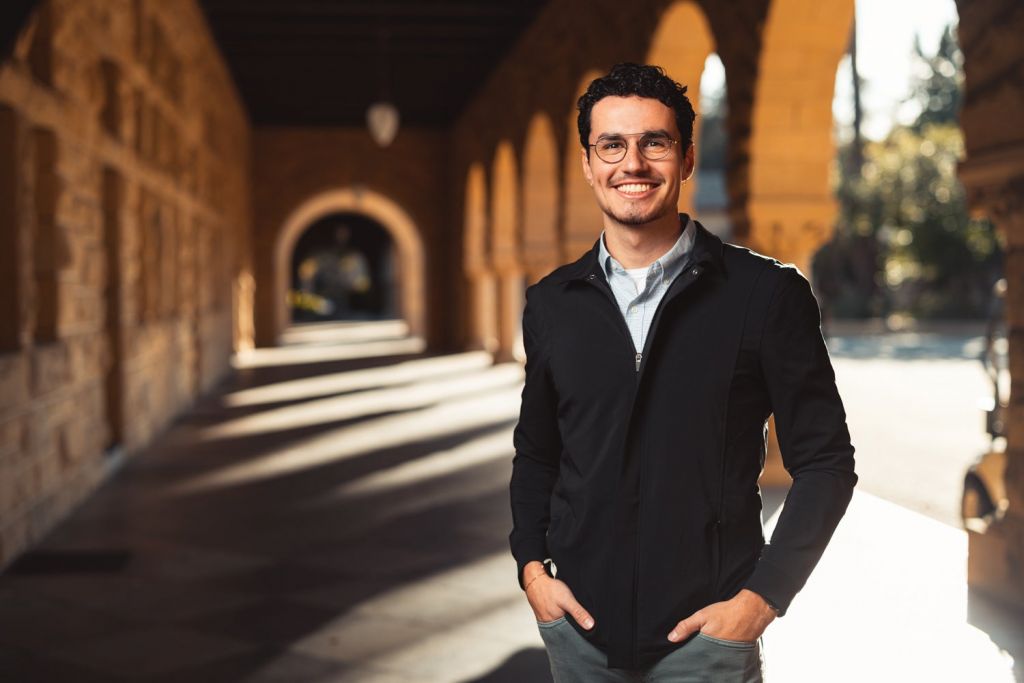
Several senators asked about how the program is being evaluated.
Senior Vice Provost for Undergraduate Education Lianne Kurina said VPUE will be sharing a report that includes data from course evaluations. She cautioned that other data, such as comparing cohorts, is more complex to assemble, in part due to the limited time that the two-quarter requirement has been in place.
Hamilton emphasized that the program is continually evolving as it reconsiders what works best for students; for example, only a dozen of the 21 original major readings for the autumn course remain. “It is a constant churning and we are learning as we go along,” Hamilton said.
Brad Osgood, professor of electrical engineering and, by courtesy, of education, noted that COLLEGE is only the latest edition of the first-year requirement and asked if there are any lessons learned from previous versions.
Edelstein said it’s become clear that it’s crucial to offer first-year students a shared intellectual experience in small discussion seminars. “That’s how you really get them to engage, not only with the ideas and with the text, but with each other,” Edelstein said.
Jennifer Burns, the Edgar E. Robinson Professor in United States History, said that teaching in the citizenship course was beneficial to her own growth, especially for cultivating skills of disagreement and dialogue that were “perhaps rusty or perhaps not really ever formally developed,” and she urged other senators to be COLLEGE instructors.
Paula Welander, associate dean for research in the Doerr School of Sustainability and a professor of Earth system science, said she felt well-prepared to teach in the citizenship course even though she is a microbiologist because of the extensive support and preparation provided by the COLLEGE program’s team. “From that perspective, the program has done a really, really good job,” Welander said.
This winter, the C-USP will also host listening sessions with senators ahead of the spring legislation.
Post-bacc study
The Faculty Senate also voted to approve policy updates for non-matriculated (post-bacc) graduate study, which allows post-baccalaureate students to take classes for credit on a non-degree basis. This can help students prepare for graduate or professional school, entry into the workplace, or continue pursuing a particular academic interest.
The first motion formally places oversight of non-matriculated study under the Faculty Senate, alongside the Office of the Vice Provost for Graduate Education, the Graduate Admissions Office, and the Registrar. This enables the senate to issue future exemptions and ratifies current ones.
A second motion grants a three-year exception allowing student-athletes to pursue post-bacc study while competing under NCAA rules. Previously, decentralized department programs and misaligned admission deadlines made compliance difficult.
The approved motions followed recommendations by the Committee on Graduate Studies (C-GS), which began reviewing the matter last year, said Stephen Monismith, C-GS chair and the Obayashi Professor in the School of Engineering and professor of oceans.
Under the new policy, student-athletes who have completed their bachelor’s degree but still have remaining athletic eligibility may enroll in graduate courses across departments for up to two years. A faculty oversight committee appointed by the provost will review admissions standards, participate in the admissions process, mentor the student-athletes, monitor academic progress, and provide an annual report on the program.
This change helps expand access to educational opportunities, establish faculty oversight, improve the educational experience, and support competitiveness in college athletics, said Jay Mitchell, the Faculty Athletic Representative (FAR), professor (teaching) of law, emeritus.
Monismith noted that other universities have this option for student-athletes, and “it helps them deal with the volatility that we see in rosters these days” due to the transfer portal.
One senator asked if this option would be only available for student-athletes who earned their undergraduate degree from Stanford or also for students from other institutions.
Mitchell clarified that this is for both students at Stanford and those transferring in. “It reflects the reality of modern-day college athletics and the fact that there is oftentimes movement from one school to another,” Mitchell said.
Peter DeMarzo, the John G. McDonald Professor of Finance and senior fellow of the Stanford Institute for Economic Research, noted that there is already a post-bacc program for students who come from other universities and asked if there is a programmatic requirement for student-athletes.
Monismith said there is not, adding that the lack of certificate programs is a gap Stanford hopes to address.
Marcia Stefanick, professor (research) of medicine, of obstetrics and gynecology, and, by courtesy, of epidemiology and population health, observed that this appears to only impact a small number of student-athletes and said she believes providing this access supports Stanford’s educational mission.
Mitchell added that the student experience has been a focus in conversations with the Department of Athletics, Physical Education, and Recreation (DAPER) on the matter. “This is going to be something that’s valuable for students, not just because they can compete, but because they will get something of value educationally,” he said.
In memory
Senators also heard a memory resolution for Dr. James Whitlock, Jr., professor emeritus of molecular pharmacology, who died Feb. 16, 2023, at age 80. Whitlock discovered the negative effects of dioxin, the toxic chemical in Agent Orange, on the human body.
Writer
Chelcey Adami