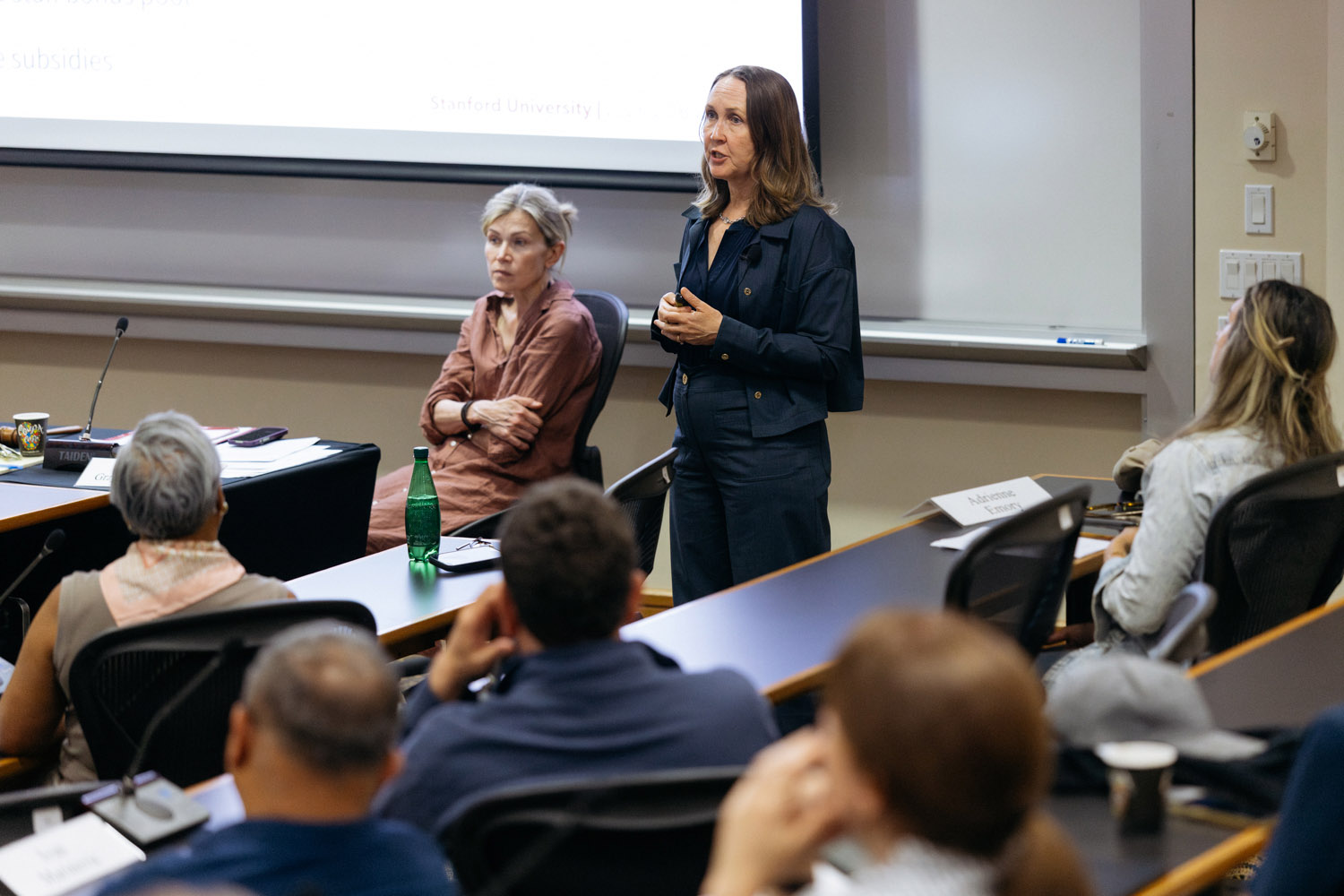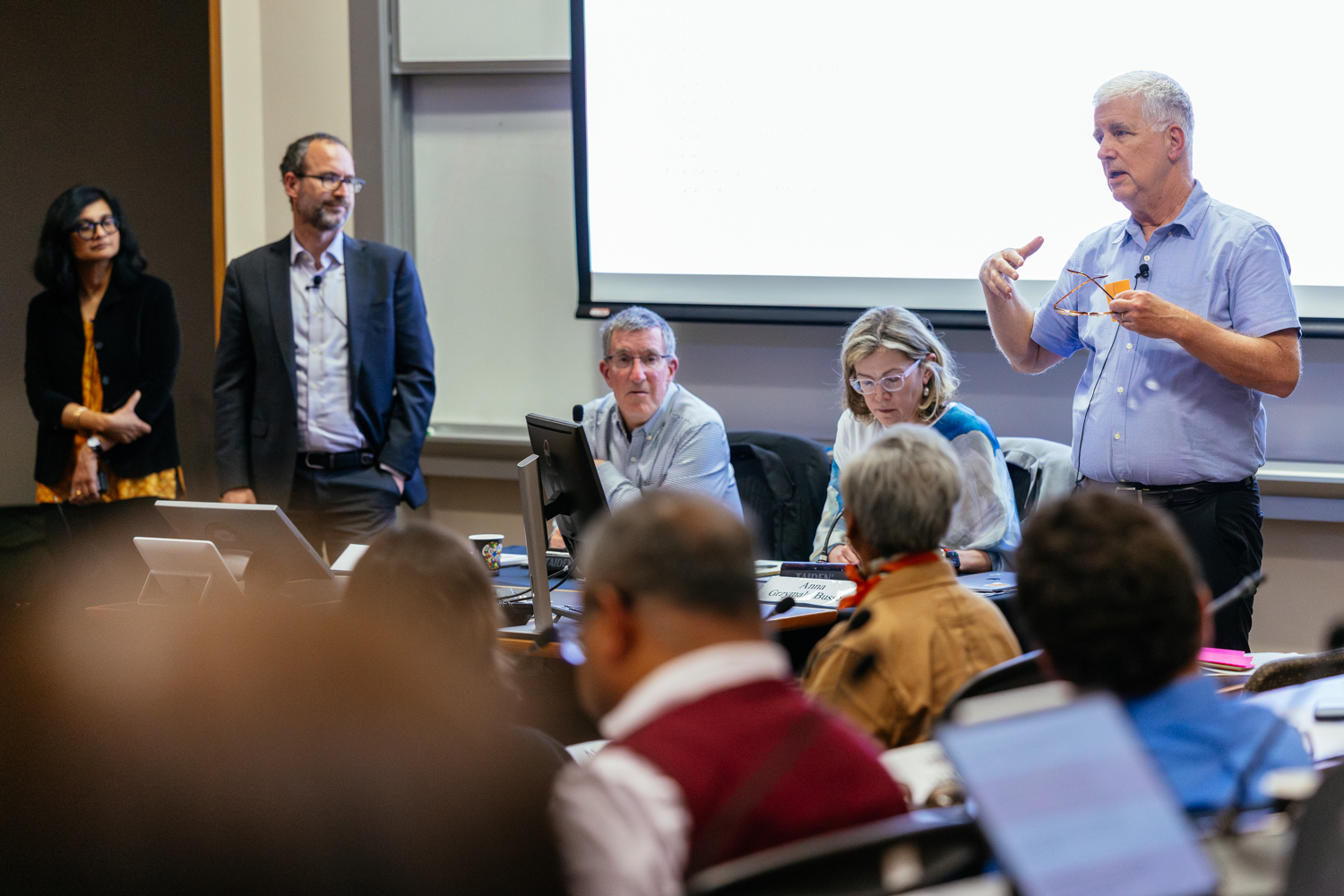
The Faculty Senate voted Thursday to extend the first-year requirement Civic, Liberal, and Global Education (COLLEGE) from two to three quarters beginning in fall 2027.
The program has been successful in providing students with a shared intellectual experience while strengthening reflection, critical thinking, and discussion skills, said Jim Campbell, chair of the Committee on Undergraduate Standards and Policy (C-USP) and the Edgar E. Robinson Professor in United States History in the School of Humanities and Sciences, in recommending its expansion.
“This is an exemplary program. It has entrenched itself in the lives of our undergraduate students,” Campbell said while citing high student survey scores on the program’s quality of instruction.
Stanford has offered first-year liberal education courses for more than a century, with formats that have evolved as students, the university, and higher education have changed. COLLEGE is the latest iteration, influenced in part by concerns that Stanford lacked a common intellectual experience and that students were choosing majors early, without time for exploration or self-knowledge.
The senate approved COLLEGE in 2020 for a pilot period that ends this academic year. While COLLEGE was designed as a three-quarter sequence, first-year students have been required to take only two of the three COLLEGE courses offered during the pilot.
After consulting stakeholders and various reports, the C-USP recommended extending COLLEGE to a three-quarter requirement and continuing its self-assessment, collaborative teaching, curricular renewal, experimentation, and program review.
The COLLEGE sequence
- The autumn seminar, COLLEGE 101: Why College? Your Education and the Good Life, explores questions of meaning and purpose.
- The winter seminar, COLLEGE 102: Citizenship in the 21st Century, delves into living together in a divided society.
- Spring lecture courses on Global Perspectives apply skills learned in the first two courses to global problems.
Most senators spoke in favor of extending the COLLEGE program, with several citing positive experiences teaching in it or praising the skills it imparts to students.
Shashank V. Joshi, senior associate vice provost for academic well-being in the Office of the Vice Provost for Undergraduate Education, said Stanford students are “brilliant, but they are also brittle at times.”
“They arrive with extraordinary academic preparation but very little practice sitting with discomfort and engaging respectfully across difference,” Joshi explained. “COLLEGE 101: Why College? is not a soft course for our students. The well-being framework that we start with in that first quarter is a clinical intervention at scale, in my opinion. It gives students language, community, and tools before the weight of Stanford fully lands on them.”
Iván Marinovic, the Jonsson Family Professor and professor of accounting at Stanford Graduate School of Business, expressed concerns about the program’s academic rigor and the reading materials required for the general education course.
Dan Edelstein, COLLEGE faculty director and the William H. Bonsall Professor in French in the School of Humanities and Sciences (H&S), said COLLEGE tries to get students to think about their education beyond a vocational context.
The texts regularly change and are “designed to spark conversation, spark excitement, get students to realize the joy of reading, the joy of talking about ideas with others,” Edelstein continued.
Alison McQueen, associate professor of political science in H&S, noted that COLLEGE has been developed with extensive input, testing, and revision, and she invited senators with concerns about the program to participate in its updates. “It’s a virtue of the COLLEGE program that course design, specific readings, assessment, [and] teaching plans are subject to revision every year in response to student and faculty feedback,” McQueen said.
Gabriella Safran, the Eva Chernov Lokey Professor in Jewish Studies and a professor of Slavic languages and literatures in H&S, said several faculty members teaching in COLLEGE have shared that the program benefits teaching as well.
“It gives people in different departments a chance to kind of grapple together, in a very supported way, with shifts in student learning capacities, and faculty take what they learn there back to their departments,” Safran said.
Keith Winstein, an associate professor of computer science in the School of Engineering, said teaching in COLLEGE has helped him be a better instructor in his disciplinary classes.
“My familiarity with what they’ve seen as freshmen helps me connect better with them and helps me have a better curriculum when they’re juniors and seniors,” Winstein said. “So I think it is very helpful and very interesting when you have this common core.”
Leadership
In addressing the senate, President Jonathan Levin highlighted the recently announced unification of the Stanford Institute for Human-Centered Artificial Intelligence (HAI) and Stanford Data Science.
Levin also encouraged the university community to visit the Department of African and African American Studies, which recently held its opening ceremony at its renovated building in the Quad.
Provost Jenny Martinez addressed questions from faculty members about AI, specifically whether the Stanford AI Playground will be upgraded with additional options and how the university is considering ethics in AI use.
Stanford is negotiating licenses for more products, which are expected to be in place shortly, Martinez said. Further, the AI at Stanford Advisory Committee is considering various topics related to AI usage at the university, and there are curricular programs focused on ethics and the use of AI, the provost explained.

James Landay, the Anad Rajaraman and Venky Harinarayan Professor and professor of computer science in the School of Engineering, and Denning Director and senior fellow at HAI, added that there is strong faculty research across campus considering the benefits and harms of AI.
“HAI, from its founding, has always taken the view that AI is going to reshape much of our society and some of that will be positive and some negative,” Landay said. “Therefore, a lot of our research is both looking at technical underpinnings but also looking at social impact policy design to make it better.”
The provost also provided a short update on a recent physical altercation in White Plaza. The Stanford Department of Public Safety has collected witness accounts of the incident, as well as video captured from multiple angles, and has turned it over to the Santa Clara County district attorney’s office for evaluation of potential legal consequences, Martinez said. Further, the university has reviewed whether the student organization involved in the incident followed White Plaza tabling policies, and it appears that they did so.
A student senate representative also asked the provost about a decision to change the annual “Beyond SexEd” event from required New Student Orientation (NSO) programming to optional.
Sexual assault prevention is a key issue for the university, which strives to foster “a culture where we’re preventing sexual assaults as much as possible,” Martinez said, and first-year students must take Title IX training, which addresses sexual assault prevention, before arriving on campus. Based on feedback, changes have been made to reduce the number of required NSO programming sessions and increase student engagement, Martinez explained.
In memory
The Faculty Senate also heard memorial resolutions for Victor Fuchs and Richard Olshen.
Fuchs, the Henry J. Kaiser Jr. Professor of Economics and of Health Research and Policy, Emeritus, died Sept. 16, 2023, at age 99. Fuchs was a pioneer of health economics who worked to illuminate problems and propose policy fixes to the U.S. healthcare system.
Olshen, a statistician who created groundbreaking machine learning applications, died Nov. 8, 2023, at age 81. Olshen was professor emeritus of biomedical data science at the School of Medicine.
This story was updated to include additional remarks from the provost.
For more information
Edelstein is a professor, by courtesy, of history and of political science. Joshi is a professor (teaching) of psychiatry and behavioral sciences (child and adolescent psychiatry and child development) and, by courtesy, of pediatrics and of education. McQueen is a professor, by courtesy, of history. Safran is a professor, by courtesy, of German studies and of comparative literature.
Writer
Chelcey Adami