This story was originally published in July 2024 and has been updated.
Stanford’s public art program includes more than 80 works spanning the 19th, 20th, and 21st centuries, each reflecting the history, spirit, and dynamism of life on campus. From Ursula von Rydingsvard’s monumental bronze MOCNA (2018) at Denning House to Sam Van Aken’s Tree of 40 Fruit (2019) growing beside the Rodin Sculpture Garden, the works are accessible to the public year-round. For an interactive map, download the Stanford Mobile app. Or, if you’d rather leave your wayfinding tools behind and wander the grounds for chance encounters with art, here are four great places to start.
Stanford Arboretum
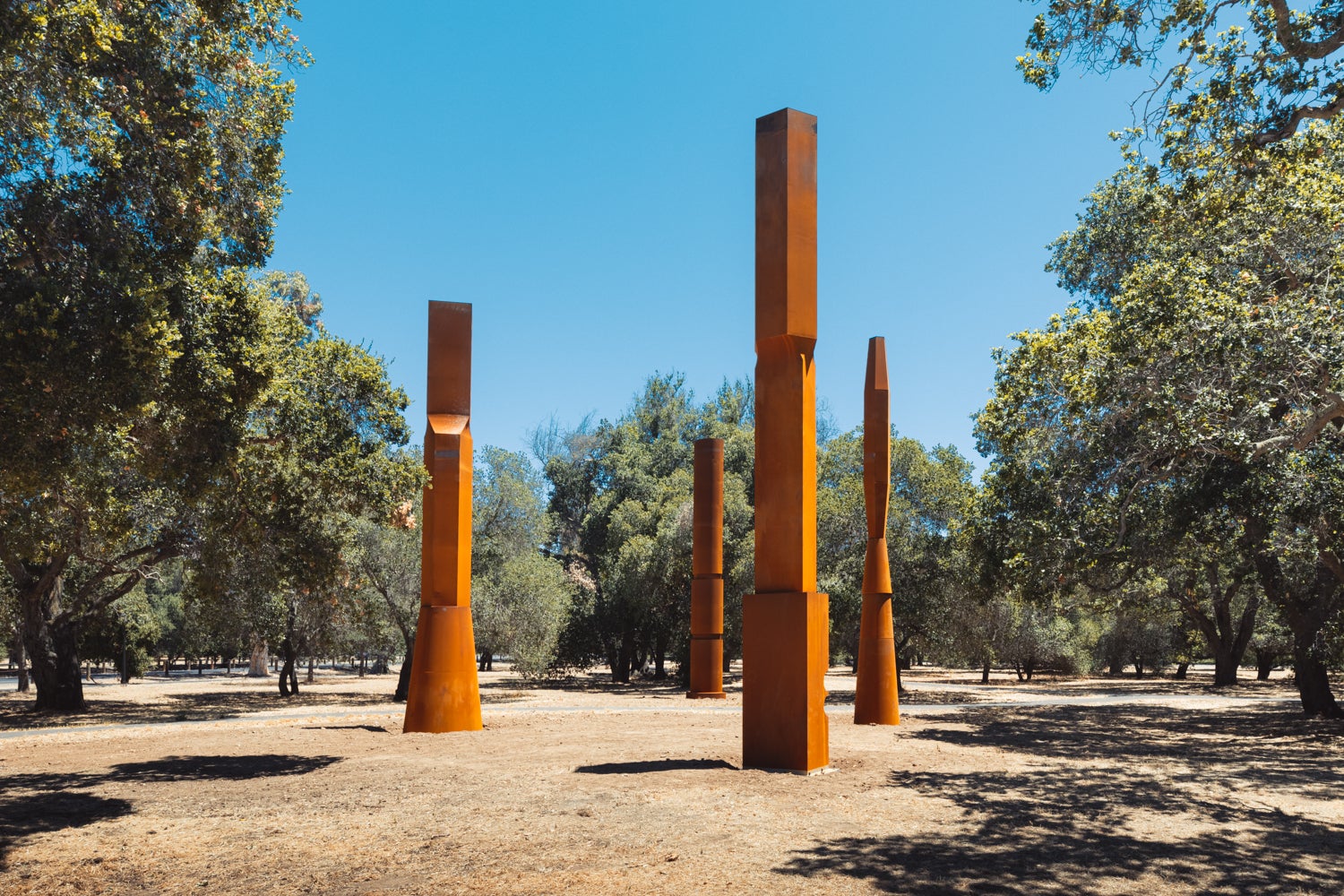
“The Stanford Columns” (2022), an installation at the Stanford Arboretum of four oxidized steel columns by award-winning American sculptor and environmental artist Beverly Pepper, is an iteration of an installation in Italy created specifically for the Stanford campus. | Andrew Brodhead
Among the California oaks across Lomita Drive from the Anderson Collection, you’ll find Beverly Pepper’s The Stanford Columns (2022). The tapered, irregular steel columns, each weighing between 3 and 5 tons, suggest the trunks of massive trees, while the metal’s velvety-looking oxidized patina is reminiscent of brightly colored lichen. Across the Arboretum, look for Chaos Kosmos by sculptor Jedd Novatt. The towering sculpture, a dynamic assembly of interlocking geometric forms that appear frozen in motion, was installed at Stanford’s Center for Academic Medicine in February 2026.
Canfield Court
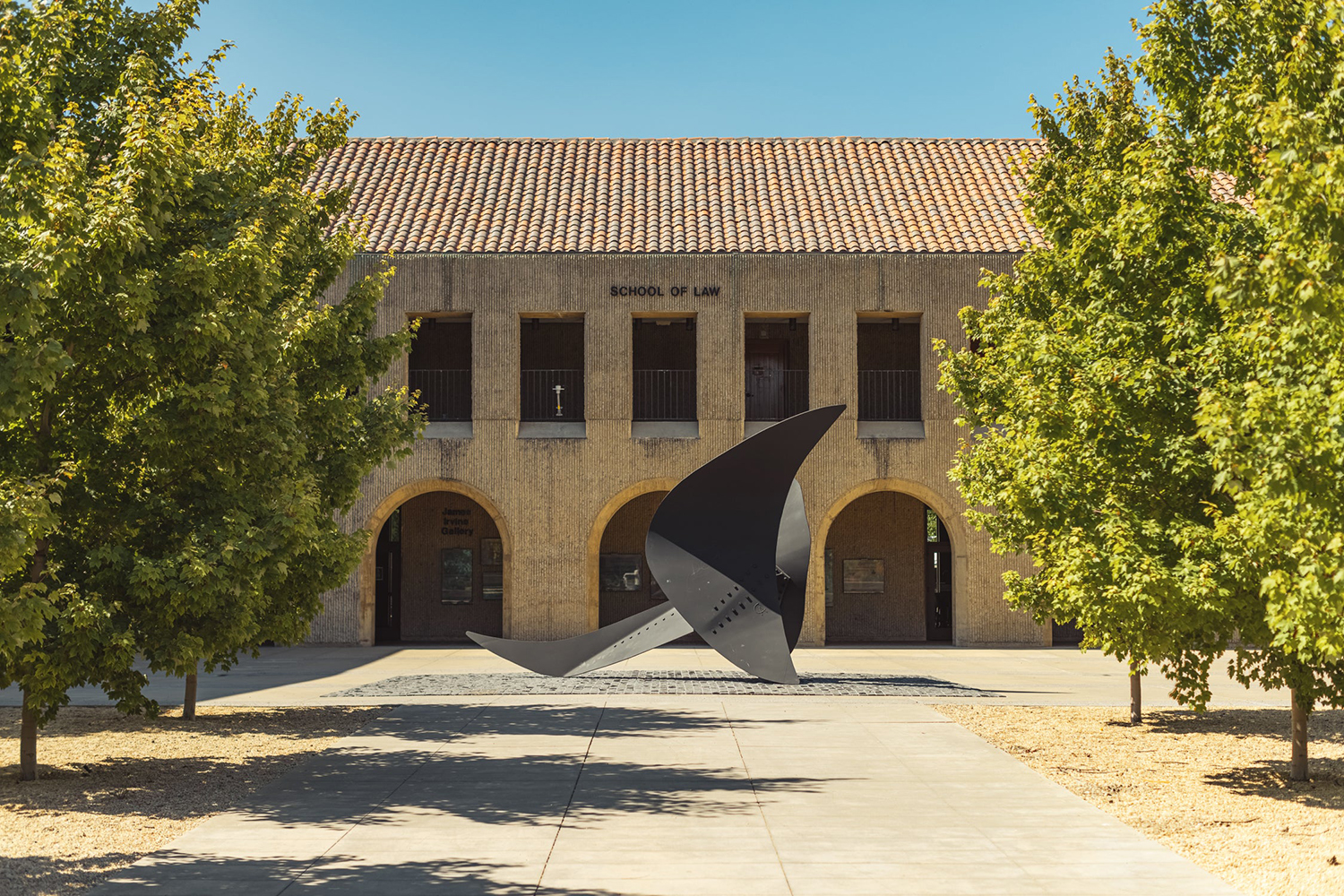
“Le Faucon (The Falcon)” (1963) by American sculptor Alexander Calder once stood in front of the artist’s studio in Saché, France. It is now the centerpiece of the Cooley Courtyard at Stanford, which opens out into Canfield Court. | Andrew Brodhead
Deeper into the center of campus, between Stanford Law School and Green Library, are half a dozen artworks around walkable Canfield Court, including Alexander Calder’s The Falcon (1963), Don Yeomans’ carved totem pole titled The Stanford Legacy (2002), and Alia Farid’s Amulets (2024) – two translucent forms made of blue faience, a turquoise glaze used for more than 6,000 years, and polyester resin, a byproduct of modern petroleum production.
Rodin Sculpture Garden

The Rodin Sculpture Garden next to the Cantor Arts Center features some of the French sculptor’s most iconic late 19th-century works. | Andrew Brodhead
Within a single acre of cypress trees and gravel paths next to the Cantor Arts Center is the Rodin Sculpture Garden, modeled after the Bagatelle Gardens in Paris. Stanford’s garden comprises 20 monumental bronzes that include many of Rodin’s most famous sculptures created in the late 19th and early 20th centuries, including The Walking Man, two heads of the Burghers of Calais (the life-size Burghers are in Memorial Court in front of the Main Quad), and Adam, Eve, and The Three Shades. Visually anchoring the garden at its eastern end is The Gates of Hell, a massive work cast by the Coubertin Foundry in 1981 using the lost-wax process favored by Rodin.
Papua New Guinea Sculpture Garden
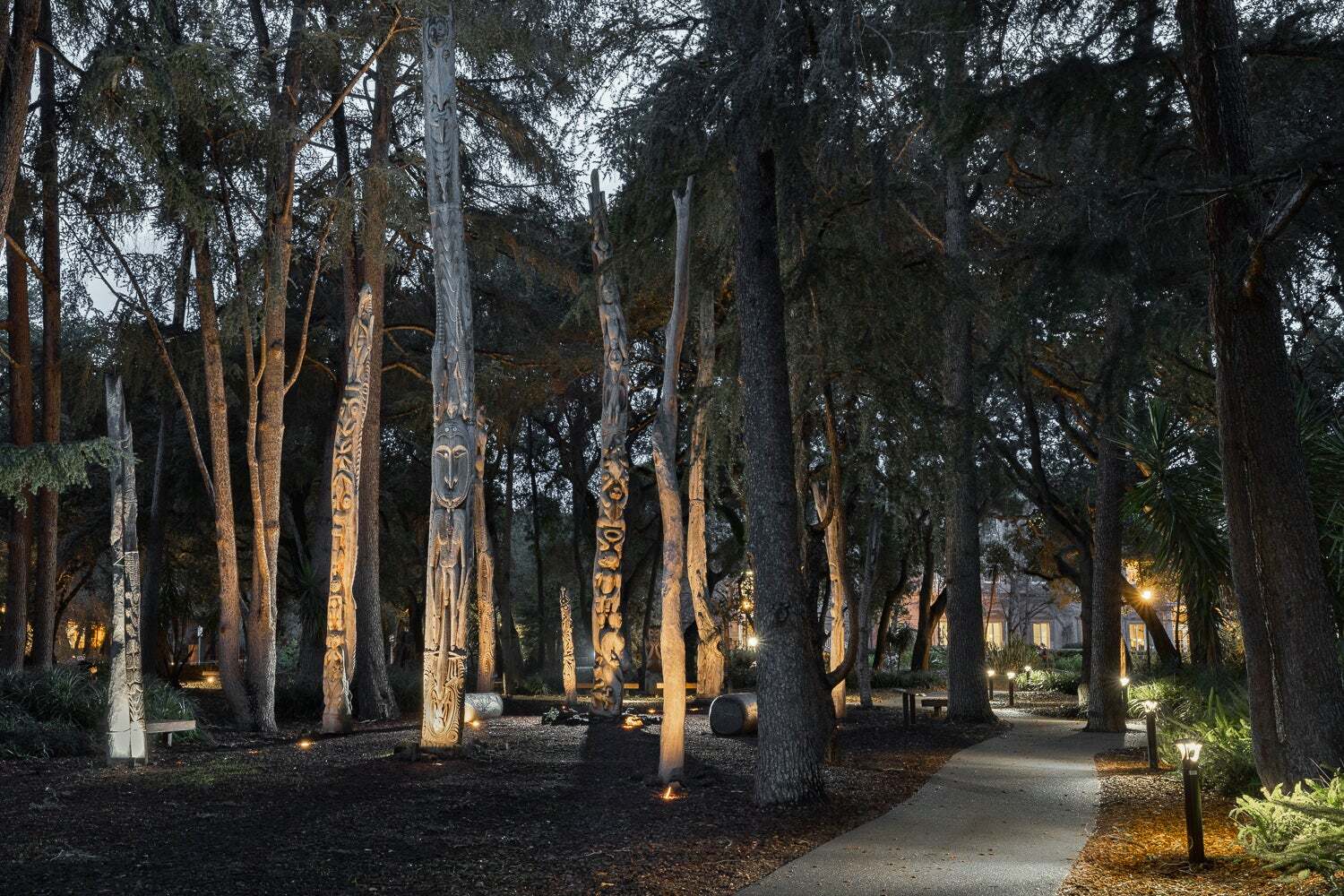
The Papua New Guinea Sculpture Garden on the corner of Santa Teresa Street and Lomita Drive has been a feature in Stanford’s landscape since 1994. | Andrew Brodhead
A 15-minute walk due south of the Rodins, through the center of campus, puts you in the leafy center of the Papua New Guinea Sculpture Garden at the corner of Santa Teresa Street and Lomita Drive. Thirty years ago, 10 artists-in-residence from the Sepik River region of Papua New Guinea were invited to Stanford to reinterpret their artistic and design perspectives within the new context of a Western public art environment. The artists produced 40 carved posts, freestanding individual figures, garamut slit drums, and other large-scale site-specific artworks. Improved lighting and new smooth, flat walking paths easily accessed off the street sidewalk make this oasis easy to navigate year-round.
Take a self-guided tour
The Stanford Mobile app maps out five thematic art walks, each featuring multiple works and details about every stop.
The “BeWell Arts Tour” is a 10-stop loop through the center of campus, with stops at Vanguard (1980) by Oakland sculptor Bruce Beasley in Canfield Court and Alia Farid’s Amulets (2024) on the elevated plinth on Meyer Green between Green Library and Stanford Law School.
“Art and Science” features artwork in dialogue with scientific research and discovery, including Kenneth Snelson’s Mozart I (1982) on the lawn outside the Packard Electrical Engineering Building and Alicja Kwade’s Pars pro Toto (2021), installed throughout the Science and Engineering Quad. Kwade determined the positioning of the 12 stones that make up the installation Pars pro Toto by throwing tiny spheres onto a model of the quad to see where they would land.
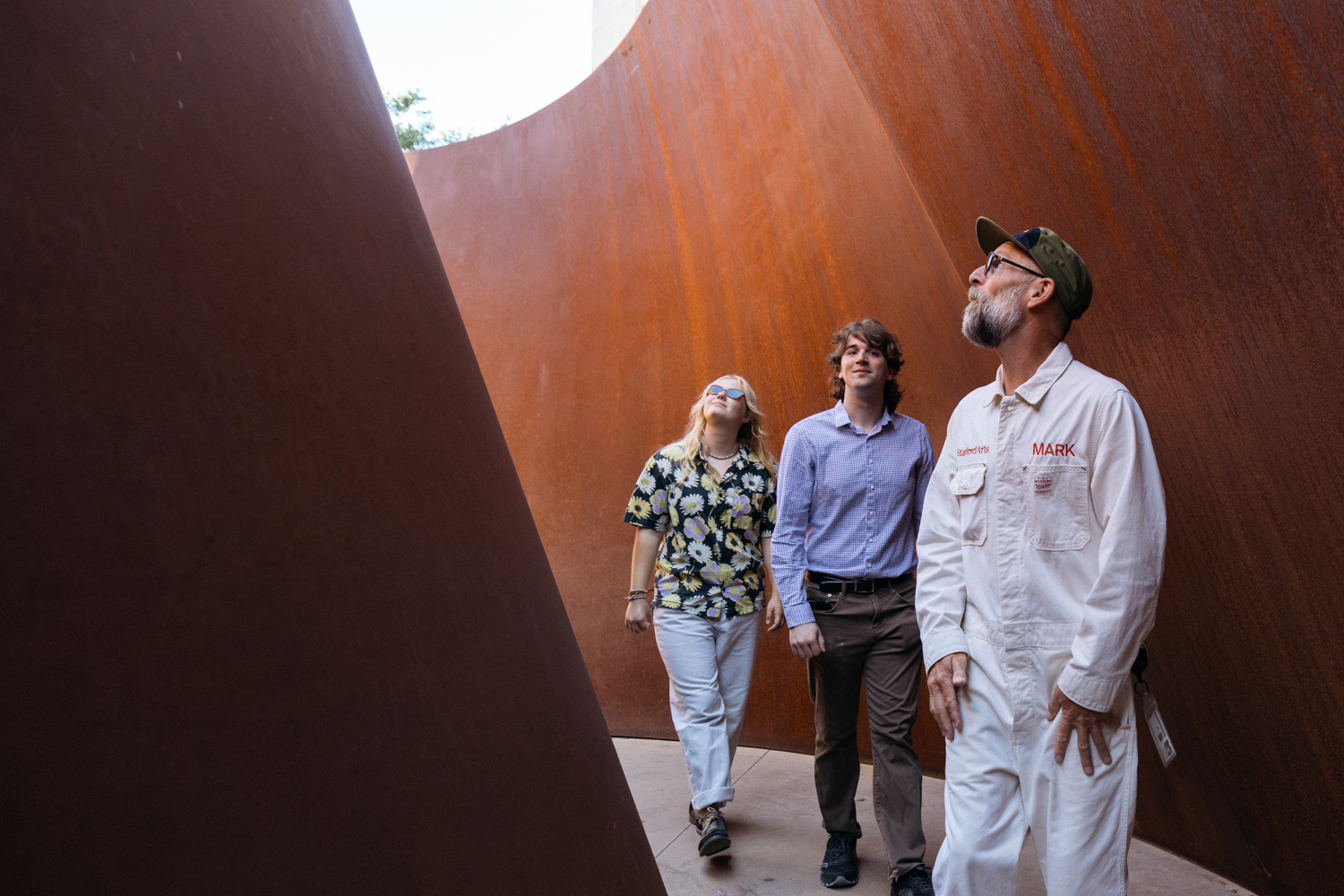
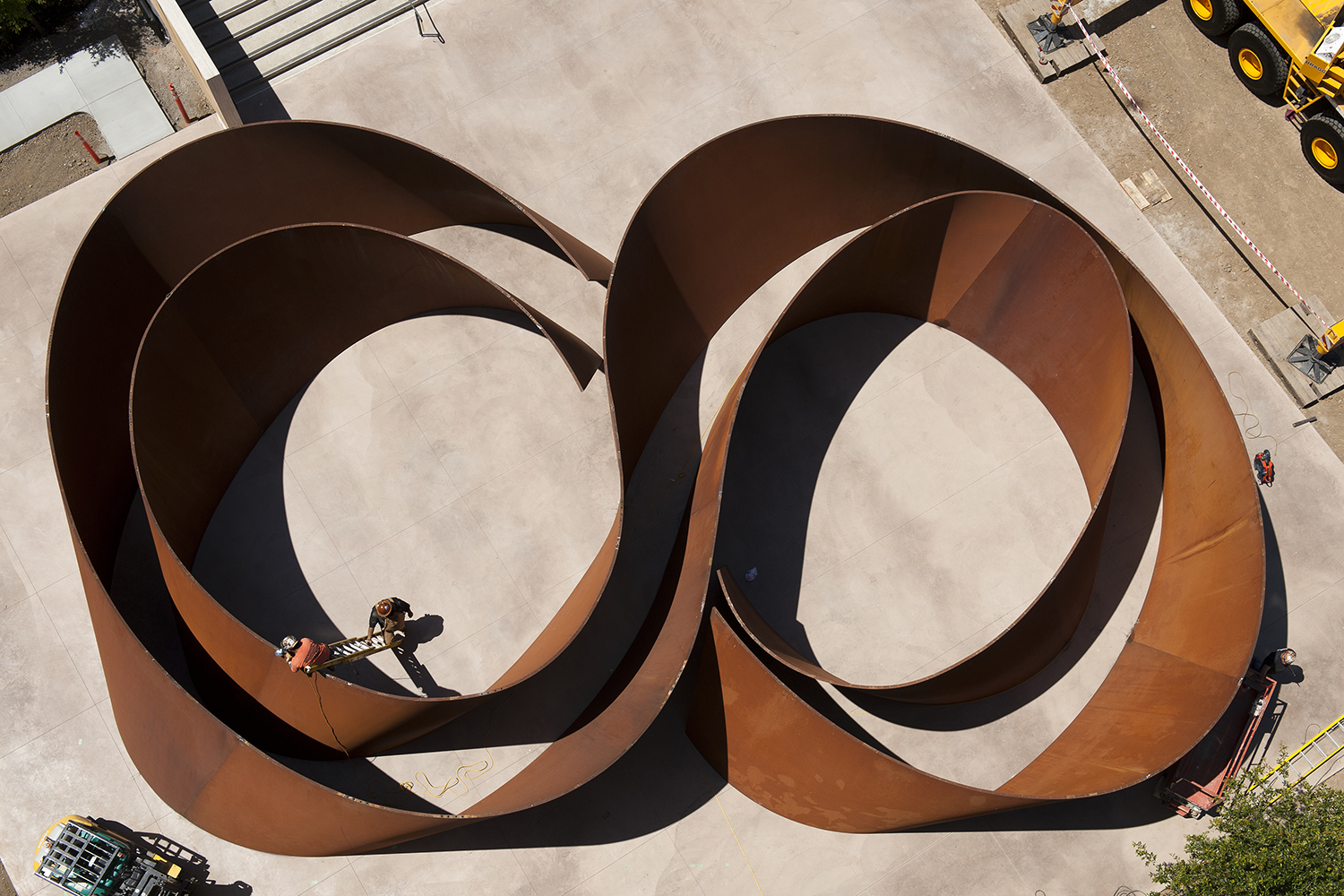
The “Sculptural Landscapes” tour takes the viewer through works that invite reflection on the dynamic relationships between site, scale, and the body, including Richard Serra’s Sequence (2006). The monumental work is composed of contoured steel and measures 67 feet long, 42 feet wide, and 13 feet high, weighing more than 200 tons.
“Around the Museums” highlights six works installed near the Anderson Collection and the Cantor Arts Center, including the extensive Rodin Sculpture Garden and The Stanford Columns.
The “Muralism and Activism” tour highlights murals as a powerful form of community engagement, shared history, and activism. A featured stop is the “remastered” 52-foot mural by Malaquias Montoya on El Centro’s facade. Originally painted on wood panels in 1980-81 with the help of Stanford students and staff, the mural was replicated in 2026 by Greta McLain, a former student of Montoya’s, using UV-protected paints on specialized fabric mounted on durable metal composite panels.
Writer
Robin Wander