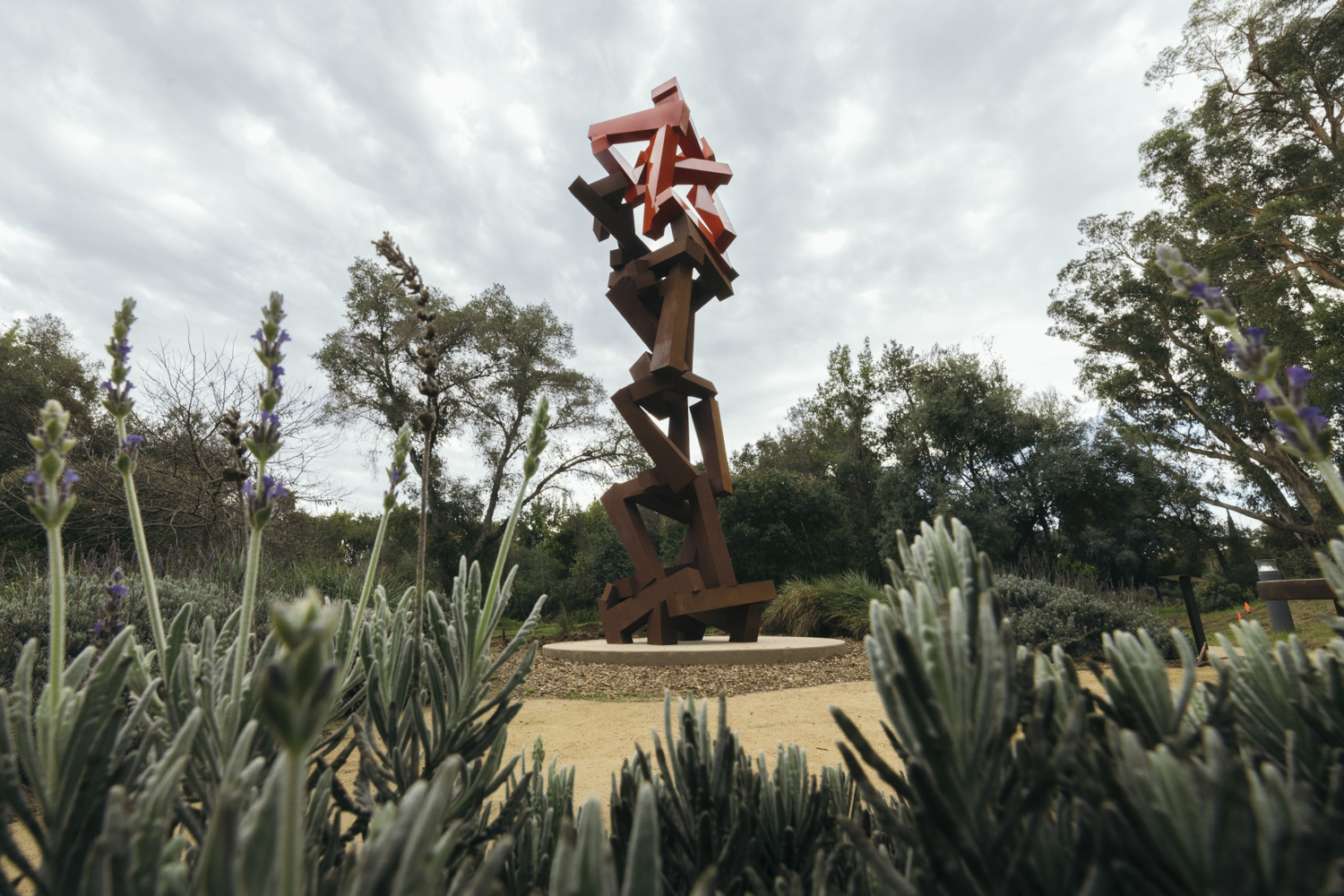

A towering new outdoor sculpture has arrived at Stanford’s Center for Academic Medicine. Chaos Kosmos by Jedd Novatt is a dynamic assembly of interlocking geometric forms that appear frozen in motion, conveying both power and delicacy. Installed in January, the work is a gift in memory of Sash A. Spencer and has become part of the collection of the Cantor Arts Center.
The installation intentionally bridges medical and natural environments, sitting at the intersection of Stanford Medicine’s academic and clinical campus and the historic arboretum filled with oak trees, walking paths, and the occasional coyote. The Center for Academic Medicine (CAM) was designed to support the well-being of clinical faculty and staff, providing spaces for research and collaboration along with reflection and renewal – goals that the new artwork supports.
“Medicine is not just a hard science, but a human art,” said Dr. Jeffrey Goldberg, professor and chair of ophthalmology at the Byers Eye Institute, who helped steward the sculpture’s donation to the university. “This new installation brings together Stanford’s longstanding commitment to the arts and to the sciences and to eye research. Chaos Kosmos will help the Stanford medical community see what we do in new ways, and reminds us that while most of our work may happen in the lab or the clinic, it really starts and ends with people and with creativity.”
For the artist, the sculpture’s interdisciplinary home echoes its themes. “Chaos Kosmos engages viewers to consider the concept of perspective, where deeper inspection reveals a tectonic dialogue in which forms, reflections, and movement collide,” said Novatt. “Perspective is not fixed; it transforms looking into insight.”
The 26-foot sculpture can be viewed from all angles at ground level and also from above, via the skybridge that connects the wings of the CAM building. This offers a unique vantage point for experiencing the work’s complex arrangements and carefully balanced forms that seem to defy the laws of gravity.
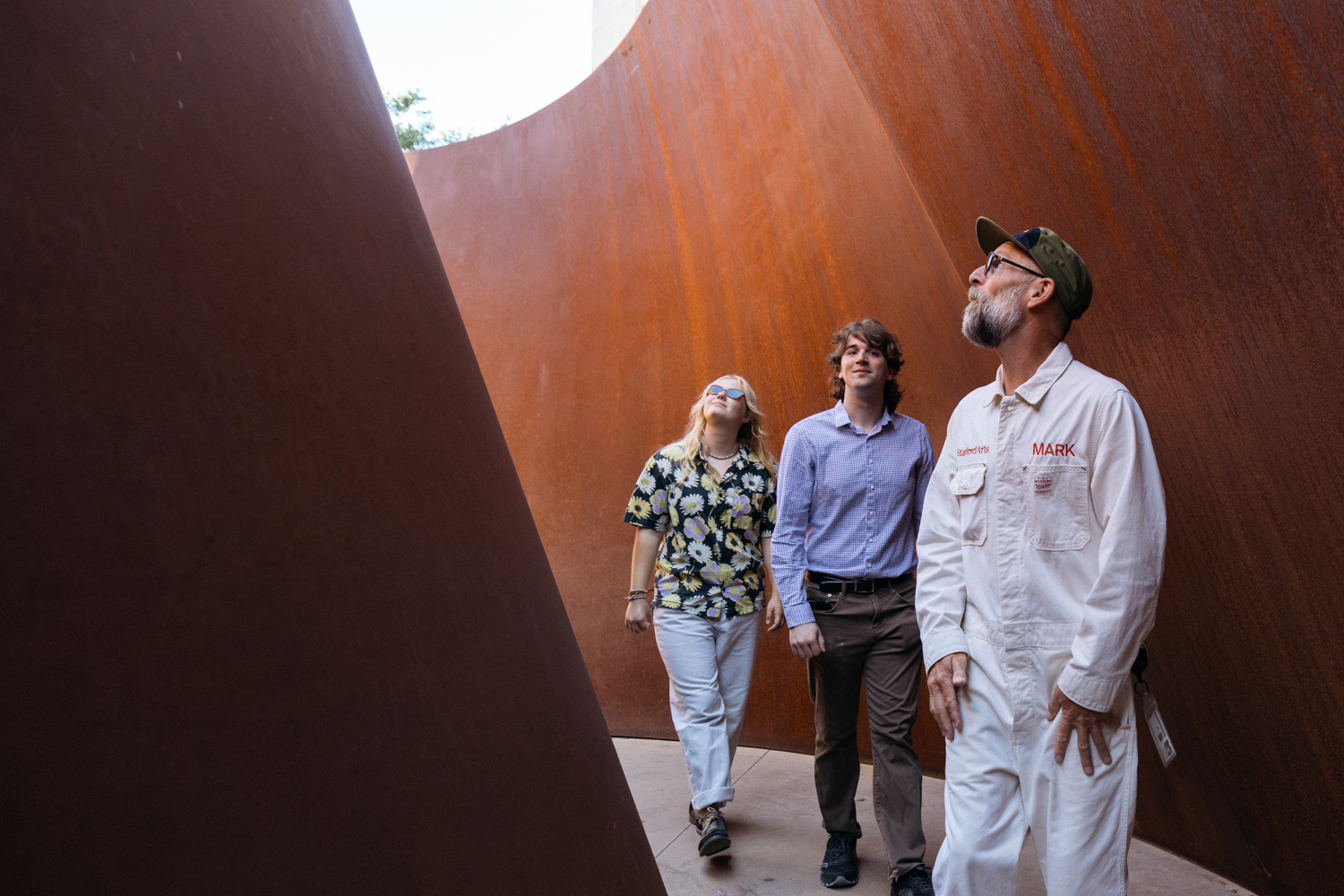
Chaos Kosmos joins other monumental sculptures on campus made from Cor-Ten, a steel alloy that ages to a distinctive golden brown patina, including Beverly Pepper’s The Stanford Columns and Richard Serra’s Sequence at the Cantor Arts Center. The glossy red epoxy paint that tops Chaos Kosmos adds a bold dimension and highlights the star-like formation that inspired the artwork’s name.
The installation is the most recent effort by Stanford’s public art program to activate the campus landscape with outdoor art, including The Stanford Columns in the grove opposite the Anderson Collection, Pars Pro Toto by Alicja Kwade in the Science and Engineering Quad, and Amulets by Alia Farid on the Meyer Green plinth.
“Public art is one of our most direct and accessible forms of art,” said Anne Shulock, assistant vice president for the arts. “As we work to integrate art and creativity across many dimensions of the university, it’s special to meet people where they are and invite moments of beauty, discovery, and reflection in their daily lives. That’s just what Chaos Kosmos will offer to all the students, faculty, staff, and visitors who cross its path.”
Large-scale outdoor works by Novatt, who was born in New York and is based in France, have also been permanently installed at the University of Miami, Pérez Art Museum Miami, and the Savannah College of Art and Design, among many other locations in the United States, Europe, and Asia, and his artwork is held in public and private collections worldwide.