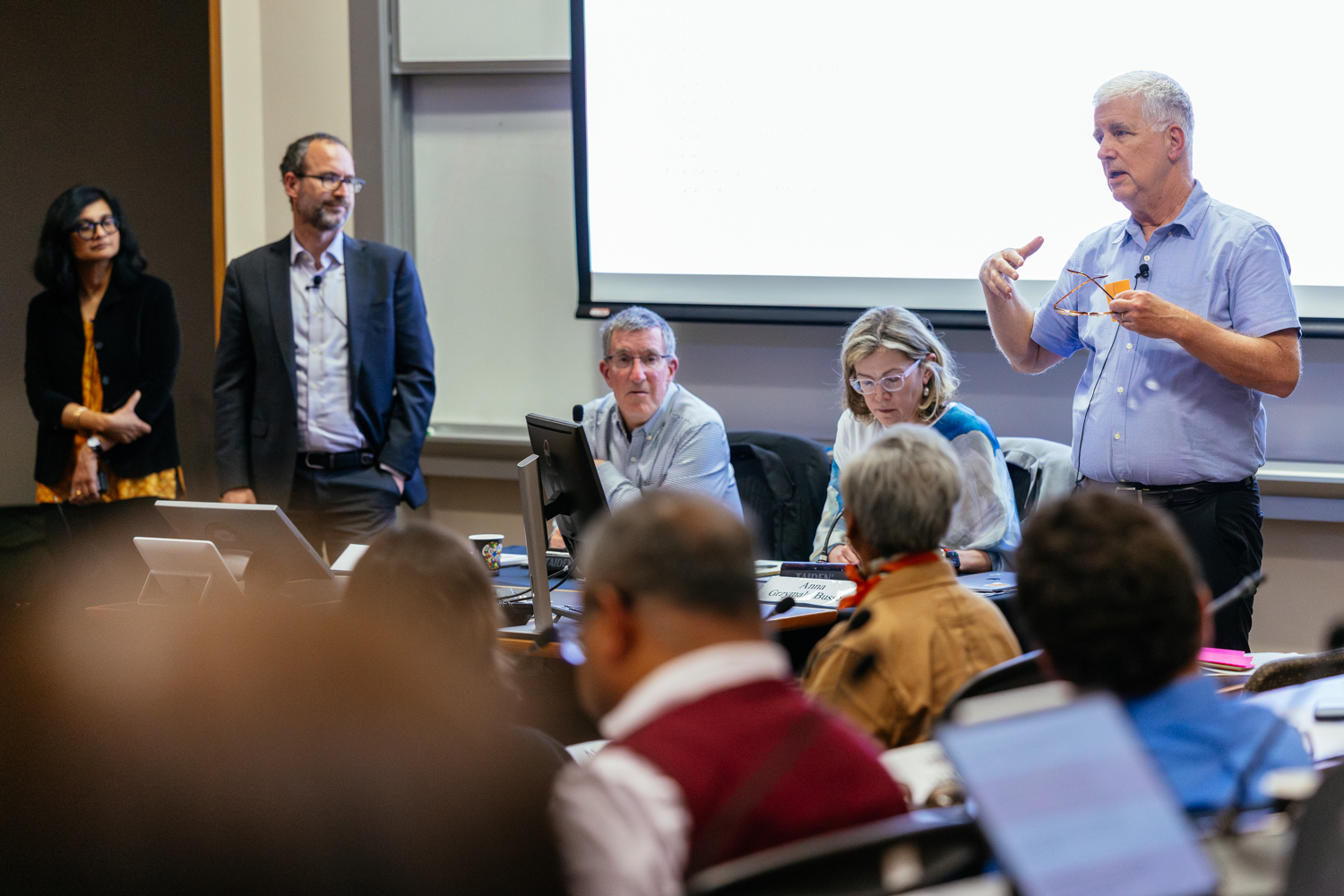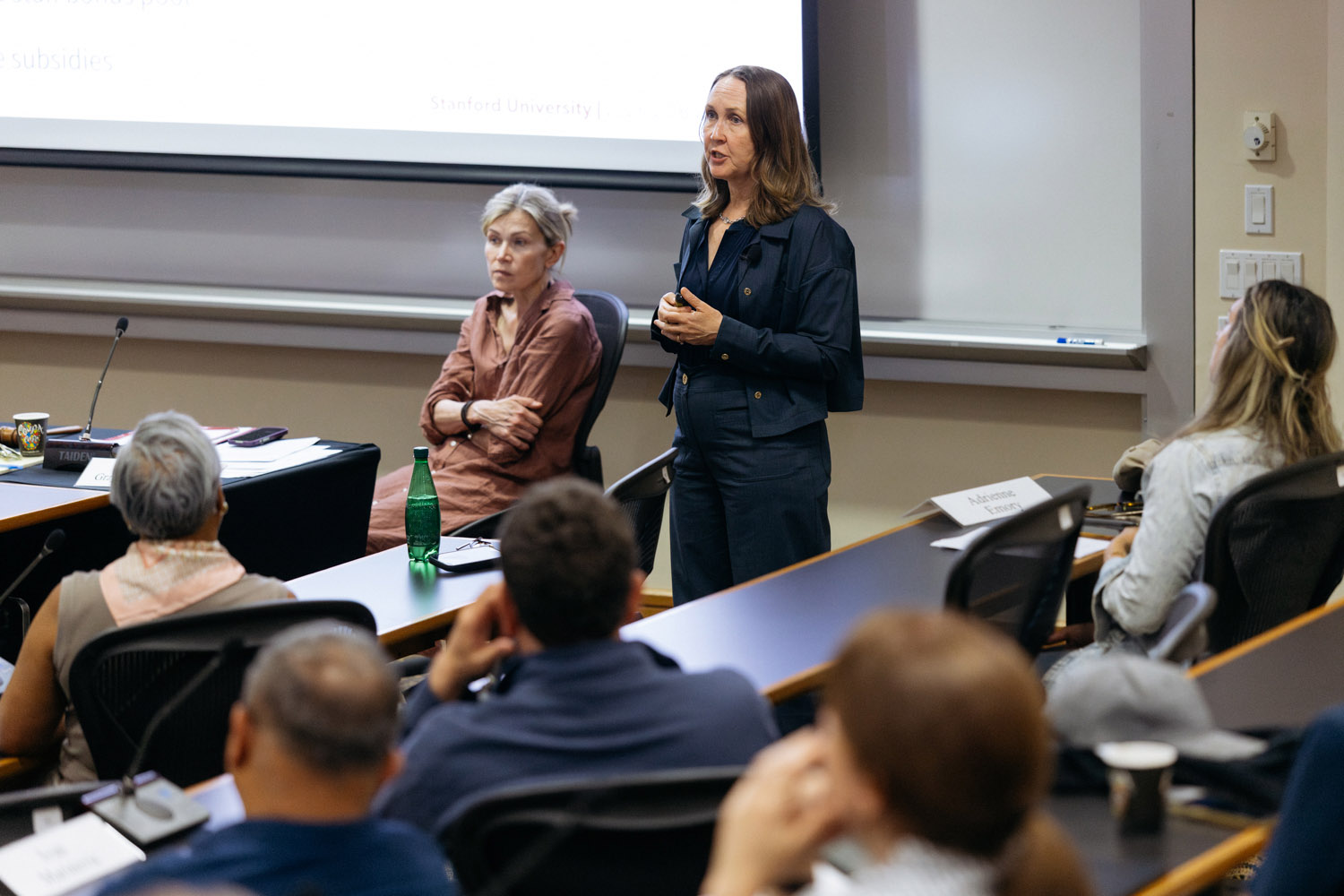
Stanford’s 2026-27 budget plan emphasizes disciplined and strategic investment in the university’s faculty, students, and staff, Provost Jenny Martinez said during the annual budget presentation to the Faculty Senate on Thursday.
“While there are still a great number of uncertainties and pressures on our budget, we find ourselves in a much more stable position where we aren’t contemplating further budget cuts [for FY27] at this time,” Martinez said. “In that sense, we feel relatively fortunate compared to where we might have stood and also to many of our peer universities who are making budget cuts right now.”
In line with the budget’s guiding principles this year, the University Budget Group prioritized investments that support the university’s core teaching and research missions. These include:
- Targeted financial aid for middle- and lower-income undergraduate students
- Addressing urgent undergraduate housing renovations
- No increase in undergraduate tuition
- Enhanced graduate student and postdoc assistance programs
- An increase in the university tuition allowance subsidy for research assistants (RAs)
- A market-based salary program for faculty and staff
- Increased staff bonus pool
- Childcare subsidies
Among the investments, the university raised the tuition allowance subsidy for research assistants from 55% to 75%, a step Martinez tied to faculty who run labs and had told the budget group that “the cost of research was something that weighed seriously on their minds.” This subsidy will support both graduate education and faculty research and is important at a time of uncertainty in the research funding landscape.
The university kept undergraduate tuition flat, with no annual increase for next year. Total student support, which includes financial aid, is projected to increase by 3.6%. Additional money was put toward undergraduate need-based financial aid, as well as graduate student and postdoc support programs and room rate cost containment.
The market-based salary program and a larger bonus pool, Martinez said, recognized staff who “have worked especially hard over the last year, following the layoffs last summer,” by rewarding “high performers with bonuses.” A competitive salary program for faculty will also help Stanford recruit and retain leading faculty. Increased subsidies for campus childcare will benefit staff, faculty, and students.
In addition, the budget emphasizes rigorous efforts around efficiency and simplification. The Simplify Work at Stanford website details efforts to make administrative processes more efficient. For the foreseeable future, the university plans to maintain the current staff hiring freeze for positions on general funds. Martinez said that staff headcount in administrative and auxiliary units has declined 7.4% since August 2024.
The budget plan was developed following last year’s federal legislation increasing the endowment excise tax, which is estimated to have an average annual impact of $250 million on investment returns and to reduce endowment payouts that support Stanford’s key missions. The endowment tax necessitated the budget cuts and layoffs that were implemented in the summer of 2025.
The budget
The budget plan projects $10.8 billion in revenue, a 3% annual increase, and $10.4 billion in expenses, a 4.9% increase.
Total revenues are increasing at a lower percentage rate than expenses, Martinez noted, which poses a long-term problem driven by factors such as increasing labor and healthcare costs. Higher compensation costs were driven in significant part by the fringe rate, which covers the cost of employee benefits, and the increased cost of health insurance. The university has also had to provide significant subsidies for student health insurance plans for the last two years to mitigate the impact of premium increases.
Federal research awards to Stanford are down slightly from last year, but still up from two years ago. Non-federal research activity is experiencing robust growth, stemming primarily from clinical research trials and faculty ingenuity and entrepreneurship, Martinez explained.
“For the first time in Stanford’s history, we’re heading to a place where non-federal sponsored research will be a larger portion of the budget than federally sponsored research,” Martinez said.
Martinez noted that the overall numbers don’t reflect the uneven nature of research funding cuts, with some areas more dramatically impacted.
Strong endowment returns last year combined with the smoothing formula, which dampens volatility of the endowment payout, helped “metabolize” the impact of the endowment tax increase. Rather than taking a large set of additional cuts as the tax goes into effect, in the years ahead the tax will likely be felt primarily through slower growth in endowment payout, Martinez said. Stanford had to reduce the payout rate to account for the tax, which will have a substantial long-term impact. However, last summer’s budget cuts already planned for this, putting the university in a position of greater stability this year. Next year’s budget plan allocates additional money to schools and academic units for endowed faculty chairs, graduate student fellowships, and postdoc salaries, to help make up for the slower payout growth.
Capital expenditures include infrastructure renewal projects such as electrical reliability improvements, campus maintenance, and digital infrastructure modernization. Addressing the university’s aging infrastructure is among the pressing future needs that will continue to place pressure on the general funds in the coming years, Martinez said, and the university is beginning to set aside the necessary money for these long-term needs.
Other items
Stephen Monismith, the Obayashi Professor in the School of Engineering and professor of oceans in the Stanford Doerr School of Sustainability, asked President Jonathan Levin about the university’s response to the Office of Management and Budget’s proposed rule regarding political oversight of scientific grants.
Levin said there are elements of the proposal that would be “really concerning and problematic long term for the science enterprise of this country,” most significantly by weakening the scientific grant review process – the cornerstone of federal funding since WWII – and giving political appointees greater control over funding allocation.
Stanford intends to submit a response outlining major concerns, and Vice Provost and Dean of Research David Studdert said Stanford has convened a working group of senior faculty and technical experts to prepare a draft. To avoid confusion, Levin and Studdert encouraged faculty submitting their own responses to clarify that they are writing as individuals, not on behalf of the university.
Faculty Senate Chair Anna Grzymala-Busse, the Michelle and Kevin Douglas Professor in International Studies in the School of Humanities and Sciences and senior fellow at the Freeman Spogli Institute for International Studies, announced Dustin Schroeder as next year’s chair and Alyce Adams as vice chair.
Schroeder is an associate professor of geophysics and of electrical engineering, and a senior fellow at the Woods Institute for the Environment; Adams is the Stanford Medicine Innovation Professor and a professor of epidemiology and population health and of health policy.
Schroeder shared a light-hearted tribute to Grzymala-Busse, and senators gave her a standing ovation in recognition of her work as chair.
In memory
The senate also heard three memorial resolutions.
Kenneth Fields, professor emeritus of English and creative writing, died Dec. 6, 2023, at age 84. Fields was an acclaimed poet and one of Stanford’s longest-serving faculty members.
Jorge Ruffinelli, professor emeritus of Iberian and Latin American cultures, was a leading authority on Latin American cinema. He died Feb. 4, 2026, at age 82.
Krishna Shenoy, the Hong Seh and Vivian W.M. Lim Professor in the School of Engineering, a professor of electrical engineering, and, by courtesy, of bioengineering, of neurobiology, and of neurosurgery, died Jan. 21, 2023, at age 54. Shenoy was a pioneer of neuroprosthetics and how the brain creates movement in the rest of the body.
Writer
Chelcey Adami