The Martin Luther King, Jr. Research and Education Institute opened Tuesday in its new home on Stanford’s Main Quad, marking a historic moment for generations of scholars who have preserved and shared King’s work.
The institute has digitized King’s writings, including his most significant correspondences, sermons, speeches, published writings, and unpublished manuscripts, all of which will be available to the public through a new, searchable online database supported by a gift from alumnus and Snapchat co-founder Evan Spiegel, ’12, and his family.
“[Stanford’s] mission is the preservation and dissemination and the application of knowledge, and the King Institute does all of those things in a very powerful way,” said President Jonathan Levin at an event at Memorial Church Tuesday to celebrate and discuss the institute’s new home and King’s legacy.
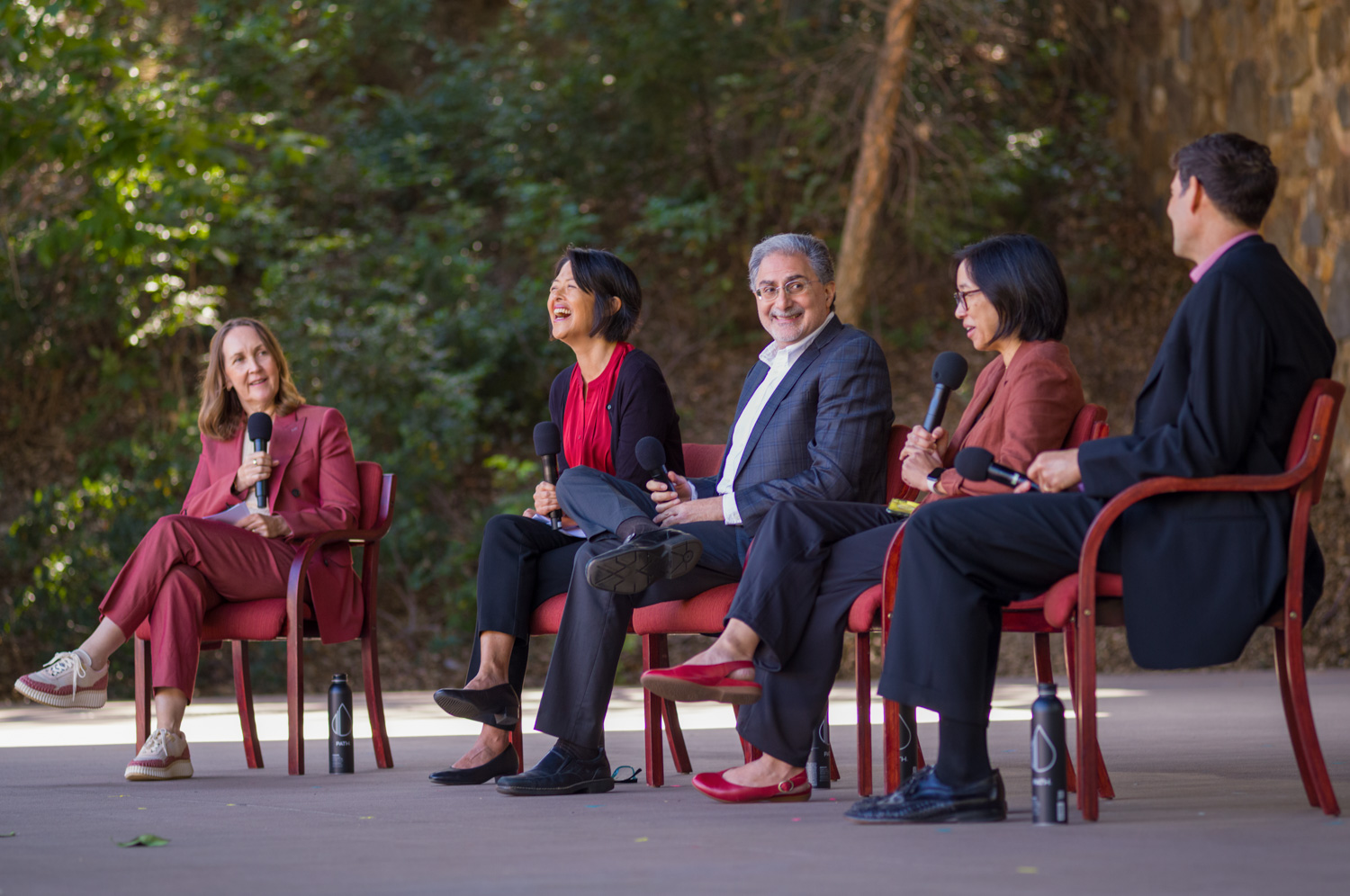
An estimated 500 to 600 members of the campus community and the public gathered at Memorial Church for a panel discussion with King’s son, Martin Luther King III; daughter-in-law Arndrea Waters King; alumnus Marina Limon, ’25; and Spiegel. The discussion was moderated by Lerone Martin, Martin Luther King, Jr. Centennial Professor and professor of religious studies and of African and African American Studies, and director of the institute.
The discussion was followed by a reception and tour of the institute’s new home in Building 370 – a central Stanford location for scholars and visitors. The institute was formerly housed in Cypress Hall.
Honoring King’s legacy
In 1985, Corretta Scott King invited Clayborne Carson – the Martin Luther King, Jr. Centennial Professor, Emeritus – to edit and publish her late husband’s papers, known as the King Papers Project. With a gift from football star Ronnie Lott in 2005, Carson founded the institute as a base for the King Papers Project and other educational activities.
During Tuesday’s panel discussion, King III discussed his father’s legacy and the importance of preserving his works. He said the institute lays out a blueprint or framework for creating a more just, humane, and sane society. But humanity, he noted, must make the choice to implement it. “We all have free will, and that’s part of what makes this a great nation, which can and must become a greater nation.”
[Stanford’s] mission is the preservation and dissemination and the application of knowledge, and the King Institute does all of those things in a very powerful way.Jonathan LevinStanford President
He and Waters King warned against the misuse of King’s words. “We are literally at a point where the words of Martin Luther King Jr. … have been used to stand for exactly the opposite of everything that he stood and worked and died for,” said Waters King. The institute, she added, provides a “framework, not for idolizing, but for challenging us and inspiring us to live up to the ideals of Martin Luther King Jr. in our everyday lives.”
Despite his father’s prominence in American history, King III said few knew that he had a robust sense of humor, was very athletic (MLK Jr. played baseball and football), and “… that the vision that he had was inclusive for everyone, no matter who and where you were. And if we could use that model, embrace that model, we really could transform the world for all humankind.”
Waters King added that MLK Jr. was highly influenced and even mentored by his wife, Coretta Scott King, who was a prominent activist in her own right. “When he met Coretta Scott King, he wasn’t just meeting a woman, he met his match.”
Inspiring Stanford students
King and the institute have influenced and inspired generations of Stanford students, many of whom contributed to the King Papers Project. President Levin recalled that when he was an undergraduate at Stanford in the 1990s, a close friend described working at the institute as “one of the most meaningful parts of her experience at Stanford as a student.”
Limon has worked with the Institute since her frosh year and said King’s writing “completely transformed the way that I interacted with history and my understanding of King’s legacy.”
In 2023, Spiegel and his family provided a gift to Stanford to advance the institute’s mission. Spiegel said King’s ideas made him view the civil rights leader as “a founding father” who treated the nation’s founding documents as “a promissory note.”
He added that placing the institute in the center of campus ensures that as Stanford students “take all of their incredible ambition and knowledge and go out in the world to make an impact, that they meet the world with the love that King had for everybody, and really this vision and dream to uphold the founding values of our country.”
Levin closed the program by recalling King’s 1967 sermon during a visit to Stanford, where he cautioned that “time is neutral” and progress depends on the tireless efforts and persistent work of dedicated individuals. Levin said the new institute will give “generations of scholars and the public greater access to the work of Dr. King, one of the most consequential leaders in American history.”
For more information
Martin is a professor in the School of Humanities and Sciences.
Writer
Alex Kekauoha