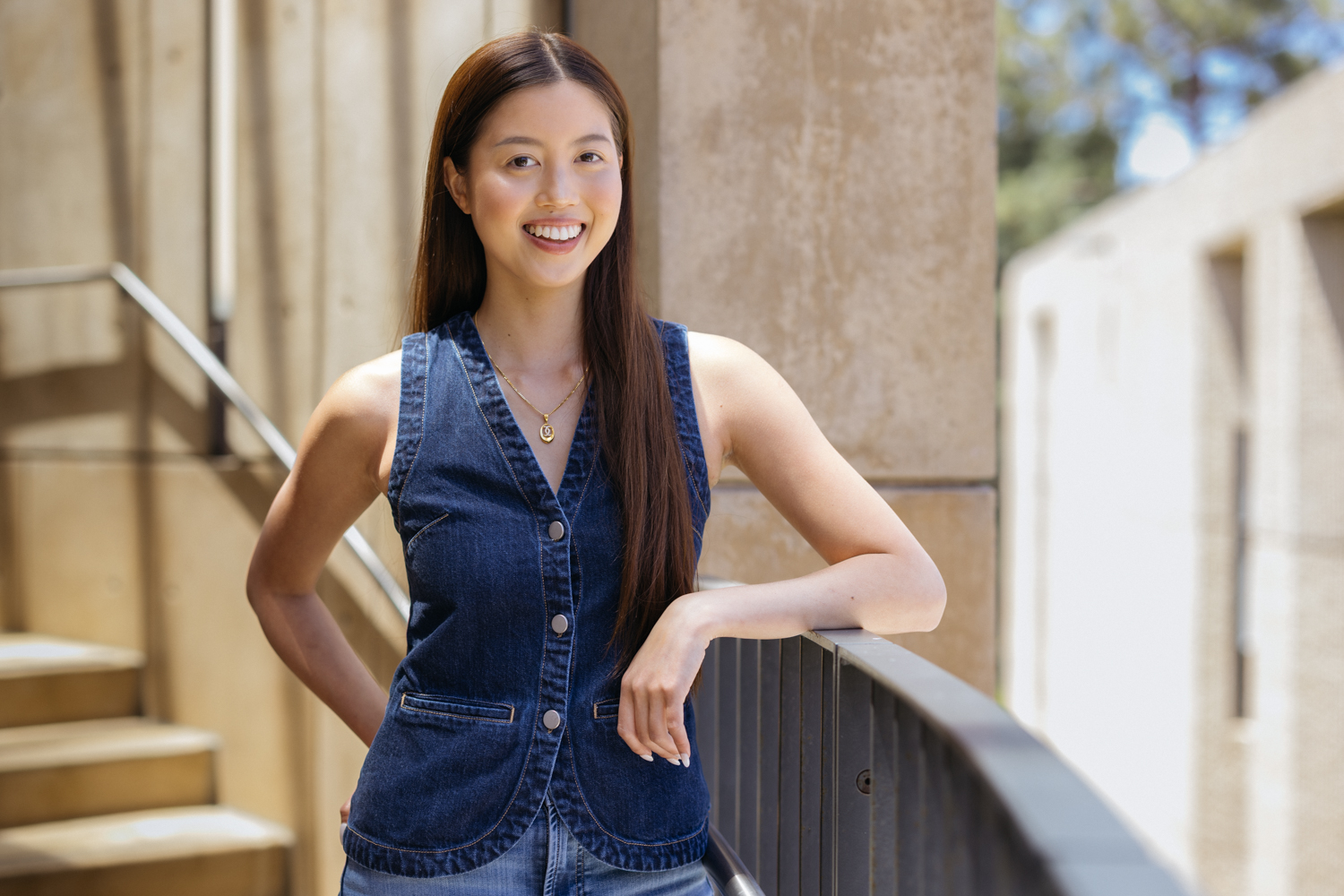
Celeste Chung, ’26, was born and raised in Sabah, Malaysia, a state on the northern tip of Borneo known for its beaches, rainforests, and wildlife. “I think it’s the most beautiful place on Earth,” she said. “But there are a lot of inequalities.”
As a child, Chung regularly saw stateless residents – people without citizenship despite being born and raised in Sabah – detained by authorities. “I grew up seeing arrests on a daily basis, and I’ve always known that I wanted to help,” she said.
Statelessness is a widespread and longstanding issue in Sabah, Chung explained, rooted in colonial-era immigration history and citizenship laws that leave tens of thousands of residents without documentation – and the right to public education.
“This creates a ripple effect, where if a stateless person can’t go to school, then their kids can’t either, and it turns into a generational cycle,” Chung said, adding that a lack of federal funding has left many schools in Sabah underresourced, leading to a high dropout rate, particularly among girls. “In Sabah, education seems very much like a privilege instead of a right.”
At 16, Chung founded a nonprofit organization called You For The Future, which builds community learning centers, or CLCs, for stateless children to learn basic subjects, like math, and business skills. The organization also hires and mentors teachers – also without citizenship – to launch their own CLCs.
“We’re creating a circular economy, in a sense, where these stateless individuals are able to sustain their own education without needing to rely on charities,” she said.
While attending a British high school in Malaysia, Chung worked with the United Nations program Girl Up, which expands skills and opportunities for girls globally. She also advised ambassadors from the European Union and the Association of Southeast Asian Nations (ASEAN) on policy matters related to Malaysian youth. For college, she set her sights abroad. “I knew the U.S. was the best option for me because I would be able to explore,” she said.
‘A leader creates more leaders’
At Stanford, Chung majored in international relations. Her work on statelessness served as the foundation for her thesis, in which she argues that demographic engineering and citizenship policy in Malaysia have been used to advance an Islamic state.
She has also continued to focus on solutions to Malaysia’s citizenship and education problems. One option, she said, is for the government to issue temporary education ID cards to stateless students. Another is to expand CLCs into a long-term, sustainable model, in which stateless residents operate the centers without government or charitable support.
Chung spent the summer of 2025 working with NATO, drafting “injects,” or scenarios for wargaming trainings – a role she found through the Stanford Global Studies program. “That was very interesting and an opportunity I wouldn’t have had if it weren’t for Stanford,” she said.
She hopes to attend law school before returning to Malaysia, with the goal of one day becoming the country’s minister of education. “I truly hope Sabah gets the representation it deserves in Malaysia and that the education there improves because it’s one of the biggest challenges the country needs to address,” she said.
She’s currently developing a scholarship program for Sabahan students to pursue education and careers, as a way of paying forward the opportunities she had at Stanford.
“A leader creates more leaders, and that’s what I want to do for the people of Malaysia,” she said.
Writer
Alex Kekauoha