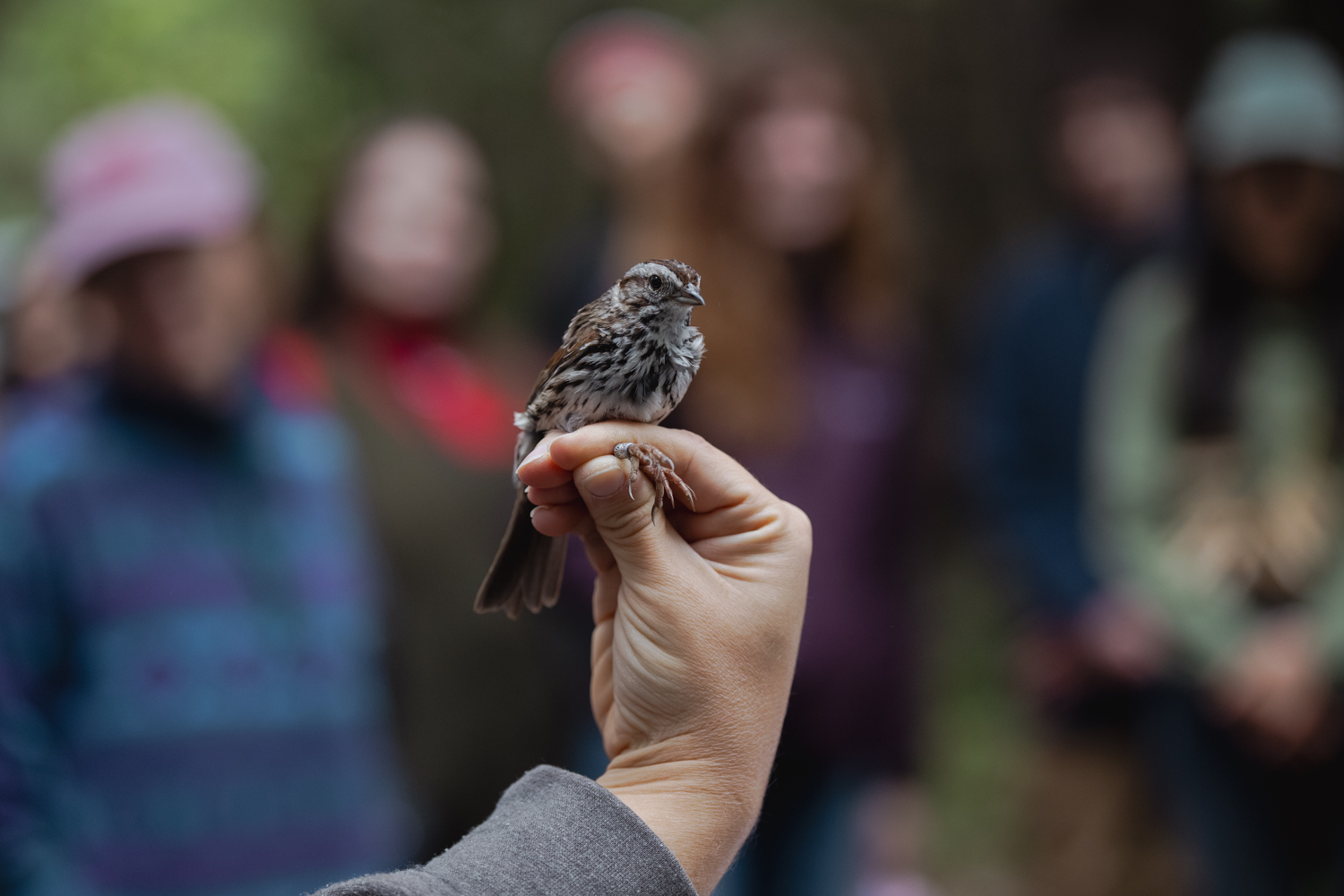
On a foggy May morning at Jasper Ridge Biological Preserve ('Ootchamin 'Ooyakma), the early birds got the birds. The early birds in this case were Stanford students in ecologist Rodolfo Dirzo’s ornithology course. These students traipsed through the muddy forests at dawn in the hopes of catching birds for an ongoing monitoring project with the San Francisco Bay Bird Observatory (SFBBO).
“We’re going to be catching some wonderful neodinosaurs today,” said Rodolfo Dirzo, the Bing Professor in Environmental Science and professor of biology in the School of Humanities and Sciences and of Earth system science in the Stanford Doerr School of Sustainability, referring to the evolutionary ties between modern birds and ancient reptiles.
The course teaches students about the ecological pressures that shaped the evolution and anatomy of today’s bird species, and by the end of it they are able to identify around 70 different birds in California. This outing was one of multiple field trips in the BIO 121/221: Ornithology course designed to bring students face-to-face with birds they’ve only seen in textbooks or nature documentaries. For some students, it may have been their first time participating in fieldwork or getting an up-close look at the creatures whose song creates the soundscape of their daily lives.
“The transformative moment that really made me fall in love with birds was when I held my first one,” said Maya Xu, a coterminal master's student in biology in Dirzo’s lab and co-instructor for the class. “There’s something so special about holding a bird in your hand that’s living and breathing and looking back at you. It creates that tangible feeling that you’re a part of nature.”
Catching birds in action
Slogging through the calf-deep mud and dense foliage of the preserve’s riparian woodland is no easy task. Unfortunately for the researchers, the birds’ most popular passageways follow streams that make the muddiest terrain. Having to unroll tall, delicate nets that snag on every tree limb adds to the difficulty of this enterprise. These nearly invisible nets gently catch and cocoon birds until handlers can extract them.
Katie LaBarbera, science director of the Landbird Program at SFBBO, likened the birds’ collisions with the nets to people encountering a sudden invisible force field on their daily commute to work.
Once the class’s nets were up, everyone returned to a dry clearing where a plastic folding table held an assortment of tools: calipers, pliers, a small scale, a laptop, and a tacklebox filled with dozens of other small accessories. Birds caught would receive a tiny silver anklet engraved with numbers, an identification band that helps the scientists recognize individual animals year after year. Recapture data from birds already sporting these silver bands provides important insight into their individual survival and population status.
Images by Andrew Brodhead except as noted.
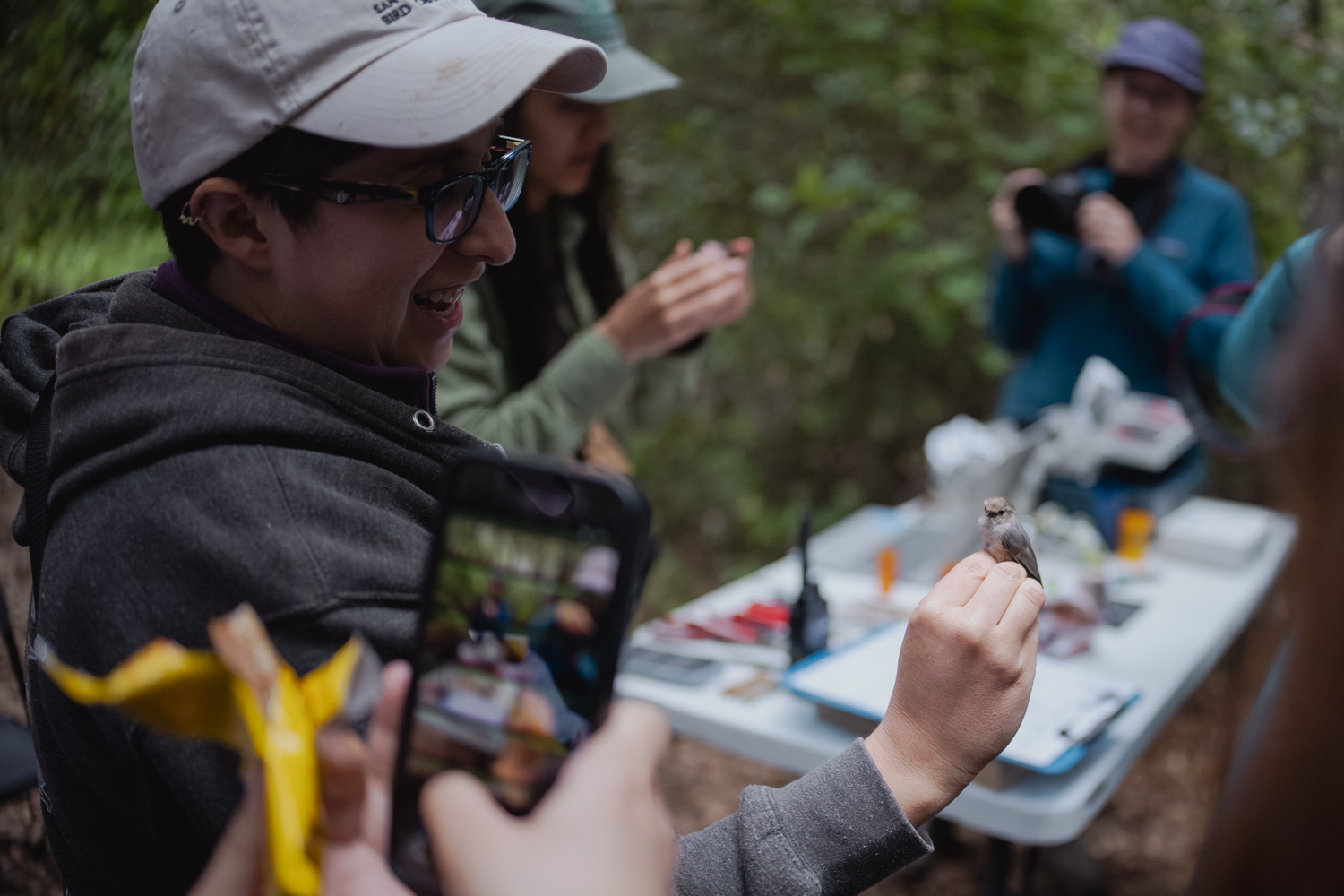
As part of a monitoring project with the San Francisco Bay Bird Observatory (SFBBO), students in the Ornithology course got to see bird banding in action – where birds are fitted with identification anklets so individuals can be studied over time. Katie LaBarbera, a science director at SFBBO, showed off one of the morning’s most special guests: a baby Bushtit.
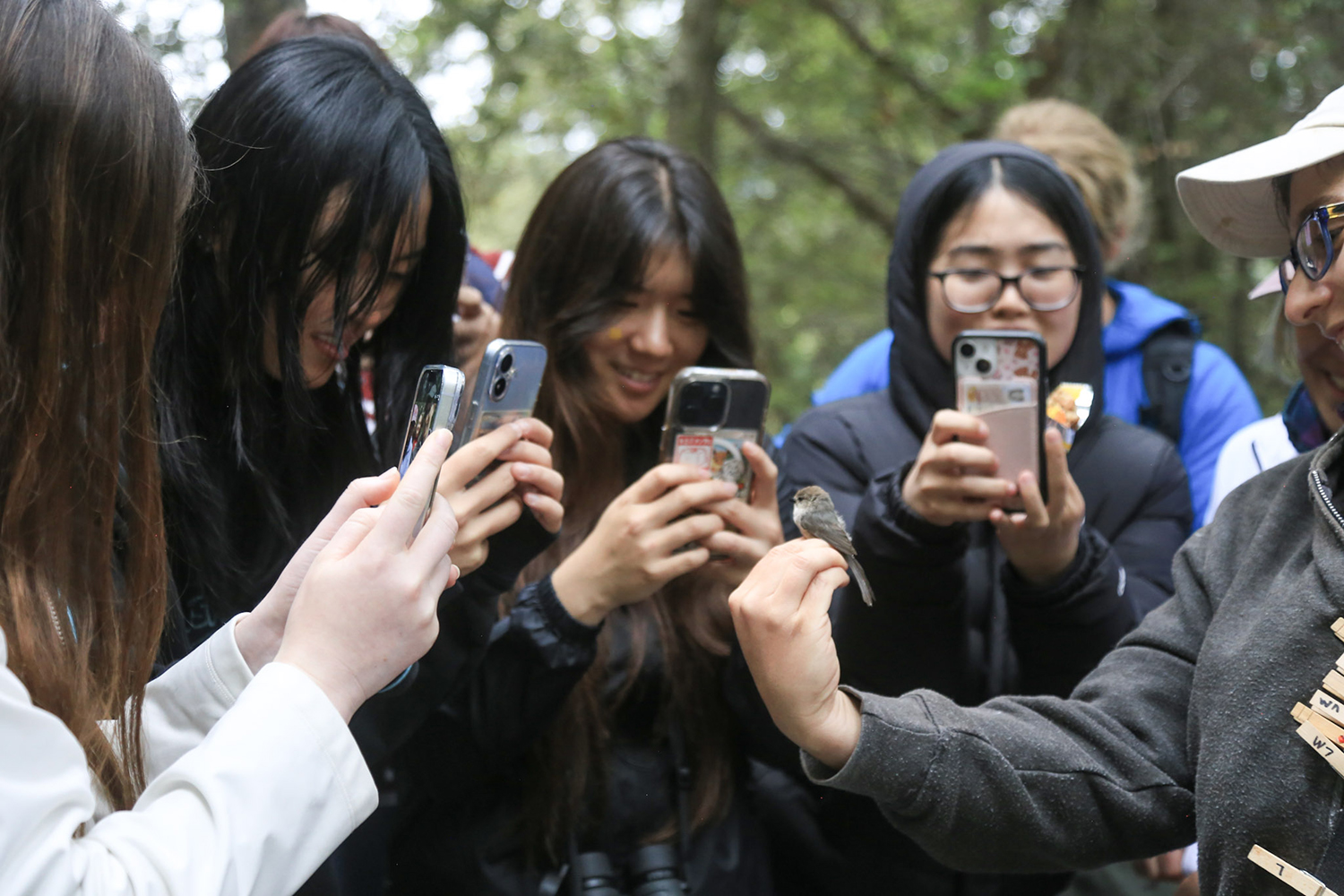
Students could hardly hold back their excitement upon seeing the baby Bushtit up close. | Kari Goodbar
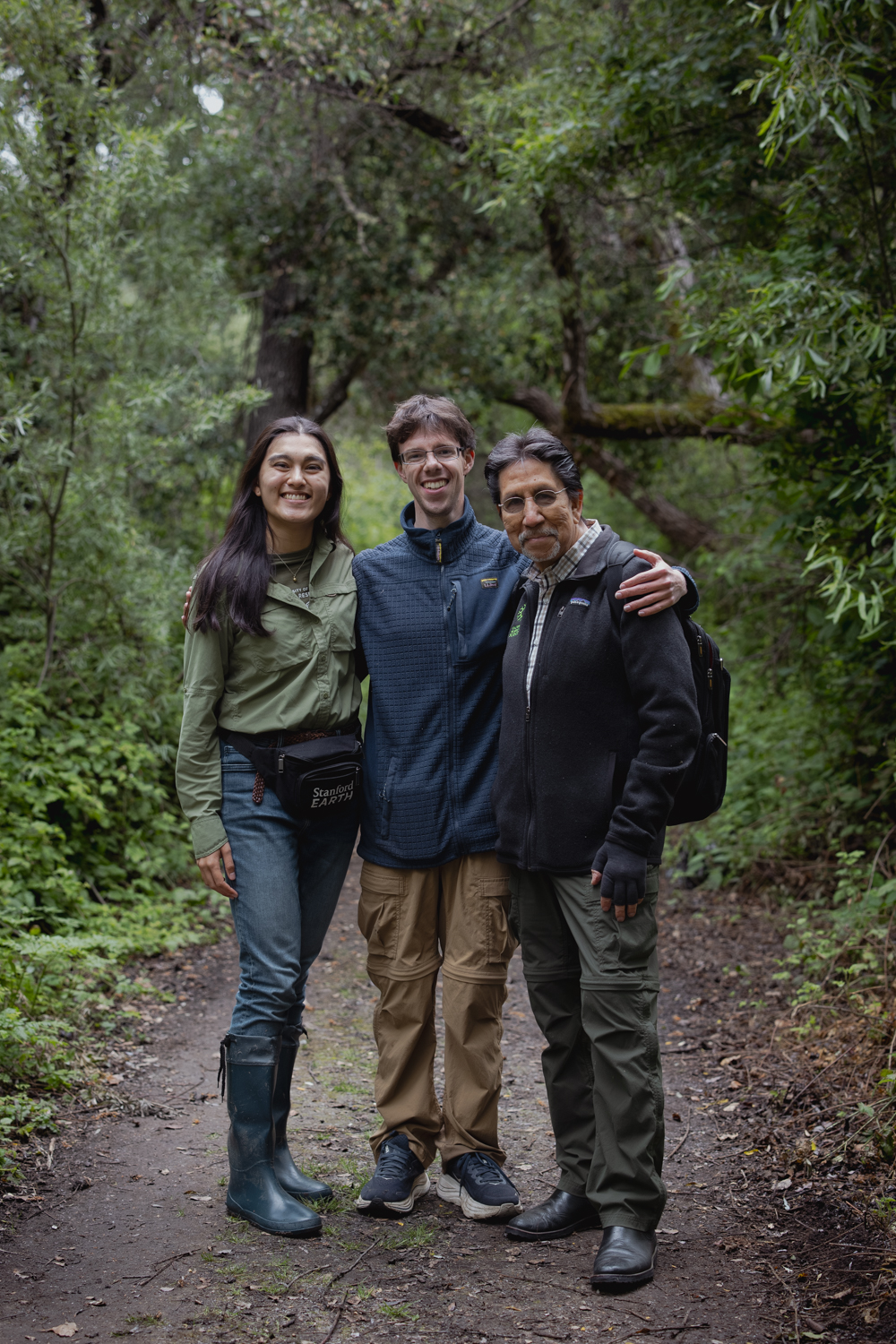
The Ornithology course instructors: Maya Xu, Marty Freeland, and Rodolfo Dirzo.
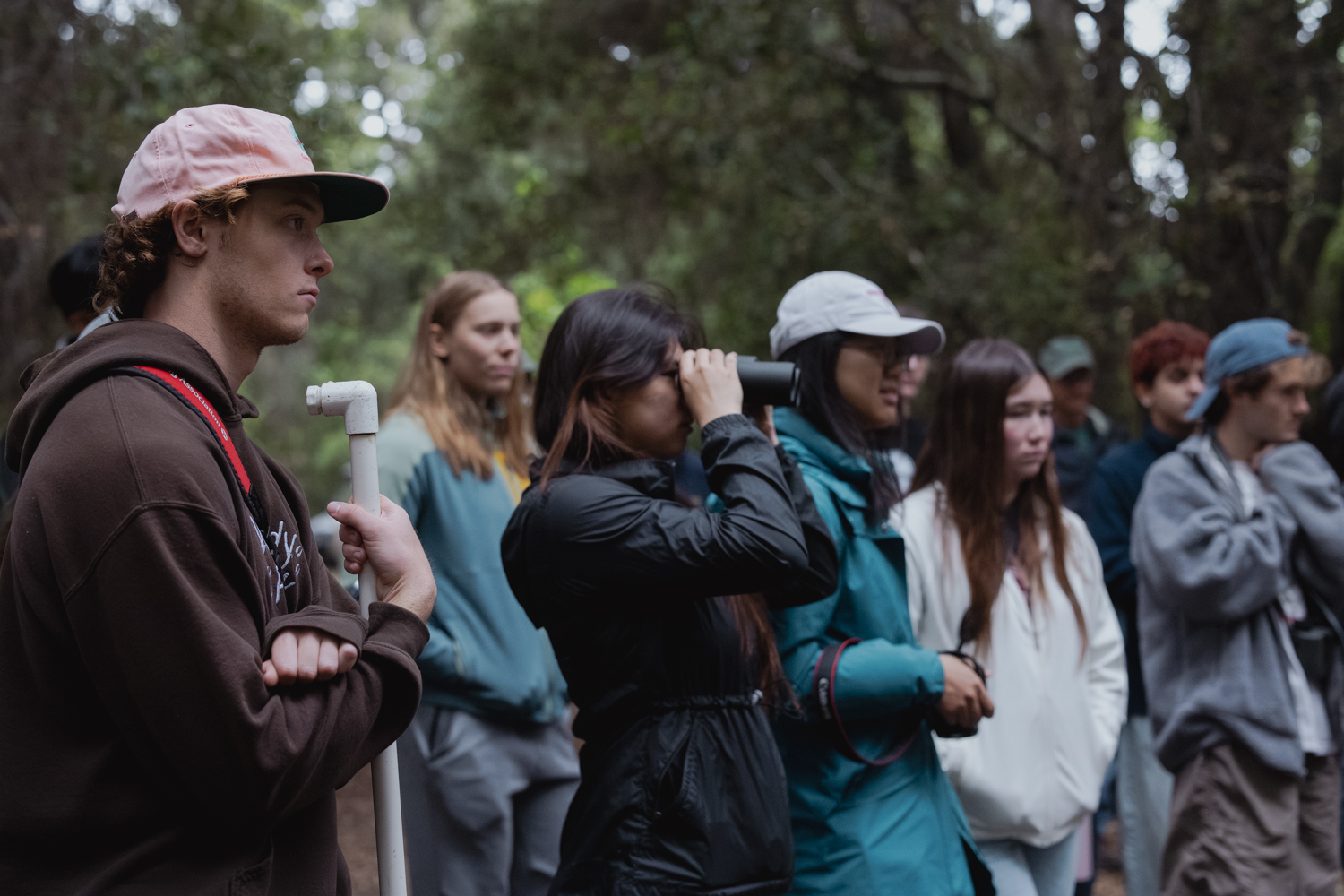
Students in the Ornithology course were up early on a soggy day to help catch birds for an ongoing monitoring project with SFBBO.
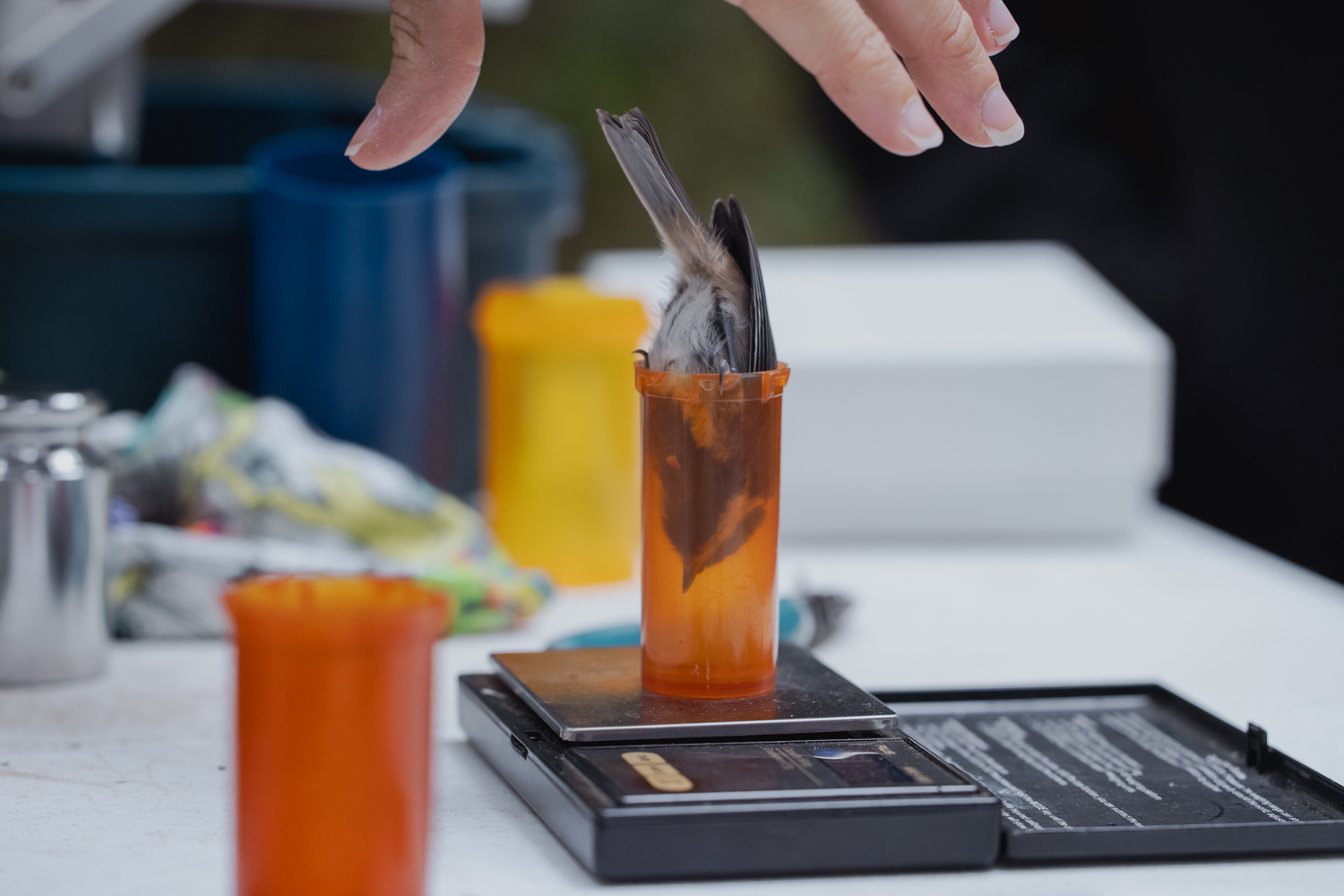
Researchers use pill bottles to keep birds safe while weighing them. This bird is a Chestnut-backed Chickadee.
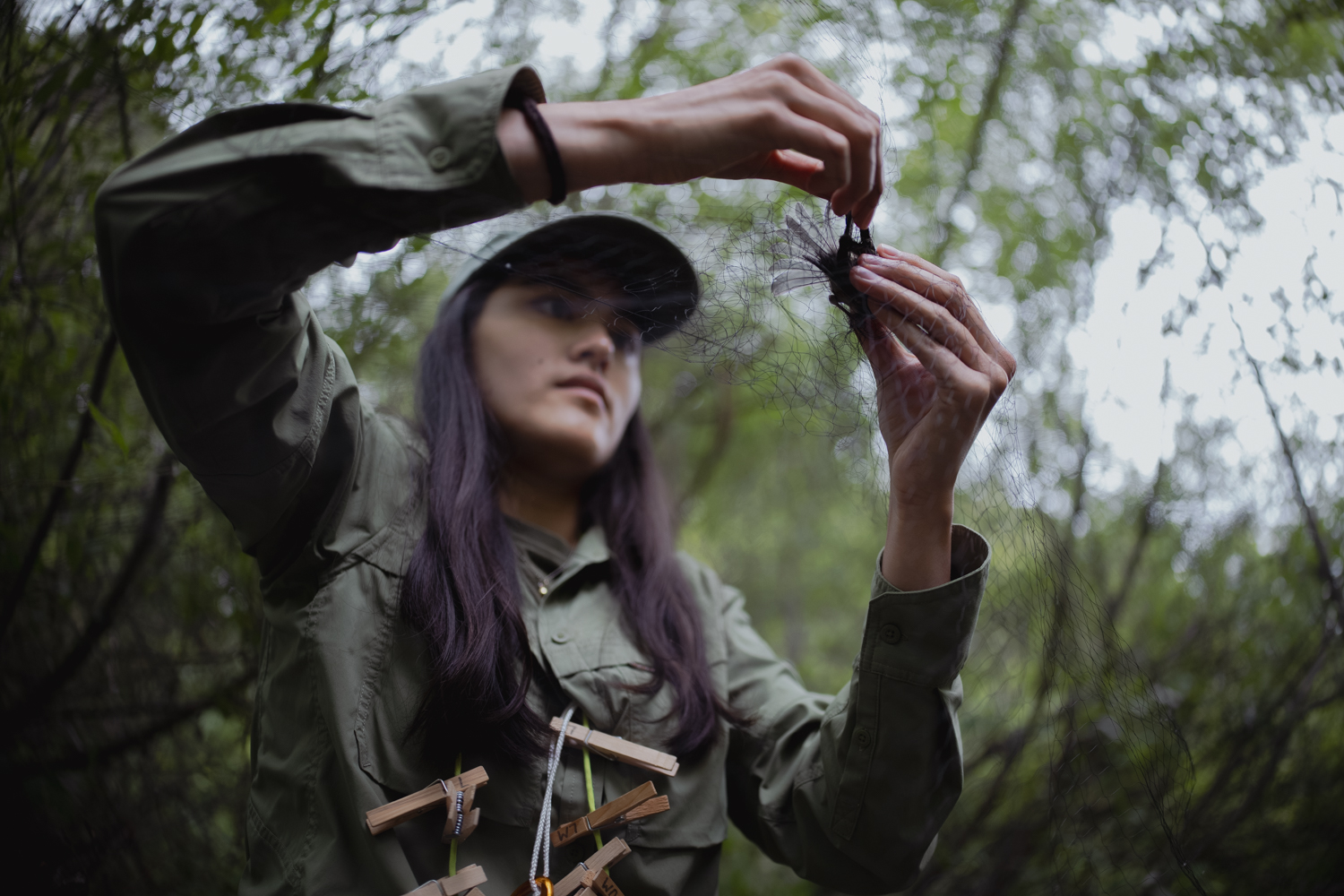
Maya Xu carefully releases a bird from the thin, gentle net that researchers use to gather birds for their monitoring project.
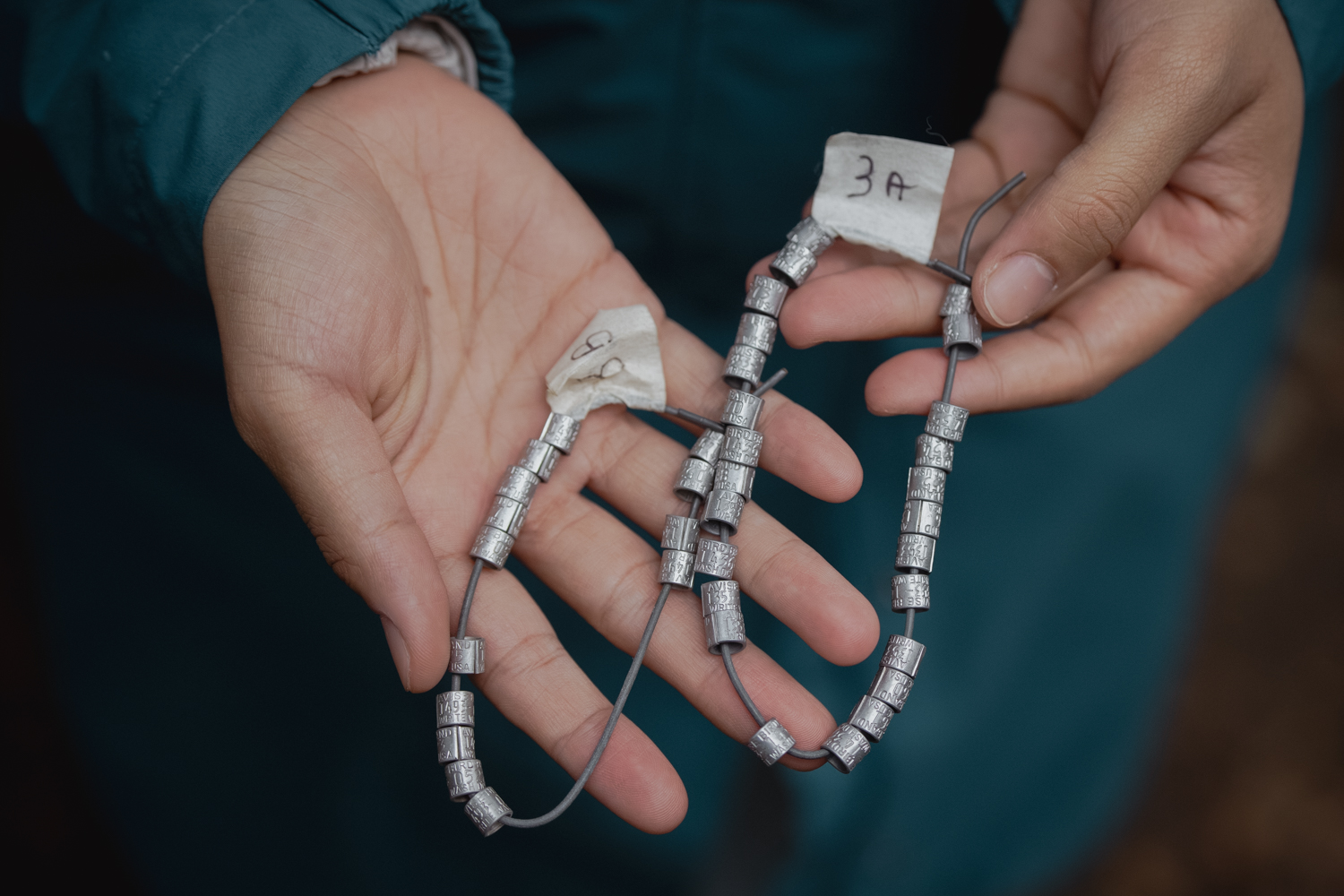
Small silver bands are designed to go around the ankles of birds. They are engraved with numbers that help scientists recognize individual animals year after year.
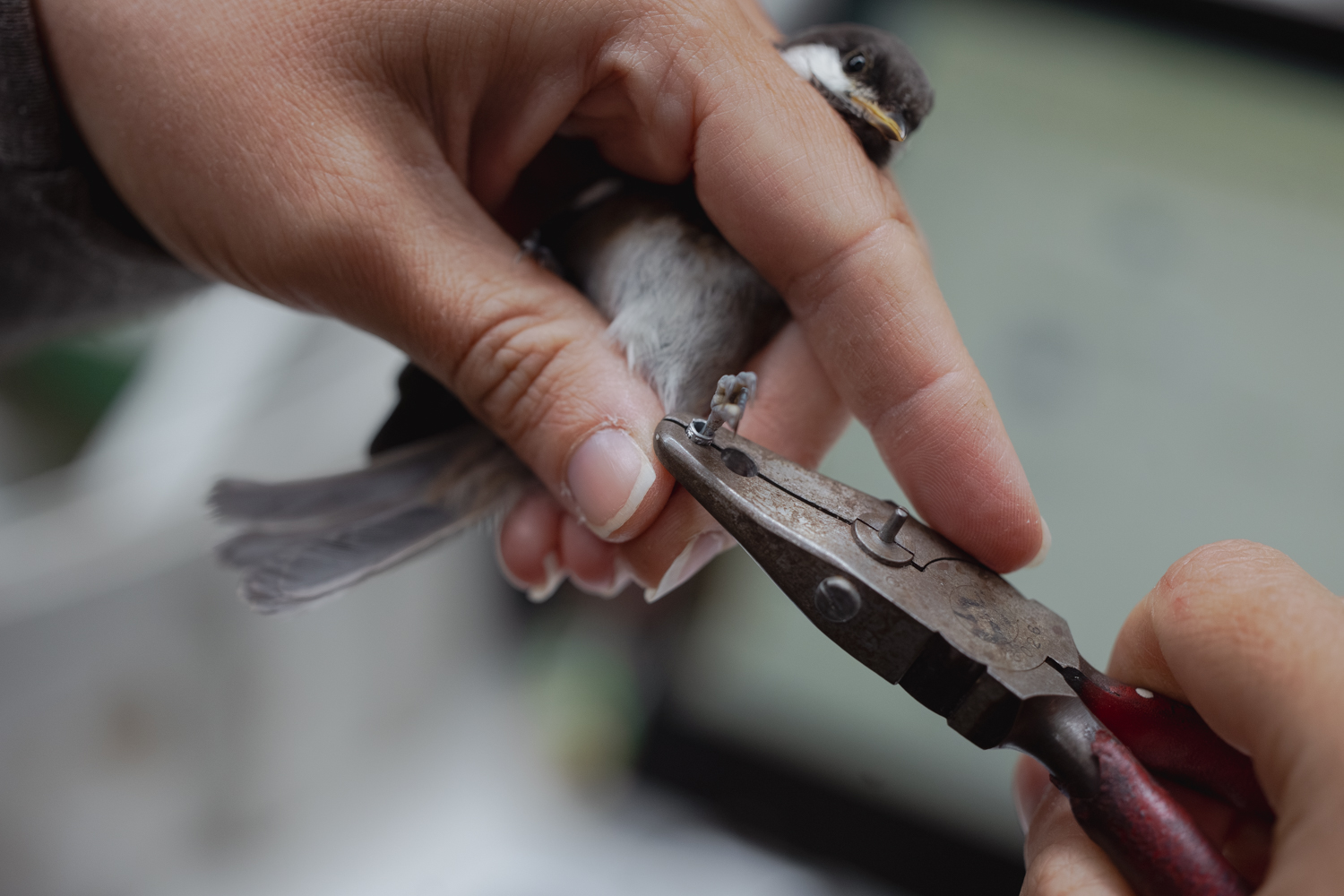
Katie LaBarbera attaches a band to a Chestnut-backed Chickadee.
In addition to monitoring resident bird species, the team hoped to intercept some migratory species on their springtime return to the Bay Area after a winter in Central America. Conservation of these migratory bird species is exceptionally tricky when they are only present a few months of the year and their habitat spans varying degrees of legal protection across continents.
Swainson’s Thrushes are a migratory bird species that, if caught, would receive more high-tech hardware. The team kept a few “bird backpacks” on hand, which are featherlight satellite tags that ping precise locations along birds’ migration route when they’re within range of a Motus tower, and help identify which habitats are the most important layover destinations for their international flights.
Birds that ended up in the nets did not quite match the team’s hopes and hypotheses, however. This sense of anticipation and waiting for the unknown is also an important lesson from the course. A willingness to endure muddy mornings and uncertain outcomes can inform the patience and curiosity required to ask deeper scientific questions about the world.
Few people demonstrate the progression from curious observer to scientific investigator better than Marty Freeland, Xu’s co-instructor. Freeland is an undergraduate student majoring in biology who has a casual encyclopedic knowledge of birds and started working in Dirzo’s lab at age 12.
“I spent a great deal of 7th and 8th grade in the Dirzo lab counting pollen grains on microscopes,” Freeland said, an effort that resulted in a peer-reviewed publication on hummingbird pollination in the Journal of Emerging Investigators.
His most recent paper, co-authored with Dirzo, Xu, and others on April 10 in Ecology and Evolution, details the first record of a Dark-sided Flycatcher in temperate North America. The fact that their instructors spotted an East Asian bird in Santa Clara County is a prime reminder for students to always expect the unexpected in their observations.
Bag, band, release, and repeat
When birds encountered the nets, Xu, Freeland, and staff from SFBBO worked with expert, gentle precision to free the little puffs of feathers and feet. They placed each bird into soft, individual cloth bags that simplify their transport, then carefully tucked these drawstring bags into their shirts to keep the birds warm until their release.
“What did you find? A toucan? An eagle?” Dirzo joked as Xu and LaBarbera returned to the banding table with chests full of bird bags.
Students watched as banders removed each bag and began assessing the bird’s age, sex, size, and body condition. If the bird showed signs of significant stress or shock, the scientists were prepared to switch to what they call a “ring and fling” approach, meaning they quickly attached the metal bands and promptly released the bird without further inspection.
“We like it when the birds bite us!” said Xu. “That means they’re still feisty and not overly stressed.”
There’s something so special about holding a bird in your hand that’s living and breathing and looking back at you. It creates that tangible feeling that you’re a part of nature.Maya Xu, MS Student in BiologyCourse Co-Instructor
Once all the measurements were complete and the band was in place, it was time to let the bird go. Xu and LaBarbera asked for release volunteers and prioritized the students who had never held a bird before. They carefully transferred the critters into the hands of the students, who audibly gasped and grinned as they walked the birds away from the group for an easy escape route.
“I’ve never experienced that ever in my life,” said Sherry Yan, a senior studying UX/UI design, after releasing one of the birds. “I’ve never even gotten close to a bird. It was very warm and soft.”
By the end of the morning, students got to see or release a total of 10 birds across three different species: one Bushtit, three Song Sparrows, and six Chestnut-backed Chickadees. The singular Bushtit and two of the Chickadees were baby birds whose tiny statures evoked squeals of delight.
“Seeing the excitement on students’ faces as they get to handle and release birds for the very first time is my favorite part of this class,” said Freeland.
Evolution of a class
This year’s class has the widest variety of prior bird experience to date, ranging from a student who banded birds in Colorado to students who had no previous interest in birds but wanted to take the same class with a friend.
“I feel like I didn’t appreciate birds as much before this class because they’re just everywhere,” said Alyssa Guo, a coterminal master’s student in biology. “But once you learn to ID them, you notice them a lot more. Now I go across campus and I see birds, and I can tell people what they are, which I think is really cool.”
James Lopez, a senior studying management science, had no experience with birds, but the popular documentary Listers: A Glimpse Into Extreme Birdwatching recently inspired him to learn more. “I didn’t realize they evolved from dinosaurs,” said Lopez. “I didn’t realize how much they tell us about evolution in general.”
Designing a course where students of all experience levels can grow in their knowledge and appreciation of birds has been a fun challenge for Xu and Freeland. They divided bird species into teaching modules that nonexperts can easily grasp. For example, Peregrine Falcons and Anna’s Hummingbirds appeared in the “acrobats” group, while Pygmy Nuthatches and Wrentits appeared in the “screaming ping-pong balls” group. Toward the end of this quarter, they planned a “choose your own adventure” module, where the students suggested and voted on topics that Xu and Freeland taught in the final weeks of the course.
“As far as I know, this is one of the only long-term advanced STEM electives at Stanford that has been exclusively student taught with an advising principal faculty,” said Xu, who is in her third year of teaching the class.
Working with Dirzo as a mentor is “just the best,” she said. “He is always so supportive and so willing to use his pedagogical knowledge to talk through ideas and help guide new modules that we want to introduce.” This year, they’ve increased their focus on class assignments that use real-time data to get students thinking about active issues in science and policy.
Xu and Freeland are carrying on the tradition of the students before them who created and grew the class under Dirzo’s mentorship. Through their time as instructors and beyond, they hope that, like the birds they study, the course can continue to evolve and address the challenges of an ever-changing world.
For more information
Dirzo is also a senior fellow at the Stanford Woods Institute for the Environment.
Writer
Kari Goodbar