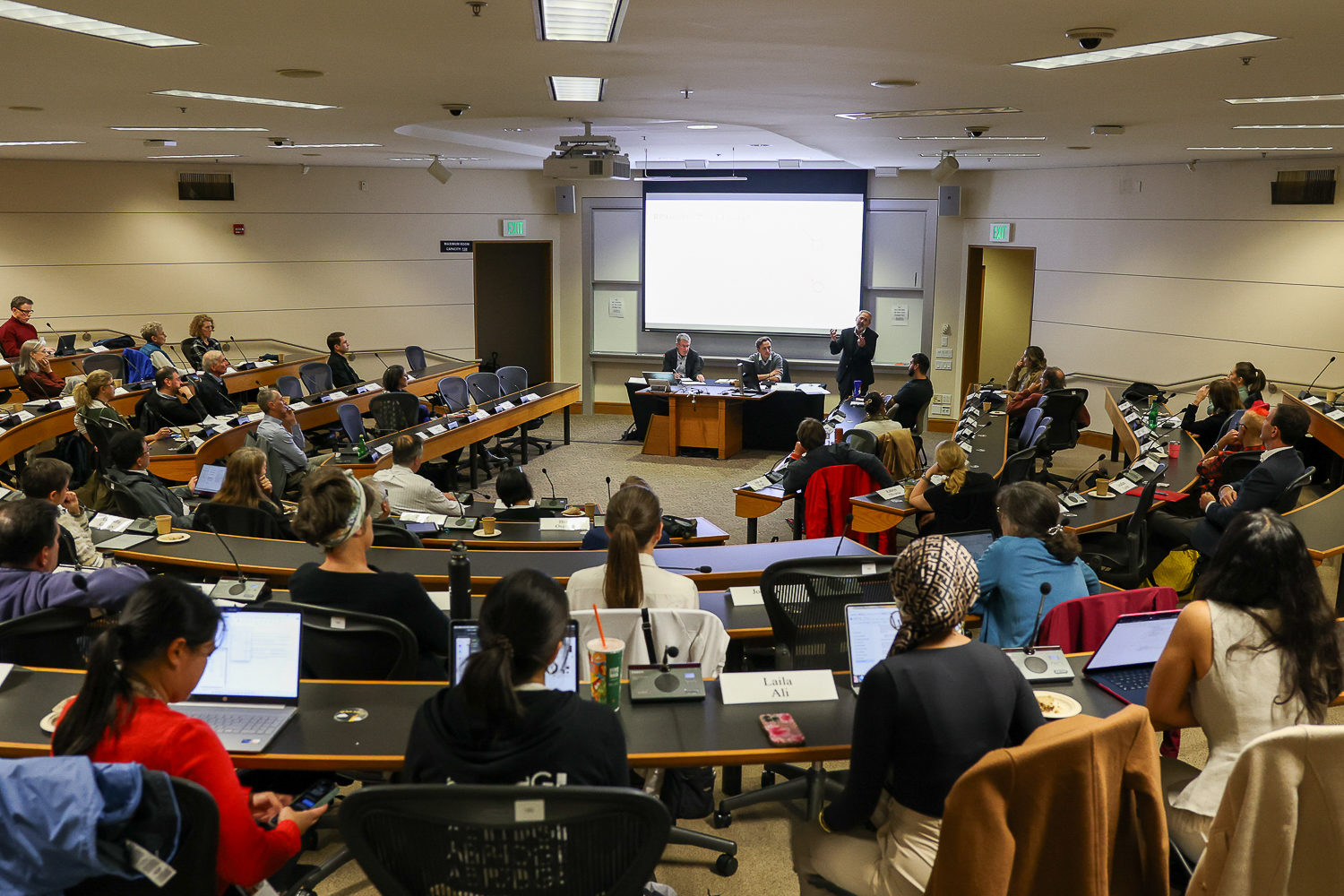
The Faculty Senate discussed the growing role of generative AI in Stanford students’ academic work during its Thursday meeting.
Survey data shows that the majority of frosh regularly use generative AI, and “they often talk about it as an intellectual sparring partner,” said Jay Hamilton, the Freeman-Thornton Chair for the Vice Provost for Undergraduate Education (VPUE).
Students most commonly report using it to understand difficult concepts, as a search tool, to generate study practice materials, to summarize or paraphrase text, to edit writing, and for research. The lowest reported use is for generating text.
At the same time, students are using faculty office hours and the Hume Center for Writing and Speaking less. In computer science courses, scores on problem sets have increased while midterm and final exam scores have declined. “This is concerning in the sense that if they were using generative AI as a study pal, they weren’t absorbing as much as they might think they did,” Hamilton said.
Students want clearer AI policies in syllabi, and Hamilton advised faculty to carefully consider and share what level of use they permit, their pedagogical reasoning behind their policy, how to cite use of AI, and examples of what’s permissible.
To meet these growing needs, VPUE has coordinated with the Center for Teaching and Learning to provide AI Meets Education at Stanford (AIMES), which offers resources such as a guide for students, professional development for instructors new to AI, a library of examples of AI course policies and assignments, and an overview of AI teaching strategies.
Hamilton encouraged department-wide discussions of AI use and underscored that faculty need to understand AI to best prepare students for a workplace where they will need to know how to write or code with the assistance of AI. “I also believe – and this is an assumption – that students need to learn to write and code unaided, to develop critical thinking skills, their agency as citizens, and also meaning – making the ideas that help them understand their own lives,” Hamilton said.
Patricia Burchat, the Gabilan Professor and professor of physics in the School of Humanities and Sciences (H&S), noted that lecture attendance is also down. She urged faculty to make lectures something students genuinely want to show up for. One way to do that, she said, is to reset classroom norms so that students know that phones and laptops are expected to be closed or out of sight when class is in session.
Some senators expressed concerns about how AI use is impacting students’ mental health in addition to their ability to learn. While a few senators suggested more one-on-one time with students can help address these needs, others said budget constraints would make that difficult.
William Barnett, the Thomas M. Siebel Professor in Business Leadership at Stanford Graduate School of Business, professor of environmental social sciences at the Stanford Doerr School of Sustainability, and senior fellow at the Woods Institute for the Environment, said Stanford students are often very competitive and it’s important for the university to support them in this rapidly changing environment. “It’s up to us to create the constraints so that competition leads to the healthy behaviors that make them better educated people by the time they get out,” Barnett said.
Keith Winstein, associate professor of computer science and, by courtesy, of electrical engineering in the School of Engineering, noted that the ethical challenges of AI use extend far beyond undergraduate education. “We are dealing with this at every level of society,” he said.
James Landay, the Anad Rajaraman and Venky Harinarayan Professor and professor of computer science in the School of Engineering, and Denning Co-Director and senior fellow at the Stanford Institute for Human-Centered AI, said many faculty are making small changes in hopes of continuing with the way they have previously taught.
“We actually have to see this problem less as a problem and more as an opportunity,” Landay said. “How can Stanford lead in rethinking how we teach, how we learn … and have our students be benefiting and being the leading edge of that?”
Renewing public support
The Faculty Task Force on Renewing Public Support for Universities shared a brief introduction to its work, which is to develop strategies to strengthen public understanding and support for higher education and Stanford in particular.
The task force will begin by seeking to understand reasons behind the decline in public confidence in higher education, said Task Force Co-chair Kathryn “Kam” Moler, vice president of the SLAC National Accelerator Laboratory, the Marvin Chodorow Professor and professor of applied physics and of physics in H&S, and of energy science and engineering in the Doerr School of Sustainability. “I think it is appropriate for all of us to reflect on what is our public value as a university and to reflect on that with some degree of confidence, but also some degree of humility,” she said.
The task force will also identify opportunities to communicate and advance the university’s education and research missions, explore long-term processes for reflection, and potentially develop resources for Stanford and other universities. It is also considering spring convenings focused on timely policy issues such as challenges and opportunities in research funding; the role of international students at U.S. universities; access and affordability; and perceptions of political polarization at universities.
The task force invites faculty to share their thoughts, said Task Force Co-chair Brandice Canes-Wrone, professor of political science in H&S, the Maurice R. Greenberg Senior Fellow at the Hoover Institution, and professor, by courtesy, of political economy at the Graduate School of Business.
“We want to support faculty outreach and messaging … and then potentially identify university strategies that could help with this,” Canes-Wrone said.
Alyce Adams, Stanford Medicine Innovation Professor and professor of epidemiology and population health and of health policy, spoke in favor of highlighting the university’s years of work with outside communities. “Researchers and faculty may not be the best voices to convince anyone else of our best value,” Adams said. “The best sort of voices for that are going to be public community partners who’ve worked with us, who appreciate what we’re doing.”
David Palumbo-Liu, the Louise Hewlett Nixon Professor and professor of comparative literature and, by courtesy, of English in H&S, emphasized that it’s important for this work to focus on matters that the general public cares about. “They’re talking about – as they say in politics – bread-and-butter issues,” he said. “What is the university doing to educate their children?”
Debra Satz, the Vernon R. and Lysbeth Warren Anderson Dean of the School of the Humanities and Sciences, agreed: “We tend to be in a bubble, and we just have to make sure whatever we’re doing, we’re not just talking to ourselves and each other, but we’re actually getting input from people who really have different perspectives than we do.”
In memory
Senators heard a memorial resolution for Ronald “Ron” Lyon, professor emeritus of applied Earth sciences, who died at age 95 on Jan. 17, 2023. Lyon was a geologist and pioneer of geological remote sensing, using satellites to study mineral formations on Earth, the moon, and Mars.
For more information
Hamilton is the Hearst Professor and professor of communication in the School of Humanities and Sciences (H&S) and a senior fellow at the Stanford Institute for Economic Policy Research. Satz is the Marta Sutton Weeks Professor in Ethics in Society and professor of philosophy and, by courtesy, of political science in H&S.
Writer
Chelcey Adami