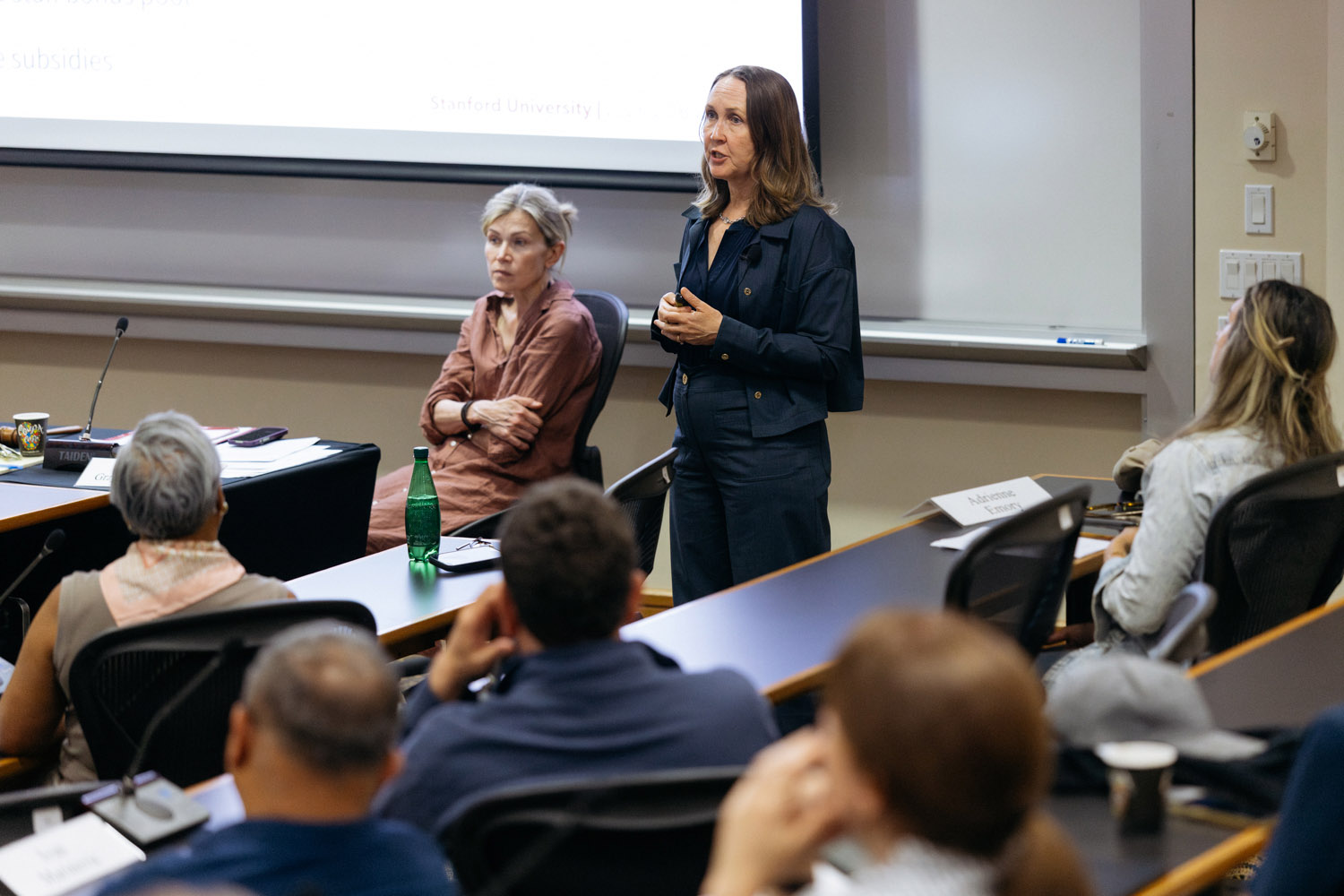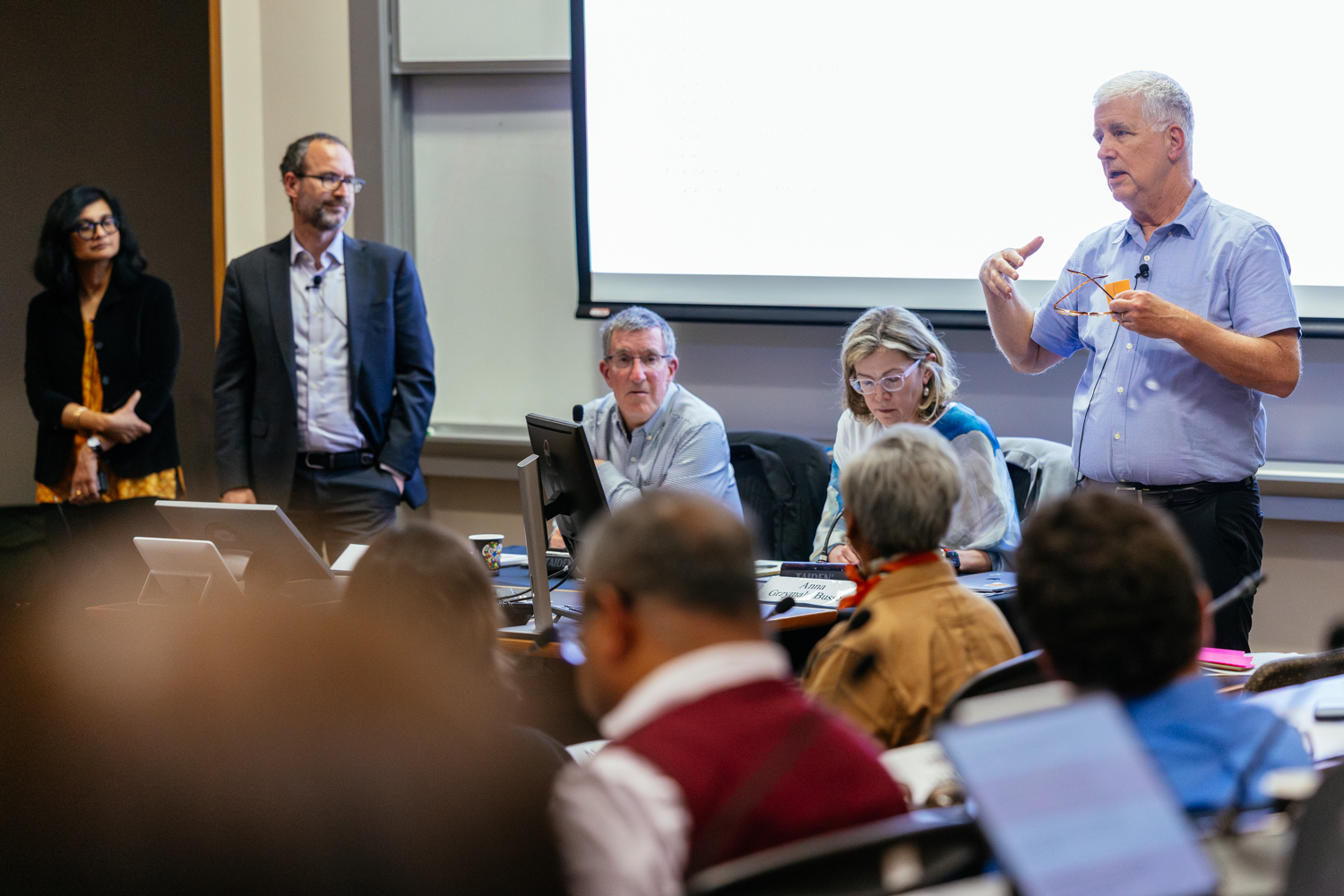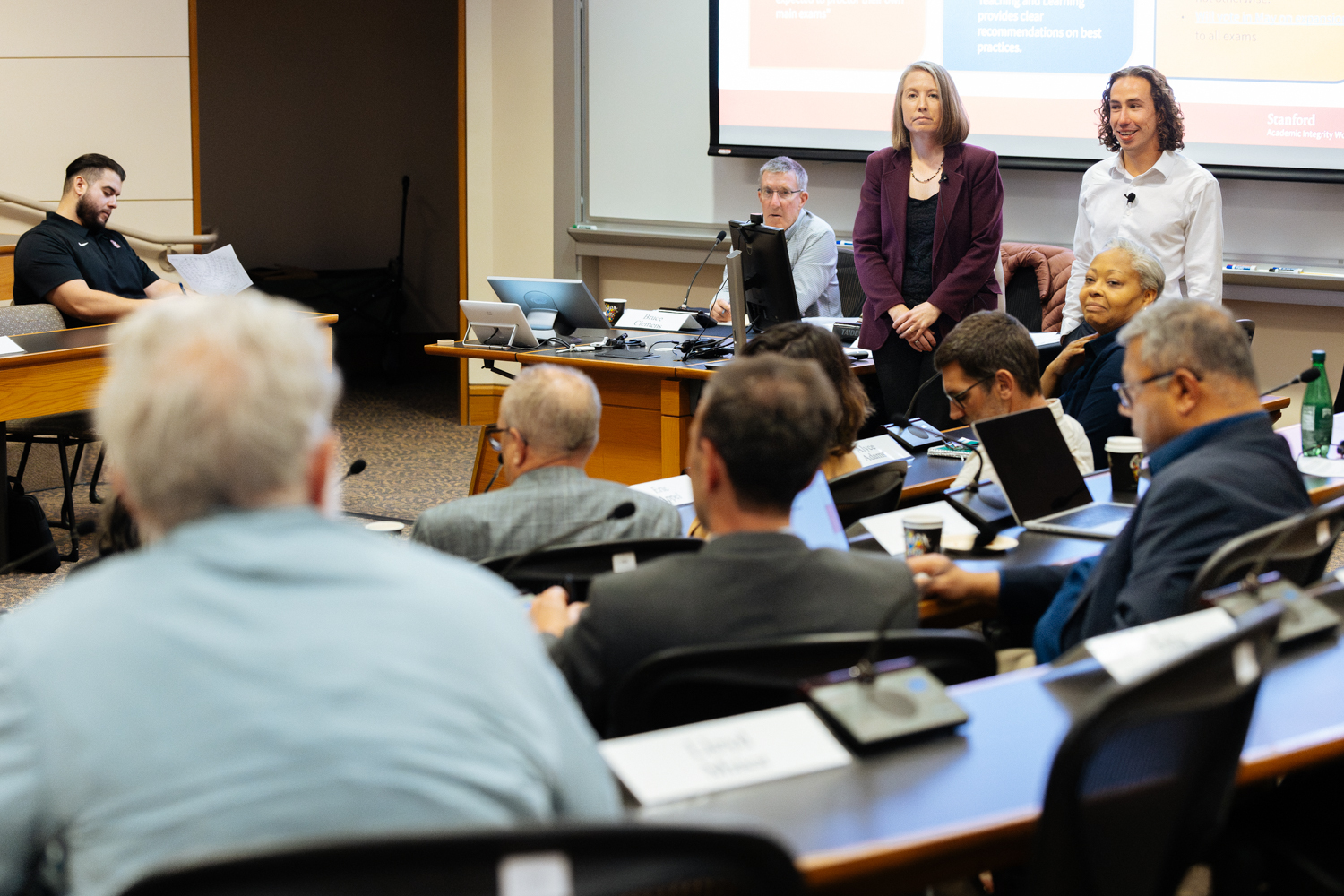
The Faculty Senate unanimously voted to permit proctoring of in-person assessments following a presentation from the Academic Integrity Working Group (AIWG) on Thursday.
Formed in 2024 after updates to the Honor Code and Fundamental Standard, the AIWG was charged with studying the scope of academic dishonesty at Stanford and overseeing a multi-year proctoring pilot study, which launched the same year. Historically, proctoring was not permitted at Stanford; students were expected to report peers for academic misconduct.
“What we’re finding is that a lot of the expectations we might be putting on our students is creating an unsustainable moral burden on them,” in which students must choose to cheat to keep up or report their peers, said Jennifer Schwartz Poehlmann, AIWG co-chair and senior lecturer in chemistry.
During the pilot, instructors reported that it helped them better assess students’ learning goals, clarified academic integrity standards, and reduced student frustration, said AIWG Student co-Chair Xavier Millan, ’26, an undergraduate in computer science.
The proctoring policy was previously passed by the AIWG, the Board on Conduct Affairs, the Undergraduate Senate, and the Graduate Student Council.
Poehlmann and Millan highlighted some of the student feedback that showed support for proctoring, including one who said proctoring feels like “more of a fair level playing field.”
The AIWG also identified other issues beyond proctoring. In response, it created a Canvas training course; resources on exam integrity best practices, transitioning to in-person exams, and handling off-campus students; and other tools to support academic integrity. “This really varies depending on the size of your course or how your assessment might be run, and we want to leave that up to you to choose what works best in your system,” Poehlmann said.
As AI continues to evolve, the AIWG encourages a more proactive, consistent approach to promoting a culture of academic integrity, Poehlmann added. “There are a lot of changes happening out there that can make this situation a lot better for our students, and they’re really looking to us for advice on, ‘how do I use these new tools?’” she said.
The approved motion also updates the Honor Code and gives the Board on Conduct Affairs responsibility to regularly review the Honor Code and the Proctoring Guidance bylaw to ensure both remain responsive to the academic landscape.
Joel Cabrita, professor of history and of African and African American studies, asked for clarification on who the proctors will be and whether this signals a shift toward more exam-setting assessments.
Who proctors exams primarily depends on the course configuration, Millan said, with some large courses proctored by the instructor and their teaching assistants.
Poehlmann added the AIWG didn’t want to mandate proctoring due to the variety of course pedagogies and assessment needs.
Some faculty asked how proctoring may work around classroom size limitations and student accommodation needs.
The AIWG would like to see as many accommodated exams moved to the Centralized Testing Center (CTC) as possible to help address the logistical challenge for instructors, Millan said.
“I teach very large courses too, and this is a huge ask on faculty right now,” Poehlmann added. “We are communicating to the [Office of Accessible Education] how very much it is needed to expand this more quickly.”
A national testing association can provide logistical support for students away from campus, Poehlmann said. The AIWG is also discussing classroom options with the registrar, such as having some large exams in the evening.
The discussion also noted a cultural shift: more students now favor proctoring. Patricia Burchat, the Gabilan Professor of Physics, said her department has held very large proctored classes, and as the pilot has rolled out, students have arrived at exams expecting to be proctored.
Open Access Policy
The Faculty Senate also approved an amendment to the Open Access Policy for research publications, which passed in 2020 to give faculty a free legal pathway to deposit their work in the Stanford Digital Repository (SDR) and make it widely available to the public. However, most faculty were unaware of the Open Access Policy even as they made their work open access, said John Willinsky, chair of the Committee on Libraries (C-Lib) and the Khosla Family Professor, Emeritus.
The revised policy maintains that faculty can grant Stanford a nonexclusive copyright to their work. It also clarifies that faculty publishing options remain unrestricted and that the Stanford Libraries’ Office of Scholarly Communications (OSC) can waive the license at a faculty member’s request.
“We’re moving from a requirement to an encouragement, to treating this as something that we want to do and that we need as a university to support,” Willinsky said. This also recognizes that there are multiple ways of making research publications freely available to the public, including some that have emerged in recent years, Willinsky added.
Erin Mordecai, associate professor of biology and senior fellow at the Woods Institute for the Environment, asked whether the SDR is compatible with open-access requirements for the National Science Foundation, the National Institutes of Health, and major journals.
Willinsky recommended that faculty consider the compliance requirements for each program providing research funds, as they can differ. “PubMed Central is a very particular one that’s been in place for some time, and so the Stanford digital repository is not a replacement or an option with regard to that,” Willinsky said. “But in many of the other cases, it is.”
Debra Satz, dean of the School of Humanities and Sciences, asked how many scholarly journals restrict open access and how often that occurs.
Willinsky said that this happens in only a very small percentage of publications, and that the OSC can manage the waiver process for the policy.
From the president and provost
In his remarks to the senate, President Jonathan Levin noted that Admit Weekend is underway as the university welcomes prospective members of the Class of 2030 and their families. He also praised recent faculty recognitions, including four faculty who were elected to the American Academy of Arts and Sciences, and applauded the men’s gymnastics team’s recent NCAA championship win, which extended Stanford’s annual NCAA championship streak to 50 years.
Stephen Monismith, the Obayahis Professor in the School of Engineering and professor of oceans, asked Levin about the university’s response to the Department of Justice’s probe into medical school admissions policies at Stanford and other universities, and how it will balance privacy protection and Stanford's academic independence with legal requirements.
Levin explained that the School of Medicine is working with the university’s general counsel and the Office of Government Affairs to respond to the request in a way that validates Stanford’s compliance with Title VI and respects privacy considerations. “The process is ongoing,” Levin said. “What I can tell you is a lot of thought is going into how to achieve both of the two goals.”
Provost Jenny Martinez highlighted the recent decision to increase the university’s share of tuition for research assistants, which makes it less expensive for faculty to conduct research, and a new university-wide initiative that offers $1 million in seed grants for faculty and other teaching staff to adopt AI in their teaching.
Multiple student representatives and senators asked about the university’s response to reports this week of a physical altercation between a person unaffiliated with Stanford and a Stanford student in White Plaza.
The Stanford Department of Public Safety is collecting evidence on the incident and will turn it over to the district attorney, who will decide whether to file charges, Martinez said. The university will update the community once more information is available.
“White Plaza is our designated free speech zone, and we encourage the broadest expression of views there, including views that may be offensive, as long as they are protected by the First Amendment, and that includes access to the space by people who are not Stanford affiliates in accordance with our time, place, and manner rules in California, as well as federal law,” Martinez said. “There is a line between speech and conduct, and a physical altercation obviously falls on the conduct side of that line.”
In memory
The senate also heard three memorial resolutions. Arthur Barnes, professor emeritus of music, died Feb. 5, 2024, at age 93. Barnes was a distinguished conductor, musician, musical arranger, teacher, and mentor who helped transform the way band music was played.
John Roberts, the John H. Scully Professor of Economics, Strategic Management, and International Business, Emeritus, died Jan. 23, 2026, at 80. Roberts was a world-renowned economist who brought game theory to management practices at firms worldwide.
Norman Wessells, 91, professor emeritus of biology and the former dean of the School of Humanities and Sciences, died Sept. 20, 2023. Wessells’ research helped explain the biological building blocks of life.
Writer
Chelcey Adami