
In the “Research Matters” series, we visit labs across campus to hear directly from Stanford scientists about what they’re working on, how it could advance human health and well-being, and why universities are critical players in the nation’s innovation ecosystem. The following are the researchers’ own words, edited and condensed for clarity.
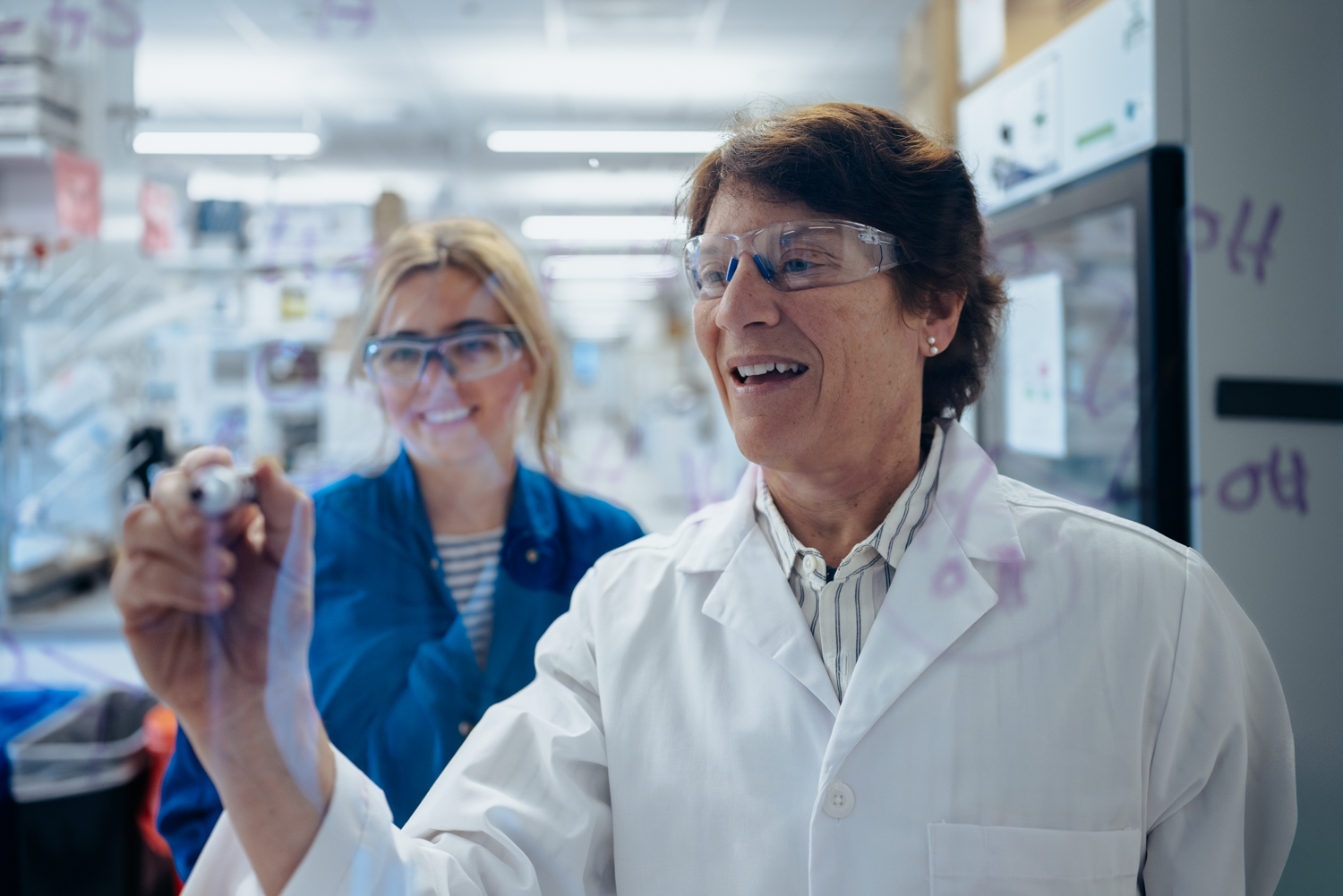
I am a chemical biologist. My lab develops chemical technologies to study biological systems and to make new kinds of medicines.
The area of biology that we focus on is called glycobiology, which is the biology of complex carbohydrates (sugars), called glycans. Cells have a forest of glycans on their surfaces, so they’re kind of the first point of contact when cells are touching each other and exchanging information.
In my lab we try to understand, at a biological level, how cell surface glycans contribute to the immune system, how immune cells recognize cancer cells, and how immune cells might contribute to autoimmune diseases. Then we develop molecules that we think might have therapeutic value because they interfere with some disease process having to do with those cell surface sugars.

Back in the late 1990s and early 2000s, we invented a new type of chemistry that we call “bio-orthogonal chemistry” to study changes in the structures of cell surface glycans for diseases like cancer. This allowed us to chemically attach molecular imaging probes to these glycans, so that we could literally see them in a microscope. This is the work for which I received the Nobel Prize.
Using this technique, we recognized that the cell surface glycan structures were changing in the cancer cells compared to the healthy cells. Now, we are trying to develop medicines that target the surface of cancer cells to chop up these immune-suppressive glycans. We have a couple of new candidates that are going through tests in animal models now, and then if they look good, we will try to spin them out into companies.
I’ve put myself in positions where I bridge different fields and interact with different kinds of scientists all at once. The big breakthroughs often come when concepts from a different field get brought to bear on a problem for the first time. A lot of the problems we’ve tried to solve in glycobiology, for example, have required high-end instrumentation that has its roots in physics. To advance science, I think it’s important to blur the boundaries between the disciplines.
I do this work because it’s interesting, hopefully important, and benefits patients who don’t have good treatment options. I do this at a university because I care about the opportunity to educate, mentor, and train students. That’s our primary mission; it’s not the primary mission of a private pharmaceutical company.
“The big breakthroughs often come when concepts from a different field get brought to bear on a problem for the first time.”
The cool thing about Stanford is it does encourage entrepreneurship. We have this investment community around us, and Stanford has a very progressive approach toward helping faculty file their intellectual property disclosures and file patent applications and even spin out companies. Stanford is one of those rare academic environments where you can have it both ways. Private industry doesn’t really invest much in super-early-stage basic science. But we do.
The reason we’re able to make discoveries and breakthroughs in science is because we go deep into subjects. You have to go really deep into the science to be able to get to the root of how things work and, if they’re off-kilter, how to fix them. So you end up in this world of technical jargon and concepts, talking mostly to people in your workplace bubble who already understand what you’re saying.
In times like these, you realize what a problem that’s been – because it’s the taxpayers who have, for 70 years, been supporting basic, curiosity-driven research, through the agencies of the federal government. And they might not even know that the government has stopped the flow of research funding, or they might not care, because they never really understood the purpose of the science, or their relationship to it anyway.
This points to an urgent need for scientists, and especially those in universities who are being supported by federal research funds, to have a more direct connection to the people who are actually giving them the money – the taxpayers.
If the taxpayers lose their faith in you, it undermines the entire scientific enterprise.
For more information
Bertozzi is the Baker Family Director of Sarafan ChEM-H and the Anne T. and Robert M. Bass Professor and professor of chemistry in the School of Humanities and Sciences. She is also a member of Stanford Bio-X, the Wu Tsai Human Performance Alliance, the Maternal & Child Health Research Institute, the Stanford Cancer Institute, and the Wu Tsai Neurosciences Institute.
Photographer
Andrew Brodhead