When the Chinese AI company DeepSeek released its open-source AI model in January 2025, it stunned both Washington and Wall Street: Nasdaq dropped 3%, and Nvidia saw 17% of its market value wiped out in a single day, the largest one-day loss at that point in U.S. stock market history. But inside Stanford’s computer science labs, researchers had seen China’s growing technological advantage coming for months.
“That was a powerful lesson that surprises are not surprises to everybody,” said Amy Zegart, a senior fellow at Stanford’s Hoover Institution, at the inaugural retreat of the new Tech Futures Lab, which she co-launched this year as part of the Technology Policy Accelerator program to help leaders better anticipate technological disruption.
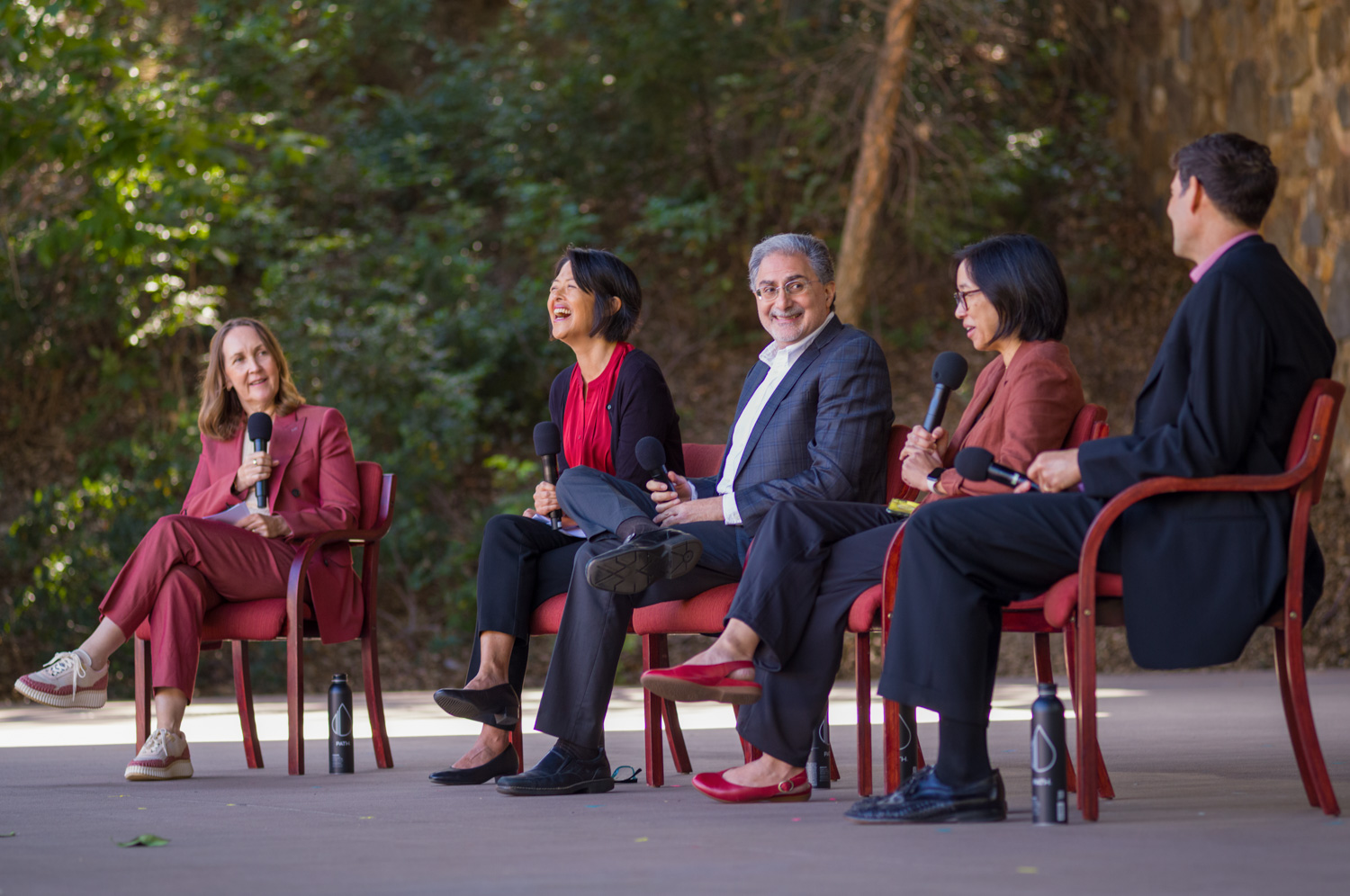
At the group’s first convening, held June 23 and 24, security experts, technologists, and scholars from a wide range of disciplines discussed “strategic technological surprises,” in which technological developments can significantly invalidate core assumptions, alter a strategic domain, and demand a large-scale response. DeepSeek, which defied expectations about how quickly and cheaply powerful AI models can be built, was a case in point.
Zegart emphasized that no single expert can see the whole field, which is where the Tech Futures Lab comes in.
“Anticipating strategic surprise starts by bringing together people who are watchers in different areas,” said Zegart, the Morris Arnold and Nona Jean Cox Senior Fellow.

Co-leading the Tech Futures Lab is Herbert Lin, a leading expert in cyber policy and security. Hoover Institution distinguished visiting fellow Maria Langan Riekhof will also play a leadership role, bringing more than 30 years of experience supporting policymakers at the highest level of U.S. government in senior roles at the CIA and the Office of the Director of National Intelligence (DNI). As Lin and Riekhof argued in the lab’s first publication, the surprise of DeepSeek revealed a lack of communication among policymakers, researchers in academia and industry, as well as a failure of imagination about how new technologies can upend power dynamics.
“We have to learn to scan for weak signals and think expansively and creatively – not just about what’s likely, but what’s plausible,” said Riekhof in her opening remarks.
Avoiding an ‘AI 9/11’
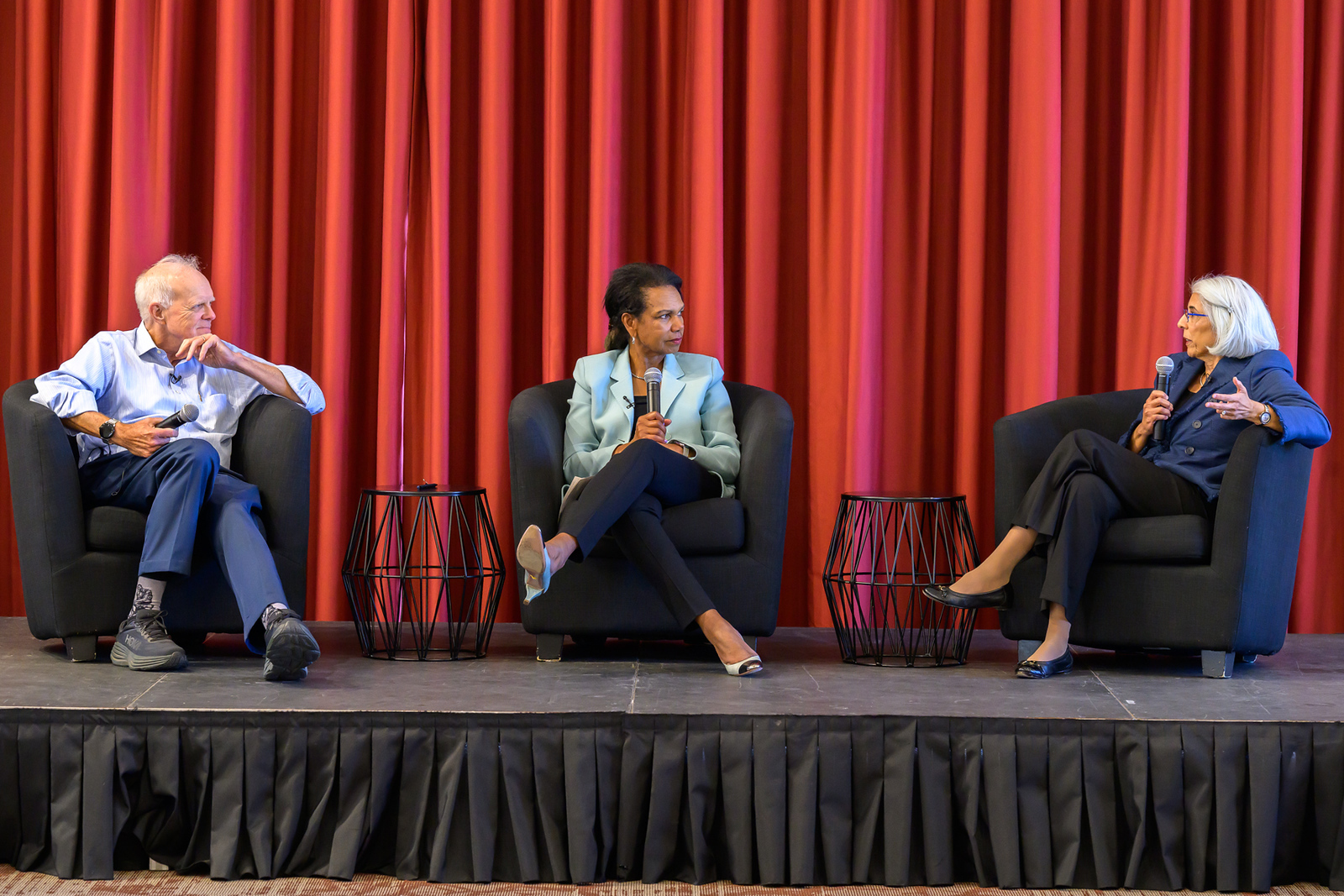
The lab’s inaugural event opened with a conversation between Condoleezza Rice, the director of the Hoover Institution and former U.S. secretary of state; John Hennessy, president emeritus of Stanford and chairman of Alphabet; and Arati Prabhakar, former director of the Defense Advanced Research Projects Agency (DARPA).
Rice, who was national security adviser on Sept. 11, 2001, shared three lessons learned from the attacks that have direct implications for the national security risks posed by technology today: One, she said, while intelligence agencies had detected activity on channels they were monitoring, “It never occurred to us that it might be people driving airplanes into buildings. We didn’t know what we were looking for.” Two, there were gaps in information sharing between agencies, and three, there was no playbook for the day after, leaving officials scrambling to respond to an unprecedented crisis.
While these lessons illustrate how to prevent an “AI 9/11,” Rice said, AI is advancing at a speed and scale that risks outpacing government response.
“By the time you’ve built out that structure, the technologies are in another time zone,” Rice said.
Prabhakar stressed that AI is “simply raw power.” The threat, she said, lies also in the people using it.
“When we talk about AI today, I find overwhelmingly we only talk about what’s happening inside the large language model or inside the technology. Everything that happens with AI is the consequence of human choices,” Prabhakar added.
Human calculus is only part of the challenge. Another issue is ensuring the U.S. maintains a global advantage, a point Hennessy made.
Hennessy underscored the importance of continual investment in research universities, which have been at the forefront of knowledge production and innovation. Undercutting those institutions, he warned, would mean forfeiting technological leadership to adversaries like China. He also pointed out that in comparison to past periods of technological disruption, such as the introduction of microprocessors or the internet, AI is advancing at a much faster pace.
Another difficulty, Rice said, was that development is happening in private companies, putting it beyond the traditional reach of government oversight. “This is not something I’ve seen before, where the most powerful tools are being created outside of the realm of the government and the government doesn’t really even have the capacity to test them.”
Later this year, the lab will convene private-sector tech leaders for crisis exercises long reserved for government officials – a reflection of the outsize role industry now plays in national security.
Anticipating strategic surprise starts by bringing together people who are watchers in different areas.Amy ZegartThe Morris Arnold and Nona Jean Cox Senior Fellow
Challenging prevailing assumptions
Strategic technological surprise can never be fully eliminated, Tech Futures Lab leaders said, but its impact can be reduced when experts come together to pay closer attention to underlying assumptions and emerging trends, and think through how leaders and civil society can improve resilience and agility before a crisis. The Tech Futures Lab was designed to address exactly this challenge.
Retreat participants engaged in a series of exercises designed to facilitate critical, creative, and collective thinking about hypothetical disruptions. One exercise asked them to generate possible future scenarios framed as “what ifs.” Some “what ifs” included questions like: “What if deepfakes become convincing enough to fuel massive, state-backed disinformation campaigns?” “What if non-state actors had unmanned weapons systems at scale?” “What if Google, Meta, and Tesla were more powerful than the U.S. government?”
Other “what ifs” imagined more hopeful outcomes.
“What if AI reduced polarization among democracies?” “What if we found the political will and collective action to dramatically reduce global poverty?” “What if we solved the energy crisis?”
Participants also surfaced a series of assumptions that may be limiting the field of view. For example, while the U.S.-China dominance in the AI arms race is a legitimate concern, one participant wondered if a “race” is the right framing: There is no finish line, and focusing on just two countries risks overlooking other nations that might enter the field.
The event culminated in a discussion about which paradigms need to shift, and closed by posing a fundamental problem: the assumption we make about what truth is.
Building resiliency into adaptability
A team of Stanford graduate and undergraduate students helped facilitate discussion and capture ideas that will shape the lab’s future work, while also offering their own perspectives to the conversation.
Rising sophomore Levi Schiffer took Zegart’s popular course Spies, Lies, and Algorithms in his first year, and one takeaway was how human relationships will change in a world augmented by technology. “I am already feeling it. There’s less going out to seek expert information because you feel like you have what you need on your computer, on your phone,” Schiffer said.
Despite the skepticism, Schiffer came away cautiously optimistic about human resilience amid change. “If we can learn anything from history, it’s that humans aren’t going anywhere, and we always find ways to learn and to adapt,” Schiffer said, with efforts like the Tech Futures Lab committed to helping people prepare for what comes next.
For more information
Zegart is also a senior fellow at the Freeman Spogli Institute for International Studies and at the Stanford Institute for Human-Centered AI.
The Tech Futures Lab is supported by a grant from the Hewlett Foundation.
Writer
Melissa De Witte