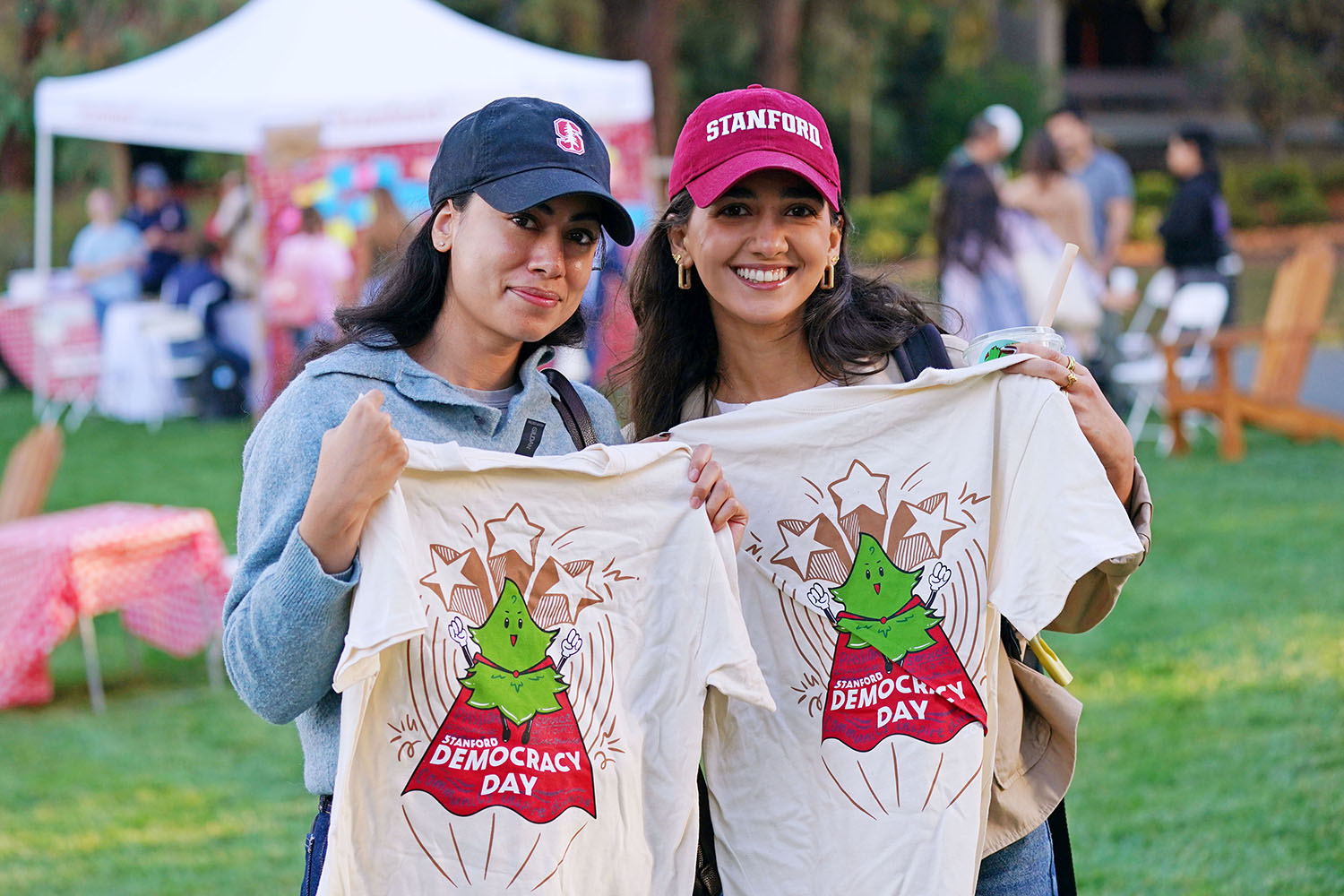
Tuesday, Nov. 3, is Stanford’s sixth annual Democracy Day, a university-wide academic holiday held on U.S. Election Day when classes pause and students come together as a community to vote and to reflect on how to make civic engagement part of their everyday lives.
More than 20 events are planned for the day, with an emphasis on the tangible things students can do to participate in democratic processes.
“Democracy Day is only one day a year, but we want the skills that students develop on the day to be something that they can carry with them beyond Democracy Day,” said Jadon Urogdy, ’27, this year’s Democracy Day chair.
Interactive learning
Democracy Day is nonpartisan and student-run, led by a committee of 16 dedicated students and around 50 enthusiastic volunteers.
This year, much of the day’s programming will take place on the green in White Plaza, where a series of interactive displays and discussions will run throughout the day – starting with a Public Service Career Mixer where students can network with Stanford alumni who have pursued meaningful careers in public service.
As the nation reflects on the 250th anniversary of the Declaration of Independence, the theme of this year’s Democracy Day traces the evolution of American democracy from its earliest days to where it stands today, and what students can do to strengthen it.
“Democracy Day is an opportunity for students to celebrate the progress we’ve made as a nation, and as a world, in creating systems that people can engage in,” Urogdy said. “At the same time, we want to be realistic about the issues at hand and what we can do right now to solve them.”
In one hands-on workshop, editors from the student newspaper The Stanford Daily will walk students through writing a persuasive op-ed. In a policy hackathon with former Federal Communications Commission Chairman Reed Hundt, who founded the nonpartisan, nonprofit Refounding America, students will draft policy proposals addressing democratic backsliding, with the winning idea to be presented at a policy conference.
At another hackathon, students will build an election prediction model using polling data, which will be tested in real time at the election night watch party at the Arbor Live Stage behind the Tresidder Memorial Union later that evening.
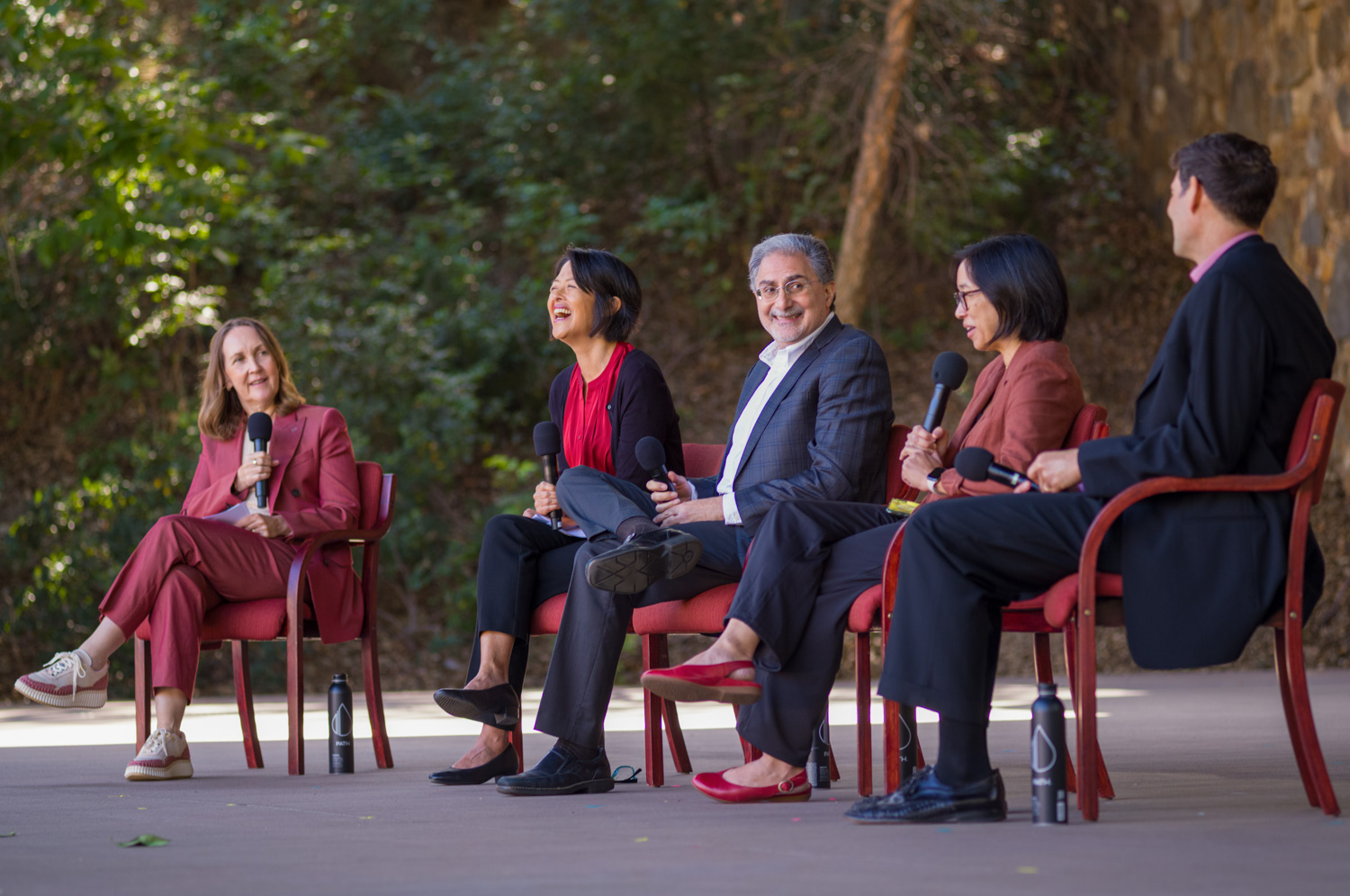
Over lunch, students can engage with Stanford scholars from across disciplines on the election and civic life more broadly at “Dine and Dialogue,” one of Democracy Day’s signature events.
“Democracy Day gives students and faculty an opportunity to explore and revitalize the democratic ideals, institutions, and processes that are fundamentally important for the future of our pluralistic society,” said Ira Lit, the Peter E. Haas Faculty Director of the Haas Center and a member of Democracy Day’s faculty advisory committee. “It offers the entire Stanford community a multitude of inspiring and energizing activities to affirm our shared commitments to a healthy public square and the common good.”
Meanwhile, there will be a number of other lively discussions with faculty across campus, such as “You Be the Judge,” in which Stanford Law School’s Pam Karlan will argue a case alongside members of the Federalist Society and the American Constitution Society. Students will then get to decide the outcome. There will also be a discussion exploring the impact of AI on democracy, featuring Stanford political scientist Andy Hall.
Back at White Plaza, students can watch a debate in the afternoon with students from across the political spectrum.
There will also be moments for self-reflection, such as opportunities to create art that reflects their civic values. Students and other members of the Stanford community can also come and share their vision for the future of democratic societies at the “Democracy Wall.”
Finally, at the end of the night, students can unwind and debrief the election results at On Call Cafe..
Events Democracy Day committee members are looking forward to:
“People feel really disillusioned right now,” Urogdy said. “There was a recent poll that came out saying that only 16% of people my age believe democracy is working. Our job is to build agency and show what they can do beyond casting a ballot, whether it is writing an op-ed, learning how to communicate more effectively with somebody you disagree with, or having a meaningful conversation with a professor.”
He added: “It’s really special that the whole Stanford community can stop for a day and reflect on what democracy means for all of us. In an era of division, bridging disciplines and missions across campus is the heart of what Democracy Day is about.”
The full schedule of events can be viewed on the Democracy Day website, including the keynote speaker to be announced.

For more information
Hall is the Davies Family Professor of Political Economy at the Stanford Graduate School of Business (GSB) and a senior fellow at the Hoover Institution and Stanford Institute for Economic Policy Research (SIEPR), and is currently teaching Mastering the Creator Economy: Building Audiences, Brands, and Businesses at the GSB this fall.
Hundt is a lecturer at SLS this quarter, where he is teaching Refounding America: Seeking Structural and Functional Changes in the Government of the United States.
Lit is a professor (teaching) in the Graduate School of Education.
Karlan is the Kenneth and Harle Montgomery Professor of Public Interest Law and the co-director and co-founder of the Stanford Supreme Court Litigation Clinic.
Writer
Melissa De Witte