In brief
- Students in Stanford’s COLLEGE 102 course drafted policy memo-type essays on how the university should handle AI in learning and assessment.
- Over 70 sections voted on proposals; the most popular earned a meeting with the provost and other university leaders.
- Students behind the winning memo suggested “understanding checks” to ensure comprehension.
- The assignment showed students the more pragmatic side of citizenship: committee work and negotiating within self-governing groups.
Last quarter, more than 1,200 first-year students wrestled with a question Stanford leaders and schools across the country are also grappling with: In the age of AI, how can a university create a policy that promotes learning, prevents cheating, and ensures accurate assessment?
The exercise was an assignment for COLLEGE 102: Citizenship in the 21st Century, the winter quarter course in Stanford’s first-year requirement program, Civic, Liberal, and Global Education (COLLEGE). It builds on a long tradition of students self-governing academic integrity at Stanford, going back to 1921 when a student-led petition led to the “Honor Code.”
“COLLEGE, like life, involves critical thinking, the process by which you decide what you believe. This assignment helped students clarify their own ideas about AI and education by listening closely to the perspectives of others and fashioning a solution through informed deliberation,” said Jay Hamilton, the Freeman-Thornton Vice Provost for Undergraduate Education.
In the COLLEGE 102 course, students wrote essays styled as policy memos addressing how Stanford should address academic integrity in a world where LLMs can write essays, solve problem sets, and answer homework questions.
After rounds of drafting, deliberation, and voting across more than 70 sections, one proposal rose to the top, earning its authors a meeting with Stanford Provost Jenny Martinez and other university leaders, including Hamilton and Cassandra Volpe Horii, associate vice provost for education and director of the Center for Teaching and Learning (CTL).
On May 4, those students pitched their idea: “Understanding checks” – periodic, individual assessments throughout the quarter to verify that students have a firm grasp of the material.
Students walked university leaders through the central tension their proposal addresses: how to ensure genuine comprehension and critical thinking when AI can perform the very tasks meant to build these capacities. Checks, they said, would hold students accountable – making sure they use AI to learn, not to hand off work and claim it as their own.
“You have to work to develop your writing skills, your personal voice, your opinions,” Ariadne Vidalakis, one of the students behind the winning memo, said before the meeting with university leaders. “You can’t outsource critical thinking.”
Critical thinking was a primary concern for students and leadership alike at the May 4 meeting. Students worried about its erosion and stressed that any policy university leaders develop must give students an incentive to engage with the material themselves.
Developing the winning memo
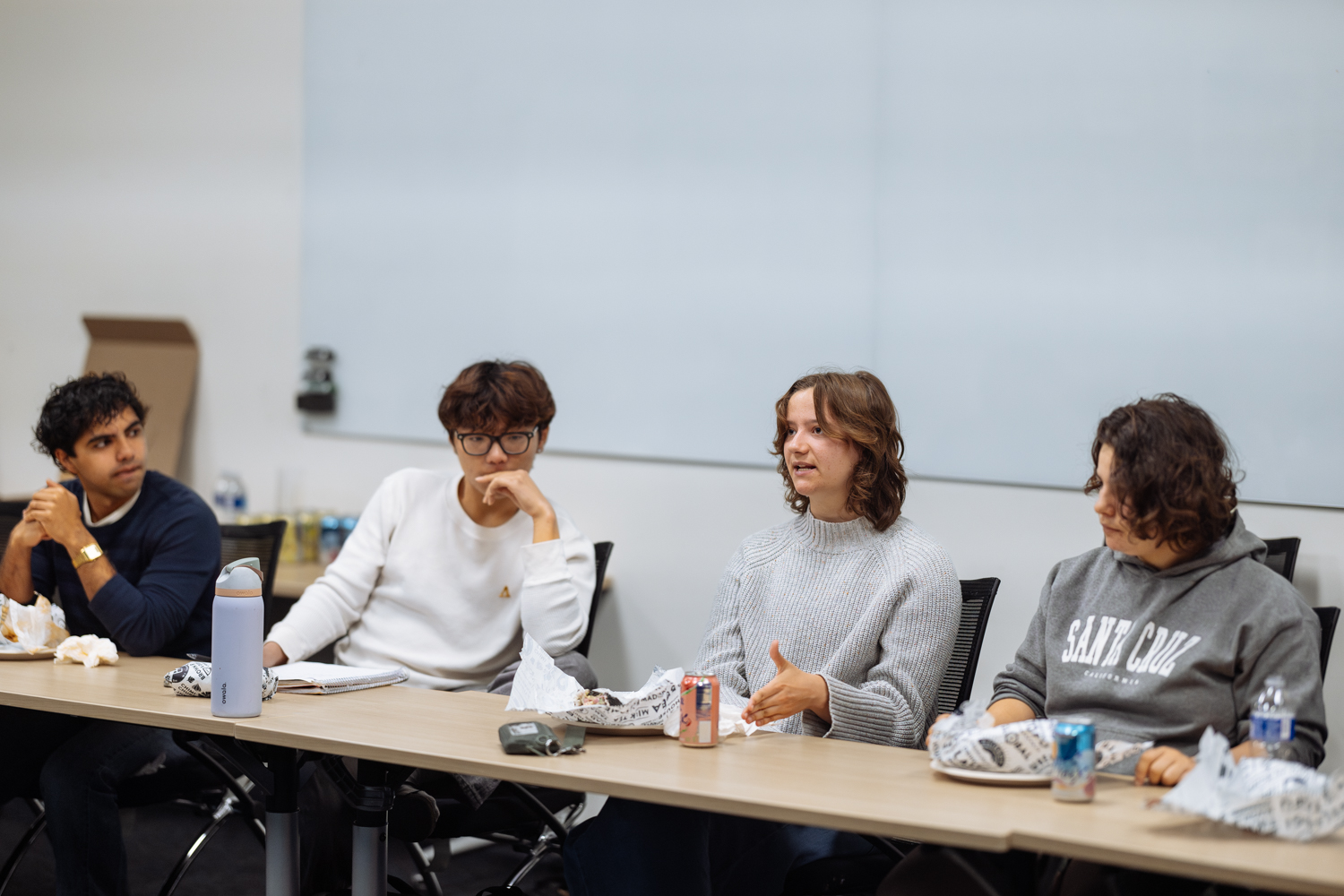
For an hour, students shared how they arrived at their idea – and the practicalities they wrestled with along the way. They explained that they began with the premise that an outright ban on AI use was unrealistic.
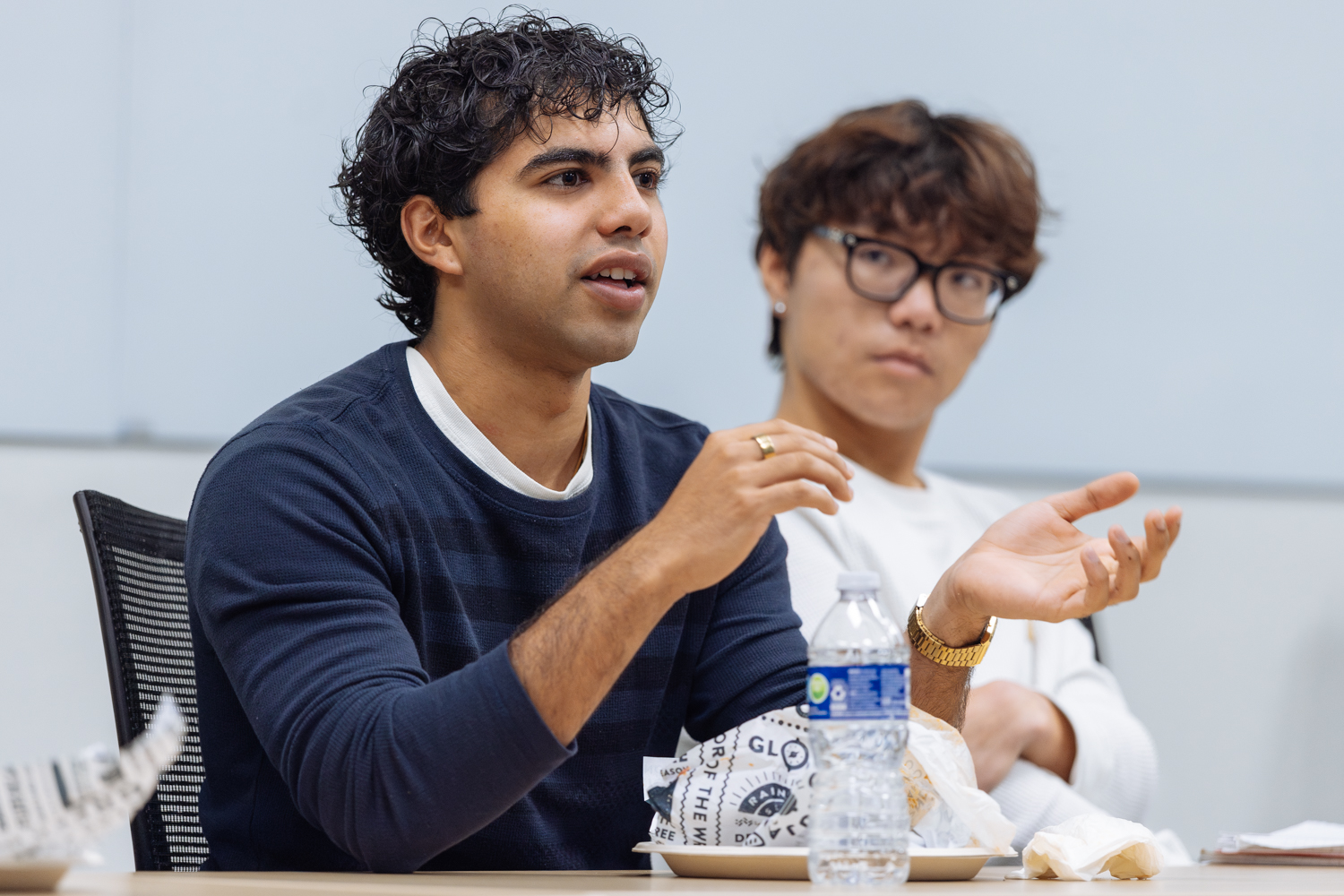
“It would be very difficult to convince students not to use these tools at their disposal,” said computer science major Neel Ahuja in an interview before the meeting. A policy had to ensure that students using AI did so without compromising their learning.
What if AI could be used as a learning tool, rather than a shortcut?
Ahuja and his classmates described various approaches they had considered and ultimately rejected.
“At first, we thought about building custom AI models for each class. Instructors could decide what material the model had access to, and students could use it like a TA, where instead of just giving them the answer, it could guide them through the learning process,” Ahuja said in an interview.
But thinking it through, he and his classmates realized the idea ran into problems with implementation, adoption, and a more fundamental issue: any custom model would likely be less capable than what students already have.
AI tutors raised similar concerns. One student recounted a disheartening experience using one for an advanced science class: the LLM asked for an explanation of what an atom was, which any human tutor would assume a student would understand at that point in the class, which was frustrating. Limitations like these led the group toward their final recommendation: graded oral check-ins and supervised problem-solving sessions. Students told Martinez that other sections had arrived at the same suggestion independently, giving them confidence that their memo reflected a consensus among frosh.
Students also stressed to university leaders that an AI policy shouldn’t add to their existing workload. One concern about “understanding checks” was that it would do exactly that. The class negotiated a tradeoff: keep the checks but reduce the weight of other written assignments – a solution students told Martinez would also lower the incentive to lean on AI.
Students also suggested changes beyond their proposal, including coursework less susceptible to AI misuse, such as more in-person, hands-on learning assignments or original research.
“I was impressed by the students’ thoughtful approach to arriving at a smart, nuanced recommendation,” Martinez said. “As the ones grappling with these issues in the classroom and on assignments every day, their perspective is uniquely valuable when it comes to solutions that will actually work for their peers.”
Doing citizenship
The assignment was partly developed by Keith Winstein in computer science and Emilee Chapman in political science, who wondered if students could learn the concepts they were studying in the classroom by practicing them.
“Could we come up with an exercise of active citizenship that had freshmen not just read or talk about, but actually do the skills we’re trying to convey and make a decision as a freshman class?” Winstein said.
The idea of a policy memo – a formal document that articulates values and builds consensus – emerged.
“A policy memo is a piece of writing that has effect,” Winstein said.
To give the assignment real weight, students needed to feel like they had “skin in the game,” Winstein said.
Winstein and Chapman chose a topic students were already grappling with – AI and academic conduct – and arranged for the winning team to meet with some of Stanford’s top leaders.
Students knew from the outset that their proposals would not become official university policy, but the chance to talk directly with university decision-makers made the stakes feel real.
“I was really excited by that,” Ahuja said.
Collaborative writing and consensus building
The assignment was built around stages of negotiation. Students began by working in small groups to draft their 350-word memos. Each draft was then brought to their sections for broader discussion. Through those conversations – which often required balancing differing points of view – sections distilled their ideas into single proposals, which were then shared across sections for a vote.
“To me, what was most exciting was seeing that they came to the project with a range of different ideas and experiences, yet through a mix of persuasion and negotiation were able to find a space of agreement,” Chapman said.
Students experienced what any self-governing citizens might: collaboration, consensus-building, and collective decision-making.
For example, when negotiating the weight of “understanding checks,” students went back and forth over what percentage of their grade they should count toward. Their section lecturer, Byron Gray, told them the granular work is what self-governance actually looks like.
“I told them, ‘This is committee work. This is the first day of the rest of your life. Whatever you end up studying, whatever you end up doing, you’re probably going to end up in a ton of meetings just like this,’” Gray told them.
Being an active member of a community
Even knowing their memo wouldn’t set university policy, students came away with a clearer sense of what membership in a community demands – including accounting for needs beyond their own.
Crafting a one-size-fits-all policy at a place as intellectually diverse as Stanford proved challenging. Whatever Vidalakis and her classmates developed had to work for students in both STEM and the humanities.
“We had to put ourselves in other people’s shoes and engage with different perspectives,” Vidalakis said. “We realized not everyone has the same goals for being here or wants to do the same thing,” she explained.
That intellectual variety is precisely what Vidalakis worries AI use could erode. If students all rely on the same AI models, she said, their work could start to look similar.
“You don’t want all the answers to look the same, because that decreases diversity of thought,” she said.
Step inside the COLLEGE classroom
In fall 2021, Stanford launched a new first-year requirement for undergraduate students, COLLEGE. The program aims to provide first-year students with a shared intellectual experience and sharpen skills in critical thinking and civic engagement.
While designed as a three-course sequence, students are required to take two out of three quarters, which are designed to invite deeper reflection about their place and purpose at Stanford, in society, and in the world.
- In fall quarter, the first course in the COLLEGE sequence is Why College? Your Education and the Good Life, which encourages students to reflect on the purpose of college in their lives and in society, with the ultimate goal of preparing them for a lifetime of inquiry.
- In winter quarter, students look at citizenship, tackling big questions about what that means in a divided society where many threats are global. Students also hone skills in negotiating political differences and how to put pluralism into practice.
- In spring quarter, students take a global approach. Seminar-style classes tackle topics ranging from sustainability to science fiction as a way to approach problems in a rapidly changing world.
COLLEGE is in a pilot phase through the 2025-26 academic year, and replaces the Thinking Matters requirement.
Writer
Melissa De Witte