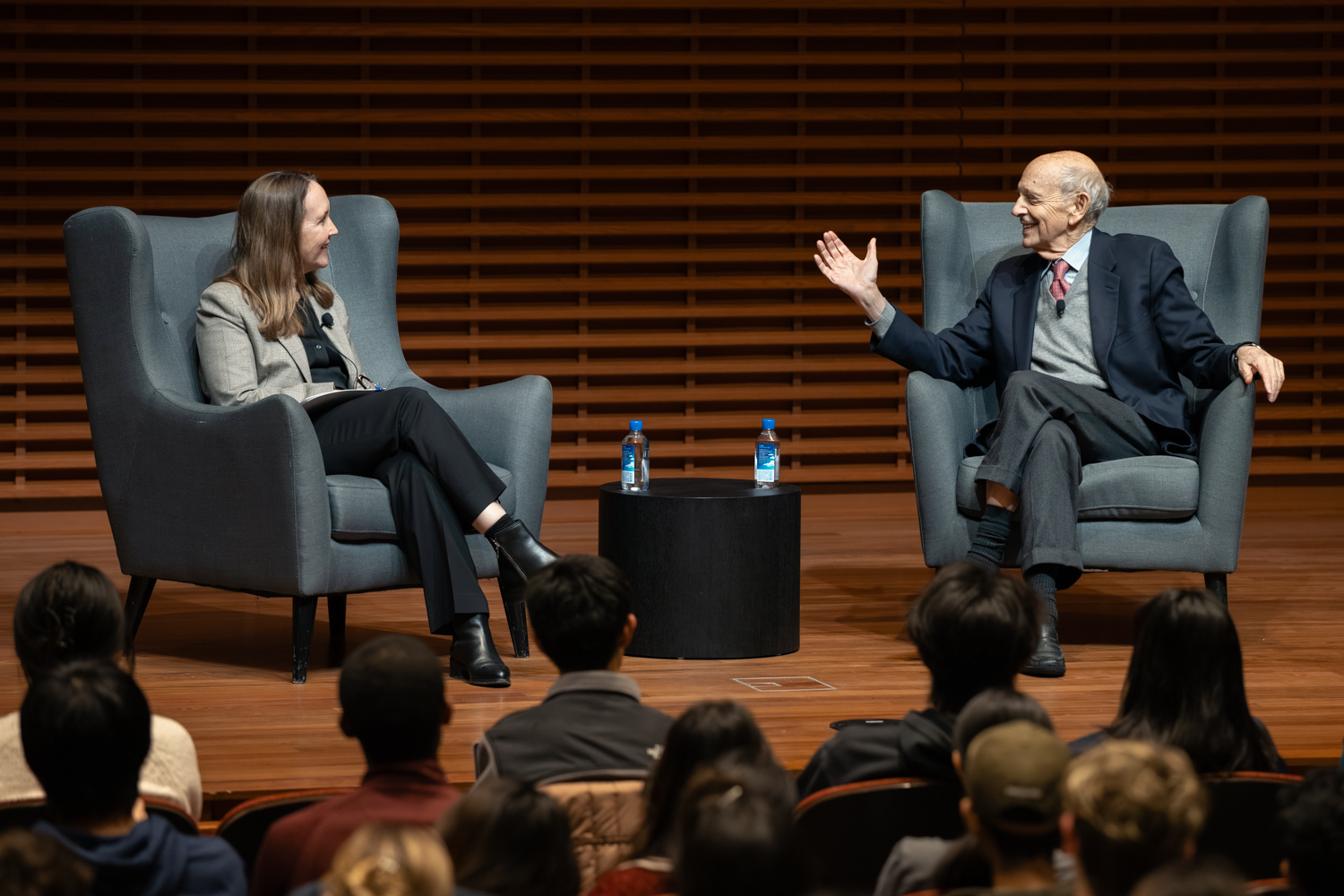
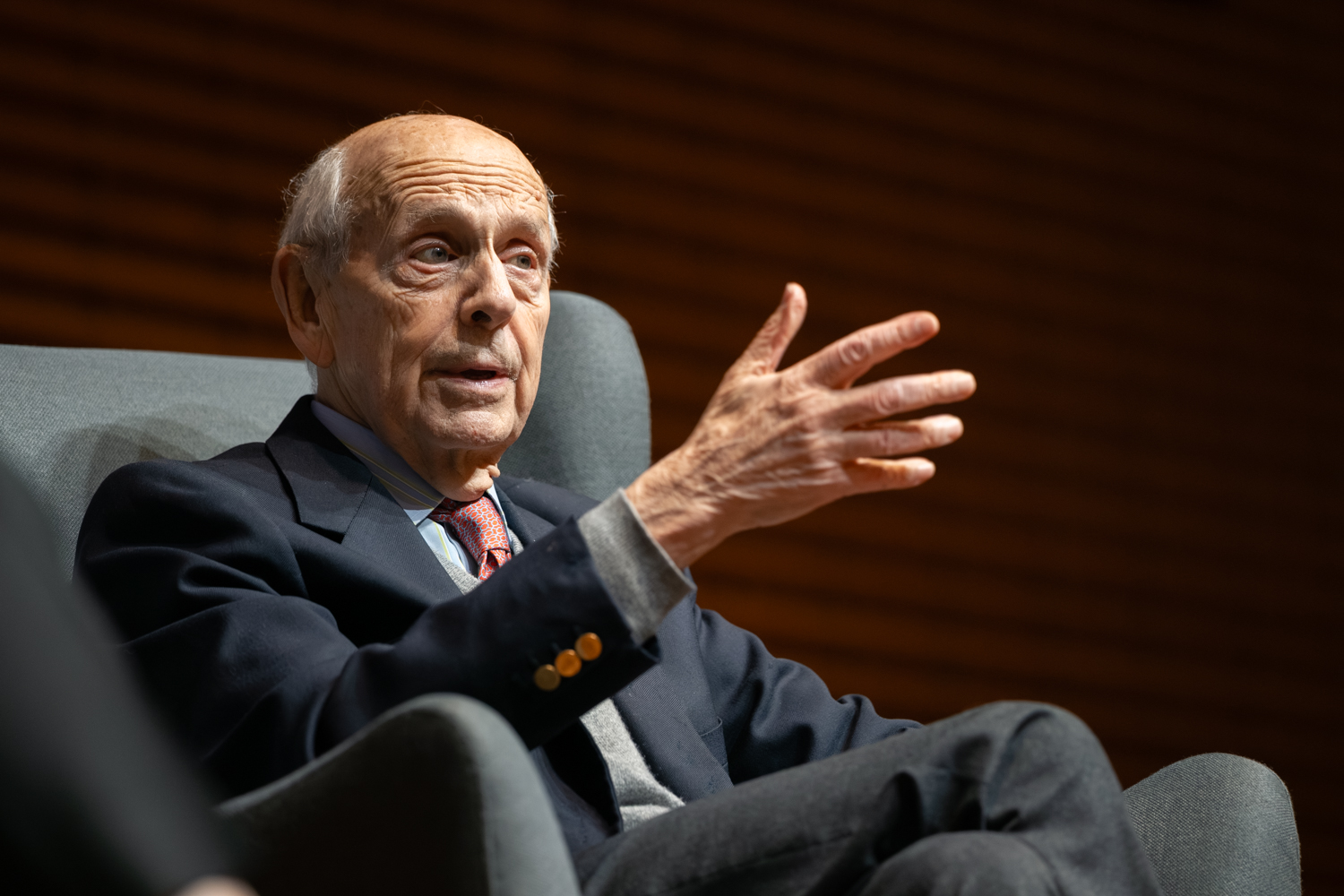
Sitting before a packed audience at Stanford University on Tuesday, retired Supreme Court Justice Stephen Breyer posed a question the nation’s founders faced 250 years ago.
“Can we do this?” Breyer asked, referring to the Constitution’s bold experiment in self-government. At the time, many doubted a democratic republic could work.
“The founders said, ‘Yes, we can and it will. It will.’ And that’s our challenge.”
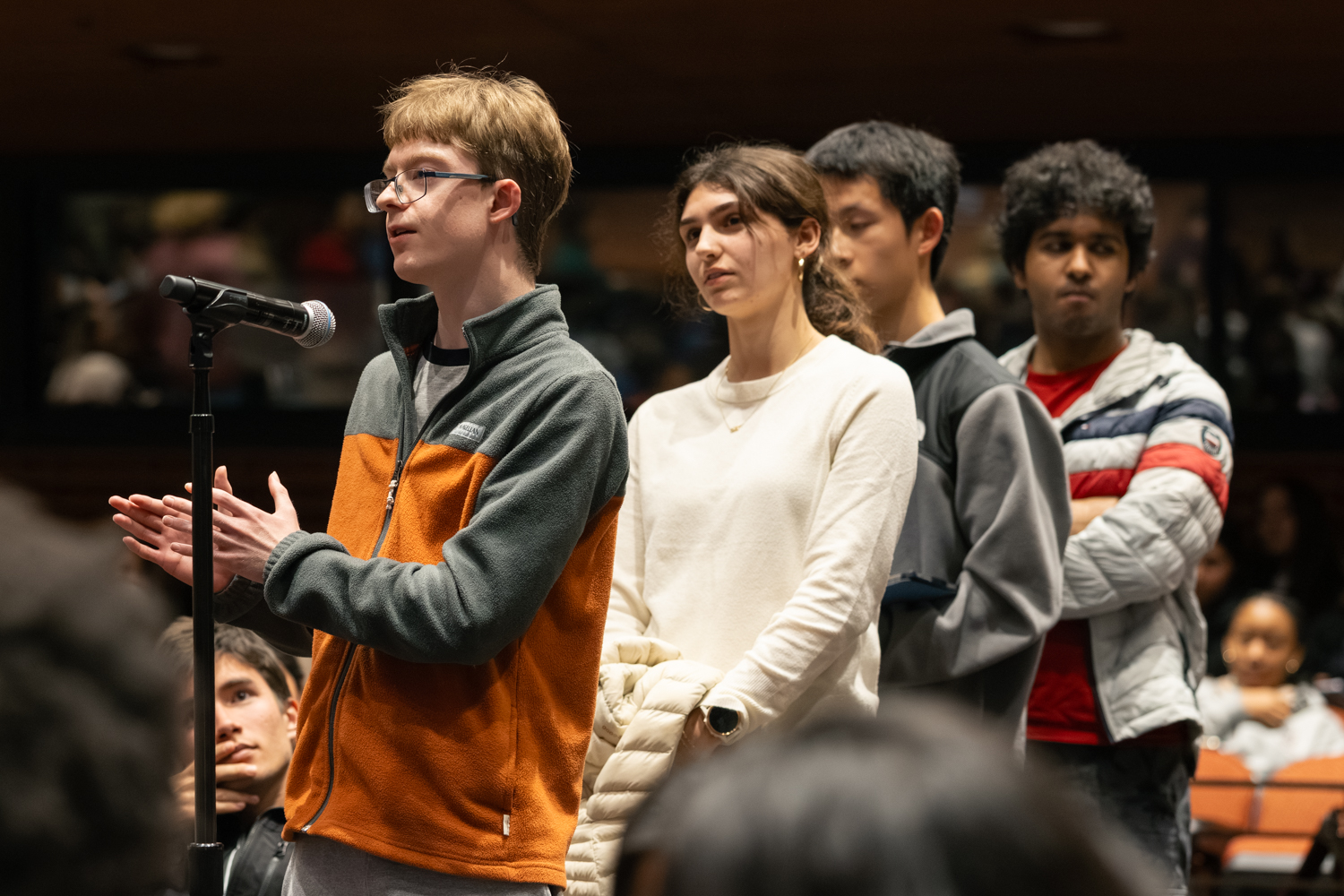
Breyer was speaking in a wide-ranging discussion moderated by Stanford Provost Jenny Martinez. Their conversation served as the plenary session for students enrolled in Citizenship in the 21st Century, the winter quarter course in Stanford’s first-year requirement program, Civic, Liberal, and Global Education (COLLEGE), and was co-sponsored by the Stanford Builders Forum, a quarterly event series organized by ePluribus Stanford.
Throughout the discussion, Breyer returned to a single refrain: get involved.
“Participate!” he told students, listing voting, volunteering for political campaigns, serving on a public school or library board, joining a civic organization, or engaging seriously with people who hold opposing views. “You may sometimes learn something,” Breyer said.
From philosophy to pragmatism
Breyer reflected on his own academic journey, beginning with his undergraduate years at Stanford, where he earned a degree in philosophy in 1959 before continuing his studies at Oxford. Philosophy, he said, shaped how he later approached the law.
“The question is, what’s the scope of the word as applied through this statute?” Breyer said, explaining how legal interpretation requires attention not just to text but to how language functions in practice.
That approach came to define his judicial philosophy. During his tenure on the Supreme Court, Breyer argued that the Constitution’s meaning cannot be derived from text or original understanding alone. Judges, he said, must consider consequences, historical evolution, and how legal rules operate in real life.
He expressed skepticism toward strict originalism, associated with his late colleague Justice Antonin Scalia. A Constitution interpreted only through the words and understanding of the founders, Breyer said, would be “a Constitution no one would want.”
After Harvard Law School, Breyer served on the Harvard faculty from 1967 to 1980, then held senior roles in government, including counsel to the U.S. Senate Judiciary Committee and chief judge of the U.S. Court of Appeals for the First Circuit. He was appointed to the Supreme Court in 1994 and served until his retirement in 2022.
A consistent thread throughout Breyer’s distinguished career has been his unwavering commitment to civic life. He emphasized the importance of community-oriented participation, particularly listening to opposing perspectives, applying practical reasoning, and demonstrating respect across differences to make law and democracy work for real people.
These are all ideals that students in Citizenship in the 21st Century put into practice. In small seminar classes that meet twice a week, students apply essential skills of democratic citizenship, including communicating across differences, critical thinking, and collaborative problem-solving.
They also grapple with complex questions, such as how to respond to injustice – something Breyer also had to contend with throughout his career.
Breyer pointed to the long aftermath of Brown v. Board of Education as a lesson in persistence. Although the 1954 decision declared school segregation unconstitutional, it took years of pressure from courts, activists, and political leaders to turn the ruling into real, lived equality.
Breyer stressed the importance of perseverance, a quality he learned from Arthur Goldberg, an associate justice of the Supreme Court in the early 1960s and a pivotal figure in the American civil rights movement.
“You keep going. If you lose this one, we may win the next one,” Breyer said.
Tips for constructive dialogue from a Supreme Court Justice
Inspired by the advice Breyer offered about how to communicate across differences, here are six ways to have a constructive conversation.
1. Listen first
Breyer received this advice when he worked with Massachusetts Senator Ted Kennedy: Find an intelligent person who thinks differently from you and listen until they say something you agree with and build from there.
2. Don’t try to win by showing you’re smarter
Otherwise, people will just dig in, Breyer said. Instead, show you’ve understood where they’re coming from and work with that.
3. Find common ground to achieve progress
Look for partial agreement and work from there.
4. Amid disagreement, maintain respect and professionalism
Breyer notes that in 28 years in conference with his fellow Supreme Court justices, he never heard a voice raised in anger or a demeaning remark, despite their strong disagreement at times.
5. Separate the person from their position
Breyer emphasized how he is friends with justices with whom he strongly disagrees.
6. Create an environment in which everyone is heard
During the Supreme Court conferences that Breyer participated in, no one would speak twice until everyone had spoken once.
Civic Salons
Breyer continued the conversation Wednesday evening at Otero, Stanford’s public service- and civic engagement-themed residence hall, during the first Civic Salon of the quarter.
Moderated by Luke Terra, Otero’s resident fellow and deputy director of the Haas Center for Public Service, the informal discussion echoed themes from the previous night.
“Where is the power in this country?” Breyer asked. “It is with the people.”
Change rarely begins in Washington alone, he said. Students should look to state and local politics and to the people who influence elected officials in their districts. “Think about Sacramento, San Francisco, San Mateo, Palo Alto, even Burlingame,” Breyer said.
For Waleed Haider, a Stanford freshman and Otero resident interested in civil rights advocacy, the message landed. “What I’ve been searching for … is a theory of change,” Haider said.
Breyer offered one grounded in coalition-building and compromise. Judges cannot fix everything quickly, he said. Durable change depends on civic engagement, compromise, and public opinion. “Don’t hold up for 100 percent,” Breyer said, noting that accepting partial victories is still something. Public opinion also matters, as that too helps shape legislation.
This long-term perspective resonated with Haider.
“It’s really important to think not just in the time span of a few days or weeks or even months and years, but over decades and in the chapters of American history,” Haider added.
Breyer’s campus visit also included a conversation with students from the Stanford Political Union on Thursday. He is co-teaching a two-week seminar with Martinez at Stanford Law School, which explores the workings of the United States Supreme Court and its role in American democracy.
Step inside the COLLEGE classroom
In fall 2021, Stanford launched a new first-year requirement for undergraduate students, COLLEGE. The program aims to provide first-year students with a shared intellectual experience and sharpen skills in critical thinking and civic engagement.
While designed as a three-course sequence, students are required to take two out of three quarters, which are designed to invite deeper reflection about their place and purpose at Stanford, in society, and in the world.
- In fall quarter, the first course in the COLLEGE sequence is Why College? Your Education and the Good Life, which encourages students to reflect on the purpose of college in their lives and in society, with the ultimate goal of preparing them for a lifetime of inquiry.
- In winter quarter, students look at citizenship, tackling big questions about what that means in a divided society where many threats are global. Students also hone skills in negotiating political differences and how to put pluralism into practice.
- In spring quarter, students take a global approach. Seminar-style classes tackle topics ranging from sustainability to science fiction as a way to approach problems in a rapidly changing world.
COLLEGE is in a pilot phase through the 2025-26 academic year, and replaces the Thinking Matters requirement.
Writer
Melissa De Witte