Polarization is a fact of political life in the U.S. today. Gen Z, however, is less inclined than older generations to view it as a permanent fixture in American politics, according to research by students in the Stanford political science course Democracy in the Balance: Polarization and the Road Ahead. Students found that Gen Z is more optimistic than any other age group about the possibility of bridging the political divide in America.
“Polarization doesn’t seem to be a fixed trend in Gen Z’s minds,” said Jadon Urogdy, ’27. “We have a bright future. Our identities and views are still malleable, and that’s exactly why this moment matters so much.”
Urogdy and his classmates also found that Gen Z, which is the cohort born between 1997 and 2012 and considered the first true “digital natives,” is more comfortable than their elders in having a political conversation online – findings that suggest they may be more reachable and receptive to online interventions aimed at reducing polarization.
A cohort studying itself
Urogdy’s results were among many findings from Democracy in the Balance: Polarization and the Road Ahead, a spring quarter course taught by Ashley Fabrizio, a Stanford alum and head of research at the nonpartisan think tank More in Common. Working with Fabrizio and her team, students created and conducted a nationally representative survey of 1,610 U.S. adults that oversampled Gen Z to provide a more granular look into their political attitudes and opinions.
Fabrizio, who has taught the course for three years, has found that working with students surfaces concerns that standard polling may miss. “If we want to know what Gen Z’s political beliefs and attitudes are, we should let our students, as members of Gen Z, use their intuition to decide what matters in a survey,” Fabrizio explained.
Working in small groups, students were allocated several minutes of survey time to explore topics such as the political influence of online content promoting masculinity – aka the “manosphere,” the religious revival in Gen Z’s lives, and their beliefs about the American dream. Fabrizio guided students step by step through survey design, showing them how to craft research questions, field the survey, analyze data, and finally, present their findings.
Students also examined the academic literature on polarization’s effects in American politics, from how it contributes to political gridlock, drives support for political violence, and erodes trust in American institutions.
“There are many legitimate divisions in politics over competing policies and values, but polarization often drives us apart unnecessarily,” said Fabrizio. “Young Americans will have to find their own ways of bridging partisan differences and overcoming misconceptions about one another. I hope this class helps students see the value of doing so and gives them a sense of agency in addressing polarization.”
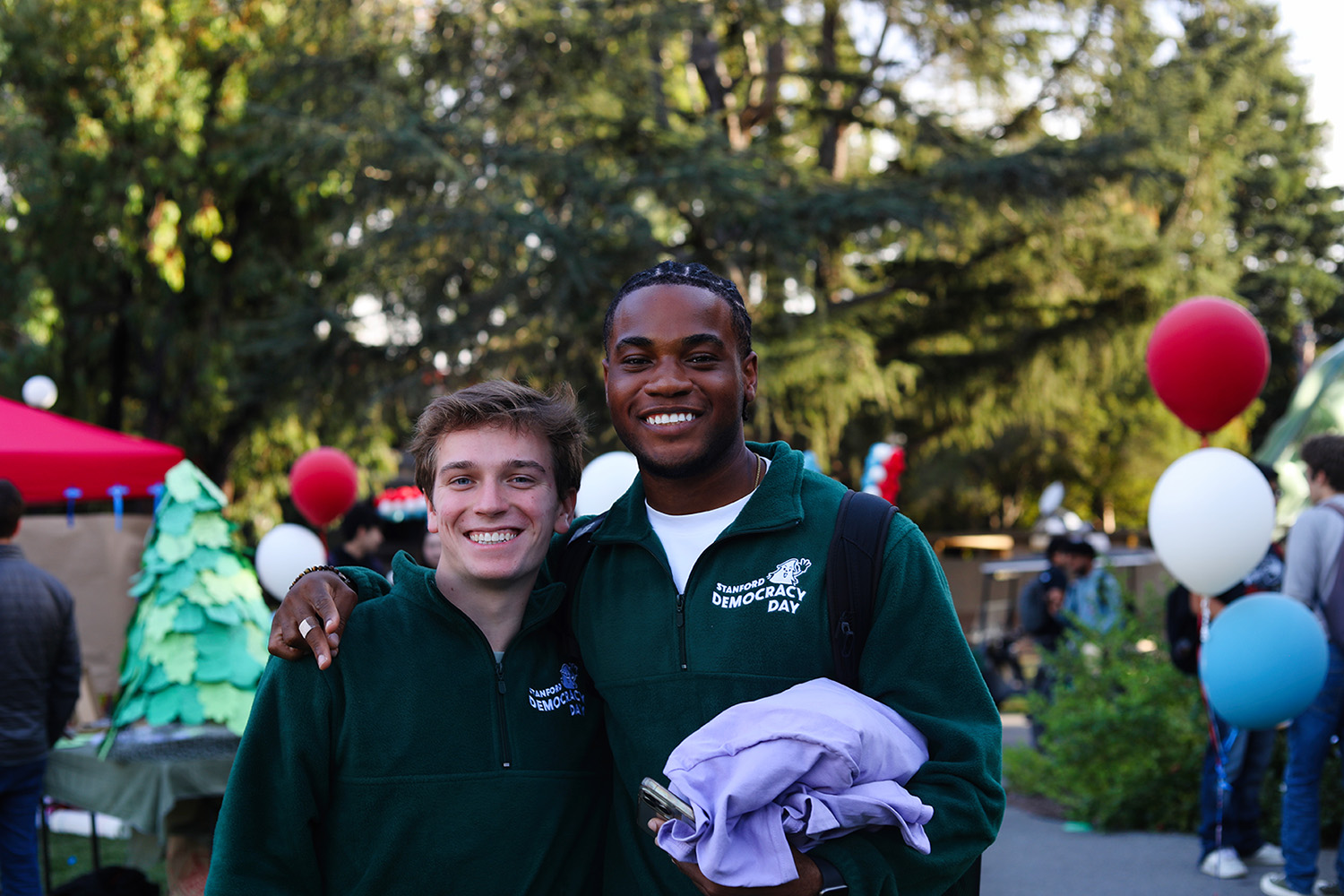
Jadon Urogdy (left) with Uchenna Akanno, ’25, at Democracy Day in 2024, where Urogdy helped lead programming to inspire civic engagement during Stanford’s annual Election Day academic holiday. | Peggy Propp
Scrolling deepens divides, but does not distort
Natalia Galperin, ’27, was excited about the opportunity to run her own study from start to finish, a first for the Stanford undergrad majoring in psychology. She also wanted to expand on her prior work as a research assistant for political scientist Shanto Iyengar through the political science department’s Summer Research College in his Political Communication Lab, where she studied the effects of negative political campaign ads.
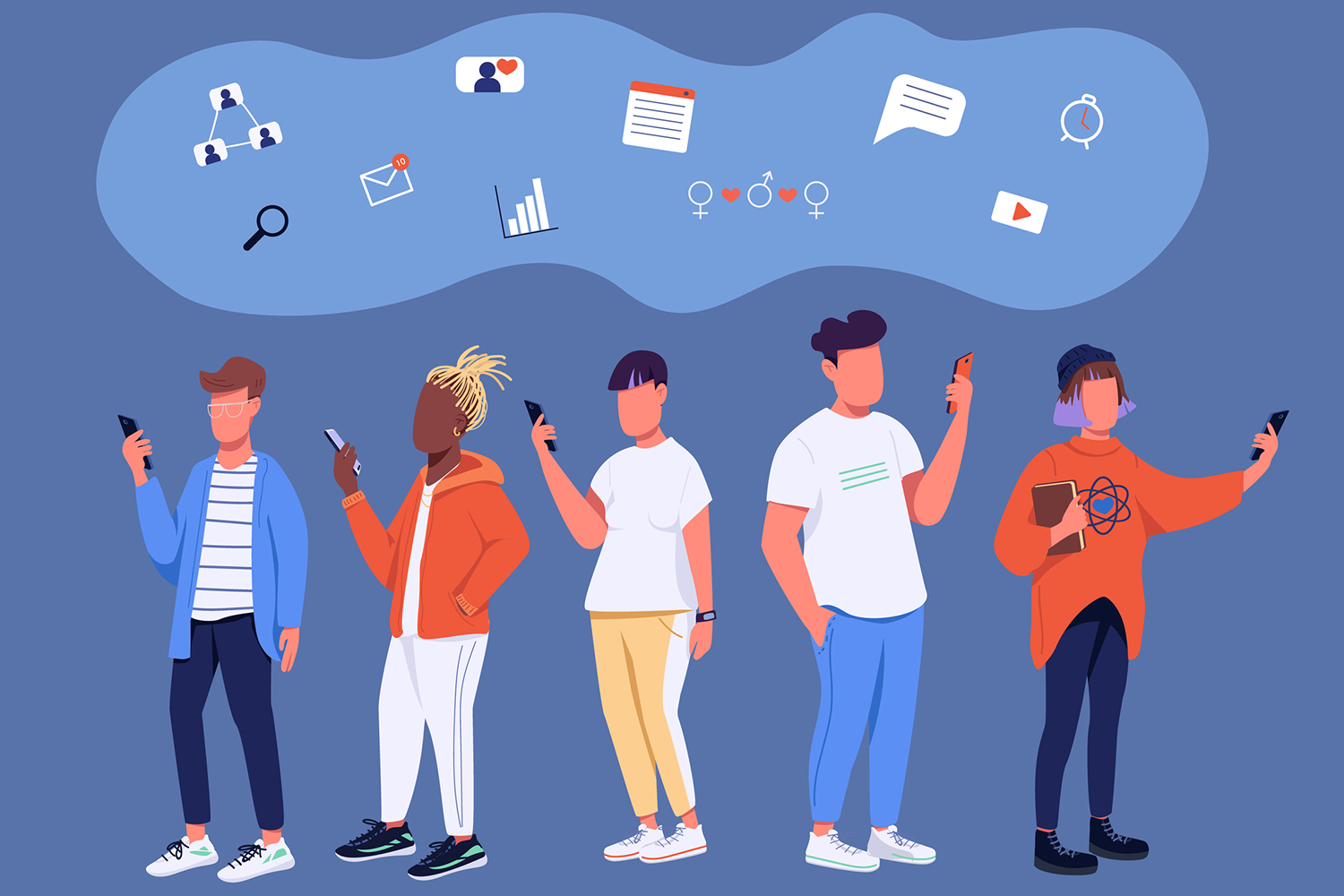
For her research project, Galperin examined the role of social media in inflating Gen Z’s hostility toward people from the opposing political party, a phenomenon political scientists call “affective polarization.”
“We thought Gen Z would be more polarized and misinformed because we get so much of our news on social media compared to older generations,” Galperin said.
What she and her classmates found reveals a more complicated picture.
While Gen Z respondents who said they used social media daily or almost daily were more likely to dislike the opposing party, their scores were almost identical to those of other generations.
“We found that greater social media engagement is generally linked to more polarized views of political parties, and the effect is seen at similar rates across all generations, not just Gen Z,” said Galperin, who will be interning with More In Common this summer through the Haas Center for Public Service’s Cardinal Quarter program.
Polarization doesn’t seem to be a fixed trend in Gen Z’s minds. We have a bright future. Our identities and views are still malleable, and that’s exactly why this moment matters so much.Jadon Urogdy, ’27
Galperin also wanted to know whether social media deepens the divide between what Gen Z thinks people from the other side believe versus what they actually think, a phenomenon known as “perception gaps.” In testing people’s perceptions on immigration, she found that Gen Z did not appear to hold wildly distorted views about the other side – findings that push back against the familiar narrative that being online warps a person’s perceptions of politics.
Taken together, actively using social media seems to harden Gen Z’s feelings more than it distorts basic facts.
Gen Z is not a political monolith
The class also found a wide range of political viewpoints, including differences between Gen Z who identified as Democrats and Republicans.
For example, in Urogdy’s project, he and his teammates found that those who were the most confident that polarization can be reduced identified as conservatives and Republicans, while liberals and Democrats believed the opposite – a finding that Urogdy said tracks with prior research: A person’s view of government depends on whether or not their political party is in control.
Galperin’s team also found lower levels of affective polarization among Republicans and Gen Z overall, and Democrats who reported actively using social media daily have higher perception gaps on immigration-related issues than average.
Another student team’s project revealed further complexities. They found that many Gen Z respondents are more likely than other generations to attribute problems like the affordability crisis to systemic failures in democracy itself rather than to specific policies or leaders. In their data, a notable share of young people said the system itself “is not capable of doing its job,” signaling a deeper, structural disillusionment.
“I think we’re all exhausted by the political system,” Urogdy said. “There’s this underlying feeling that what we want isn’t being translated into tangible change, and I think that there’s this overall feeling that instead of having animosity towards people across the aisle, there’s an animosity towards the system itself.”
Urogdy is pragmatic about what comes next.
“We can’t say polarization will disappear if we will it away,” said Urogdy, who is majoring in political science. Now, he feels he has a better understanding of what kinds of solutions matter. If people are disillusioned with the system, surface-level fixes – such as messaging – won’t last, he said. Efforts need to be ongoing. “If Gen Z is still one of the most reachable generations, the answer is sustained civic engagement, where we can rebuild trust in the system while working to reform it. We have a long path ahead,” said Urogdy, who said he is optimistic.
Fabrizio, too, is hopeful. “Gen Z is inheriting a polarized nation, but they are inheriting deep wells of democratic vitality as well,” Fabrizio said. “America has a long history of self-government, a robust civil society, and communities that remain deeply committed to democratic values. Gen Z has high standards for our democracy, but living up to them is within reach. I hope older generations will listen and be inspired by Gen Z’s vision for the American Dream.”
For more information
The survey was funded by the Department of Political Science and the Stanford Haas Center for Public Service. It was also a Capstone Course for the Political Science Department. Capstone experiences provide opportunities for student-guided learning toward challenging goals. In addition, it was also a Cardinal Course certified by the Haas Center. The courses apply classroom knowledge to pressing social and environmental problems through reciprocal community partnerships.
Writer
Melissa De Witte