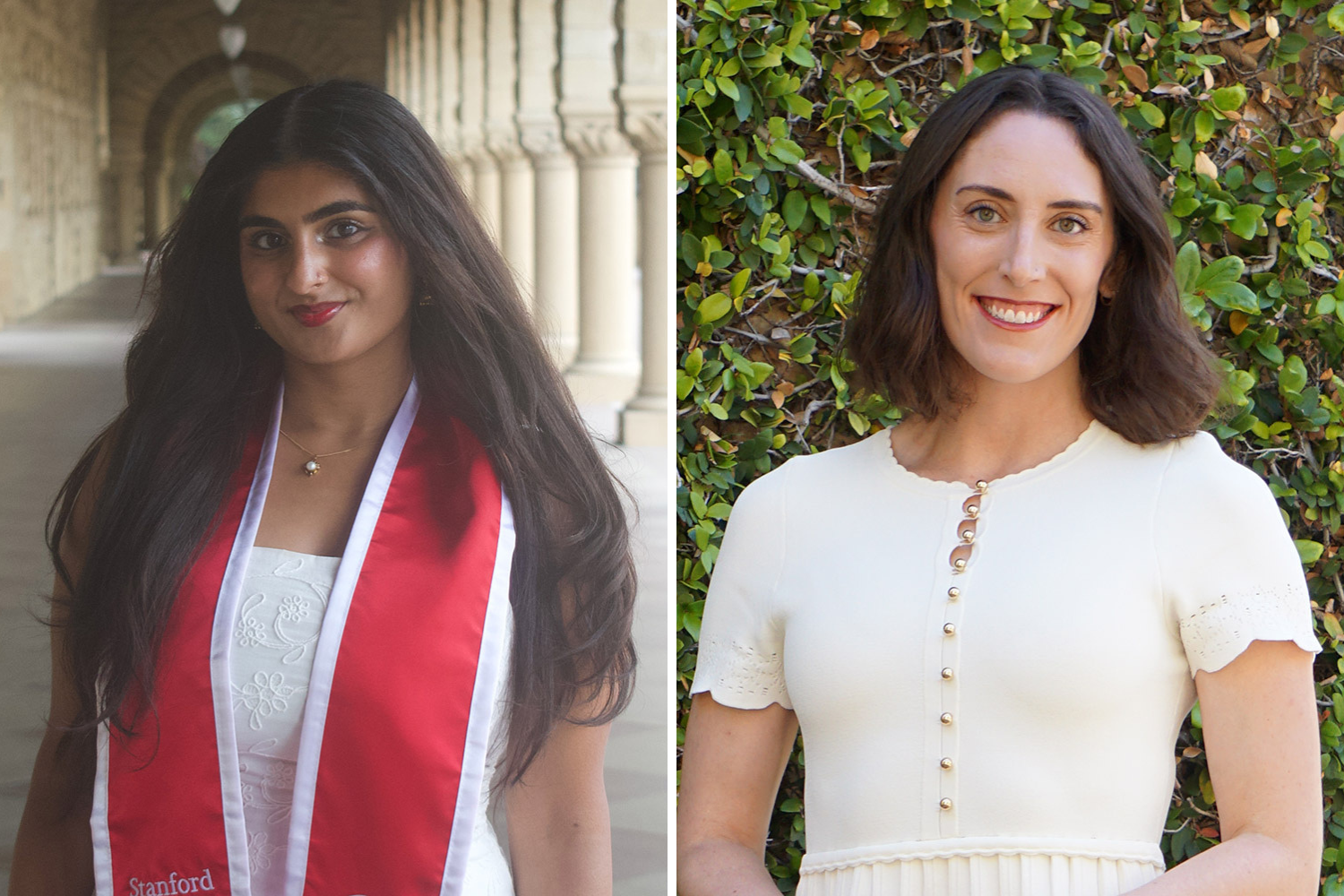
At a graduate student event during spring quarter, the evening included an unusual exercise for a dinner designed for open-ended discussion: Pick a side. Their hosts – Julia Proshan, a PhD student in social psychology, and Daniel Richman, a PhD student in computer science – read a series of brief but provocative statements, asking attendees to position themselves in the room along a spectrum from “strongly disagree” to “strongly agree.”
Some of the statements included:
“The U.S. should prioritize immigrants who bring skills to America.”
“A fair immigration system means: one, giving people a path to citizenship if they’ve been here for a long time, or two, deporting people if they are here illegally.”
The prompts were designed not to divide, but rather to show the wide range of views a person can hold on a single issue. Students who stood shoulder to shoulder on one question found themselves on opposite ends at the next. “You don’t really see people on all the extremes. They are all over the scale,” Proshan said.
The exercise, known in facilitation circles as “Beyond the Line,” was one of several activities that showed students how a person’s thinking resists simple categorization. Students were then paired for one-on-one exchanges, followed by a broader discussion.
As students realized, how to even approach the issue varied. For example, on immigration, some viewed the issue through the experiences of immigrants within the system, while others emphasized its effects at the national and societal levels.
But this was the event’s aim: to contend with the complexity.
Gray areas welcome
With support from a campus community grant from ePluribus Stanford, a university initiative that promotes constructive dialogue across campus, Proshan and Richman have hosted six dinners on topics ranging from immigration to institutional neutrality to gun policy.
The idea for the dinner series, called “Constructive Conversations,” emerged when Richman observed a tendency among his peers to slip into an “apartment-to-department” routine, shuffling only between their housing and the labs. But he also noticed a deep curiosity to engage with different ideas and viewpoints.
“Grad students want community, and they want to talk about difficult things, but they just didn’t quite have a place to do it,” Richman said.
Richman’s interest in facilitating dialogue grew from his work as a GED tutor at Rikers Island, New York City’s main jail complex. The experience showed him how transformative it can be when people have space to set aside their day-to-day troubles – and the identities attached to them – and simply learn.
He reached out to Proshan, who also had prior experience in dialogue work, to build the kind of “third space” he felt missing from graduate student life at Stanford.
“We were eager to create a space where there could be room for as much nuance on a topic as possible and say to students, ‘This is a space where gray areas are welcome. This is a space where you can come with your own ideas, and you can come to learn,’” Proshan said.
Dealing with hard questions
Dinners are held in graduate student housing – Escondido Village Graduate Residences and Rains Houses – and structured as a three-part series, with the same cohort of about 8-10 students returning each session, which furthers connection and community.
The event structure has evolved, with the two from the ePluribus Stanford team – executive director Karina Kloos and program fellow YuQing Jiang – helping advise on structure and best practices. Proshan and Richman initially imagined a “Jeffersonian dinner” – a format in which all guests sustain a single conversation as a whole table. But they found their attendees, while curious, lacked enough background for a lengthy discussion.
Grad students want community, and they want to talk about difficult things.Daniel Richman
Now they provide guests with additional context: fact sheets and short videos from both left- and right-leaning sources.
“Our goal is not for people to change their minds,” Richman said. “For us, a successful event is when students feel like they were able to listen and to be listened to.”
Desmond Mantle, a third-year law student, has attended two “Constructive Conversations.”
At an event on incarceration policy, what stood out was the chance to explore fundamental philosophical questions about the role of prison in society: Should it focus more on rehabilitation than punishment? Do people who commit crimes act of their own free will? Is imprisoning people for minor offenses a waste of resources?
“I went to law school because I loved the law as a field in which there are all sorts of disagreements about how you apply legal rules to the world, and it’s very worthwhile to connect with everyone I can to hear how they think about those issues, too,” Mantle said.
Mantle appreciated grappling with these hard questions with his peers across campus. Students came from the Graduate School of Business, the School of Engineering, the School of Humanities and Sciences, and the School of Medicine.
“Talking with people who aren’t as far into law – or aren’t in law at all – is an excellent reminder not to be so dug in in my ways of viewing the law, because the world changes, and the way people are going to read the law changes, and I need to stay on top of that to be a good lawyer,” Mantle said.
More events are being planned for the fall. Those interested in participating in the 2026–27 academic year can fill out this interest form.
ePluribus Stanford has funded 14 community projects so far, with a few, like “Constructive Conversations,” receiving seed funding followed by a second round of financial support through a Sustain & Scale grant.
Other community grants ePluribus Stanford has been awarded include the student-led Indo-Pak Dosti Conference; a Qur'an-Torah study organized by the Office for Religious and Spiritual Life; a Divided Democracies workshop led by Stanford Civics Initiative postdoctoral fellows to study how societies have weathered previous eras of polarization; and Cardinal Unite on bridging first-year and transfer students’ educational and civic experiences at Stanford.
Writer
Melissa De Witte