Bounce back quickly from setbacks. Ask how things actually work. Tough intro courses are like cognitive calisthenics – hang in there, because it does get fun.
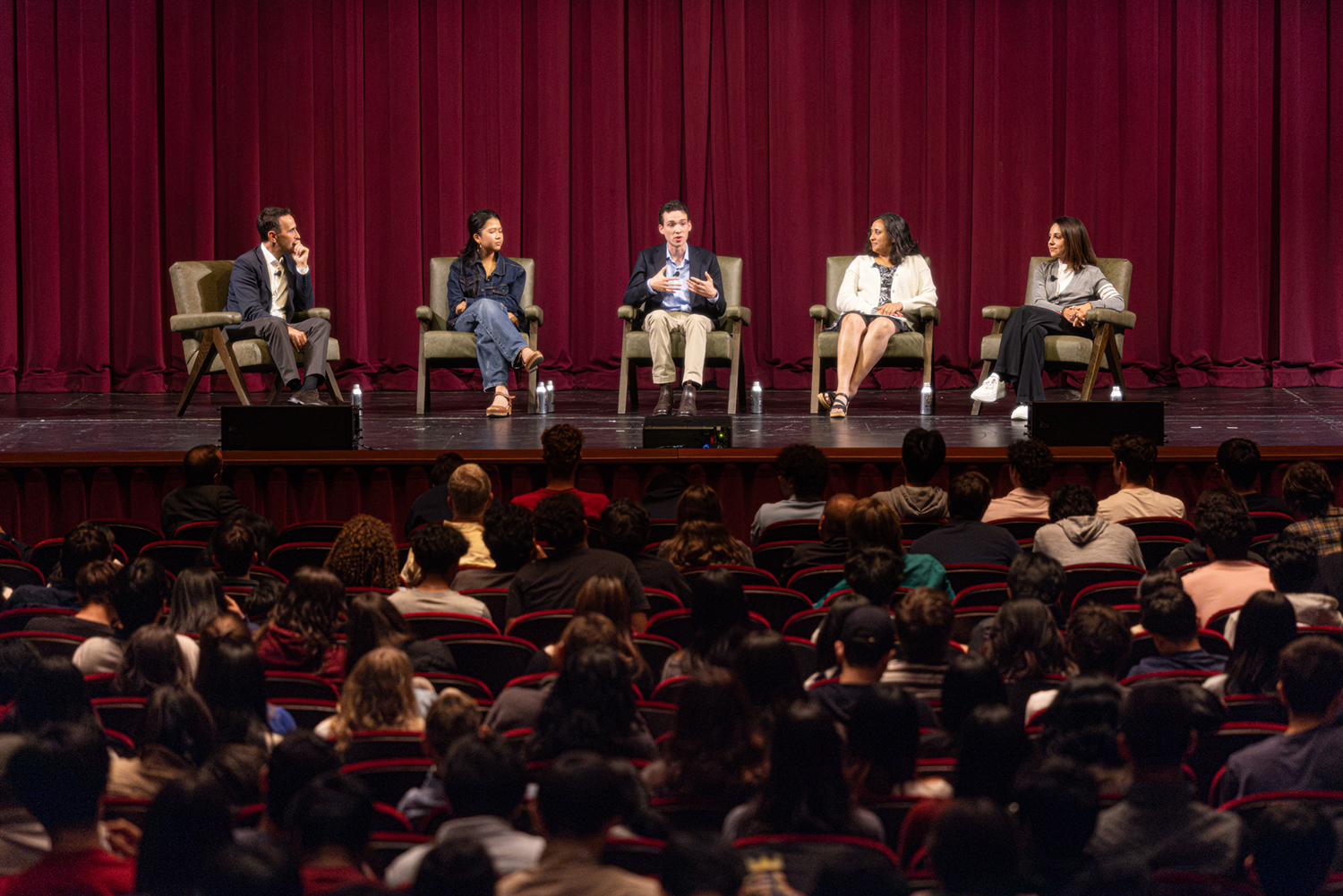
These are just some of the pieces of advice some of Stanford’s Nobel laureates shared in wide-ranging conversations they had with Ran Abramitzky, the senior associate dean for the social sciences in the School of Humanities and Sciences (H&S), in his 2023 course, ECON 3: Big Ideas: Conversations with Stanford’s Own Nobel Laureates & MacArthur “Genius” Fellows.
We revisited some of those discussions, which are available to watch, and gathered their advice for students navigating their academic path.
1. Build a broad base
Narrow training risks limiting your perspective, so study the world from multiple points of view, advised economist Paul Milgrom.
“We learn things from all the people who came before us,” said Milgrom, who received the Nobel Prize in economic sciences with his long-time collaborator Robert Wilson in 2020. “You need this broad education in order to have a whole set of perspectives and narratives available to you. So when you look at something, you can see it from several different angles.”
2. Apply theory to the real world
For aspiring economists, Wilson urged students to look outside theoretical modeling and into the real world. As he explained, economies are shaped not only by supply and demand but also by prices and market rules and procedures. “In terms of studying economics, I would certainly say having a very close attention to the complexities of the way real markets are run should be the driving force that one has, the curiosity to say, ‘How does it actually work?’” Wilson said.
3. Keep learning
Milgrom emphasized the importance of staying on top of new developments in fields like technology and computational analysis – throughout his career, he has continually acquired new skills in computer science.
“There are changes taking place that are massive in what you need to know to be a successful economist in the future,” Milgrom said, adding: “Big data is affecting everything.”
His advice to students is to stay curious about emerging innovations and consider how new tools might advance their own research.
4. Don’t let setbacks slow you down
Steven Chu, recipient of the 1997 Nobel Prize in physics, offered a candid reality check: success in science means learning quickly what doesn’t work and moving on. He estimates that 1 in 10 experiments ends up working, and he doesn’t let that deter him. “I just fail really fast, and quickly,” said Chu. “I learned to fail in weeks or months rather than years. Everybody will tell you that’s the secret.”
In addition to failures, there are rejections too.
Carolyn Bertozzi, who received the 2022 Nobel Prize in chemistry, said that for every journal article she’s published, she received three or four rejections. “Sometimes people find that to be frustrating. They might call it a failure, but it’s just part of the learning experience,” said Bertozzi, who keeps a slide deck of all the “failures” she has had throughout her career to show that behind every major success are many unseen setbacks.
I learned to fail in weeks or months rather than years. Everybody will tell you that’s the secret.Steven ChuRecipient of the 1997 Nobel Prize in physics
5. All roads (eventually) lead to a solution
Similarly, it’s important to keep persevering. Stanford economist Guido Imbens noted that breakthrough moments that seem obvious in hindsight are often the result of investigating a problem from the wrong angle before discovering the right one.
“Some of the work now looks to me very straightforward and intuitive, but it took us a huge amount of time because we kept going in the wrong direction,” said Imbens, who, together with Joshua Angrist, received the Nobel Prize in economic sciences in 2021. “But at some level, we were very – maybe, foolishly so – very confident there was something there, there was something to learn. But it took us a huge amount of time and, going in lots of directions that were not working before we hit on the right way of framing the problem in a way that [provided] a very clear solution.”
6. Reps now will pay off later
Bertozzi compares early science education to athletic conditioning. Just like high-performance athletes who have to do “boring” drills to build their strength, so do young scientists.
“Those introductory courses that you’re taking ... might feel like push-ups and sit-ups and running and sprints and stuff. But that’s just how you build the muscles, right? The real show is yet to come. So hang in there ’cause it does get fun.”
7. Embrace collaboration
For Imbens, being part of a team has been one of the most rewarding parts of his academic career.
“Research nowadays is not really something you can do on your own,” Imbens explained. “In a lot of the social sciences, you have bigger teams where people work together, and that is often one of the things that’s the most fun about the work. It’s learning these things together, figuring things out together.”
8. Cultivate a network across fields
Technology alone will not solve global crises, said Chu, who served as United States secretary of energy from 2009 to 2013. Effective problem-solving requires expertise across disciplines, from physics to political science.
“It’s not just gonna be inventions in technology; it’s also gonna be innovations in public policy that will be needed to change the track we’re on – all those other fields will be useful. It’s going to take not only a village, it’s going to take all the villages to do this,” Chu said.
That breadth of perspective requires building connections beyond your own field.
“A young scientist, or even an old scientist, doesn’t know everything,” Chu said. “But what one does know is you can have friends who have friends, and you’re one to two phone calls away from getting the expert. ... That enables you to tap into this storehouse of knowledge.”
9. Hold onto your ideals
Chu encouraged students, as they progress in their careers, to hold onto their convictions that world problems can be solved.
“I would encourage you to keep your idealism,” said Chu, noting that their generation shouldn’t feel they have to shoulder the burden alone of solving those problems. They should challenge others.
“With your idealism, tell your parents and grandparents, to not leave the world in the shape that they’re in the process of leaving it,” Chu said. “It’s their responsibility to actually do something because they’re older and they’re in positions to do something about it more than you.”
10. Let curiosity be your compass
Imbens also highlighted the importance of being guided by your own curiosity and belief in what matters.
“You can’t let other people decide for you what’s important,” Imbens said.
Quotes have been lightly edited for clarity.
For more information
Abramitzky is the Stanford Federal Credit Union Professor and professor of economics in H&S.
Milgrom is the Shirley R. and Leonard W. Ely, Jr. Professor and professor of economics in H&S.
Wilson is the Adams Distinguished Professor of Management, Emeritus, at the Stanford Graduate School of Business (GSB).
Chu is the William R. Kenan, Jr. Professor and professor of physics in H&S. He is also a professor of molecular and cellular physiology in the School of Medicine and of energy science and engineering in the School of Engineering.
Bertozzi is the Anne T. and Robert M. Bass Professor and professor of chemistry in H&S, and the Baker Family Director of Sarafan ChEM-H.
Imbens is the Applied Econometrics Professor and professor of economics at Stanford GSB, professor of economics in H&S, and faculty director of Stanford Data Science.
Writer
Melissa De Witte