What if your future self could give you some advice – or at least a little assurance – as you begin your Stanford journey?
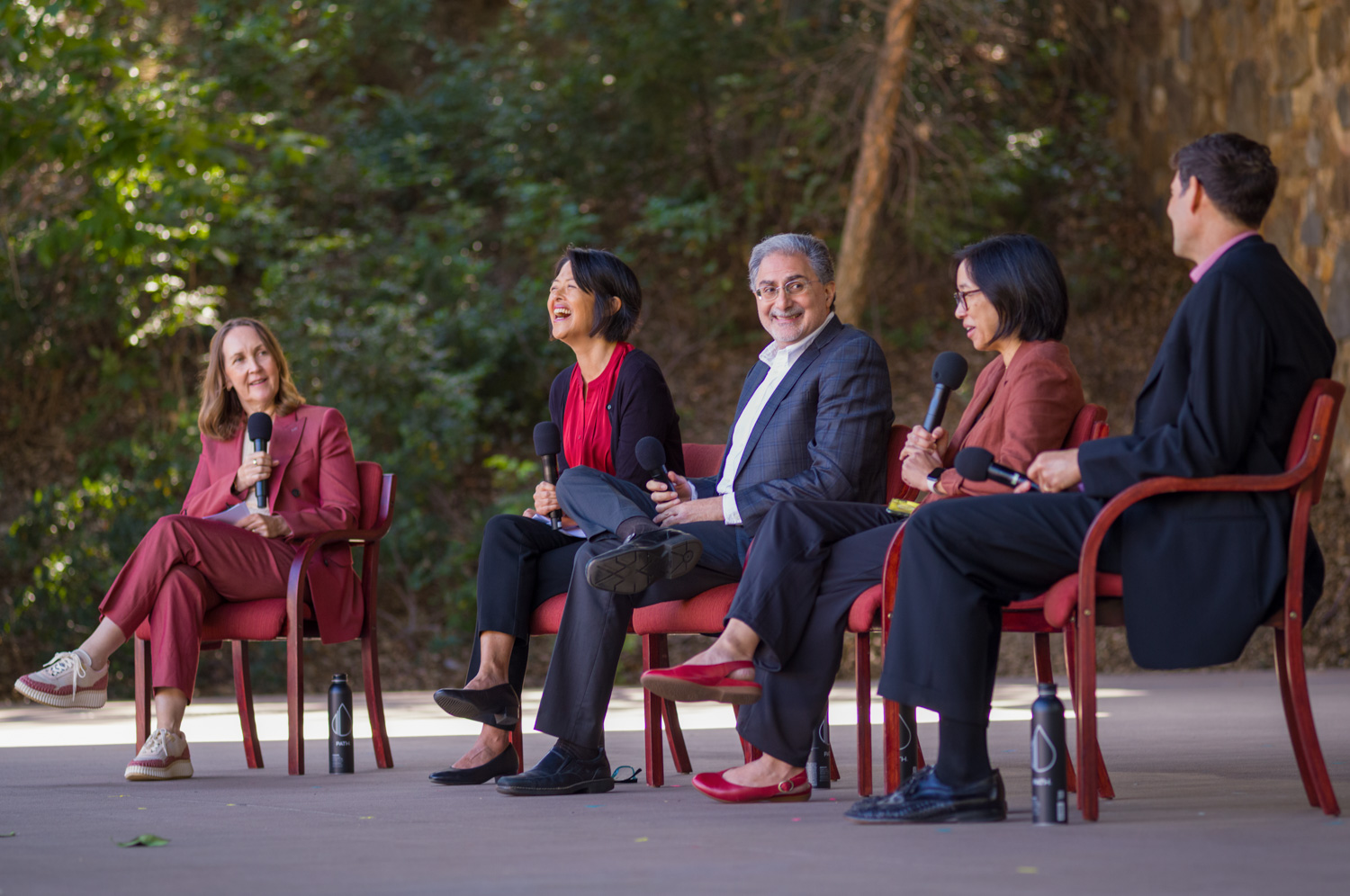
In a panel discussion moderated by Provost Jenny Martinez during New Student Orientation for the Class of 2030 and transfers, faculty members who also attended Stanford as undergraduates shared their insights with new students on taking advantage of the opportunities Stanford has to offer and making the most of their time on campus.
Keep an open mind
The first steps on your Stanford journey may not lead where you imagined they would.
“When I was in your shoes, I really didn’t know what I wanted to do here at Stanford,” recalled psychology Professor Jeanne Tsai, ’91. She was interested in human behavior and thought medical school was where she could study it. She began her Stanford journey on a pre-med track.
“I didn’t love it,” Tsai admitted. “Pre-med classes were pretty much kicking my butt.”
When Albert Hastorf, a pioneer in social psychology, delivered a series of guest lectures in her human biology class, Tsai found herself drawn in a new direction. “I had no idea that you could use scientific methods to study human behavior, so that was completely eye-opening for me.”
Tsai spent the following quarter exploring what the psychology department had to offer. “I never looked back,” said Tsai. She is now the Dunlevie Family Professor in the Department of Psychology in the School of Humanities and Sciences (H&S), where she runs her own lab.
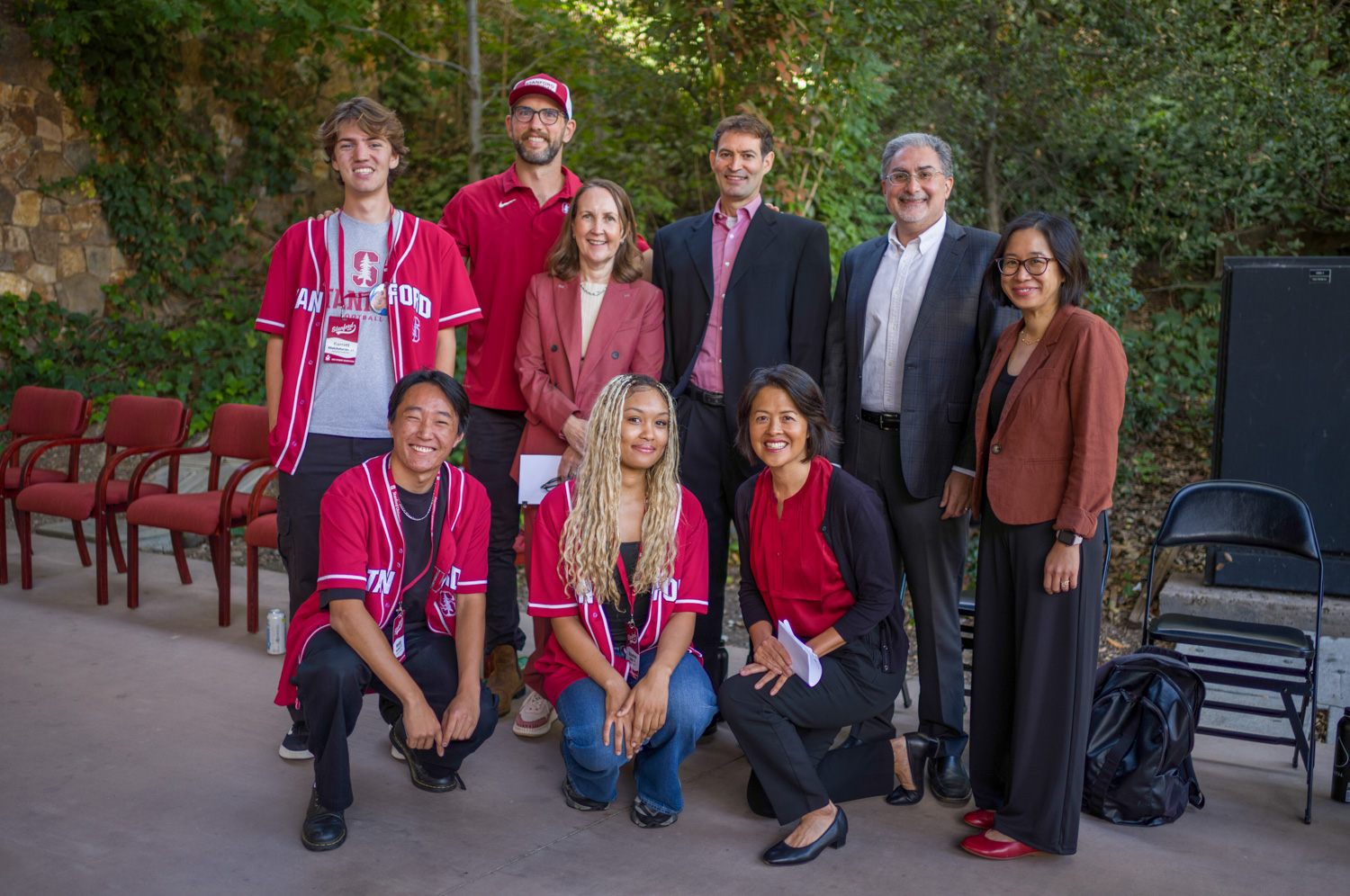
The panelists pose with NSO student coordinators and Stanford Football General Manager Andrew Luck. | Aaron Kehoe
Take advantage of access to experts
Stanford is full of opportunities to learn from leaders at the top of their field, panelists noted – and in some instances, from faculty who pioneered new disciplines of study, which was what Mehran Sahami, ’92, MS ’93, PhD ’99, experienced when he took a class on decision-making taught by Ronald Howard, a seminal figure in the field of decision analysis.
“It really, in a fundamental way, changed how I make decisions in the world,” Sahami reflected.
Howard showed Sahami what the field was capable of, but also its limitations – a lesson in humility, which was also illuminating for the young computer science major. “One of the things that Ron talked about at the very beginning of class, which I really appreciated, was that there are big D decisions and there are little D decisions, and you should only apply these techniques to little D decisions, which are things that you can actually analyze. Big D decisions are decisions of the heart, and those you have to make with your heart.”
Take classes beyond the scope of your major
Climate scientist Noah Diffenbaugh, ’96, MS ’97, shared how he took classes on William Shakespeare, Zen Buddhism, and the modern Black freedom struggle, and found them all deeply enriching.
Diffenbaugh recommends Introductory Seminars (or “IntroSems”), discussion-based courses for frosh, sophomores, and new transfer students that explore a discipline in an unconventional or quirky way – which were not available to him when he was an undergraduate Earth systems major.
“IntroSems are just an amazing opportunity to be in a small classroom with a professor talking about something that the professor is, as we’ve heard, literally a world expert in,” said Diffenbaugh, a professor of Earth system science in the Doerr School of Sustainability.
Don’t be intimidated by faculty
All on the panel encouraged going to office hours as a way to get to know Stanford faculty – which they acknowledged can feel daunting. A little bit of courage helps.
“Don’t be afraid of your professors,” Kathryn Lum, ’04, urged.
Say hi when you see them on campus, Diffenbaugh said. And, if you are unsure about starting a conversation, Sahami has a tip guaranteed to get any teacher talking: “Five words, remember them. They’re easy: ‘Tell me about your research,’” Sahami said.
Find mentors
“Mentorship has been really important to me in my journey, both as a student and now as a professor,” said Lum, who grew up in the Bay Area and began college on the East Coast. But when her father became ill and passed away soon after, Lum transferred to Stanford to be closer to home. “It was really hard for me my first year, actually both years here, honestly,” Lum said. “I found faculty mentors who really helped me navigate through that, not just academically, but also at a personal level.”
Faculty are not the only people who can mentor you: TAs, graduate students, and postdocs can also become a trusted person to turn to for advice. “It’s also important to remember that one mentor isn’t going to address all the guidance that you need in your life,” said Tsai. “There might be some people who you ask more about personal things, and other people who you ask more about professional things.”
Explore research opportunities
Diffenbaugh emphasized that Stanford offers undergraduate students something exceptional: opportunities to take part in research.
“The research opportunities are really special in terms of the support and the availability of faculty, graduate students, and postdocs,” said Diffenbaugh, who highlighted the many opportunities to get involved in research and independent projects through the Vice Provost for Undergraduate Education. Stanford also has internships and research opportunities available to students over the summer, Tsai noted.
It may take perseverance to find the right lab to work with, Diffenbaugh said. “But knock on a few doors, there’s a lot of openness to having undergraduates engaged even on a one-quarter basis, and then that can grow into something longer term.”
Don’t let AI shortcut learning
As you consider how to use AI, ask yourself why you are here, said Sahami. “Did you come here to get a bunch of grades, like letters from the beginning of the alphabet on a thing called a transcript, or did you come here to learn something?”
Using AI to offload the effortful work that hard, critical thinking demands risks “short-circuiting” the learning process, he said.
“You don’t build muscles by watching a video of someone else working out, which is basically what’s happening if you use AI to do the work for you,” Sahami said.
For Lum, doing the hard work is what makes learning deeply fulfilling. “Writing is, I mean it, frustrating. It can be really difficult, but it’s also incredibly rewarding to produce something by yourself,” she said.
When it comes to research, Diffenbaugh said, AI is a powerful tool for tackling complex questions with large data sets. “Machine learning is helping us to find the signal in the noise,” he said.
Go all in on campus traditions
Tsai recommends going to the “Big Game” between Stanford and Cal, hiking the Dish, and attending the Viennese Ball. Sahami suggested taking a picnic to the Rodin Sculpture Garden.
Lum encouraged students to learn about the Stanford family who founded the university: Go to the Cantor Arts Center, where some of that history is on view, and visit the mausoleum.
Diffenbaugh also encouraged students to take in new perspectives, including attending a gathering at White Plaza, which serves as a central place on campus for freedom of expression and where members of the Stanford community can hold events.
“White Plaza has an amazing tradition of being a place where people express themselves,” said Diffenbaugh, who emphasized that throughout NSO and their first year on campus, students will learn and develop skills to engage across differences in ways that are curious, honest, and spirited.
“Free speech is really fundamental to our mission as a university,” said Martinez in closing. “Empowering all of you to engage freely with ideas, to be curious about ideas that you haven’t encountered before, to be open to discussing even very controversial topics is something that we really view as fundamental to a Stanford education.”
For more information
Diffenbaugh is the Kara J Foundation Professor and Kimmelman Family Senior Fellow in the Stanford Doerr School of Sustainability, and the Olivier Nomellini Family University Fellow in Undergraduate Education.
Sahami is the Tencent Chair of the Computer Science Department and the James and Ellenor Chesebrough Professor in the School of Engineering.
Lum is the William Robertson Coe Professor of History and American Studies and a professor of religious studies.
Writer
Melissa De Witte