In brief
- Researchers analyzed more than 1,900 scans of adult human brains and identified a network of language-selective brain regions that is unique to each person.
- The study bypassed debates over the nature of language by focusing on patterns of connectivity among brain regions.
- Mapping these individualized networks could help researchers better understand how brain injuries disrupt language.
The language network in your brain can be seen, even if you aren’t saying a word.
For a study published in Nature Communications, researchers used data from more than 1,900 functional magnetic resonance imaging (fMRI) scans to find significant support for the existence of a language-specific network of neurons in the adult human brain. They could detect this network even when the people whose brains were scanned were at rest or performing a task unrelated to language such as putting together a puzzle or listening to music.
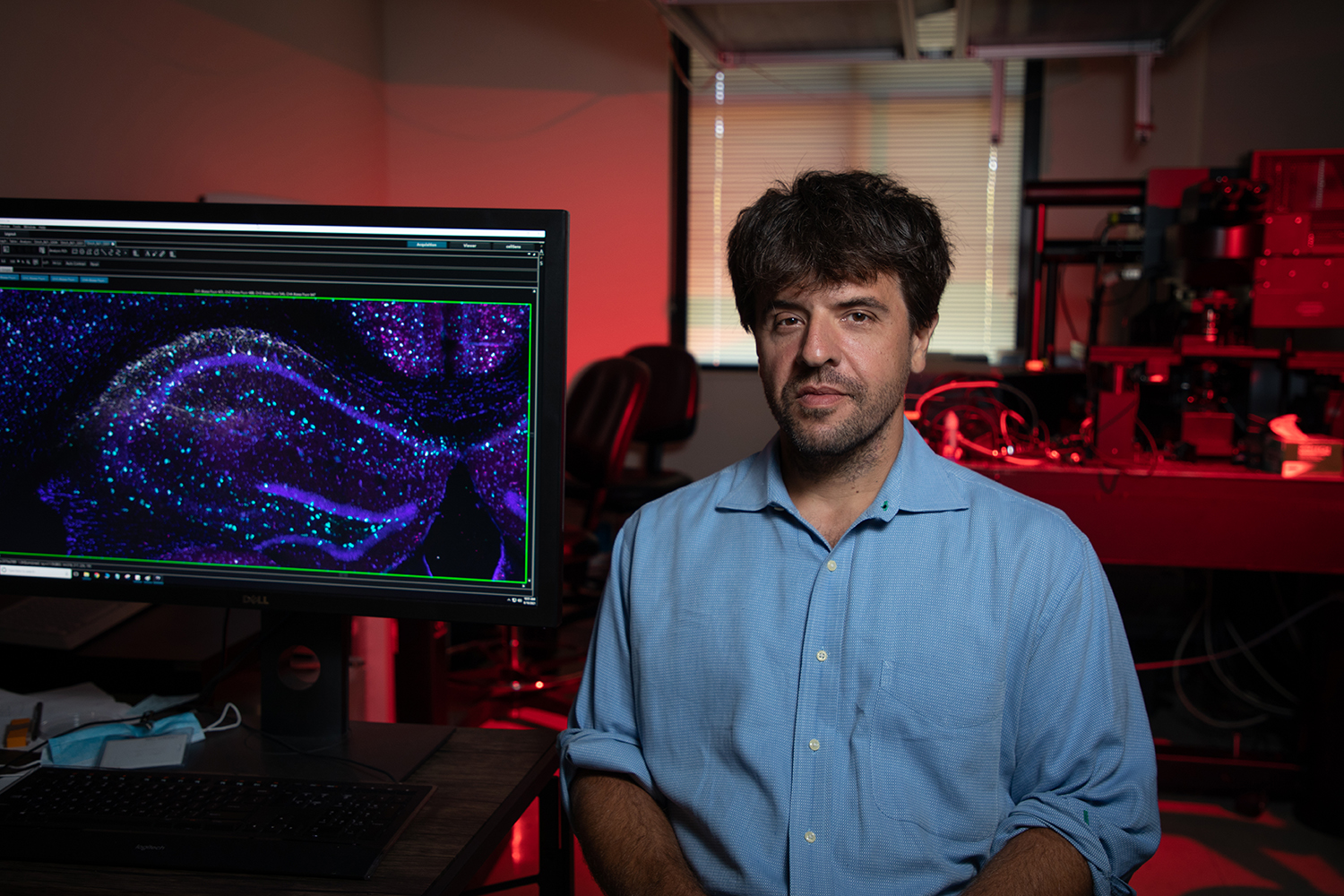
“The human brain appears to have a network that’s selective and necessary for language, and we can find that network from the activity in the brain alone,” said Cory Shain, lead study author and assistant professor of linguistics in the Stanford School of Humanities and Sciences. “The simple fact that a person’s brain activity is always going up and down lets us detect where this network is with high fidelity. It’s such an important and stable structure that we can find it no matter what someone is doing.”
Shain and co-author Evelina Fedorenko of the Massachusetts Institute of Technology found that much of the language network generally spans the left hemisphere frontal and temporal regions of the brain, but the details of its structure are different for each individual. The study findings could help make a range of advances, including finding therapies for the communication problems caused by strokes or other brain injuries.
The nature of language in the human brain has inspired many theories and been a source of debate since the 1800s. The discovery of aphasia, the selective difficulties with speech or writing caused by brain injuries, indicated that there is some structure in the brain that controls language, but the details remain controversial.
“Language is a very complex thing,” Shain said. “It’s like a spider web that ties together almost everything about us. It’s hard to reach agreement on a definition of language, or even whether language is a unified ‘thing’ at all. With this study, we tried to set aside our preconceptions about what language is and ask what the brain itself is telling us about how language might be implemented.”

The human brain appears to have a network that’s selective and necessary for language, and we can find that network from the activity in the brain alone.Cory ShainAssistant Professor of Linguistics
Seeing the individual within a big data set
While previous research has focused on small groups of subjects, the current study accessed a large dataset from prior studies in Fedorenko’s lab. This included 1,957 fMRI sessions from the brains of 1,199 individuals.
Similar to the well-known MRI scan, which produces a still image, an fMRI scan takes video of the blood flow in a person’s brain. Blood flow is driven by neuron activity, so scientists can use fMRI scans to see the connected networks of small brain regions, also called “functional connectomes,” by observing which regions show an increase or decrease in activity at the same time.
In addition to having a large data sample for their study, the researchers were able to take a close look at individual results, instead of just averaging findings across participants. Within individual brains, they reliably found a network of highly interconnected regions that were located in the same general area that prior research had identified as potentially related to language.
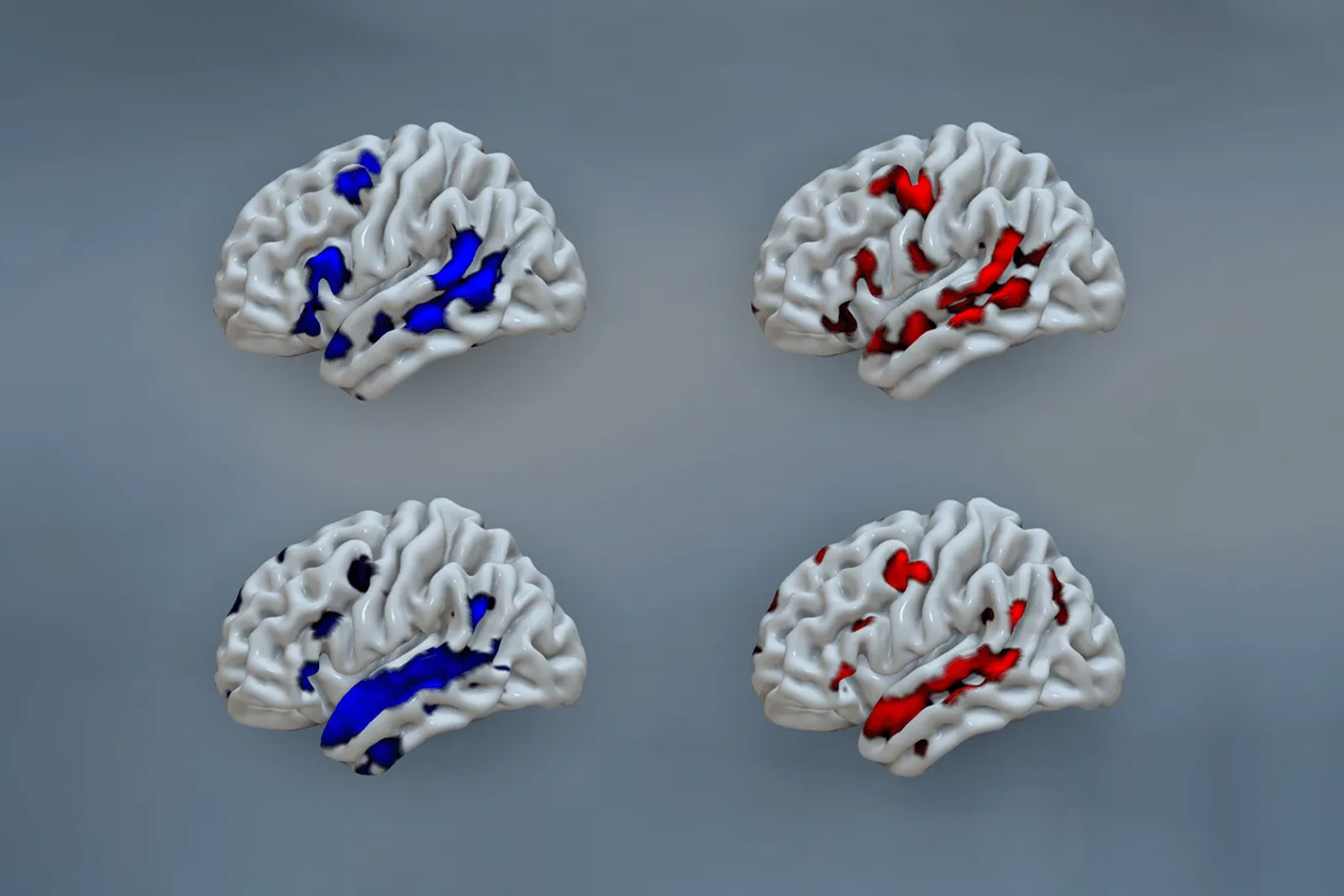
The language networks of two different individuals (top and bottom) were identified using two different methods (left and right). Scans identified the blue networks when the individuals were not performing language-related tasks and the red networks when they read sentences and then nonsense words. This illustrates how the language network can vary between individuals and how it can be identified without having an individual speak, read, or write. | Courtesy Stanford H&S
Finding the language structure without words
As part of the experiments that the researchers analyzed, the participants often performed several different types of activities while undergoing fMRI scans. For instance, they might perform a non-language-related task, such as matching colored squares on a grid, and later a language-specific task, such as reading aloud.
To identify a participant’s language network, the researchers first looked at activity over time in different regions of the brain, without considering the type of task the person was doing while in the scanner. They then identified a range of potential networks, including the one for language. The language network that they identified this way, based only on activity over time, responded strongly to language and little else.
Then, the researchers went a step further to see whether language was necessary to identify the network at all. To do this, they dropped all the information gathered from language-related tasks, leaving only data from nonlinguistic tasks. They were still able to find in each individual a very similar network to the one that they had identified based on all the data. The language networks varied in shape from person to person, but within an individual, the network’s structure was very consistent no matter the task performed.
This ability to find a person’s language network – without needing that network to be directly activated by a language-related task – could open the door to many advances, including new approaches to help people with brain injuries, Shain said.
“If we can reliably determine how the damaged areas were organized on the basis of the organization of the rest of the brain that's still intact, then we could discover new things about the causes and consequences of aphasia, which could have clinical relevance for a lot of people,” he said.
For more information
Shain is also a member of Bio-X and the Wu Tsai Neurosciences Institute and is associated faculty of the Institute for Computational and Mathematical Engineering (ICME) in the Stanford School of Engineering.
This research received support from the National Institutes of Health, the McGovern Institute for Brain Research, MIT’s Department of Brain and Cognitive Sciences, the Simons Center for the Social Brain, and MIT’s Quest for Intelligence.
This story was originally published by Stanford School of Humanities and Sciences.
Media contact:
Sara Zaske, School of Humanities and Sciences
510-872-0340, szaske@stanford.edu
Writer
Sara Zaske