In brief
- The Stanford Doerr School of Sustainability recently hosted a forum to discuss pressing sustainability challenges and innovative solutions.
- Keynote speakers emphasized the need for affordable clean energy and local community engagement for effective disaster responses and food security.
- Researchers presented breakthroughs in combating wildfire pollution and coral recovery, highlighting Stanford's commitment to addressing climate threats.
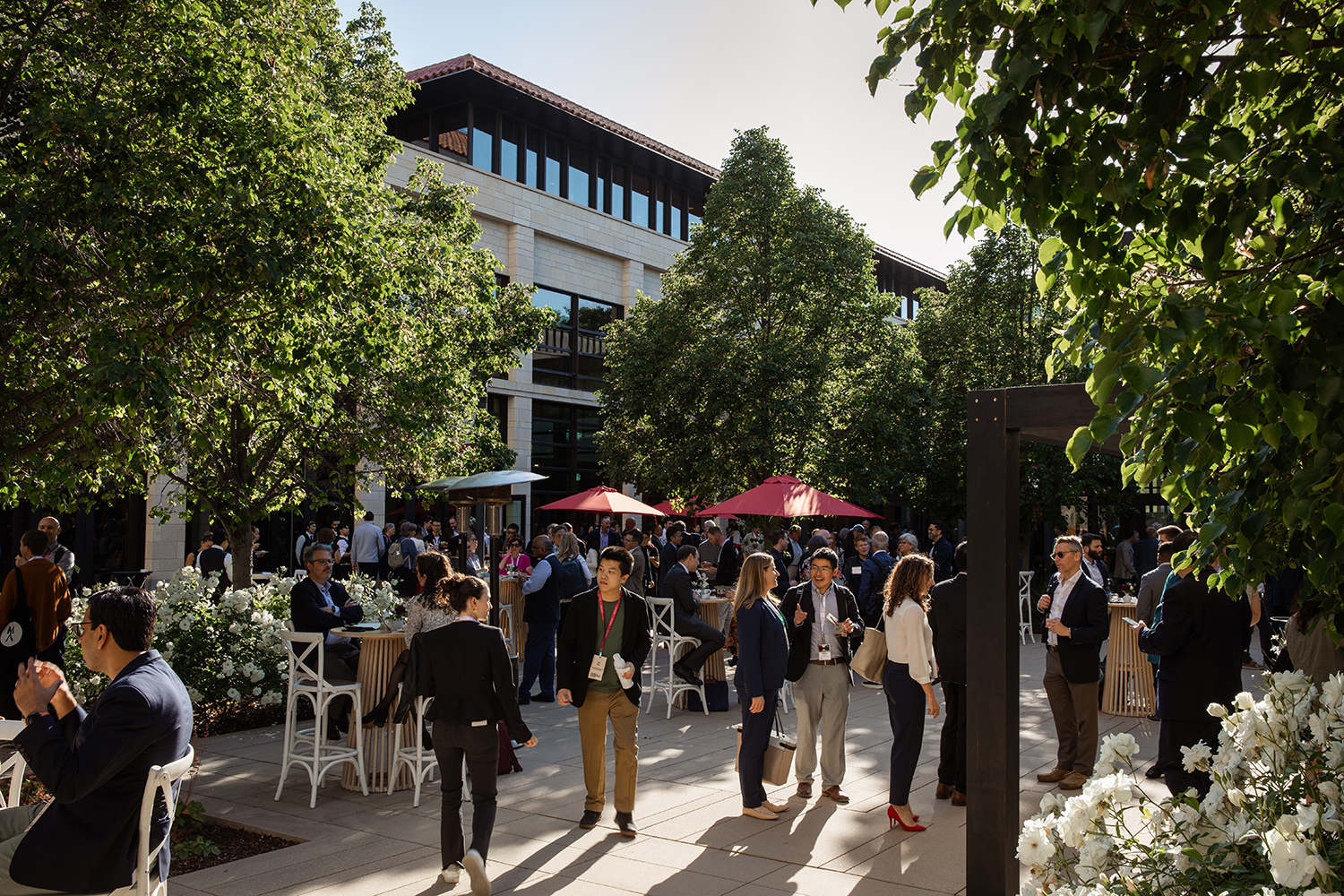
Across two days of panels and presentations, participants in the Stanford Sustainability Forum examined how solutions to planetary challenges can move from laboratories and pilot projects into widespread use. | Patrick Beaudouin
“We created the Doerr School of Sustainability with a vision both simple and audacious: to serve life on Earth,” Arun Majumdar, the school’s dean, said after the event. “The school is the highest expression of what a great university owes the world. This is our social contract for the 21st century.”
Food security as national security
Chef José Andrés, founder of the food-relief nonprofit World Central Kitchen, stressed that effective disaster response and recovery involve listening to local residents and recognizing resources on the ground – from restaurants and bakeries that can be converted to emergency kitchens, to fishers and boat owners who can help supply and deliver food. “You cannot bring everybody from the outside. You need to rely on the power of the local community,” he said.
He also warned that Florida’s near-total loss of orange production signals risks to staple crops. “I’m fascinated that this is not at the highest level of national security in the country,” Andrés said. “What happens if we have a big drought at the same time equally in the food production areas?” He warned of the risk of mass starvation and urged governments, starting with the United States, to have a “national security food advisor very close to the ear of the president.”
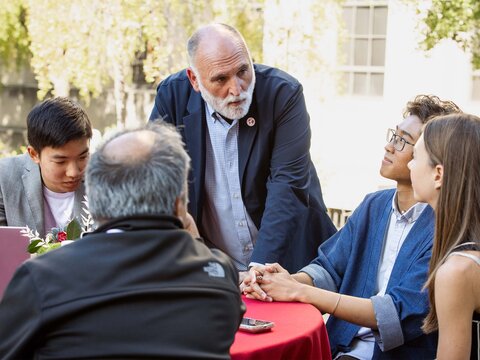
Chef and restaurateur José Andrés, founder of the food-relief organization World Central Kitchen, spoke with students at the forum. | Patrick Beaudouin
Key to the solution, he said, is simplifying the core mission of agencies tasked with providing emergency food aid to “feed everybody and as quick as we can, bring water to everybody as quick as we can, and do whatever it takes to do it today.”
Building ‘herd immunity’ against fire
California’s rainy season now arrives about 30 days later than it did decades ago, leaving vegetation tinder dry when late fall winds peak, said Ann Patterson, a policy scholar at Stanford who previously advised the governor on wildfires and insurance issues. “That’s a recipe for wildfire disaster,” she said.
The number of extreme fire weather days in California has doubled since the early 1980s and is expected to grow with continued warming, she added. Even homes hardened against fires are at risk of burning if surrounded by neighbors with wooden roofs and fences. “You have to have kind of herd immunity,” Patterson said. Policies and regulations can help drive the necessary coordination.
Alongside the pursuit of policy and technological solutions, Stanford Climate and Energy Policy Program director Michael Wara said it’s important to understand the context for climate impacts. “The impacts that people feel are very contextual, and they depend on both the vulnerabilities that were there to start with that are maybe becoming more extreme, more frequent due to the changing climate, but also the societal context in which risk and hazard exist,” he said.
‘We must mobilize all’
Former UN Secretary-General Ban Ki-moon called for sustained partnerships among governments, businesses, and civil society to limit climate change and mitigate its impact, referencing the goal of keeping global temperatures below 1.5 degrees Celsius above pre-industrial levels.
“We just began talking about the 1.5 degree limit. It’s now almost impossible if we go in this speed. Therefore, we must mobilize all,” he said in a panel discussion moderated by 66th U.S. Secretary of State Condoleezza Rice, the Tad and Dianne Taube Director of the Hoover Institution and the Denning Professor in Global Business and the Economy at the Stanford Graduate School of Business.
Author and journalist Thomas Friedman argued that planetary-scale challenges including climate change and AI governance have “fused” the world in a common fate, and that technology companies have become central to geopolitics and climate outcomes in ways that rival traditional government power. “The center of gravity has shifted to the G7, and it seems to me the G7 are Meta, Microsoft, Google, Anthropic, OpenAI, xAI, and Amazon,” Friedman said.
AI reshaping energy systems
Artificial intelligence is creating new energy demands while potentially accelerating clean energy deployment, said William Chueh, director of the Precourt Institute for Energy. “The need to power AI rapidly and sustainably is driving the deployment of capital and the development of technologies,” he said.
Fei-Fei Li, founding co-director of Stanford’s Institute for Human-Centered Artificial Intelligence, cautioned against both overstating AI’s immediate capabilities and underestimating its long-term trajectory. “It truly is advancing at a breathtaking rate, but the hype cycle is also advancing at an even bigger breathtaking rate,” Li said.
She emphasized that AI’s energy needs will extend beyond data centers as the technology advances and more computation moves onto devices. “Truly, robots will be coming. Smart devices, smart appliances, all this will be coming when they are in our daily life. And that’s a different pattern of not only energy consumption but also energy distribution,” she said.
Bridging the financing gap
In a video shown to forum attendees, Stanford alumni described how the university encourages students to think about deploying knowledge beyond academia. Entrepreneur James Kanoff, BS ’22, said he was urged as a student to consider “how do we build the solution at scale now.” The company he co-founded is now field testing a method for removing carbon dioxide from the atmosphere by accelerating the natural process of rock weathering.
Even proven technologies often falter at commercial deployment because of financing structures and regulatory barriers, forum panelists said. First-of-a-kind projects typically require hundreds of millions or billions of dollars that traditional equity financing cannot provide, said Eric Toone, chief technology officer of Breakthrough Energy. “We need new financial models to bring successful technology innovations to the broad society.”
‘Glimmer of hope’
Earth system science professor Scott Fendorf presented research showing toxic metal particles in wildfire smoke small enough to move directly into the bloodstream can travel thousands of kilometers through the air, often hours ahead of the main smoke plume.
New approaches to sampling smoke and sensing toxicity under development in his lab are opening pathways to predict and mitigate this threat. “As we go into the future, it’s really a more hopeful period that we can give you agency on how to fight the toxins that are in there,” Fendorf said.
Danny Collins, a PhD student in the lab of oceans professor Fiorenza Micheli, shared promising results showing healthy corals can share symbiotic algae with bleached corals through connecting tissue and revive them within days. “We’ve shown we can recover bleached corals through just contact with healthy corals, which is a glimmer of hope for coral reefs,” Collins said.
Nobel laureate and Stanford chemistry professor Carolyn Bertozzi noted that transformative advances often originate outside their primary disciplines. High-throughput DNA sequencing came from semiconductor industry techniques, she said, while AI from applied mathematics is disrupting drug development.

Nobel laureates Steve Chu (left), Frances Arnold (center), and Carolyn Bertozzi (right) discussed unanswered scientific questions at the forum. | Patrick Beaudouin
“A lot of the problems of the day, you look at them on their face and you don’t realize that the answer might come from a completely unexpected place,” said Bertozzi, the Baker Family Director of Sarafan ChEM-H and the Anne T. and Robert M. Bass Professor in the School of Humanities and Sciences.
Stanford paleobiologist Jonathan Payne said studying Earth’s past mass extinctions makes it clear that interventions today can make a difference within our lifetimes. “We can create a world that’s better not just for future generations whom we’ll never meet, and whose lives we can scarcely imagine, but for ourselves and for the people that we live with today,” he said.
For more information
Majumdar is also the Jay Precourt Professor and a professor of mechanical engineering, of photon science, and of energy science and engineering. He is a senior fellow at the Precourt Institute for Energy and the Woods Institute for the Environment.
Rice is also the Thomas and Barbara Stephenson Senior Fellow on Public Policy at the Hoover Institution and a professor of political science in the School of Humanities and Sciences.
Chueh is the Kimmelman Professor and a professor of materials science, of energy science and engineering, and of photon science. He is also a senior fellow at the Precourt Institute. Li is the Sequoia Capital Professor at Stanford and a professor of computer science in the School of Engineering.
Patterson is a policy scholar at the Woods Institute and the Stanford Sustainability Accelerator, both in the Doerr School of Sustainability. Wara is senior director of policy at the Accelerator and a senior research scholar in the Woods Institute. The Climate and Energy Policy Program is a program of the Woods Institute in partnership with the Environmental and Natural Resources Law & Policy Program at Stanford Law School.
Micheli is the Harold A. Miller Director of Hopkins Marine Station, the Lucile Packard Professor of Marine Science, and chair of the Oceans Department. Fendorf is the Terry Huffington Professor and senior associate dean for research in the Doerr School of Sustainability, a professor of Earth system science and of photon science, and Woods Institute senior fellow. Bertozzi is a professor of chemistry in the School of Humanities and Sciences. Payne is the Dorrell William Kirby Professor in the Department of Earth & Planetary Sciences and senior associate dean for faculty affairs in the Doerr School of Sustainability, and a Woods Institute senior fellow.
This story was originally published by Stanford Doerr School of Sustainability.
Writer
Josie Garthwaite