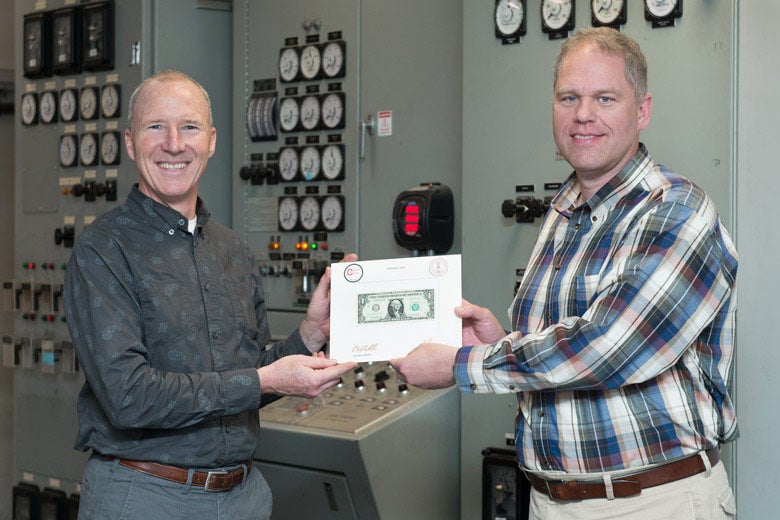
Cardinal CoGen plant general manager Ron Dahlin, left, receives a dollar from Ron Gawer, manager of the new SESI plant, as payment in full for the now offline Cardinal CoGen plant. (Image credit: L.A. Cicero)
Stanford has said goodbye to an old friend.
Cardinal Cogeneration, an energy plant located off Campus Drive at Via Ortega, has been closed and shut off as part of the ramp-up to the Stanford Energy System Innovations (SESI) April conversion.
The plant was formally decommissioned Tuesday. Stanford, represented by Ron Gawer, director of energy operations, bought back the plant from its owner, Cardinal Cogeneration, a subsidiary of General Electric, for $1. After useful equipment from the plant is sold, the building will be demolished.
Technically, however, the plant decommissioning has already occurred. Although SESI will not formally debut until today (April 1), it has been online providing energy to the campus since March 24.
Cardinal Cogeneration provided virtually all the university’s energy needs for about 30 years. The natural-gas-fired plant was considered remarkably efficient for its time. It produced steam, chilled water and more electricity than Stanford actually used. Some 40 percent of the electricity produced by Cardinal Cogeneration was sold to the Pacific Gas & Electric grid.
Commissioned in 1987, Cardinal Cogeneration worked by using fossil fuel to produce electricity and then recovering and reusing waste heat from the combustion process. For many years, Cardinal Cogeneration helped Stanford achieve the lowest energy consumption per gross square foot of any research university in California.
Lost in the process, however, was much of the heat generated by cooling processes. That heat ended up discarded into the atmosphere – visible throughout campus – through evaporative cooling towers. SESI corrects that shortcoming, taking heat recovery to the next step by capturing and reusing discarded heat.
SESI enables the university to cut its greenhouse gas emissions by 68 percent and reduce water usage another 15 percent beyond the levels achieved since 2000. Although efficient, Cardinal Cogeneration accounted for 85 percent of the university’s greenhouse gas emissions and used 25 percent of its fresh water supply.
Before construction of Cardinal Cogeneration, the university used a boiler plant for its energy needs. That boiler plant was retained and, until recently, provided backup power for the university. An ice plant was added to the site in 1999 to provide additional cooling capacity. Both of these legacy facilities will be demolished along with the cogeneration facility to make room for a building to house the new Stanford Neurosciences Institute and Stanford ChEM-H.
Author
Kate Chesley