The Office of the Vice Provost for Undergraduate Education (VPUE) has awarded seed funding to 12 course and curriculum projects through the inaugural round of AI in Teaching and Learning at Stanford, a program that supports instructors working on critical issues in AI and higher education. The 12 proposals were drawn from over 60 applications submitted by faculty and lecturers across the university.
The awards, administered by the Center for Teaching and Learning (CTL), include a planning grant and 11 course and curriculum implementation grants, and will fund projects in the Graduate School of Education, the School of Humanities and Sciences, and the School of Engineering; and programs overseen by VPUE. Projects began on Aug. 1, 2026. CTL will support the grant awardees with pedagogy consultations, individualized support, regular check-ins, and a final showcase event where they will share their discoveries with the Stanford community.
AI in Teaching and Learning at Stanford Grants
The Stanford Accelerator for Learning has announced further AI in Teaching and Learning at Stanford Grant awards: Innovation with Evidence Grants to fund the development and evaluation of AI-enabled teaching approaches, and Thought Leadership for scholarly and intellectual works.
Graduate School of Education
Christine Min Wotipka, associate professor (teaching) of education, is leading a planning grant that brings together a group of education master’s program directors, as well as the Stanford teacher education program and joint MA/MBA in Education and Business Administration. The group will run surveys and listening sessions, a focused speaker series, and hold working groups and a working retreat to produce a shared framework to guide the coordinated, intentional use of generative AI across their programs.
School of Humanities and Sciences
Brian Conrad, professor of mathematics; Lernik Asserian, senior lecturer in mathematics; and Romain Speciel, PhD student in mathematics, will explore how AI tools are changing the way mathematics is learned, practiced, and communicated, creating a new course on mathematical communication that will encourage students to develop an informed relationship with AI tools.
Tselil Schramm, assistant professor of statistics; Judith Fan, assistant professor of psychology; Dennis Sun, associate professor (teaching) of statistics; Julia Palacios, associate professor of statistics and biomedical data science; and Jonathan Taylor, professor of statistics, propose an integrated curriculum project across four large introductory statistics courses, and will evaluate which interventions improve student learning and experiences. The team will share instructional materials, create new assessment methods, and report on their design choices and implementation plan.
Srđan Keča, associate professor of art and art history; Shane Denson, professor of art and art history; and Morehshin Allahyari, assistant professor of art and art history, are developing a redesigned curriculum and studio tool changes that bring AI into art-making instruction, along with a pedagogical “cookbook” for teaching arts with and against AI.
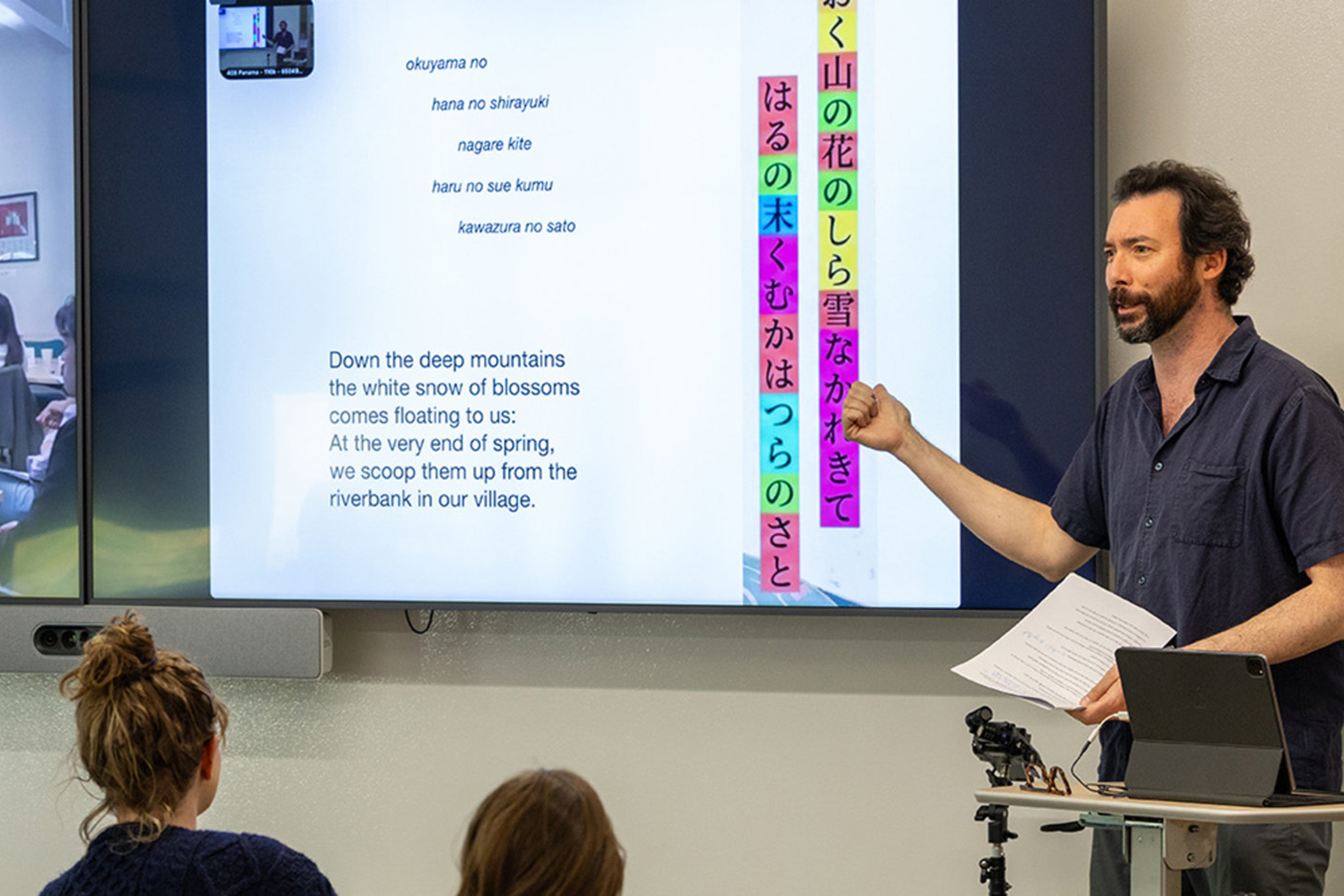
After finding that off-the-shelf chatbots overwhelmed language learners with information rather than teaching them, Ariel Stilerman, assistant professor of East Asian languages and cultures, built three custom AI tools for students of premodern Japanese, including a tutor that asks guiding questions rather than handing over translations. With the grant, he will create new assignments that integrate these tools into coursework and establish metrics to evaluate their effect on student learning.
School of Engineering
James Landay, professor of computer science and the Anand Rajaraman and Venky Harinarayan Professor in the School of Engineering; Chris Piech, assistant professor (teaching) in computer science; Alan Cheng, PhD student in computer science; and Justin Blumencranz, masters student in computer science, are implementing coding-interviews as a form of assessment for CS147L, Cross-Platform Mobile Development, to verify that students genuinely engage with and understand the work they submit, and closely evaluate their effectiveness.
Nick Troccoli, lecturer in computer science, is introducing AI-administered, teaching-assistant-graded interviews in CS107, Computer Organization and System, as a way to assess student understanding of programming assignments, a parallel approach to the assessment challenge that Landay's team is also addressing.
Keith Winstein, associate professor of computer science, is building an AI grading assistant for CS144, Introduction to Computer Networking, which enrolls about 200 students each term, to take over time-consuming style and code-quality grading so that course assistants can spend more time running small-group tutorials with students.
Nicolas Lee, senior lecturer in aeronautics and astronautics; Marco Pavone, associate professor of aeronautics and astronautics; and Mac Schwager, associate professor of aeronautics and astronautics, will take a scaffolded approach in three related courses to develop students’ critical AI literacy to evaluate and deploy AI tools.
Sho Takatori, associate professor of chemical engineering, is expanding on a pilot in which he used AI to build interactive simulations of engineering equations live in class. Students will build their own AI-generated simulators, keep “prompt journals” documenting how they checked and corrected the AI output, and complete a capstone project connecting math and art.
Office of the Vice Provost for Undergraduate Education
Advanced lecturers in the Program in Writing and Rhetoric: Lisa Swan, Christopher Kamrath, and Megan Formato, will generate a shared lesson plan across three writing courses for instructors and students to co-create classroom norms around AI use. They hope to ease the social pressure many students feel to use AI on sustained reading and writing assignments.
Sarah Pittock and COLLEGE lecturers Hannah D’Apice, Caitlin Brust, Katie Fiocca, Mahel Hamroun, Moya Mapps, and Meghan Warner are addressing the fundamental skill of college reading and a related pressure: the temptation to let AI-generated summaries substitute for close reading. For COLLEGE 101, Why College? Your Education and the Good Life, and 102, Citizenship in the 21st Century, the team will build multiple resources – including an annotated bibliography and training workshops for the instructors who teach these courses each year – new student-facing reading guides, and a symposium next spring to share what they have learned.
Together, the 12 projects demonstrate the range of creative approaches, urgency of the challenges, and the commitment to innovation, discovery, and enhancing student learning of Stanford instructors.
CTL plans to share more about the cohort's progress, including a synthesis of common themes across the proposals, later this year. To learn more and to find resources and updates to help instructors engage productively and teach effectively in the context of generative AI, visit AI Meets Education at Stanford (AIMES) online.
For more information
This story was originally published by Center for Teaching and Learning.