Transit maps hold a unique place in both the urban environment and the cultural zeitgeist, often transcending their utilitarian purposes to become symbols of cities and nations alike. Iconic transit maps such as Henry Charles Beck’s 1933 map of the London Underground or Vignelli’s 1972 map of the New York subway have been lauded as cultural touchstones that were both inspired by the past and have influenced the future.
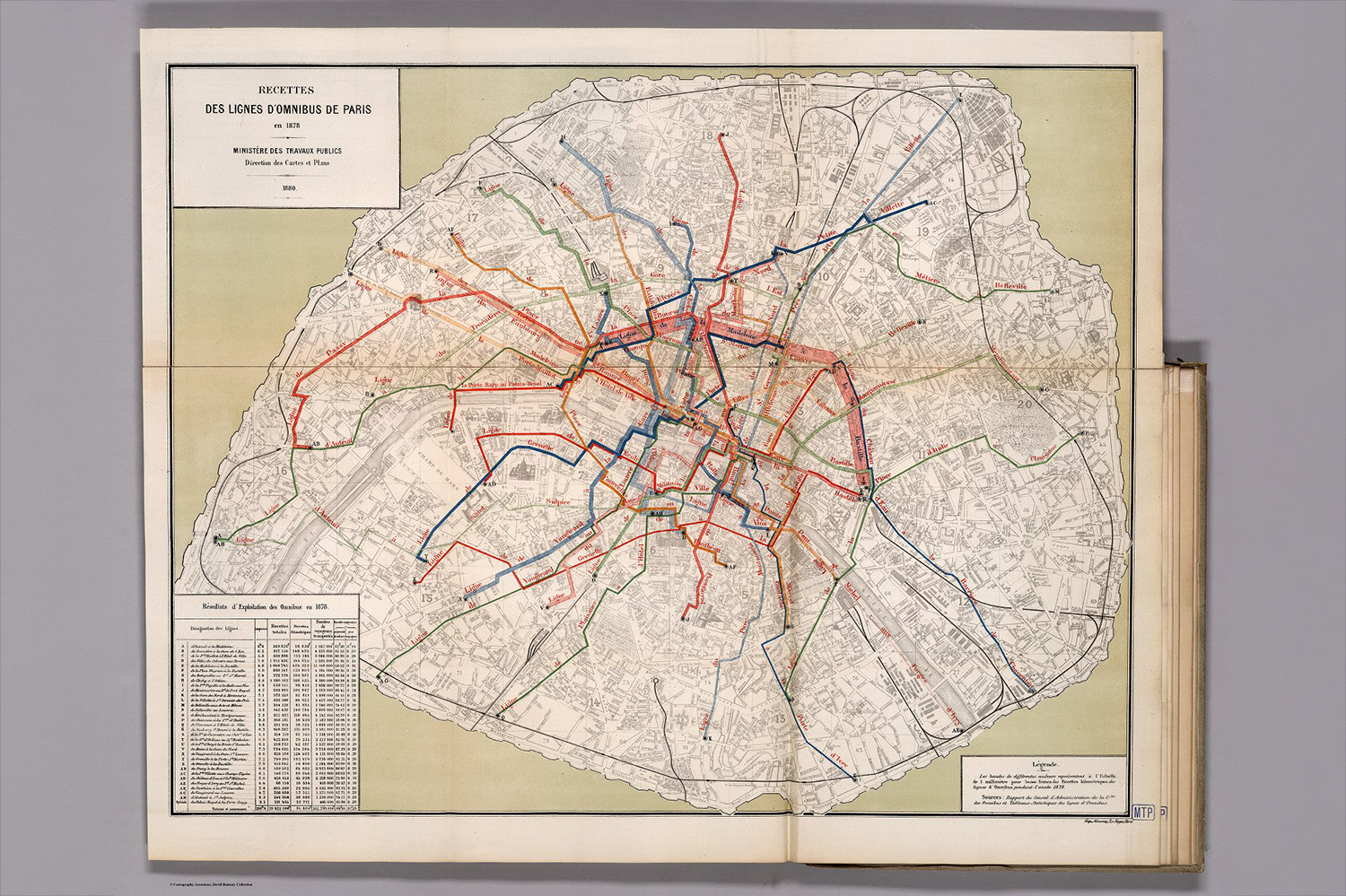
You Are Here: Transit Cartography and Spatial Identity is a new exhibition exploring that relationship between transit maps and the identity of their subjects. The exhibit traces the evolution of a shared cartographic language, from early, inconsistent attempts to map transit – including an 1881 statistical map of the Paris Omnibus system – to Beck’s now-famous 1933 Underground map, which set a template still recognizable today: eliminating the street grid, keeping only the Thames as a geographic anchor, and relying on clean 90- and 45-degree angles to simplify a sprawling network.
That design language spread far beyond subways, turning up in 1930s Imperial Airways route maps and Soviet-era transit posters, and continues to inform new projects today, including London’s Black History Tube Map, which reimagines Beck’s design to spotlight Black activists, artists, and transportation workers across the city’s history.
Curated by Jayne Kilander, winner of the California Map Society Student Exhibition Competition, the exhibit is open Wednesday and Thursday from 1 to 5 p.m. and Friday from 9:30 a.m. to 5 p.m, and will be on view through Friday, Aug. 21, 2026. It is also available to view digitally.
Coming to campus
As a platinum-level Bicycle Friendly Campus, Stanford offers more than 13,000 bike parking spaces. The Marguerite shuttle is free and open to the public, traveling to and around Stanford campus on weekdays. Hourly paid visitor parking is available in designated areas and managed through Park Mobile. Many lots on campus are free after 4 p.m.
Coming soon: Local updates from Stanford
Sign up to receive weekly news about campus activities, events, and research.