Third-year undergraduate Jessie Bough grew up in rural Montana, where wheat fields stretched for acres. Moving to Stanford’s palm-tree-lined campus between oak-dotted hills and the bustle of Silicon Valley was – and still is – a significant change for Bough. Like many students, she has sought ways to bridge her experiences.
“A lot of what I’ve done at Stanford is because I grew up in an area where there was a lot of agriculture,” said Bough, who is majoring in Earth systems with a track in sustainable food and agriculture. “Any opportunity I have to integrate that, I usually do. It’s what I connect with most and a part of me that I want to share.”
That connection is stronger than ever for Bough, thanks to the immersive writing seminar Environmental Storytelling (EARTHSYS 177M/277M) and the time it splits between the university’s O’Donohue Family Stanford Educational Farm and an urban garden in Fremont.
The Farm
Stanford University has been affectionately known as “the Farm” ever since it was established by founders Leland and Jane Stanford on their Palo Alto stock farm. There is still a farm on campus, in the form of O’Donohue Family Stanford Educational Farm. Part of the Doerr School of Sustainability, the 6-acre farm is located near the university’s historic Red Barn. There, staff and volunteers harvest more than 200 varieties of fruits, vegetables, and flowers throughout the year. A living laboratory for hands-on learning in sustainable agriculture, the farm offers academic and experiential learning opportunities for the Stanford community and beyond.
The class works in direct collaboration with Local Ecology and Agriculture Fremont (LEAF), an educational nonprofit whose urban farm in the East Bay functions as a regenerative agriculture lab, community gathering space, and living classroom.
E’jaaz Mason, a lecturer in the Earth Systems Program and the Environmental Communication master’s degree in the Stanford Doerr School of Sustainability, has taught the course for two years. Through 10 weeks of reporting, interviews, field trips, discussion, and collaboration with stakeholders, Mason offers hands-on lessons on the art of science communication, extolling the value of listening deeply and crafting human-centered narratives about environment, community, and justice.
“I love being able to translate complex ideas around the environment into stories that the general public will not only enjoy reading, but will be educated or inspired by,” Mason said.
Ten weeks, two stories, three farms
The course’s most deliberate design choice is also its simplest: it requires students to leave Stanford.
LEAF is roughly 25 minutes by car from campus, tucked amidst busy roads and train tracks. Most site visits are arranged as a class, with transportation provided. But students can also independently reach out to staff, volunteers, and community members to arrange additional site visits. Bough, for example, did a solo reporting trip to LEAF, which led to the revelation that a member of the LEAF team had a family farm not far from where Bough grew up.
“I can be in a place that reminds me of home, even somewhere I’ve never been before,” said Bough.
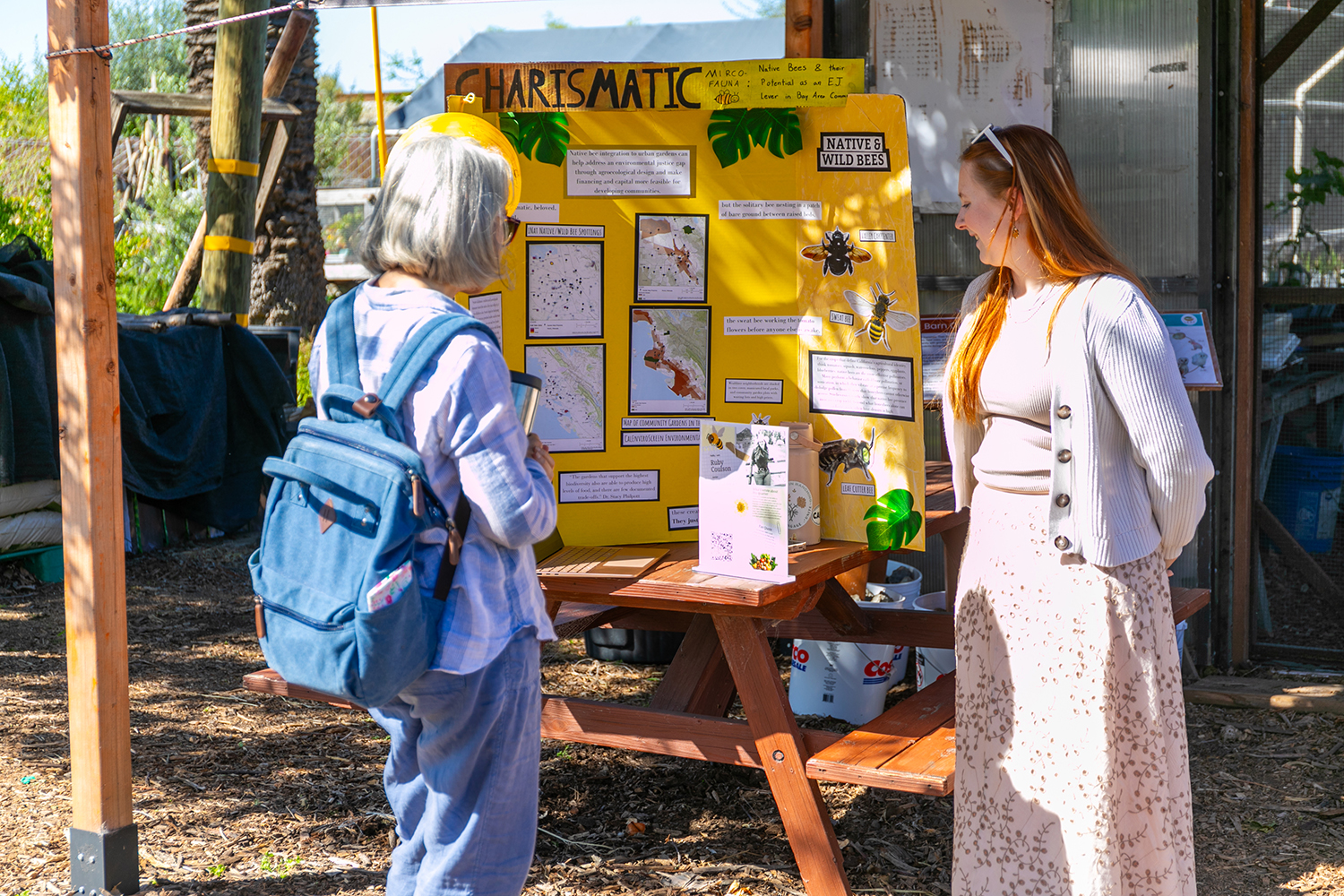
“Environmental Storytelling” student Ruby Coulson speaks about her project with one of the attendees of the Environmental Storytelling Showcase event at LEAF Urban Farm. | Nate Bernardo
LEAF’s work spans five areas: growing and donating fresh produce to local food banks, ecological and soil research, community education through school visits and programming, pollinator conservation through an on-site bee apiary, and hosting open community events. Students in the Environmental Storytelling course choose to focus on one of those areas through two storytelling projects.
Bough decided to write her first assignment, a short-form story, on bees in urban spaces, drawing on her nostalgia for plastic tubs of honey gifted from her Montana neighbors. The piece, published on Medium as part of the course, is embedded with photographs she took during her field visit – preparation for the course’s long-form narrative project, which requires a multimedia component. Students have incorporated videos, designed websites, and even made lemonade from LEAF honey and the educational farm’s Meyer lemons and mint.
Lily Joy, “LJ,” a coterminal master’s student in Earth systems finishing her undergraduate degree in comparative studies in race and ethnicity, also developed projects inspired by her home. Originally from Albuquerque, New Mexico, she joined the course wanting to tell stories about Indigenous communities and their relationship to the land. For her short-form piece, she wrote about LEAF through that lens. Her long-form project explores the connection between language and land.
Joy sees environmental storytelling as urgent work, not just craft. “The data is not having as much of an impact as we thought it was going to have,” she said. “Telling stories of people who have intimate relationships to the land gives others a better understanding of how they can get involved. It becomes more tangible.” For her own community in Albuquerque, she adds, oral storytelling has carried people through some of the hardest chapters in history.
As exemplified by Joy’s projects, Mason encourages students find common ground between what motivates them in their work or research and what that work can mean to communities.
“I want to help students who spend a ton of time in academia develop how they communicate science,” Mason said. “If we don’t prepare students to discuss their science with others, there are a lot of people who need that information who won’t have access to it, either because they’re not in the Stanford bubble or have historically been excluded from those conversations.”
He describes his teaching philosophy as helping students find the deeper why behind environmental storytelling, and believes that once they have it, the technical skills, like narrative arcs and interviewing, follow naturally.
The deeper why
Mason’s teaching is motivated by his own experiences. He grew up in New Orleans and was a teenager when Hurricane Katrina hit in 2005 – an experience he describes as core to who he is.
“These conversations around environmental sustainability, how to best protect communities, how to help people heal – they’re not just contextual for me,” he said. “They’re deeper than that.”
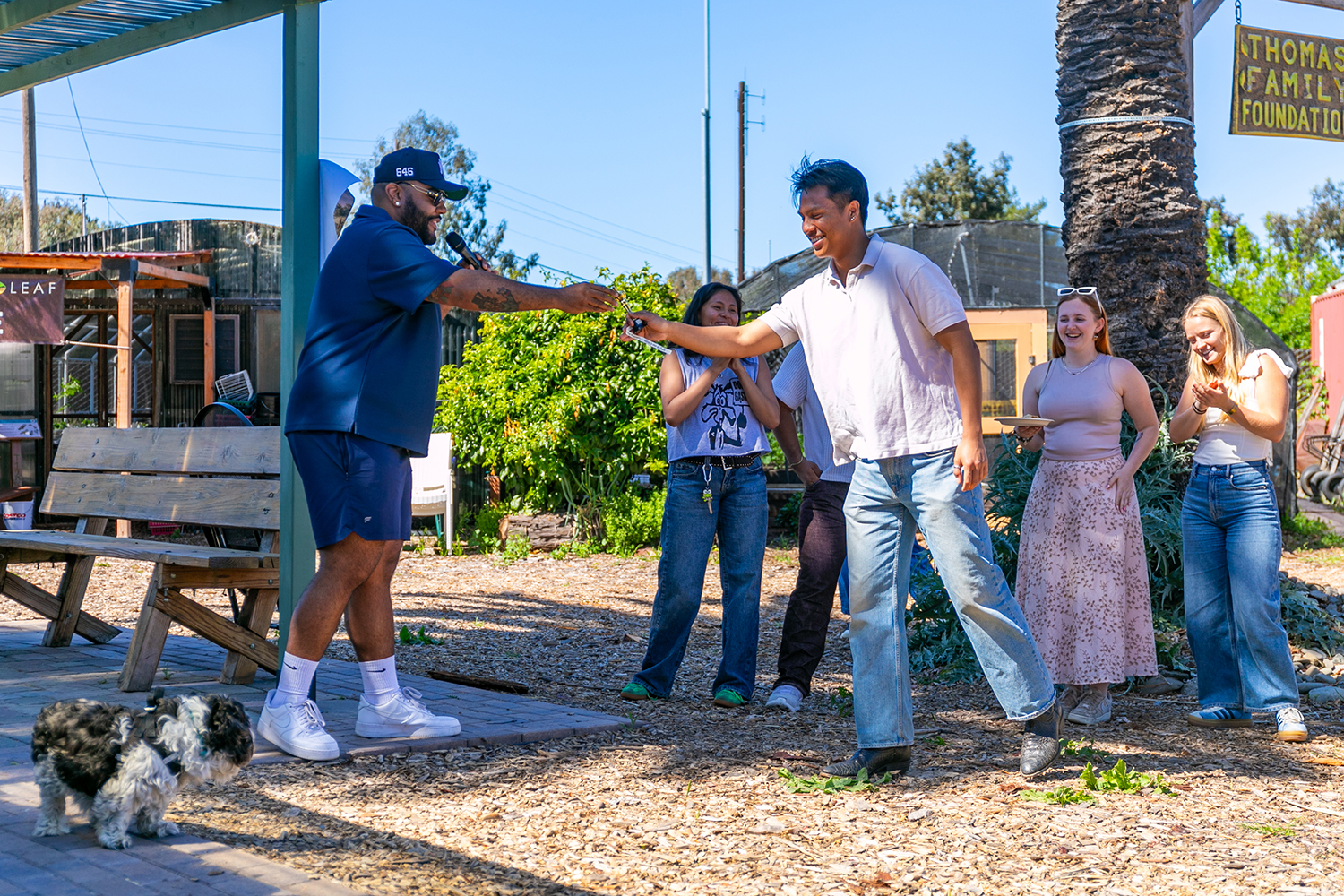
E’jaaz Mason hands out end-of-course awards to students at the Environmental Storytelling Showcase event at LEAF Urban Farm. | Nate Bernardo
He came to Stanford as a John S. Knight Journalism Fellow and now teaches within the Environmental Communication MA program that his colleague Thomas Hayden built more than a decade ago, a Stanford Doerr School of Sustainability program that is gradually expanding.
Mason’s inclination toward visual storytelling and his desire to help students find their own voice shape his pedagogy. Class time is structured around peer workshops and collaborative feedback sessions, but also around activities that feel, as Bough puts it, like “being a kid again.” During lectures this year, for example, students interacted with earthworms at the farm and even played a version of musical chairs where each new seat prompted them to offer unique feedback on peers’ assignments.
When Bough mentioned mid-quarter that she was unsure of her multimedia project, Mason restructured the next session into an open workshop, arriving with boxes of podcasting equipment and art supplies for everyone to experiment with.
“To be able to change your whole lesson plan just because I asked for help,” Bough said, “that’s a really nice thing.”
Mason also recorded short video clips each week and turned them into GIFs that were revealed at the start of the next class’s slides. It is, he explains, partly the yearbook he never had growing up, and partly a reminder to students of all the immersive activities they’ve done.
“I have no evidence that I did anything in college, now that my school email has gotten erased,” Mason reflected. “If any student wants to keep these memories forever, they’ll have them.”
Pressing publish
For Joy, the course unlocked permission to incorporate her identity with her reporting in a way that academic writing rarely allows. “He really accepts and encourages bringing in your personal story to journalistic practices,” she says of Mason. “Having a little more of my opinion and personal story lead my writing has been a joy.”
At the end of the quarter, students traveled back to LEAF to present their work on poster boards in a science fair-style celebration open to community partners and the public.
Students in previous iterations of the course have been hired by outside publications, gone on to work with local and state governments, and are now shaping sustainability conversations in fields ranging from ecology to global fashion.
“The moment you press publish on a story, you are a storyteller,” Mason said.
Writer
Olivia Maule