To make a point about what is possible through collaboration, the British designer Thomas Thwaites tried to build a toaster from scratch.
It was an experiment; he wanted to see whether one person could make an everyday object on their own. After nine months and spending about $1,600 (£1187.54) gathering and processing raw materials, and trying to assemble the appliance, he concluded it was unfeasible.
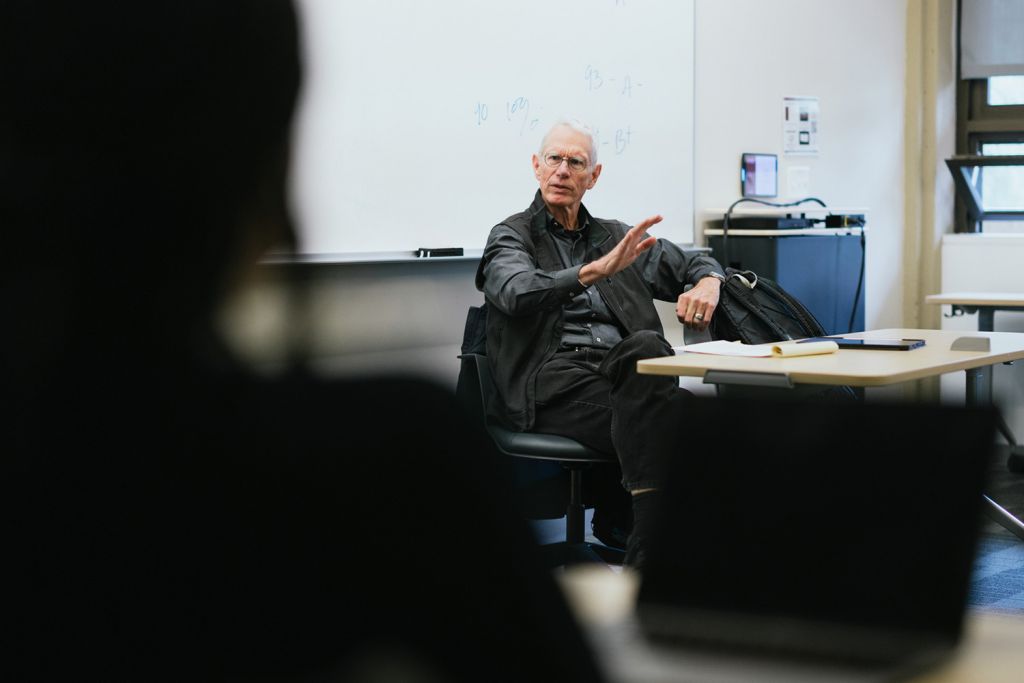
In the fall quarter course POLSCI 103: Justice, Stanford lecturer Brian Coyne used Thwaite’s “Toaster Project” to illustrate what people can achieve only by working together.
“Social cooperation generally produces much more than the sum of what people could produce solely as individuals,” explained Coyne to students in the course’s opening lecture.
Household appliances aren’t the only things that depend on collaboration; entire civilizations do too. But social cooperation comes with trade-offs, which raises the central question of the course: how to distribute those responsibilities fairly.
“The fundamental question of justice is how we should split up the benefits and burdens of social cooperation,” said Coyne, an advanced lecturer in political science and the Nehal and Jenny Fan Raj Lecturer in Undergraduate Teaching. Coyne has been teaching the course since 2018; before then, it was taught by Rob Reich.
Throughout the course, students explore how people in a pluralistic society work together, as well as the moral fault lines that cooperation exposes.
The fundamental question of justice is how we should split up the benefits and burdens of social cooperation.Brian CoyneThe Nehal and Jenny Fan Raj Lecturer in Undergraduate Teaching
“Studying how we balance benefits and burdens gives us a theoretical lens for examining how we justify injustices, too,” said Arjun Ayyappan, ’26, who took Justice because he was intrigued by the ethical dilemmas the topic surfaces. A transfer student, he has taken two previous courses with Coyne.
The syllabus spans key thinkers in political philosophy. Students begin with the English philosopher John Locke, whose 17th-century writings on the social contract inspired the U.S. Declaration of Independence. Locke argued that a government’s legitimacy rests on the tacit consent of its citizens to live under its laws and the protections it provides.
Students also studied critics such as the 18th-century thinker David Hume, who argued that most people never genuinely consent to their government at all; they’re simply born into a society and follow its rules out of habit or necessity.
The class also takes up John Rawls’ 20th-century reframing of these debates. Rawls proposed the “original position,” where the rules for a fair society are decided behind a “veil of ignorance” that hides each person’s advantages and social status, thereby ensuring impartiality.
Coyne hopes students see how these philosophers model a rigorous intellectual practice that tests assumptions, including their own. “A lot of theory really gets at your base, moral intuitions,” said Ayyappan.
Studying how we balance benefits and burdens gives us a theoretical lens for examining how we justify injustices, too.Arjun Ayyappan, ’26
Students also explore imagined scenarios – hypothetical situations that philosophers refer to as “thought experiments” – to test those beliefs.
One that stayed with Ayyappan came from the contemporary moral philosopher Peter Singer. Singer’s thought experiment asks a person to imagine walking past a shallow pond where a child is drowning. Most people would wade in and save the child, even if it meant ruining their $50 shoes or missing an appointment.
Singer argued that the same logic should compel people to donate small amounts to prevent serious harm elsewhere, such as giving to a charity that fights malaria. Distance, he says, is morally irrelevant; if you can prevent suffering at a small cost, you should.
“Theories about justice really make you think hard about what decisions you’re making in your own life and if you’re doing things that are perpetuating injustice or at least trying your best to avoid injustice,” Ayyappan said.
Contributing to a democratic society
The course also examines the principles that guide a democratic society.
“Questioning on what terms we should cooperate in a large, diverse society of the kind we live in is also the vision of democracy,” explained Coyne, who is also the associate director of the Stanford Civics Initiative (SCI), which includes POLISCI: 103 Justice as one of its course offerings in the fall quarter.
SCI courses aim to teach students how to engage thoughtfully with diverse worldviews and understand that living in a democracy requires learning how to listen, deliberate, and work productively with one another across moral disagreements.
For first-year student Mary Zheng, ’29, the class helped her articulate her own beliefs.
“The course has given me the language to describe how I feel about my life and what I want to do with it,” Zheng said. A session on meritocracy – the idea that status is earned through talent and effort – prompted her to reflect on competitiveness at Stanford and across Silicon Valley’s startup culture. A discussion of utilitarianism – prioritizing the greatest net benefits – made her consider how incentive structures shape her choices.
The course has given me the language to describe how I feel about my life and what I want to do with it.Mary Zheng, ’29
Concurrently with taking POLSCI 103: Justice, Zheng also took COLLEGE 101: Why College, the fall quarter course in the first-year Civic, Liberal, and Global Education (COLLEGE) requirement. She found that the topics she examined in Justice complemented the theme of Why College, which invites students to reflect on what kind of person they want to be. She has thought about what the “good life” is to her, which she believes is entwined with making positive contributions to society.
“Being in Justice helps me reflect on what my goals are and what I think is right for me in life and in the world,” Zheng said.
Writer
Melissa De Witte