


The Wu Tsai Neurosciences Institute is launching the Stanford Digital Brain Project, an ambitious new research effort to develop predictive computational models of the human brain.
Launched with lead support from philanthropists Mark and Mary Stevens, and with additional support from Clara Wu Tsai, ’88, MA ’88, the project reflects a university-wide consortium of researchers leveraging state-of-the-art brain imaging technologies to build a uniquely rich portrait of the human brain in action. The resulting data will be used to train foundation models scientists can query to predict how the brain might respond in a wide range of contexts, resulting in a powerful new tool to accelerate neuroscience research and clinical care, including the detection and treatment of brain disorders.
“This visionary project is exactly the kind of ambitious, collaborative science that Stanford is singularly positioned to undertake,” said Stanford President Jonathan Levin. “By bringing together talent from across multiple disciplines and sharing the results openly, we can ensure our discoveries provide maximum societal benefit. I am profoundly grateful to Mark and Mary for recognizing this potential, and to Clara for her longtime support.”
Mark and Mary Stevens have been core supporters of the Wu Tsai Neurosciences Institute since its inception. Mark is a venture capitalist and managing partner of S-Cubed Capital, as well as a board member of Nvidia and a member of the Board of Trustees of University of Southern California. At Stanford, he has served on the Interdisciplinary Life Sciences Council and the Hoover Board of Overseers. Mary is a member of the Board of Trustees at Santa Clara University. The couple serve on the U.S. Olympic & Paralympic Foundation Board of Directors and are parents of a Stanford student who graduated in 2020.
“We’re at a pivotal moment where our ability to measure and understand the brain at unprecedented scale is converging with rapid advances in artificial intelligence,” said Mark Stevens. “Stanford’s position at the intersection of world-class neuroscience and cutting-edge AI creates an unmatched opportunity to build predictive models of the human brain. If successful, this could revolutionize how we understand and treat brain disorders.”

Faculty members and trainees involved in the Stanford Digital Brain Project at the Wu Tsai Neurosciences Institute, pictured in the courtyard of the Stanford Neurosciences Building. Back: Laura Gwilliams, Dan Yamins, Justin Gardner, Brian Wandell, Jonathan Polimeni, Jiyao Wang, Ehsan Adeli, Anthony Norcia, Anthony Wagner; Front: Kalanit Grill-Spector, Atlas Kazemian, Wonkyeong Lee, Vaidehi Natu, Seda Akbiyik, Saskia Bollmann, Milena Kaestner, Xan McPherson, Klemen Kotar. Not pictured: Russ Poldrack. | Alan Toth / Wu Tsai Neurosciences Institute
Clara Wu Tsai was the foundational supporter of the Wu Tsai Neurosciences Institute and the Wu Tsai Human Performance Alliance at Stanford, both designed to operate at interfaces of diverse fields to create transformational advances in human health and cognitive and physical performance. She is a member of the Stanford Board of Trustees, governor of the WNBA’s New York Liberty, owner of the NBA’s Brooklyn Nets, vice chair of Brooklyn Sports and Entertainment, and a trustee of Lincoln Center for the Performing Arts.
“I have always believed that Stanford’s unique strengths at the intersection of science, engineering, and medicine would catalyze the kind of interdisciplinary neuroscience that opens entirely new fields and leads to breakthrough treatments for brain disorders,” said Wu Tsai. “This new project exemplifies that moonshot vision. I’m excited to partner with Mark and Mary to help launch this endeavor, and I hope it inspires others to join us.”
A digital observatory for the human brain
As an initiative of the interdisciplinary Wu Tsai Neurosciences Institute, the project brings together faculty from across Stanford’s schools of Humanities and Sciences, Medicine, and Engineering, who will collaborate over the next five years to create large, custom-tailored datasets of human brain activity and use this data to train the most detailed and accurate models of human brain activity ever attempted.
To understand the value of such a model, consider how meteorologists use complex models of our atmosphere to simulate future weather and predict the effects of different atmospheric conditions. An accurate and detailed predictive model of the brain has never existed in neuroscience, but would give researchers the ability to test hypotheses about brain function in health and disease in a virtual environment an order of magnitude faster than could be accomplished in a laboratory setting.
“By training foundation models on brain data at scale, we’ll be able to form quantitative predictions of how brain circuits process information – tools that can help us explore hypotheses about brain function in ways that would be impossible without a digital model,” said Dan Yamins, a Wu Tsai Neuro faculty scholar and an associate professor of psychology and of computer science, who has played a leading role in catalyzing the new project.
Perhaps most importantly, scientists could use digital brain models to help them identify the often-subtle brain network dysfunctions underlying disorders like depression or Parkinson’s disease. Understanding these patterns could lead to early biomarkers for these disorders and serve as guides for targeted interventions, which could then be tested in clinical studies.
“The best way to figure out how to fix a system – whether it’s a car, a heart, or the brain – is to build a detailed model that lets you compare what it looks like when it’s in working condition and when it’s not,” said Yamins, who is also an affiliate of the Stanford Institute for Human-Centered Artificial Intelligence (HAI). “But the brain is so complex that only in the past few years has the path to building a really useful model become clear, and here at Stanford we have all the key ingredients – the technology, the know-how, and the will – to make it happen.”
For example, major depressive disorder remains a leading cause of disability and early mortality worldwide in part because different people have wildly different responses to available therapies. It can take years of trial and error for patients to find a treatment that provides relief without intolerable side effects, and some never do. Digital brain models could help match individual patients with personalized treatments based on their brain activity, potentially even guiding precisely targeted brain stimulation to effectively shift key networks into a healthier state.
“Imagine being able to test a new circuit intervention for depression by simulating its effects on a digital brain model before ever trying it in a patient, or conducting thousands of virtual experiments overnight to develop a testable new theory of the brain networks behind autism or Alzheimer’s disease,” said Kang Shen, the Vincent V.C. Woo Director of the Wu Tsai Neurosciences Institute, the Frank Lee and Carol Hall Professor, and a professor of biology and of pathology. “This collaborative team science effort at Wu Tsai Neuro represents our vision for how today’s remarkable advances in AI technologies can truly improve human health and well-being.”
What is a brain foundation model?
Foundation models are machine learning algorithms trained on datasets large and varied enough to become general-purpose predictive tools. Unlike single-purpose algorithms designed for specific tasks – like chess-playing AIs or speech-to-text translators – foundation models extract broad statistical patterns from enormous training sets. This allows them to generate realistic outputs in response to prompts they’ve never seen before, which is why they’re sometimes called “generative” or “predictive” AI.
Large language models (LLMs) like Claude or ChatGPT are foundation models trained on vast text datasets. Once trained, they can generate naturalistic responses to a wide range of user prompts. The Stanford Digital Brain Project aims to build what might be called “large brain models” – foundation models trained on diverse brain imaging data that can predict how the human brain would respond across a wide range of circumstances.
Team science at scale
While other efforts to build foundation models from brain data exist, the Stanford Digital Brain Project is taking a unique approach to modeling the entire human brain by collecting custom-tailored data using complementary high-resolution brain imaging tools now available on campus.
Project leaders have developed a unified experimental framework to produce an integrated, naturalistic portrait of how our brain’s many functional networks work together in everyday life. The project is organized into large-scale experimental campaigns, in which researchers will capture different aspects of the brain activity underlying perception, memory, language, movement, decision-making, emotion, social interaction, reasoning, and more.
“This is one of the most ambitious and exciting human neuroscience experiments I can imagine,” said Kalanit Grill-Spector, the Susan S. and William H. Hindle Professor in the School of Humanities and Sciences, a professor of psychology, and one of the leaders of the project’s data collection efforts. “Each new domain of mental function we measure will contribute to a growing body of brain and behavioral data capable of grounding a comprehensive digital model of the human brain.”
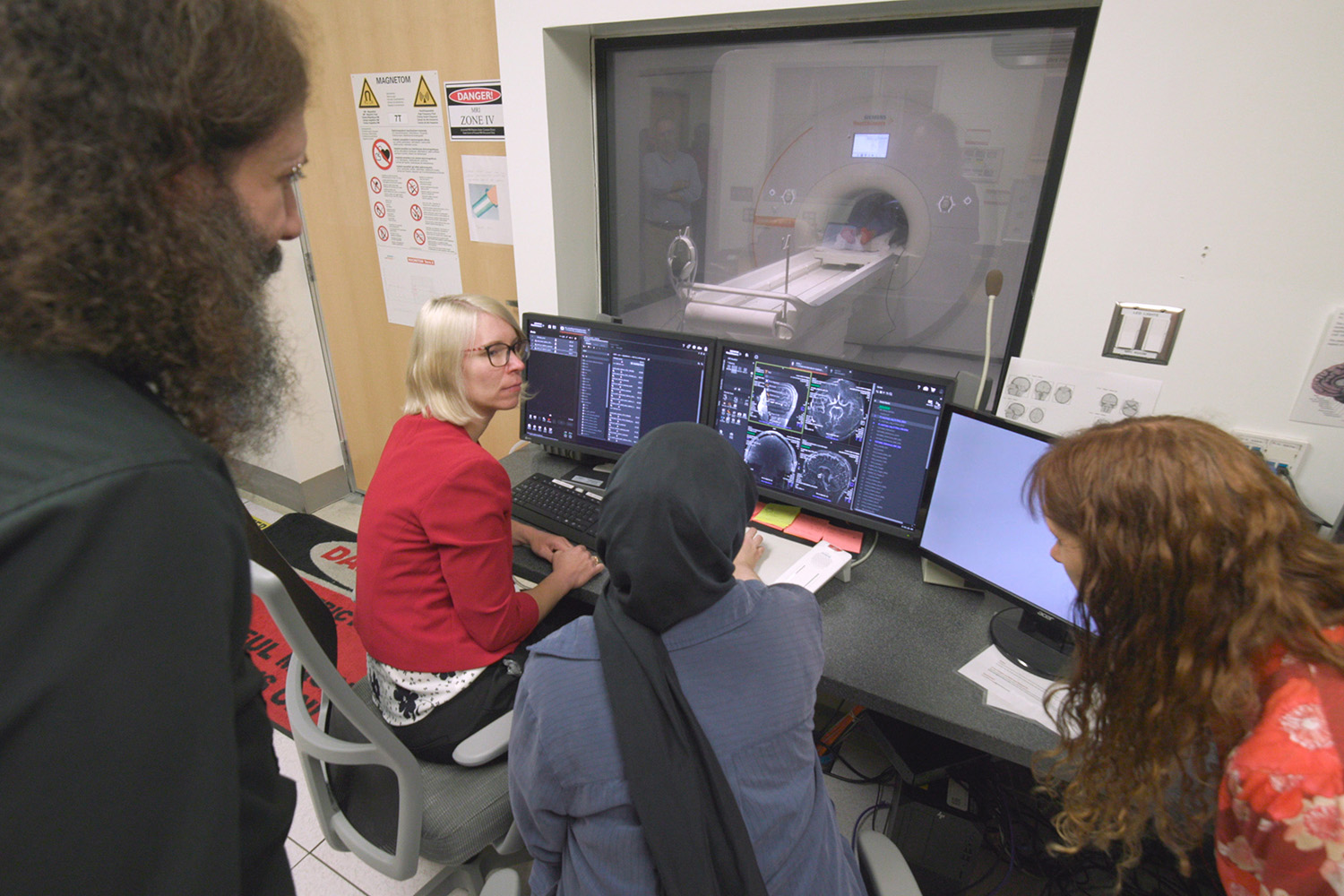
The approach leverages the university’s major investments in high-end shared neuroscience technologies: Researchers will collect data from research participants using both a next-generation, ultra-high-performance, clinical-grade 7-Tesla MRI scanner, unveiled at the Lucas Center for Imaging at Stanford Medicine in 2025, and a new state-of-the-art wearable OPM-MEG system at Wu Tsai Neuro’s Koret Human Neurosciences Community Laboratory.
“By combining high-spatial-resolution imaging from the 7-Tesla MRI scanner with the millisecond temporal precision of our new OPM-MEG, we can see both where and when neural activity unfolds – for example, as people view, describe, and recollect thousands of naturalistic videos – revealing how brain networks coordinate perception, attention, and memory,” said Laura Gwilliams, a faculty scholar at Wu Tsai Neuro and Stanford HAI and an assistant professor of psychology who leads the project’s OPM experiments.
“Each of these cutting-edge tools is among the most powerful brain imaging systems in the world,” said project member Jonathan Polimeni, an associate professor of radiology and director of ultra-high-field MRI at the Lucas Center. “Together, the portrait of brain activity they will produce will be absolutely unparalleled.”
Anthony Norcia, a professor emeritus of psychology, and Milena Kaestner, the director of Wu Tsai Neuro’s Koret Human Neurosciences Community Lab, demonstrate the OPM-MEG system, a key pillar of the Stanford Digital Brain Project’s experimental campaign. | Kurt Hickman
The project’s model development team will then train foundation models on these complementary datasets using frontier computational methods developed by Yamins and colleagues, leveraging Stanford’s high-powered Marlowe GPU computing cluster. The team will begin with models of key human brain systems – such as perception, memory, and attention – and expand to models of the entire human brain.
Continuous feedback between the data-gathering and model-building efforts will allow the project to test the accuracy of models against real-world brain dynamics and human behavioral contexts, while developing prototype applications for understanding and intervening in brain disease.
In keeping with Stanford’s commitment to open science, the datasets and models developed by the project will be made freely available to researchers worldwide. This data-sharing effort will build on open data infrastructure developed at Stanford, such as the OpenNeuro data-sharing platform and the Brain Imaging Data Structure, which have become the world’s leading standards for organizing brain imaging data.
“Stanford’s long-term investments in shared research tools and high-performance computing, paired with Wu Tsai Neuro’s track record in catalyzing cross-campus collaborations, make an audacious project like this one achievable,” said Stanford Vice Provost and Dean of Research David Studdert. “It’s team science at scale and in action.”
Hear more
On the From Our Neurons to Yours podcast, two Stanford Digital Brain Project leaders, Dan Yamins and Russ Poldrack, explain the ideas behind the effort and the experimental campaign that will bring them to fruition.
For more information
This story was originally published by Wu Tsai Neurosciences Institute.