In brief
- Small proteins, called peptides, could be an excellent tool to kill harmful bacteria without causing antibiotic resistance because they destroy bacteria physically, rather than chemically.
- The problem is that peptides are short-lived and expensive to work with.
- So, Stanford researchers have developed an AI-assisted tool that predicts polymers that have similar antimicrobial characteristics to peptides. They chose these chain-like molecules because they are inexpensive, easy to work with, don’t degrade quickly, and are very safe.
- Using the tool, they found and tested polymer candidates for antimicrobial properties against E. coli bacteria. They found 10 candidates that performed well above expectations.
- The researchers are hopeful the tool could be useful to find a variety of new microbe-specific drugs, including some to address especially challenging bacterial infections.
Swimming in the blood, sweat, cells, and tears of every human are small proteins known as peptides. Many peptides can kill bacteria on contact, and yet the bacteria never seem to evolve resistance to them. Mass-produced peptides could become a new type of resistance-evading antibiotics, but peptides are a challenging partner. They are short-lived and expensive to synthesize.
In a new paper, researchers at Stanford School of Engineering describe how they have trained an AI model to scour millions of potential other molecules – polymers – for candidates that mimic the mechanisms peptides use to kill bacteria so effectively. These new polymers also share the peptides’ ability to overcome or escape the microbial resistance that plagues many traditional antibiotics, bringing hope to the public health community. Millions worldwide die each year from microbial infections resistant or immune to existing medications.
“Antimicrobial peptides are chemically able to get very close to and disrupt the cell membrane, killing the bacteria,” explained Shoshana Williams, a former graduate student chemist at Stanford Engineering who recently earned her PhD working on this challenge. “Importantly, they don’t need to get inside the cell to work, like a typical drug would. Nor do they work on one specific protein or pathway, like drugs do.”
The key to evading resistance is that these new molecules use a physical, rather than a biochemical, pathway to attack the bacteria.
“The peptides permeabilize the microbes … they literally rip holes in the cell membrane to kill them,” interjected Eric Appel, a professor of materials science and senior author of the study. “It’s much harder for a bacterium to change the entire lipid structure of its membrane or the electrical charge of its surface than to learn to reject a chemical drug or turn off its narrow pathway.”
Uncertainty principles
The researchers are quick to point out that the new chemicals are not synthetic peptides, but rather a different type of molecule altogether: polymers. These long, chain-like molecules are easier and cheaper to synthesize than peptides and do not degrade easily, enabling global distribution and access to low-resource communities. Polymers are also “super safe,” Appel added.
The researchers built a library of 1.7 million potential polymer candidates to choose from – an overwhelming number to investigate manually, so they did it computationally. They developed a new model that predicts the chemical properties of the polymers based on their chemical structures and identifies those that have similar antimicrobial characteristics to the peptides.
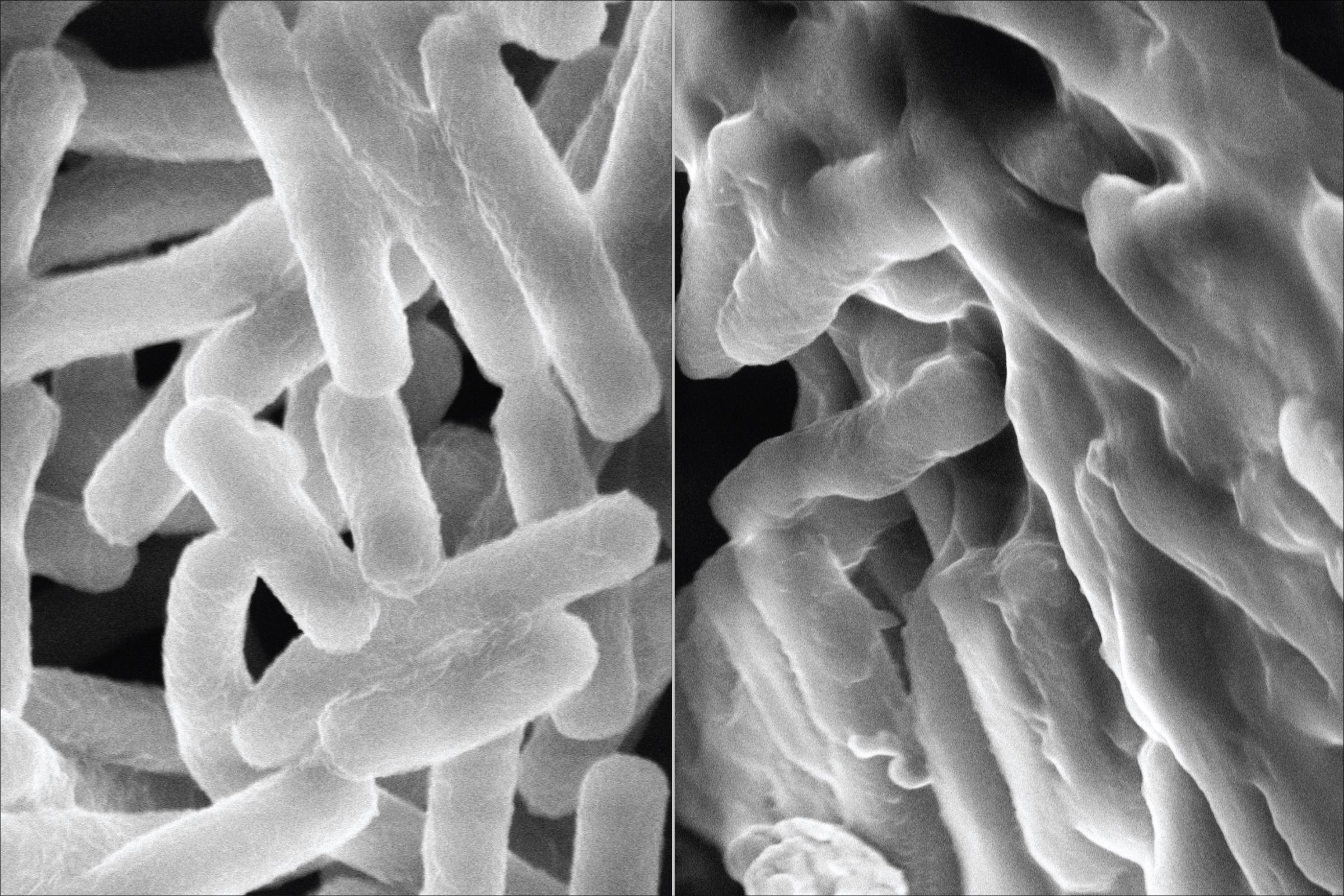
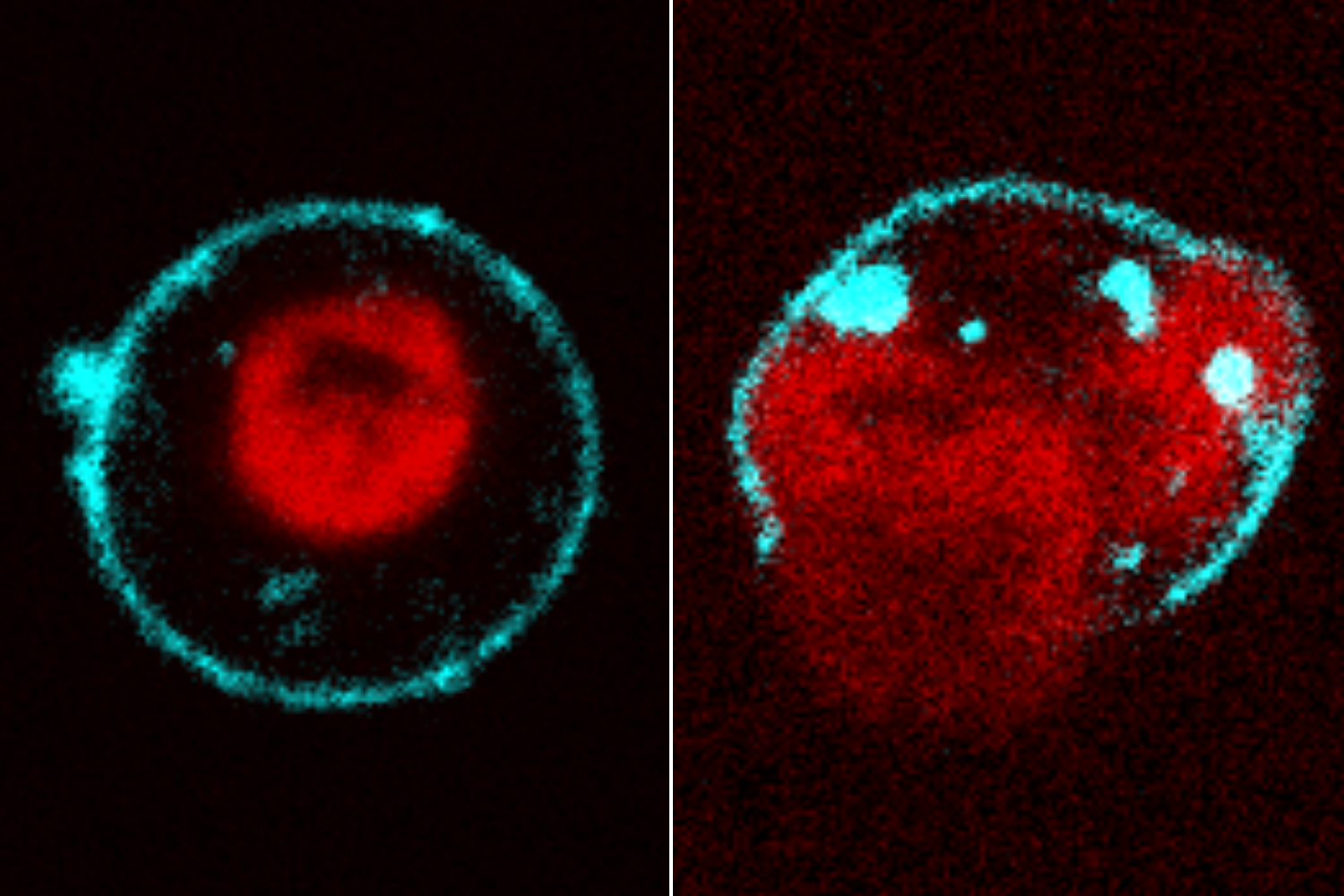
Left: Unperturbed bacteria. Right: Bacteria exhibiting damaged cell membranes after treatment with an antimicrobial polymer. | Changxin Dong and Shoshana Williams
Here the researchers ran into a challenge that afflicts many areas of medical AI: a lack of data. Large datasets exist for antimicrobial peptides, but those for polymers are scarce. “The dataset of antimicrobial polymers simply was nowhere near big enough,” said Williams, who is now a postdoctoral scholar at the University of California, San Francisco School of Medicine. “With a chemist’s intuition, however, we pivoted to train on the chemical properties of antimicrobial peptides first and applied that knowledge to the polymers. It worked!”
Leaps and bounds
One strategy the team developed to overcome the dearth of data was clever – and counterintuitive. It was based on uncertainty. They started by asking a bunch of models to predict which polymers would perform best, but instead of simply accepting the polymers that the majority of the models agreed upon, the team looked only where there was the greatest disagreement between models.
“We figured that if you want to improve the models, it’s really a good space to feed in more actual experimental data,” Williams explained. The team synthesized the 20 most disputed candidates, where some models thought the polymers would be excellent and others thought they would be terrible antibiotics. Then, they tested them and fed that data back into the models to supplement the polymer dataset.
“At this point, we had a much more robust system able to select the greatest hits from among the polymers in the library,” Williams said.
“The primary intellectual leap was training on the antimicrobial peptide data first and then to use that data to make predictions on the polymers, an entirely different class of molecules," Appel said. “There are thousands of peptides that have been evaluated where all of the chemical content is known. We just ‘featurized’ each one of those and connected them to standardized data outputs for the polymers.”
With their new, more robust AI tool, the team was able to narrow the list of polymer candidates to just 10 that were then synthesized and tested for antimicrobial properties. In tests on E. coli bacteria, all ten candidates performed well above expectations and one proved particularly effective against biofilms – a challenging type of microbial community that is difficult to treat with conventional antibiotics.
“These 10 candidates are among the most potent antimicrobial polymers ever reported, as far as I’m aware,” Williams said.
Above and beyond
Beyond an impressive proof-of-concept molecular design process, Appel and Williams think the system could prove effective in designing microbe-specific drugs. They tested their approach primarily against E. coli, which belongs to a class of double-membraned microbes, called Gram-negative bacteria, that includes salmonella and cholera.
“We haven’t had a new class of antibiotics against Gram-negatives in decades,” Williams pointed out. “But it also works against Gram-positive bacteria, like Staphylococcus aureus, as well.”
Appel can imagine designing bespoke antibiotic polymers that kill only the strains of bacteria causing an infection, leaving human tissue and good bacteria unharmed.
“We really do need better drugs,” Appel concluded. “This new process opens a promising path to identifying novel antibiotics that work in new and different ways to treat serious and complicated infections and combat resistance.”
For more information
Contributing Stanford University authors include: graduate students Anna Makar-Limanov, Gabriel Greenstein, Priya Ganesh, Noah Eckman, Changxin Dong; post-doctoral scholars Xinyu Liu, Alessio Fragasso, Alexander N. Prossnitz, and Hector Lopez Hernandez; and professors Christine Jacobs-Wagner, the Dennis Cunningham Professor in the Department of Biology in the School of Humanities and Sciences (H&S) and professor of microbiology and immunology in the School of Medicine, and Lynette Cegelski, professor of chemistry in H&S.
Appel is also a member of Stanford Bio-X, the Cardiovascular Institute, the Wu Tsai Human Performance Alliance, the Maternal & Child Health Research Institute (MCHRI), Stanford Cancer Institute, and the Wu Tsai Neurosciences Institute, and a faculty fellow at Sarafan ChEM-H. Cegelski is also a member of Bio-X and the Wu Tsai Neurosciences Institute, and a faculty fellow at Sarafan ChEM-H. Jacbos-Wagner is also a member of Bio-X and an institute scholar at Sarafan ChEM-H.
This work was funded by the Stanford Bio-X Interdisciplinary Initiative Seed Grants Program, by the National Institute of General Medical Sciences of the National Institutes of Health, and work was performed at the Stanford Nano Shared Facilities (SNSF), supported by the National Science Foundation.
Writer
Andrew Myers