Researchers at Stanford University have received an up to $27.2 million, 5-year award from the Advanced Research Projects Agency for Health (ARPA-H) Autonomous Interventions and Robotics (AIR) program to develop an AI-powered autonomous micro-robot that can be placed and guided by surgeons to swim through the bloodstream where it can treat blood clots and aneurysms. Officially known as the magnetic milli-spinner microbot – or M3bot, for short – it comes from the lab of Renee Zhao, an assistant professor of mechanical engineering in the School of Engineering who has spent years developing a prototype M3bot and similar minimally invasive technologies.
“We believe M3bot could redefine the future of endovascular surgery because it is an untethered robot that can self-propel through complex vasculature and reach disease sites that are difficult – or sometimes impossible – to access with current state-of-the-art tools,” Zhao said. “By enabling robots to reach disease sites that today’s catheter technologies can’t, we envision a future where life-saving endovascular treatments become available to far more patients.”
Two in one
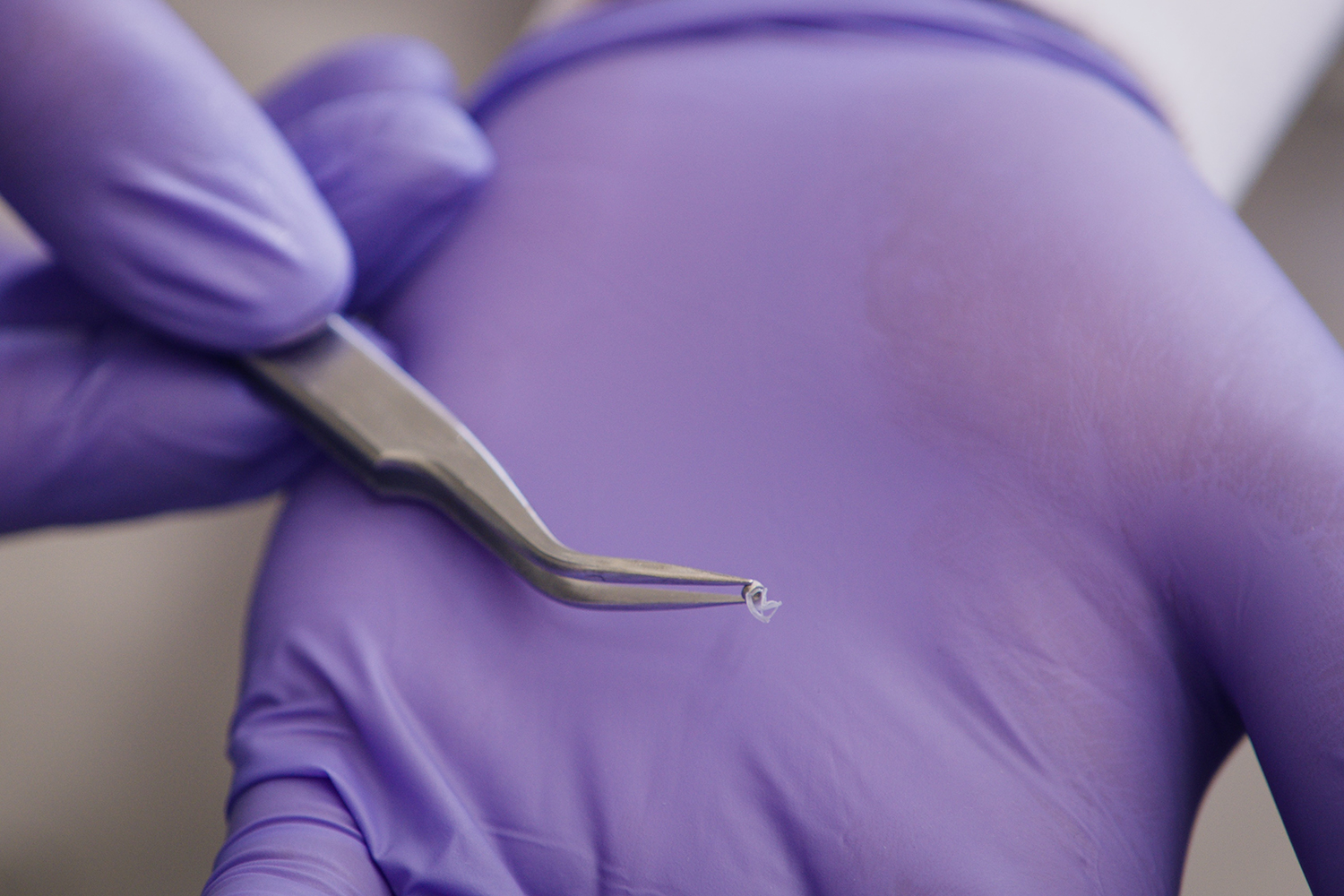
The millimeter-scale M3bot is injected into the bloodstream and guided remotely by external magnetic fields. Physicians, meanwhile, monitor its progress using real-time fluoroscopic imaging. Once inside the blood vessel, the robot starts to spin and its helical shape converts that rotation into propulsion, allowing it to swim through the blood much like a boat propeller moves through water.
The milli-spinner travels inside a porcine carotid artery. | Zhao Lab
The M3bot is remarkably quick. The current iteration of M3bot can travel at more than 55 centimeters per second (about 22 inches per second) – fast enough to swim against blood flow. More importantly, the robot’s hollow core and strategically placed lateral slits use the same spinning motion to generate localized suction and controlled flow.
“Sometimes the most transformative technologies emerge from a simple physical principle,” Zhao said. “The revolutionary idea behind M3bot is that a single spinning motion serves two purposes. It propels the robot through blood vessels but also mechanically transforms the clot, shrinking its volume by more than 95% in place, enabling removal. By coupling locomotion and therapeutics, M3bot could transform what is currently a complex, multi-device, multi-pass procedure into a single autonomous robotic intervention.”
Innovative approach
The real innovation lies in what that spinning motion does to the clot. It allows the M3bot to induce localized compression and shear forces that mechanically transform the blood clot, modifying its internal microstructure and shrinking its volume in a way that is both effective and safe for the patient.
A blood clot is formed by a mesh of protein fibers called fibrin that trap blood cells, creating a blockage that obstructs blood flow. Zhao imagines it as a blood-soaked cotton ball stuck in the bloodstream. Instead of fragmenting the clot, M3bot mechanically compresses and densifies the fibrin network while releasing the trapped red blood cells. The clot becomes dramatically smaller without generating large fragments that could travel downstream. The released blood cells flow on naturally through the blood vessel, while the compacted fibrin scaffold is removed when the robot is retrieved.
A 2.5 mm spinner debulks a large blood clot in a blood vessel phantom. | Zhao Lab
“If you compress a cotton ball between your palms and roll it, it becomes much smaller and denser,” Zhao explained. “That’s exactly what M3bot does. It swims to the blockage and mechanically densifies the clot in place, shrinking it to a twentieth of its original size while leaving the surrounding blood vessel unharmed.”
By shrinking clot volume so significantly before extraction, M3bot dramatically reduces the size of material that must be removed, allowing blood flow to be restored immediately and efficiently. Zhao’s group has also demonstrated an M3bot that can deliver therapeutic agents directly into brain aneurysms.
Promise recognized
Recognizing M3bot’s promise, Zhao and colleagues recently received an up to $27.2 million, 5-year award from ARPA-Health’s Autonomous Interventions and Robotics (AIR) program, led by Dr. Ileana Hancu. One of ARPA-H AIR’s goals is to establish the first untethered autonomous endovascular robotic intervention to treat stroke. ARPA-H is part of the U.S. Department of Health and Human Services.
By enabling robots to reach disease sites that today’s catheter technologies can’t, we envision a future where life-saving endovascular treatments become available to far more patients.Renee ZhaoAssistant Professor of Mechanical Engineering
“The key element here is time,” said Hancu, program manager at ARPA-H. “Half of Americans live more than an hour away from a hospital that can perform the current procedure – a thrombectomy. The longer treatment is delayed, the higher the risk. An innovative approach like M3bot could mean stroke patients can receive curative procedures at their nearest hospital, vastly improving health outcomes and life expectancy, while lowering costs.”
Zhao’s collaborators include Stanford faculty: Monroe Kennedy, an assistant professor of mechanical engineering; Oussama Khatib, a professor of computer science; and Jeremy Heit, a professor of radiology at Stanford Medical School. Also on the team are George Karniadakis, a professor of engineering at Brown University, and several industrial partners, including Philips, Medtronic, and Terumo Neuro.
“This project brings together mechanics, robotics, artificial intelligence, medical imaging, and clinical medicine to create something that no single discipline could achieve alone,” Zhao said. “Our goal isn’t simply to build a better medical device. We’re laying the foundation for autonomous robotic intervention inside the human vasculature, where intelligent micro-robots can navigate to disease sites, integrate real-time imaging with AI-driven decision-making, and perform life-saving procedures that are impossible today.”
Media contact
Jill Wu, School of Engineering: jillwu@stanford.edu
Writer
Andrew Myers