In brief
- Computational modeling revealed an unexpected order of bond breaking in the core molecular structure that causes bioluminescence in nature.
- Mechanical force ruptures the dioxetane molecule’s carbon-carbon bond first, which is contrary to previous understanding of how the break in the molecule’s bonded square of oxygen and carbon atoms leads to light emission.
- The findings suggest the potential to develop improved stress sensors as well as gain insight into some forms of biological luminescence.
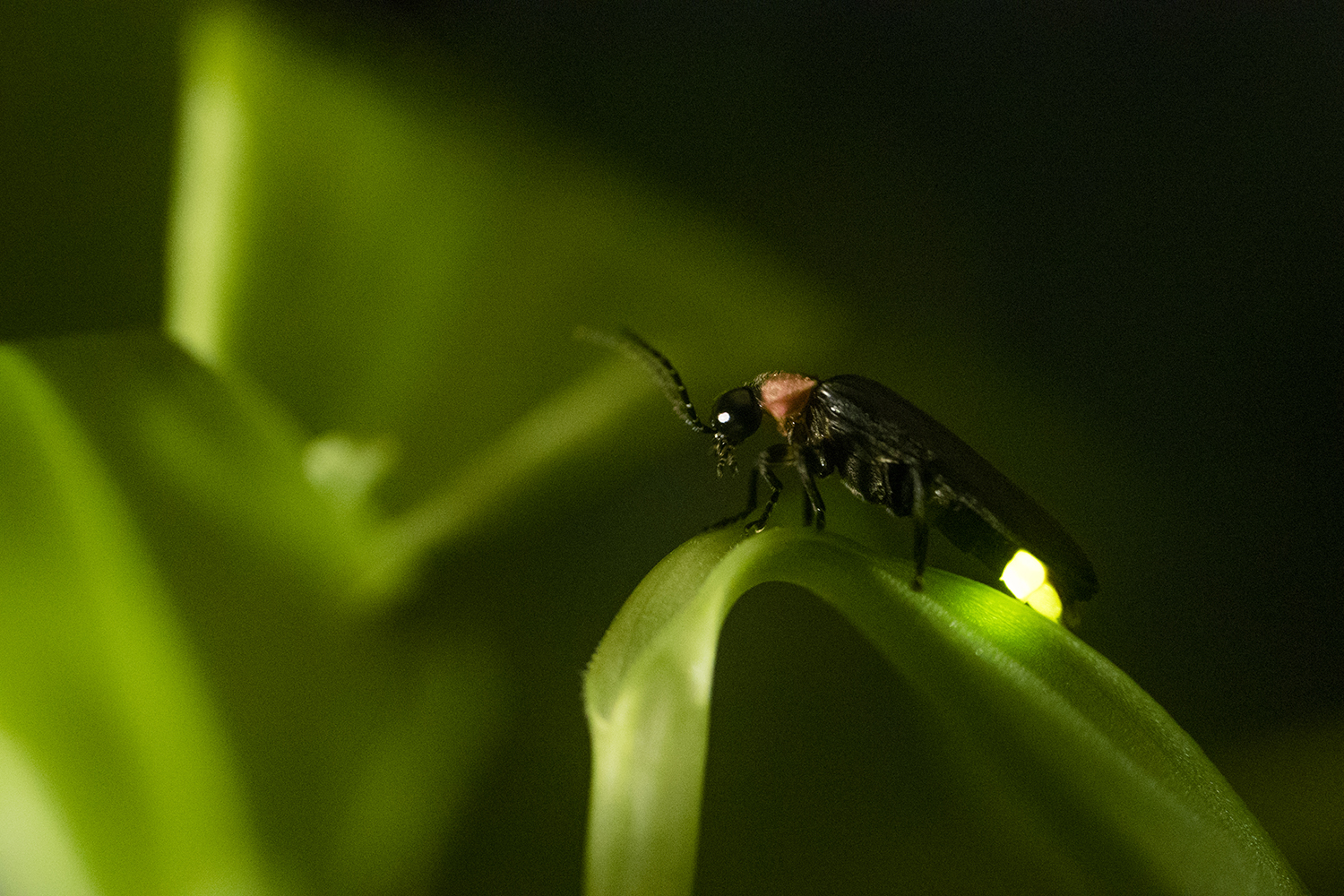
The dancing lights of fireflies and the eerie blue sparkle in crashing waves get their glow when a molecular square of carbon and oxygen atoms breaks. New research has shown that mechanical force can cause that break to happen in a different way than was previously known.
The study, published in Journal of the American Chemical Society, has implications for the development of light sensors as well as understanding luminescence in nature.
Chemists have long used molecules called dioxetanes to create light. These molecules have the same core structure that enables biological luminescence: two oxygen atoms and two carbon atoms bonded together in a square. Heat or mechanical force can break those bonds, causing light emission.
Heat is known to break apart the two oxygens first. Scientists expected that the same thing happened under mechanical force since the bond between the two carbons is stronger. But when Stanford researchers modeled force applied to dioxetanes, they found that the bond between the carbon atoms breaks first, then the one between the oxygens.
“It is a very different chemistry with mechanical force,” said Todd Martínez, the study’s senior author and a chemistry professor in the Stanford School of Humanities and Sciences (H&S). “It still gives off light. The order of events is just different, and it points to the possibility that we might be able to make different products.”
In previous research, experiments on a molecule named bis(adamantyl)-1,2-dioxetane demonstrated that mechanical force could break the oxygen-carbon square and emit light, but it was assumed the oxygens were breaking first.
The current study had its start when a Stanford visiting professor, Charles Diesendruck of the Israel Institute of Technology, suggested to Garrett Kukier, a doctoral scholar in Martínez’s lab, that they might look closer at where the force was applied in those experiments.
Kukier then developed quantum mechanics models that used the same pulling locations where force was applied to the dioxetane molecule in the experiments. He also created additional models to gain insight into other types of dioxetane molecules and applied the pulling force in different directions to see its effects.
“The reaction that causes luminescence actually gets completely modified by force, and that allowed us to discover a new pathway to emit light,” Kukier said.
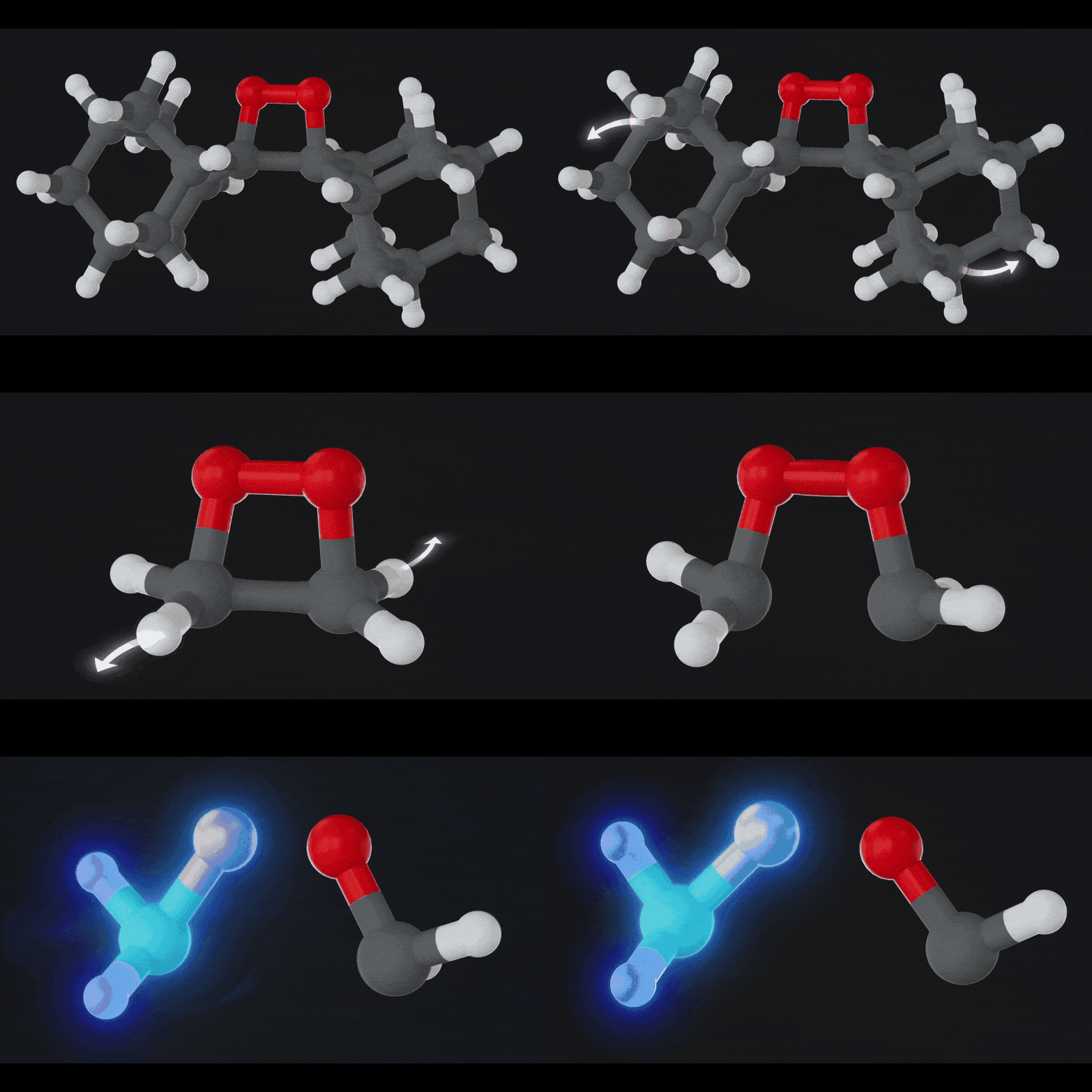
This animation shows a pulling force, indicated by arrows, applied to a molecule of bis(adamantly)-1,2-dioxetane. The strain breaks the carbon–carbon bond (in gray) of the core structure. Then, the oxygen–oxygen bond (in red) breaks, causing a remaining piece to become unstable and emit a photon of blue light to return to a more stable state. | Animation by Ella Maru Studios for Stanford University
The researchers supplemented their work with civil engineering software that treated the molecular structure like the beams of metal in a bridge under strain, providing intuitive evidence that backed the findings from the quantum mechanics models.
Knowing where the rupture begins in this force-induced method opens up new opportunities for exploration. For instance, dioxetane molecules could potentially be engineered so that they emit light only above a certain threshold of force. This could lead to sensors that light up to warn when a material or structure is reaching a stress point and might fail. Researchers could also explore applying force at different locations or “handles” on the molecule to achieve a desired property, such as emitting different colors of light.
The study findings may also help illuminate some mysteries in the natural world. While it is already known that fireflies use a chemical process to make their light, force might be involved with the blue glow found in some waves, which is created by plankton called dinoflagellates.
“Some mechanically induced situations, like the waves crashing and the plankton lighting up, are possibly using this completely different pathway that we’ve just discovered,” Kukier said.
For more information
Martínez is also the David Mulvane Ehrsam and Edward Curtis Franklin Professor of Chemistry in H&S; professor of photon science at SLAC National Accelerator Laboratory; principal investigator at the Stanford PULSE Institute; and a member of Bio-X.
Additional Stanford co-authors on the study include former postdoctoral scholars Diptarka Hait and Rui Xu, both affiliated with the Department of Chemistry in H&S and with SLAC.
Diesendruck of the Israel Institute of Technology is also a co-author on this study.
This research received support from the National Science Foundation. Kukier was supported by an NSF Graduate Research Fellowship. Hait was supported by a Stanford Science Fellowship.
This story was originally published by Stanford School of Humanities and Sciences.
Media contact
Sara Zaske, School of Humanities and Sciences: 510-872-0340, szaske@stanford.edu
Writer
Sara Zaske