In brief
- Researchers used SLAC’s X-ray laser to image early electron movement at attosecond timescales in what’s known as an “impulsively ionized” molecule.
- They captured two processes never before seen in real time: Coster-Kronig decay and quantum electron coherence.
- Experimental results contradicted leading computer simulations, forcing theorists to incorporate additional complexity for more accurate predictive models.
All chemistry starts with a push from electrons. In the early moments of a chemical reaction, it’s the movement of electrons that initiates the breaking of old chemical bonds and forging of new ones, transforming one molecule into another.
When an electron is removed from a molecule faster than the molecule can react – called “impulsive ionization” – the other electrons in the molecule enter excited quantum states that evolve on ultrafast timescales. Scientists have long sought to map the ultrasmall, ultrafast electronic motions behind chemical reactions on their natural timescales.
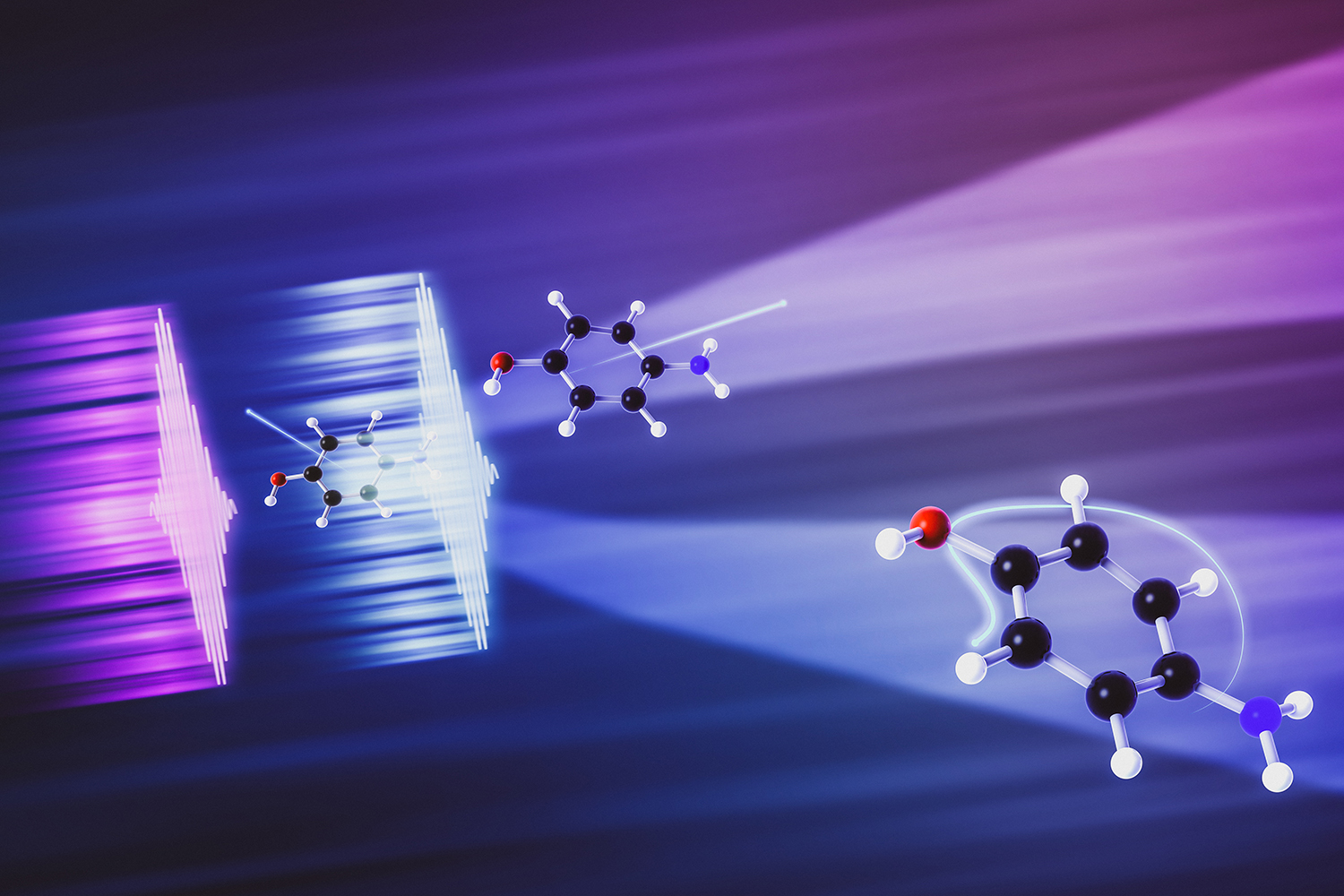
Now, researchers at the Department of Energy’s SLAC National Accelerator Laboratory have created a movie of early electron motion in an impulsively excited molecule. Each frame captures changes happening in mere attoseconds, just billionths of a billionth of a second. Their results, published in Nature Physics, map the early steps of a photochemical reaction, similar to the reactions that drive countless processes – from X-ray interactions in medical settings to cosmic ray collisions in the upper atmosphere. Their results reveal steps of these processes never before resolved in time.
But the road to this finding was not as smooth as predicted. When experimental results did not match leading computer simulations, the team’s theorists stepped in to add additional nuance to their models. This work shows how researchers combine theoretical models with experimental evidence to more reliably predict the outcome of photochemical reactions.
“By improving these models and testing them against real-world experiments, we can better understand how electrons drive chemical reactions and, we hope one day, gain the ability to better predict and control those reactions,” said Taran Driver, SLAC lead scientist and author of the paper.
Making movie magic
To make each frame of the molecular movie, the team used two precisely timed X-ray flashes at SLAC’s Linac Coherent Light Source (LCLS). The first flash dislodged one of the molecule’s electrons, giving the molecule an extremely quick jolt of energy. The second flash, arriving just attoseconds later, gave researchers insight into where the electrons had moved through a technique known as X-ray absorption spectroscopy.
The key was exquisite timing control, a capability pioneered by SLAC accelerator scientists. By adjusting the delay between flashes with attosecond accuracy, researchers could choose exactly when to take each snapshot.
The team documented 10 timestamps within the first 10 femtoseconds, or 10 millionths of a billionth of a second, creating a frame-by-frame sequence of electron motion.
The first frames: Less than 1 femtosecond
Within the first femtosecond of being energized by X-rays, the molecule relaxed by ejecting an electron from one of its inner shells. This process creates a low-energy electron that moves slowly enough to interact with surrounding molecules, causing radiation damage in biological systems and even breaking DNA strands. This team is the first to capture the steps of this effect, known as a Coster-Kronig decay, on its natural timescale.
Quantum coherence: 2 to 10 femtoseconds
After the electron was kicked out, it left behind a hole which migrated through the molecule until another electron filled it in. This fleeting motion was driven by a phenomenon known as quantum coherence.
“We believe this coherence may influence what happens downstream – the breaking and forming of chemical bonds,” Driver said. “By capturing and characterizing electronic coherence, we can better understand, and perhaps one day gain some measure of control over its effects.”
Chemistry begins: More than 10 femtoseconds
At the 10-femtosecond mark, researchers saw the chemical consequences of all this electron movement: Chemical bonds began breaking and new ones started to form.
Tuning theory to reality
The experimental data revealed that actual electron behavior was more complex than models anticipated. Because modeling ultrafast molecular motion is incredibly complex, computer models typically keep atomic nuclei fixed in place and focus only on certain types of electron motion. But accurate models need to incorporate additional complexity, explained Alicia Palacios, an associate professor at the Autonomous University of Madrid, Spain.
“While these calculations are far more computationally demanding, they produce simulations that are much closer to the reality captured during experiments,” Palacios said.
The sequel
The team is working on next-generation experiments that can collect even more data in less time, mapping electron movements in larger, complex molecules.
“When we collected this data in 2021, it took more than a week to collect the data we needed to make a comparison with our predictions. Now, with the LCLS superconducting accelerator and its high-repetition rates, our users are collecting better data, on a variety of molecules, in a small fraction of that time,” said James Cryan, senior author on the paper, SLAC associate professor of photon science and interim lead of the LCLS science, research and development division.
For more information
The research was conducted by a large collaboration including researchers from Stanford University; IMDEA Nanoscience and Autonomous University of Madrid, Spain; Imperial College London, UK; University of Connecticut; Charles University, Czech Republic; Ohio State University; Paul Scherrer Institute and Ecole Polytechnique Federale de Lausanne, Switzerland; Kansas State University, DOE’s Argonne National Laboratory and Lawrence Berkeley National Laboratory; Tohoku University, Japan; and University of Chicago.
This research is supported in part by the DOE Office of Science. LCLS is a DOE Office of Science user facility.
Citation: Driver et al., Nature Physics, 20 July 2026 (10.1038/s41567-026-03360-x)
This story was originally published by SLAC National Accelerator Laboratory.
Media contacts
Media inquiries: media@slac.stanford.edu
For other questions or comments: SLAC Strategic Communications & External Affairs, communications@slac.stanford.edu
Writer
Erin Woodward