In the hunt for one of nature’s most elusive substances – dark matter, which makes up 85% of all matter in the universe – scientists are going to extremes.
Deep underground and chilled to near absolute zero, the Super Cryogenic Dark Matter Search (SuperCDMS) SNOLAB – one of the world’s most sensitive dark matter searches – has begun collecting its very first scientific data.
During this early-science phase, the team will fine-tune the system for its full-scale search, set to begin in 2027. Although the experiment isn’t yet operating at full sensitivity, it could still deliver meaningful results.
“The search for dark matter at SuperCDMS SNOLAB is finally underway,” said Tina Cartaro, SuperCDMS operations manager at the Department of Energy’s SLAC National Accelerator Laboratory. “Even in this early phase, our most sensitive detectors have the potential to deliver breakthrough discoveries. At the same time, we’re preparing and testing the entire system, learning how our detectors and cryogenic cooling perform together so we can unlock their design sensitivity.”
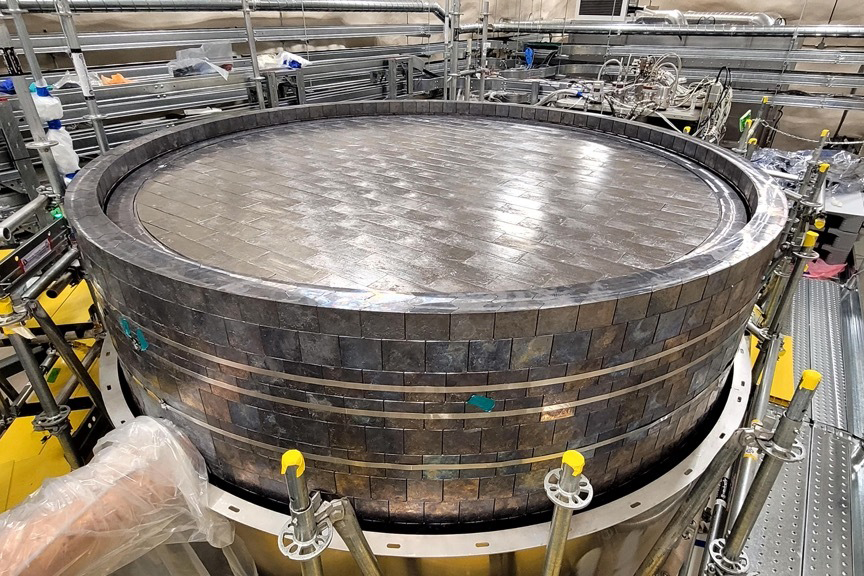
The SuperCDMS setup is surrounded by layers of clean shielding materials to prevent stray background radiation from drowning out the signal. Layers of copper, polyethylene, ultra-pure lead, and a barrier against radon are used to reduce these backgrounds to acceptable levels. The tiles seen at the top are made from ultrapure lead sourced from ancient sunken ballast in the Mediterranean, with additional layers of ordinary lead added on top. | SuperCDMS
SuperCDMS is an international collaboration of 28 institutions, with SLAC serving as the lead laboratory. This second-generation experiment is designed to detect “light” dark matter, hypothetical particles so lightweight that their interactions with ordinary matter leave only the faintest traces, making them especially hard to detect.
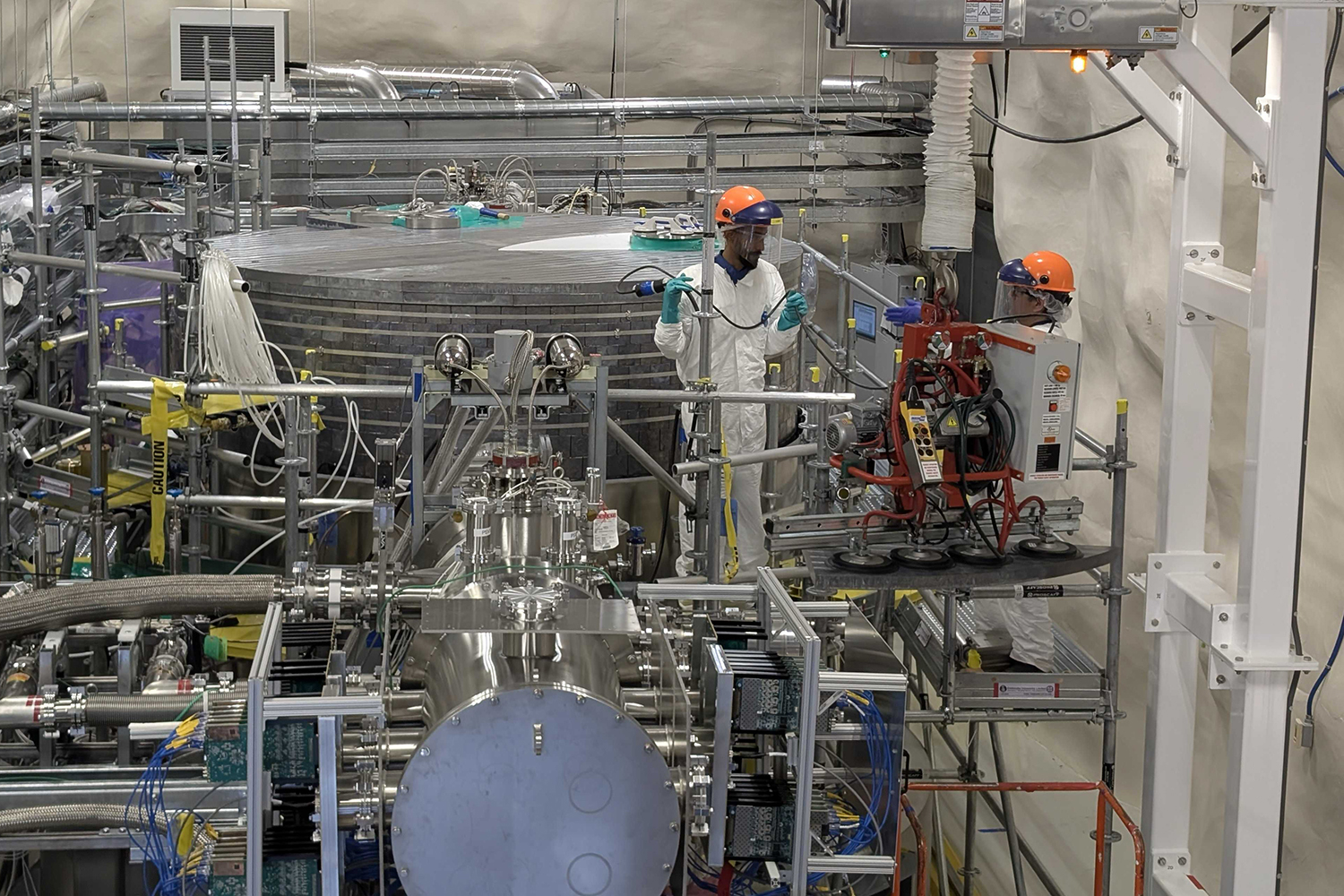
More than a mile beneath Earth’s surface, in SNOLAB, a deep underground laboratory located in the Vale Creighton mine near Sudbury, Ontario, SuperCDMS houses 24 ultra-pure silicon and germanium crystals, each about the size of a hockey puck, inside a refrigerator colder than outer space. If a dark matter particle strikes one of these crystals, it will produce a tiny vibration called a phonon, along with a small electrical signal. To detect those minuscule signals, the crystals are outfitted with superconducting sensors that only work when they are extremely cold. The entire setup is surrounded by layers of clean shielding materials to prevent stray background radiation from drowning out the signal. Layers of copper, polyethylene, ultrapure lead and a barrier against radon are used to reduce these backgrounds to acceptable levels.
The early-science phase will continue through fall 2026. Following this early data-taking period, the SuperCDMS Collaboration and Operations team plans to warm up the experiment to further optimize both the cryogenic system and noise environment. This warm-up and maintenance period is expected to last into late 2026, followed by a year of data collection with the detectors running at optimized, full sensitivity.
“Our detectors will explore, with unprecedented sensitivity, regions where the lightest-mass dark matter particles may be lurking,” said SuperCDMS spokesperson Priscilla Cushman, a professor in the University of Minnesota School of Physics and Astronomy. “This opens up new avenues in the search for dark matter.”
The SuperCDMS SNOLAB experiment is a joint project of the U.S. Department of Energy Office of Science, the U.S. National Science Foundation, the Canada Foundation for Innovation, the Natural Sciences and Engineering Research Council of Canada and the Arthur B. McDonald Institute (Canada). For more information about the SuperCDMS experiment and collaboration, please visit https://supercdms.slac.stanford.edu.
For more information
This story was originally published by SLAC National Accelerator Laboratory.
Media contact
Media inquiries: media@slac.stanford.edu
Other questions or comments: SLAC Strategic Communications & External Affairs, communications@slac.stanford.edu
Writer
Ali Sundermier