In brief
- Researchers used SLAC’s electron camera to watch copper atoms melt in real time.
- The team uncovered a key parameter that allowed the copper’s crystal lattice to deteriorate slowly instead of collapsing as predicted.
- By combining imaging with molecular dynamics simulations, researchers hope to uncover promising materials for fusion energy.
Future fusion power plants aim to recreate the heart of a star here on Earth to power our future energy needs. While the core fusion plasma will burn at hundreds of millions of degrees, the surrounding structural components must handle sudden, punishing heat loads that rival the extreme temperatures faced by spacecraft upon reentry into Earth’s atmosphere. Copper and its alloys are primary candidates for handling these intense heat fluctuations, making it vital to understand exactly how the metal behaves when pushed to its melting point.
Now researchers at the Department of Energy’s SLAC National Accelerator Laboratory and collaborators have captured an exquisitely detailed, step-by-step look at copper atoms as they underwent extreme thermal heating. Published in Nature Communications, the results revealed a key parameter that allowed copper’s crystal lattice to melt steadily, rather than collapse instantaneously as earlier simulations predicted.
“These results greatly improve the simulations we use to predict which materials have the best shot at surviving the extreme conditions of future fusion reaction chambers,” said Mianzhen Mo, a SLAC staff scientist who led the research. “They also demonstrate the incredible, atomic-scale resolution imaging we can achieve at SLAC’s electron camera.”
The precision and resolution with which we are able to see these things demonstrates how remarkable this technique is at unveiling these ultrafast, ultrasmall dynamics.Siegfried GlenzerSLAC Division Director of High Energy Density Science
Beyond melting points
In the search for resilient materials, knowing the temperature at which a material melts isn’t enough. Materials in future fusion energy chambers will undergo transient thermal heating – a swift scorching that pushes atomic bonds to the limit, supercharges energy flow across underlying crystal structures and causes otherwise well-understood materials to behave in unusual ways.
Researchers use computer simulations, aided by AI and machine learning, to sift through innumerable combinations of elements and identify promising candidate materials for real-world testing. In recent years, Mo’s group has investigated the properties of tungsten after it was flagged as a potential material for fusion chambers. Leading models suggest that copper alloys could serve as “heat sinks” – materials that cool fusion systems by absorbing heat from materials closer to the fusion reactions.
Mo’s team decided to take a closer look, starting with a pure copper sample.
Watching copper melt in real time
To test the resilience of fusion-chamber candidate materials, researchers often use a “cook and look” approach, first zapping a sample material with extreme heat, then examining the fully baked aftermath. Whether the copper melts slowly or suddenly collapses, by the time the researchers look, the sample resembles nothing more than a metallic brown puddle.
“We needed a time-resolved, step-by-step look at the melting process,” Mo said.
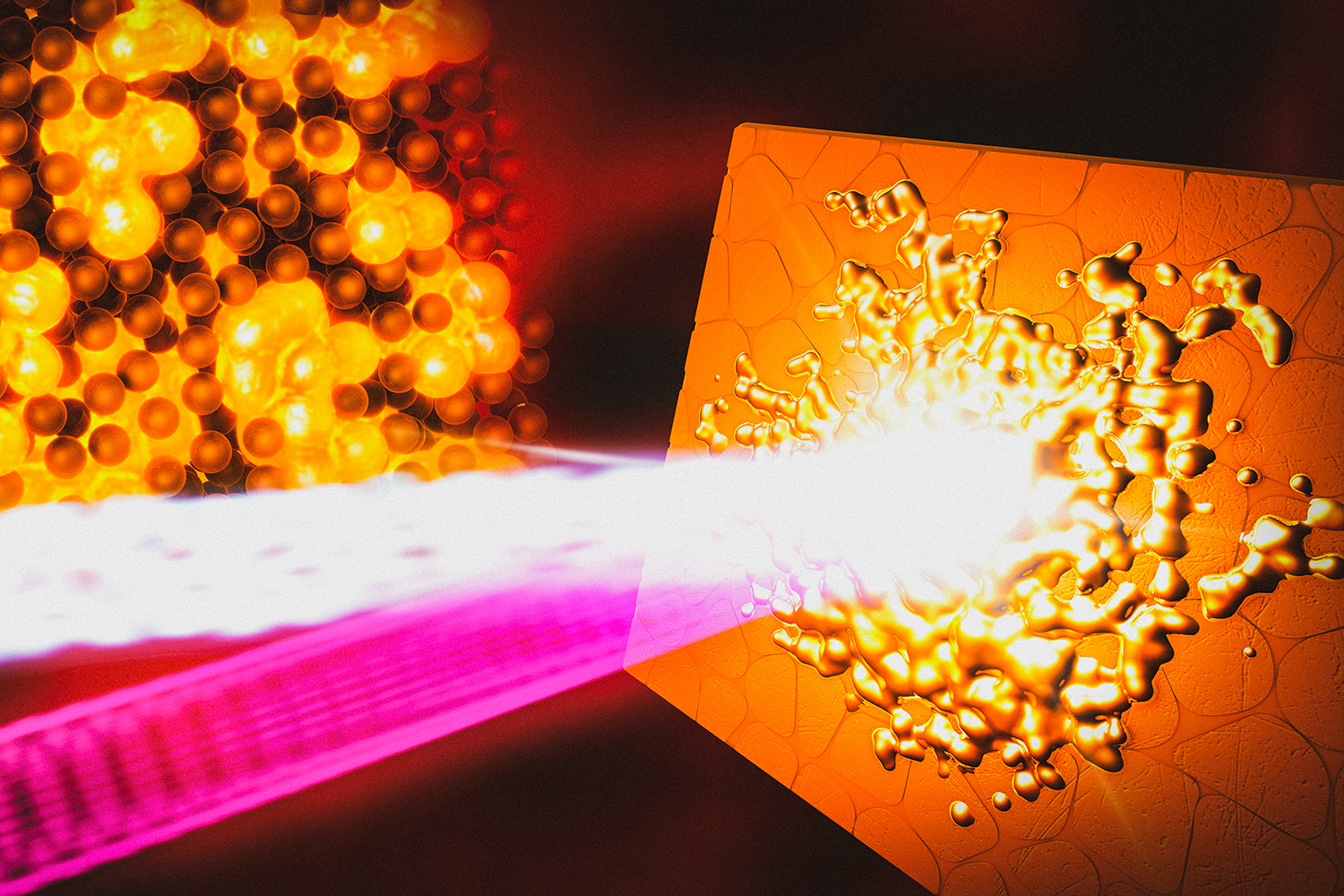
The team brought their sample to MeV-UED, SLAC’s powerful electron camera that captures atomic and molecular movements down to the femtosecond – millionths of a billionth of a second. They blasted a thin copper film with laser heat, then sent an electron beam to image the sample as it heated. What they saw surprised them.
Simulations had predicted that during ultrafast heating, the copper sample would start melting along its surfaces at about 1,085 degrees Celsius. The sides and edges would continue melting with increasing temperature, while the central area of the sample, which is subject to higher pressures, would retain its crystal lattice structure for longer. However, upon reaching around 1,424 degrees Celsius (approximately 1.25 times the melting temperature and copper’s superheating limit), the remaining crystal lattice was expected to instantaneously collapse into a fully disordered liquid.
Instead of the predicted collapse, the researchers saw a gradual melting, even as the temperature rose beyond the superheating limit. The copper had managed to evade its fate. Now, the team thinks they know why.
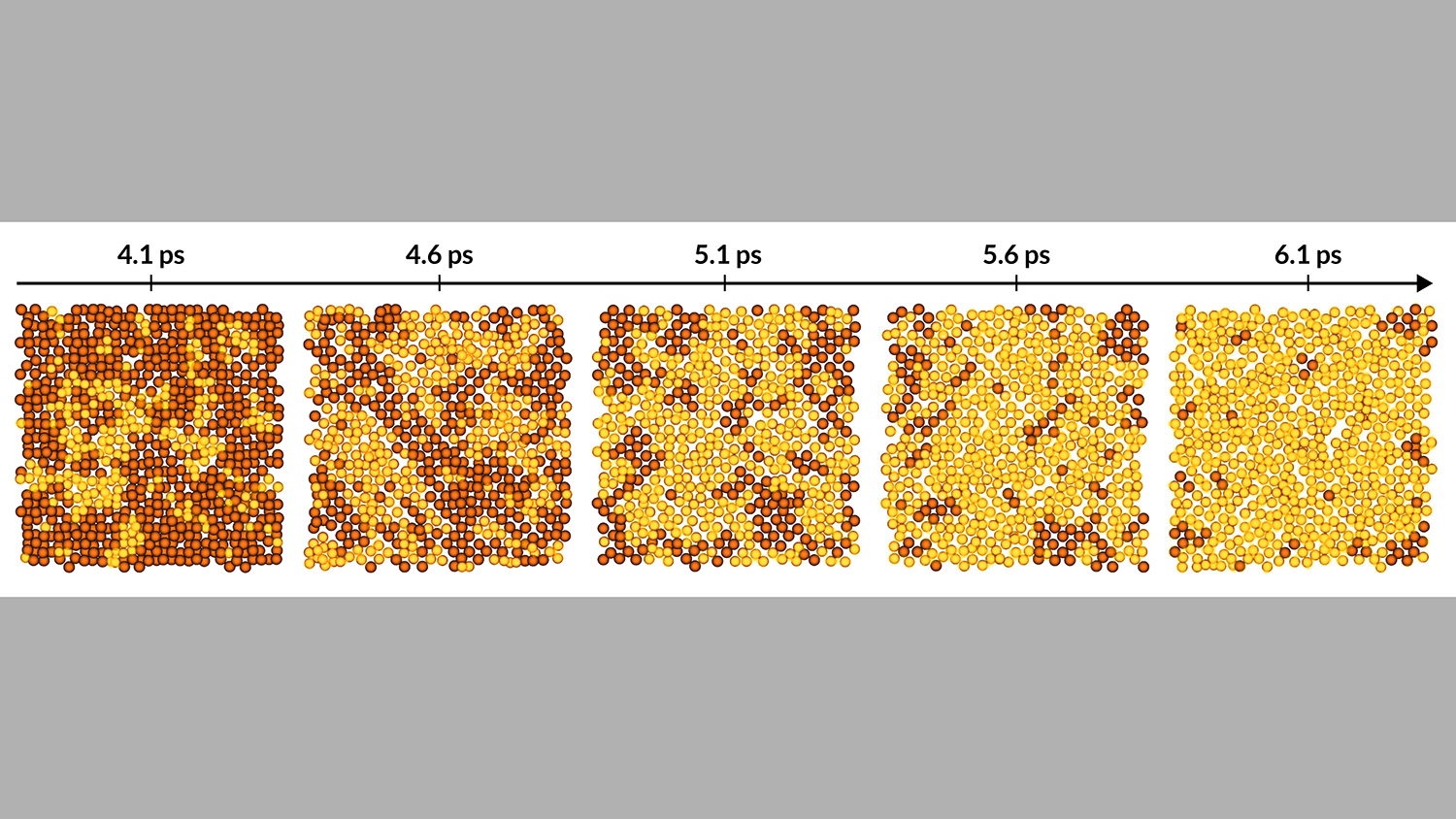
At SLAC’s electron camera, researchers recorded timestamps of solid copper atoms (orange) as they melted (yellow) after being blasted with laser heat. This graphic shows how copper atoms changed over a period of several femtoseconds (millionths of a billionth of a second), notated here as fractions of a picosecond. Instead of the predicted collapse, the researchers saw a gradual melting. | Greg Stewart / SLAC National Accelerator Laboratory
Testing assumptions
When researchers build computer simulations predicting atomic and molecular behavior, they face enormous complexity. Since capturing every variable is computationally expensive and some phenomena remain poorly understood, they must make informed assumptions. While these assumptions can speed up problem-solving, sometimes an approximation can lead to an inaccurate prediction.
In this case, existing simulations had assumed the melting copper would face static conditions, with uniform pressure on all sides keeping the atoms fixed in place. But the real-world experimental pressure conditions were far more dynamic, allowing the atoms to relax and shift and so retain some order, even beyond the superheating limit. By integrating these additional parameters into computer simulations, the team was able to replicate the experimental behavior of the copper atoms.
“It’s a straightforward solution, but molecular dynamics simulations had been overlooking it for years,” Mo said. “When you have complex simulations attempting to capture every aspect of reality, down to individual atoms, it takes real-world data to show you what’s missing from the calculations.”
“This is a major improvement to modeling capabilities and their predictive power going forward,” said Siegfried Glenzer, High Energy Density Science division director, professor for photon science at SLAC and senior author on the paper. “The precision and resolution with which we are able to see these things demonstrates how remarkable this technique is at unveiling these ultrafast, ultrasmall dynamics.”
The experiment also revealed that in ultrafast heating scenarios, copper shows signs of a phenomenon called pre-melting, in which disorder arises at surfaces of nanosized grains and the boundaries between them before the system reaches its standard melting point.
Next, the group hopes to explore whether enforcing hydrostatic conditions – in which the internal and external pressure on the copper is at equilibration – would cause the copper to collapse at its superheating limit as the simulations had predicted. With a stronger grasp on copper’s behavior, they plan to study the more complex dynamics of copper alloys and their potential for absorbing heat in fusion systems.
For more information
The team led by SLAC included researchers at Bundeswehr University Munich, University of Kaiserslautern-Landau, University of Rostock, University of Duisburg-Essen, TU Dortmund University, and University of Warwick.
This research is supported in part by the DOE Office of Science Fusion Energy Sciences and SLAC’s Laboratory Directed Research & Development Program. LCLS is a DOE Office of Science user facility.
Citation: Mo, M.Z. Nat Commun August 6, 2026. 10.1038/s41467-026-75970-1
For media inquiries, please contact media@slac.stanford.edu. For other questions or comments, contact SLAC Strategic Communications & External Affairs at communications@slac.stanford.edu.
This story was originally published by SLAC National Accelerator Laboratory.
Writer
Erin Woodward