Edmonia Lewis is having a moment. Again. The sculptor, who gained worldwide fame more than a hundred years ago but then was largely forgotten by the art history world, is now being rediscovered by a larger, modern audience.
With the new book Moving Stones: About the Art of Edmonia Lewis (Duke University Press), Stanford Professor Jennifer DeVere Brody wants to make sure Lewis is viewed with the same depth of perspective given to her medium.
“It is difficult to grasp her significance from a single point of view: Her chosen mode of artistic expression, figurative sculpture, personifies the natal details of her life,” Brody writes. “The homology between her art and life exemplifies the logic inherent in three-dimensional sculpture, made in the round.”
As a woman with Black and Ojibwe heritage, Lewis overcame many obstacles to excel at creating neoclassical marble sculpture. To further her career, she felt compelled to leave the U.S. for Europe because, as she put it, “The land of liberty had no room for a colored sculptor.”
Despite living most of her life as an expat, Lewis created many pieces with distinctly American themes, including freedom, cultural identity, and the abolition of slavery. And, as Brody notes, while the fields of art history and African American studies may have overlooked Lewis’ work, many Black and feminist artists did not.
We spoke to Brody, professor of theater and performance studies in the School of Humanities and Sciences, about her book and Lewis’ enduring influence.
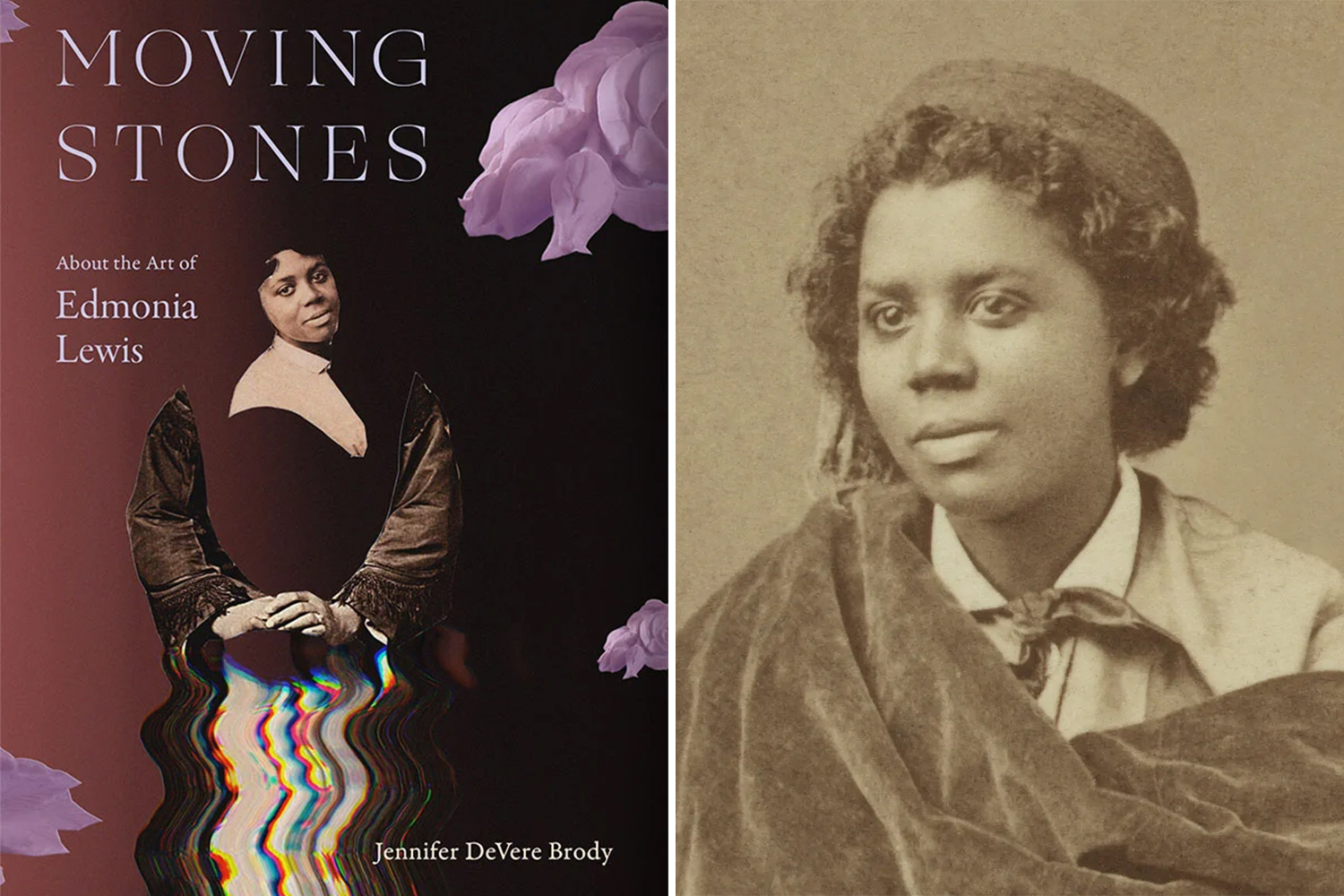
Left: “Moving Stones: About the Art of Edmonia Lewis,” by Jennifer DeVere Brody. Right: A cropped portrait of the sculptor Edmonia Lewis taken by Henry Rocher circa 1870. | Cover: Duke University Press; portrait: National Portrait Gallery
This Q&A has been edited for clarity and length.
What inspired you to write Moving Stones?
Edmonia Lewis wanted me to write it, and I’m not the only one to feel called by her story. I was researching my first book back in the 1990s in the U.K., and I was at the library of the British Museum when I came across an image of Lewis in a writer’s notebook. Then about 15 years later, I was working on another project and saw the image again. I started to do more research, and once you start on her amazing journey, I think it’s very difficult to let her go.
Edmonia Lewis was famous in her time. Why do you think she was largely forgotten?
Lewis was extraordinarily well known in her day. She was regularly quoted and interviewed by The New York Times and the international press in her era. Luminaries from across the U.S. and Europe visited her studios, including President Grant and Pope Pius IX.
I don’t know why she was forgotten. She shouldn’t have been. Traces of her always remained, and it has taken new archival research to find her again.
She actually was included in the first art historical book about Black artists published at the turn of the 20th century. Her legacy has been kept alive predominantly by Black art historians and feminists. It was the larger discipline of art history that overlooked her.
How was Lewis’ legacy carried forward?
In my book, I look at a lot of contemporary artists who pay homage to her in their work. For instance, Faith Ringgold, a famous Black artist who worked in a range of media, put herself next to Edmonia Lewis in one of her painted story quilts as if they were contemporaries.
Of course, now, ironically, it is Lewis’ time. She has been gaining more attention since she was in a recent New York Times obituary as part of the paper’s “Overlooked” series, which is mostly about women who never got their due. There is a major exhibition of about 20 of her artworks that is traveling the country. Some of her work has been lost, like her story was lost. But now there are numerous scholars and fans who have been captivated by her story, and the field of art history has opened up to recognize her.
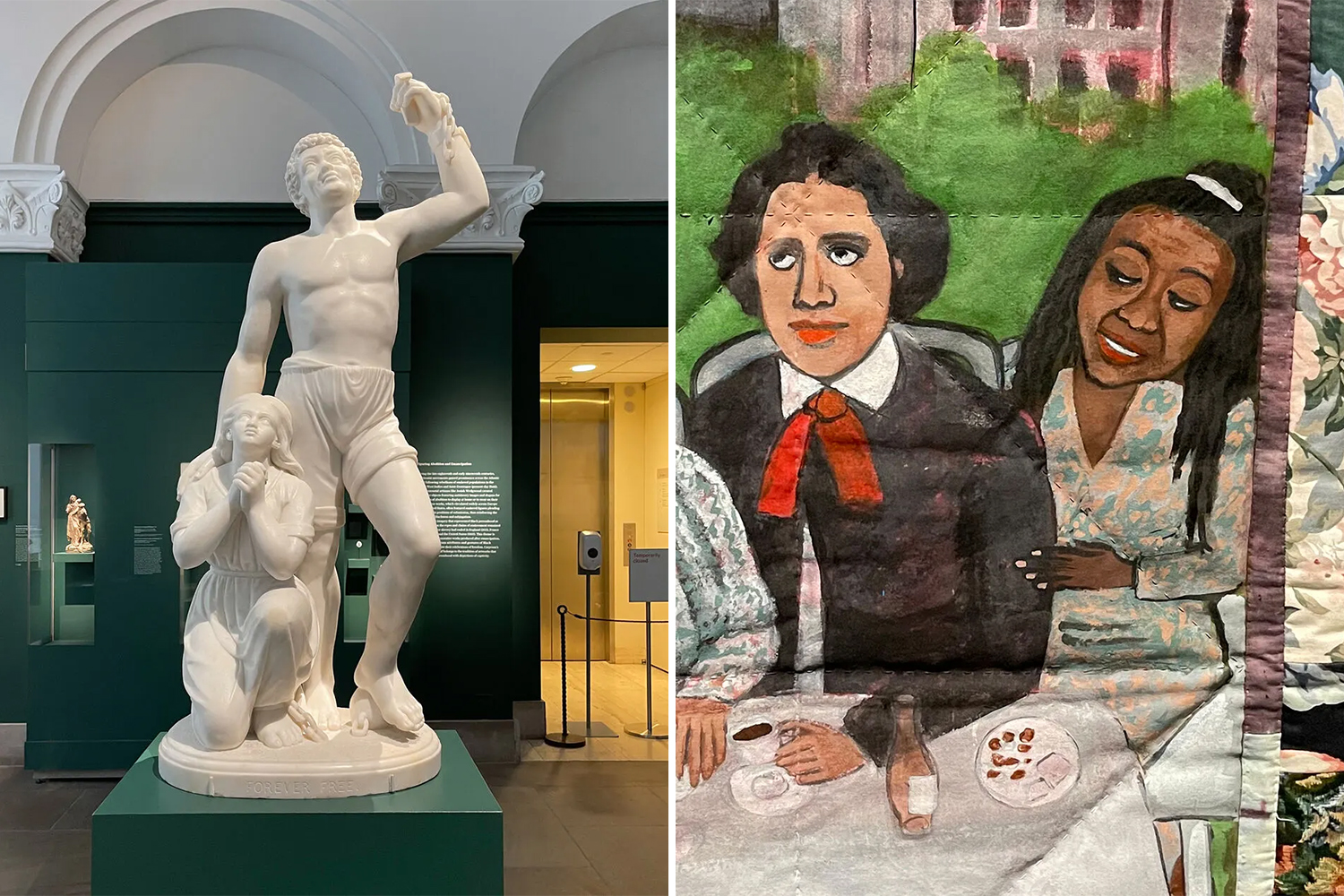
Left: Created in 1867, “Forever Free” is one of Lewis’ earliest sculptures and was the first sculpture of a newly free African American person. Right: This detail of Faith Ringgold’s “Le Café des Artistes,” The French Collection Part II, #11, 1994, shows Lewis with the artist. | Metropolitan Museum of Art, New York; collection of Juanita and Michael Jordan.
With this resurgence of interest, what do you hope people will learn about Lewis?
Lewis had this incredible tenacity and a drive to fulfill her vision for her work. Her passport says she was 4 feet tall, and yet before she hired assistants to help her, she wielded heavy sculpting tools, some of which she made herself, and often put up her own clay, which involved putting weighty wet clay on a scaffold, roughing in the form.
She attended Oberlin College, but it didn’t really have a formal art program for women. She didn't let that stop her. When she left Oberlin, she went to Boston and studied with an abolitionist sculptor named Edward Brackett, but she was largely self-taught. She had an incredible work ethic. When she went to Rome, she connected with a group of women sculptors there, but she also learned by copying classical sculptors such as Michelangelo. Some of her copies, such as the bust of Octavian, were much admired.
She did not like it when some people would criticize or praise her art because she was “a colored girl.” She was a consummate artist who was dedicated to her craft. She took criticism when it was legitimate and would go back and work again. You see this in slight variations in the copies she made where she’s trying to improve.
I think that kind of drive is a big part of what makes her story so compelling. I’m interested not only in her historical story, but also in the legacy of what draws so many different people to her work.
For more information
Brody is also a professor, by courtesy, of African and African American studies.
This story was originally published by Stanford School of Humanities and Sciences.
Media contact
Sara Zaske, School of Humanities and Sciences, 510-872-0340, szaske@stanford.edu
Writer
Sara Zaske