In 2016, a day after losing to Novak Djokovic in the semifinal of the Australian Open, tennis great Roger Federer seriously injured his knee while drawing his kids a bath. He underwent surgery, missed multiple tournaments, and took a three-month hiatus to rehabilitate. The following year, Federer, then 35, returned with a vengeance.
“When I came back to Australia, I was so ready that I played some of the best tennis of my life,” he recalled during a wide-ranging discussion with President Jonathan Levin at Maples Pavilion on Monday.
That year, he won seven titles, including the Australian Open and Wimbledon, leading many analysts to dub his success one of the greatest comebacks in sports.
“It just goes to show that when one door closes, another door opens [if] you keep believing and persevering,” Federer said.
More than 1,600 Stanford students and community members attended to hear Federer discuss career setbacks, on-court rivalries, managing pressure, and more. The event was sponsored by the Office of the Vice Provost for Undergraduate Education (VPUE) and the Department of Athletics, Physical Education, and Recreation (DAPER).
Andrew Brodhead
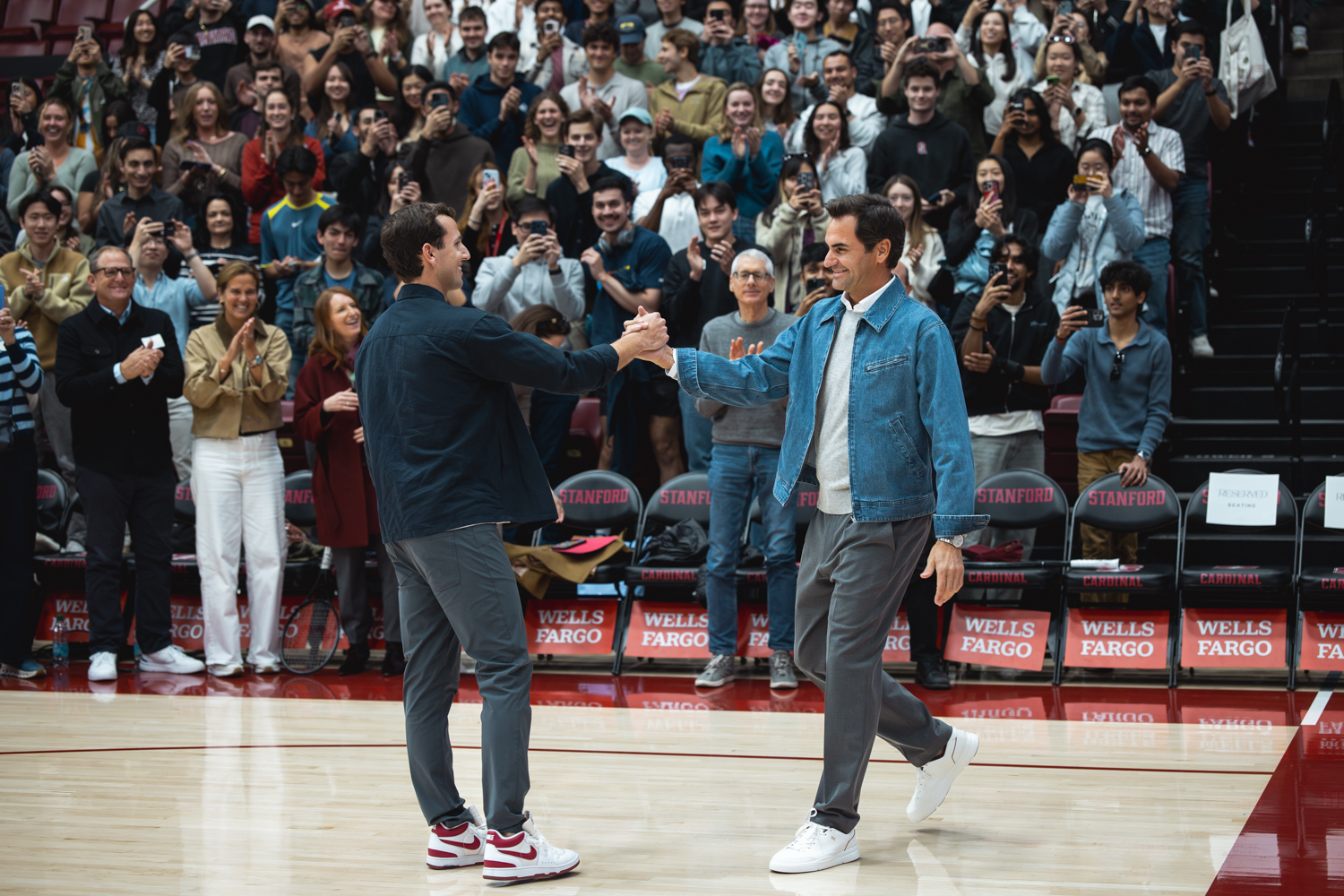
Stanford tennis player Nico Godsick greets Roger Federer.
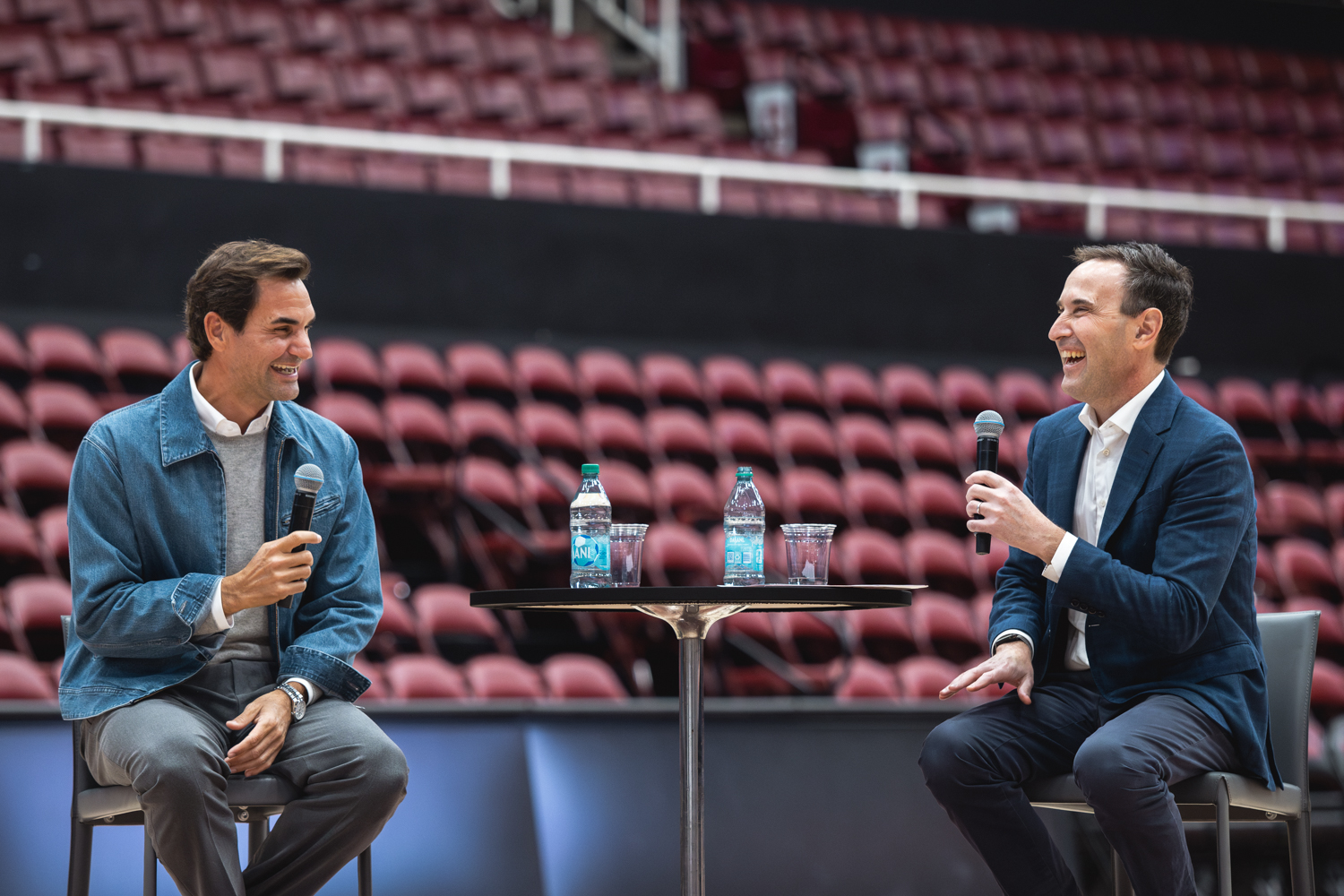
Federer and President Levin share a laugh during a wide-ranging discussion about the player's tennis career.

Federer greets fans and signs autographs.
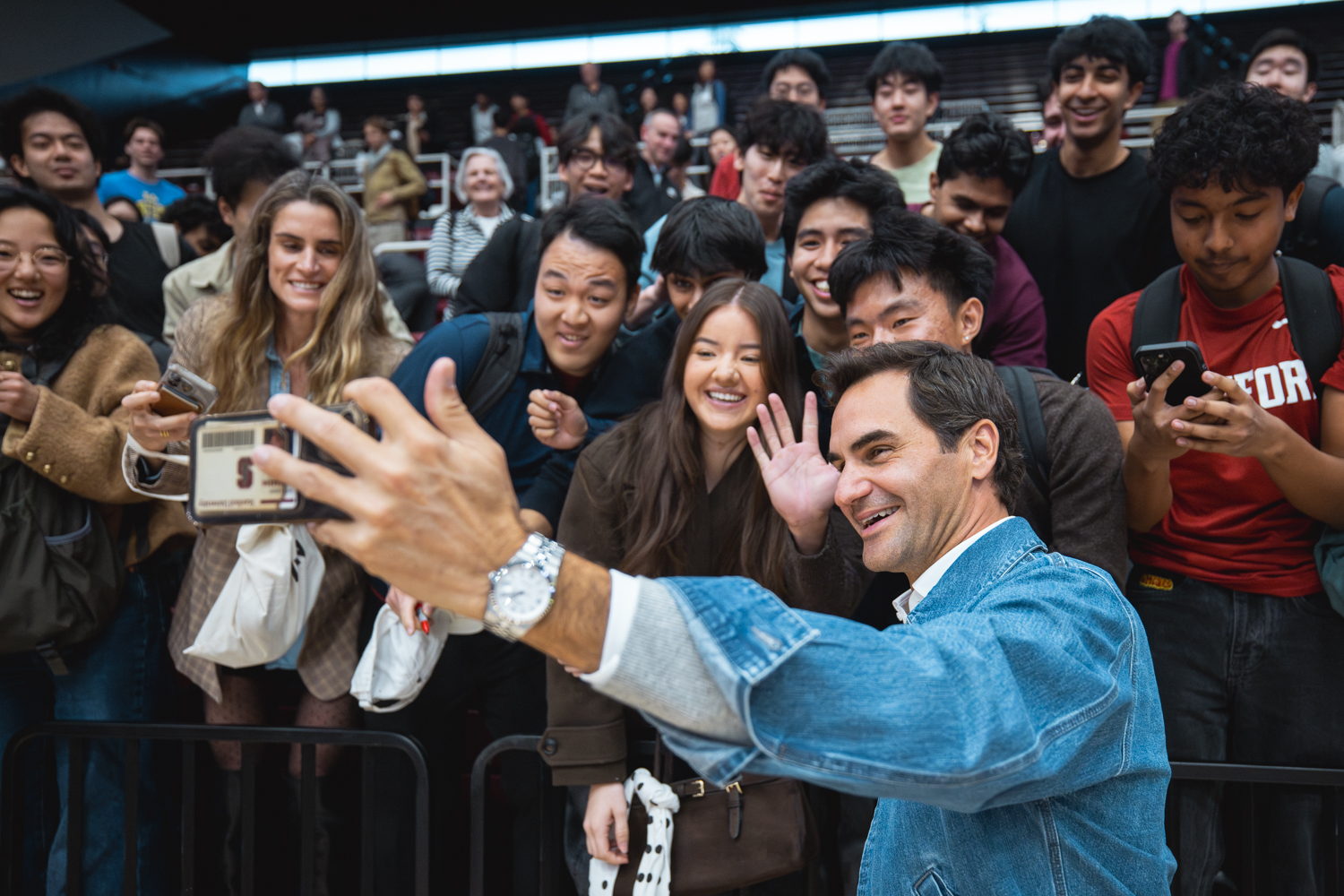
Taking selfies with Stanford students and fans.
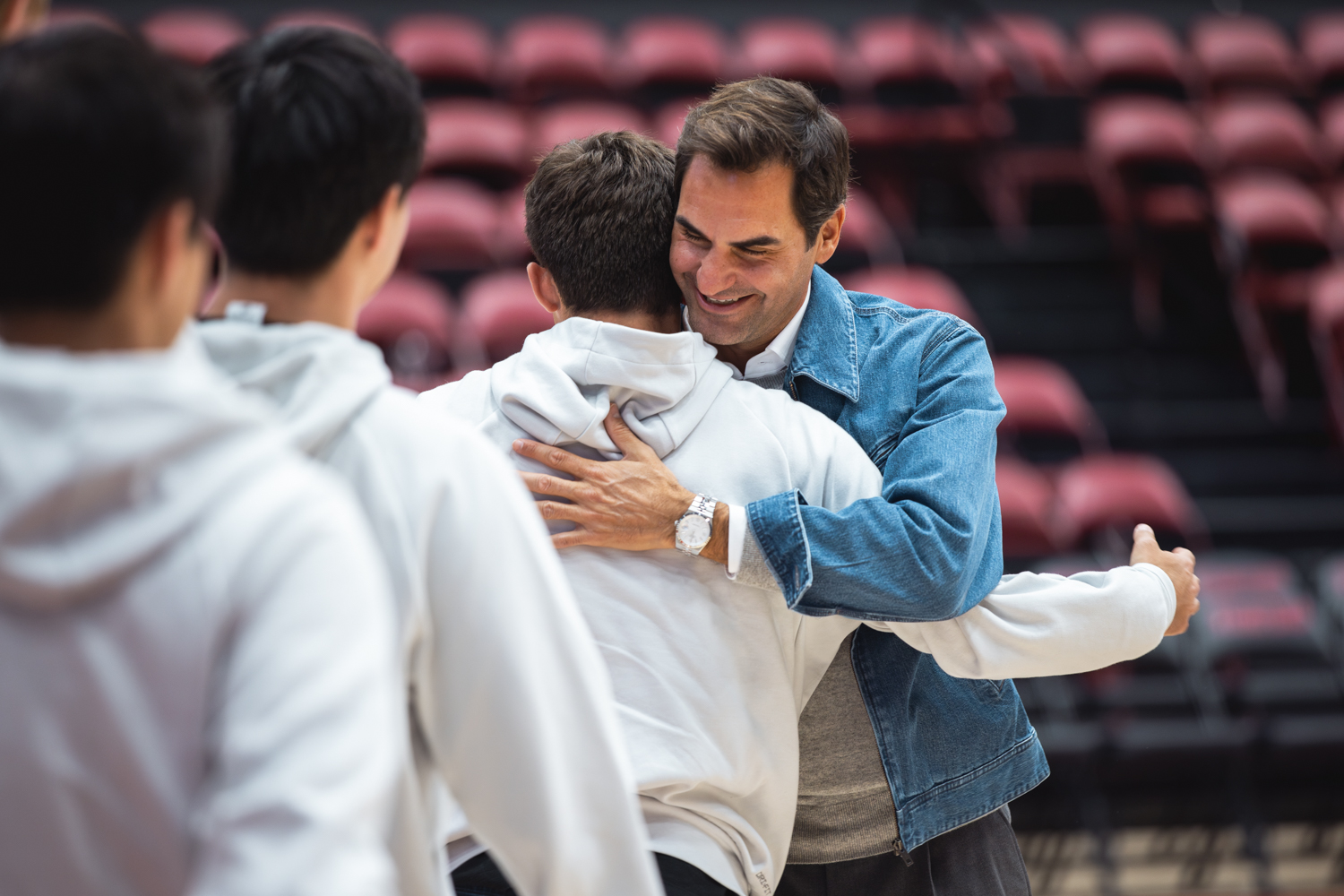
Members of the Stanford men’s tennis team greet Federer and gift him Stanford swag.

At least 1,600 Stanford students and community members attended.
In his introductory remarks, Stanford tennis player Nico Godsick noted that Federer spends as much time talking to young players, kids, and tournament organizers as he does speaking with world leaders, CEOs, and fellow champions.
“This says a lot about who he is beyond the sport,” said Godsick. “The same character shows up with his work through the Roger Federer Foundation. Over the last 20 years, Roger’s helped over 3 million children receive early childhood education in southern Africa and Switzerland,” said Godsick, adding that Federer’s character off-court will outlive his many achievements on the court.
Ice in the veins, fire in the belly
Federer began his tennis career in his hometown of Basel, Switzerland. Growing up, he worked as a ball boy and was inspired by the players he watched, leaving school at 16 to pursue tennis professionally. During his early career, he was known as a volatile and “hot-headed” player, often letting his emotions get the best of him when he lost points or matches. His coach, family, and friends told him he’d play better if he were calmer.
“I went through this process of about a year-and-a-half of trying to manage my emotions differently,” Federer said, adding that he tried to cultivate “ice in the veins and the fire in the belly.”
“You want that urge and that fight to win, but [also to be] cool, like nothing can faze you,” he said.
In his much-watched 2024 Commencement speech at Dartmouth College, Federer said that in his career, he won 80% of his matches, but only 54% of the points. On Monday, he said those statistics taught him that it’s important to “win at the right times,” rather than all the time. He also encouraged the audience “not to get too worked up about losing.” What’s more important, he said, is how one reacts to a loss.
Foes and friends
When Levin noted that tennis is a solitary sport on the court, Federer agreed that it can be very lonely, adding that the daily grind, traveling, and pressure can be mentally taxing for players. “Sometimes you need a big push, sometimes a little push, a friendly reminder. And this is where I think I’m very fortunate – I’ve had the right coach at the right time.”
When one door closes, another door opens [if] you keep believing and persevering.Roger Federer
Federer found that surrounding himself with successful people improved his game. For example, when he wasn’t on tour, he traveled to Asia with tennis player Pete Sampras to play exhibition games. And in 2014, after not winning a Grand Slam title in a few years, he reached out to retired tennis champion Stefan Edberg for inspiration. “I tried to always spend time with people that I really felt inspired and motivated me,” he said. “On the flip side, I try to also motivate my own team.”
Levin noted that Federer was ranked number one for several years in the 2000s before players like Djokovic, Andy Murray, and Rafael Nadal burst onto the scene. Although rivals, Federer said he appreciated them because “they are actually here in many ways to make you a better player and a better person, because you have to accept their presence and their strength. …”
“You really spend tons of time together, and we have enormous respect for one another,” he added. “So I think that’s one of the beautiful stories of tennis careers or my career.”
Q&A
The discussion wrapped up with a few pre-selected questions from students, including what major Federer would have selected had he attended Stanford when he turned 18 in 1999 – to which he replied, computer science or engineering, because of the many tech companies launched around that time.
Asked to define fulfillment, he said the definition changed throughout his life. It initially meant getting to play professionally, and later winning matches and tournaments. That changed when he became a dad. “When you retire, now, it’s honestly for me [about] spending maximum time with my children,” he said.
When asked what the next 20 to 30 years will look like for him, Federer said he doesn’t plan that far ahead. “To have space and not that pressure is a beautiful feeling. And right now I’m in a great spot.”
The event concluded with the men’s tennis team gifting Federer and his family Stanford Athletics and Stanford Tennis gear. Federer also signed autographs and took photos with fans.
Writer
Alex Kekauoha