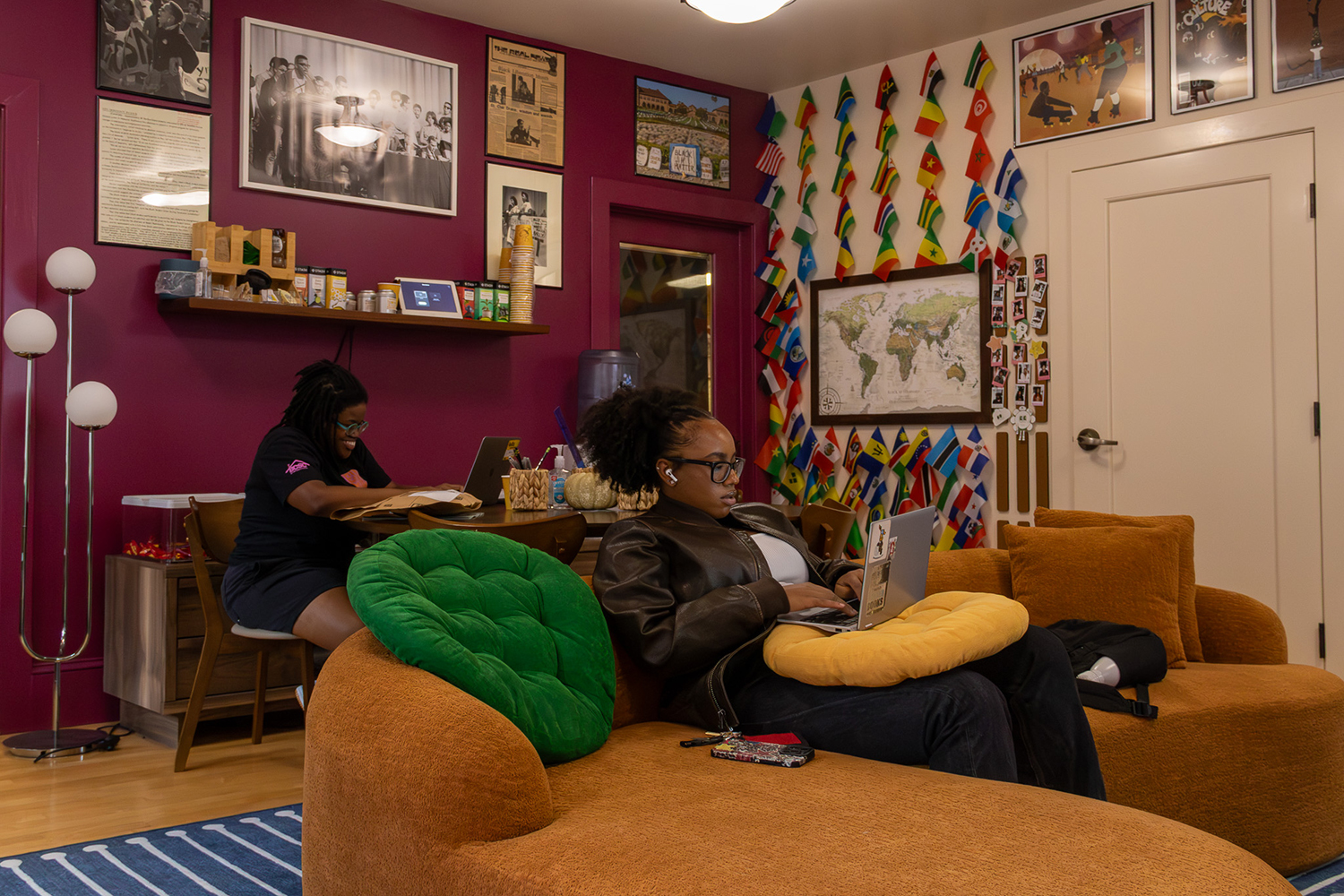
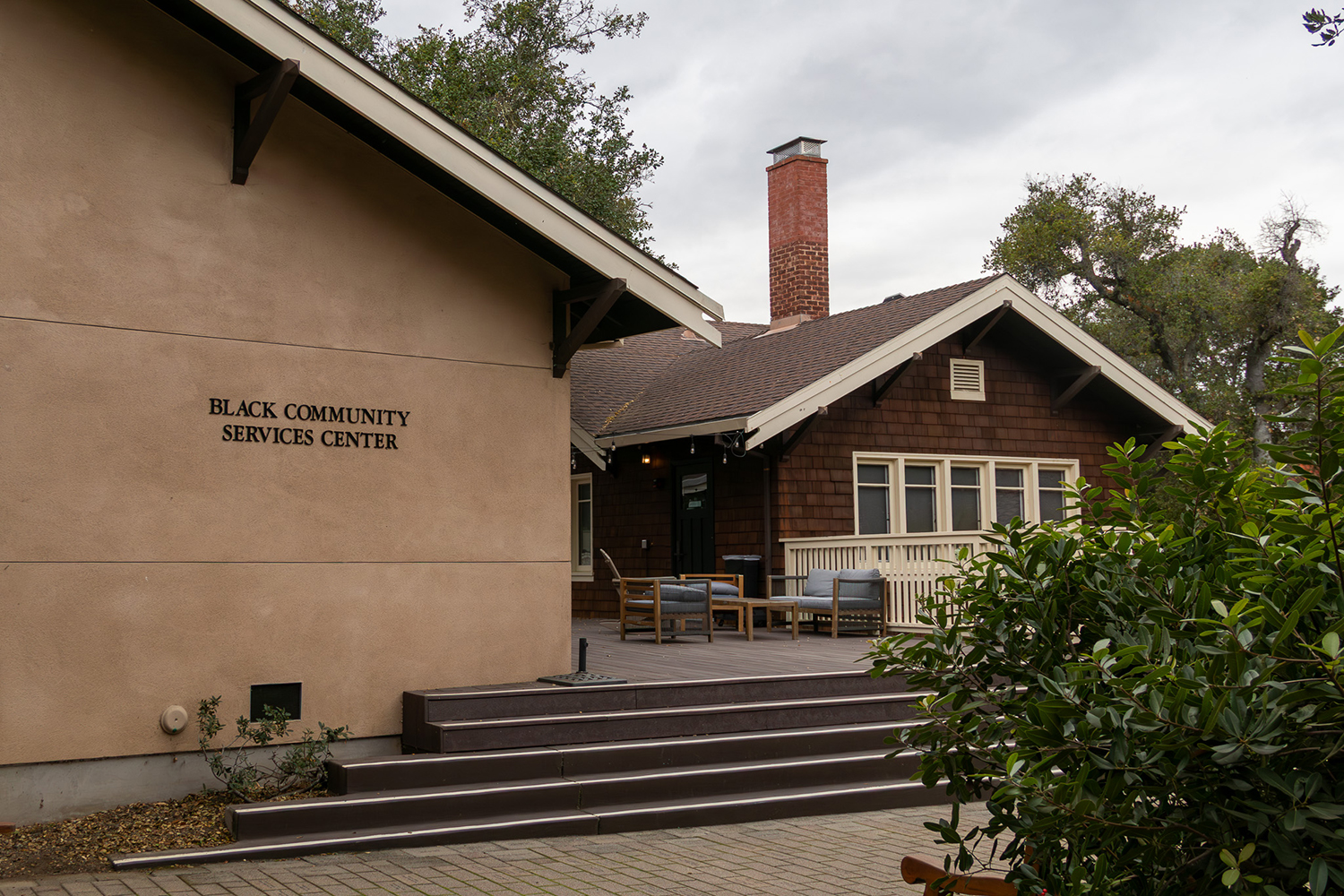
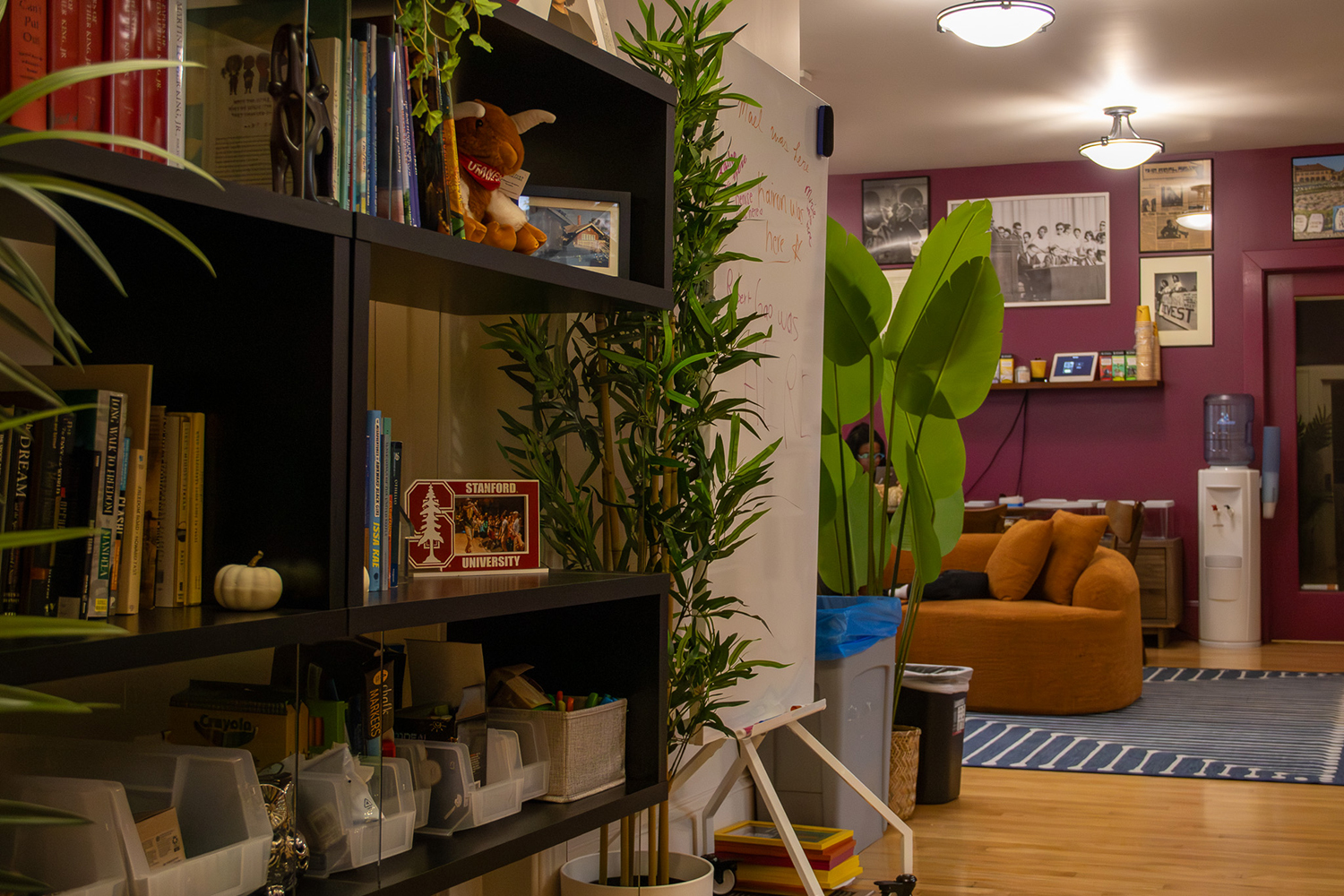
The Black Community Services Center (BCSC), widely known as the Black House, has seen its share of changes over the years. Established in 1969 as the Black Student Volunteer Center through student activism, the center’s most recent change is a comprehensive interior redesign, bringing in colorful new furnishings and a cozier aesthetic.
“Our center is a pillar in the field of cultural centers,” said Rosalind Conerly, associate dean and Karr Family Director. “We were created on the first wave of Black cultural centers in the ’60s, so we’re actually in books, and people talk about our space, but I felt like our physical space didn’t really reflect the grandeur of the Black House.”
A new vision for the space
The redesign began with alum and interior designer Danielle Colding, ’98, visiting the center and suggesting preliminary ideas. The project was initially paused due to funding and the start of the pandemic, but it later moved forward with financial support from general funding and renewed student involvement.
Fatou Barrie, ’24, MA ’25, who helped lead the redesign, said she was motivated by a lack of student political engagement noticed while organizing Congo Week in 2024.
“The Black House, I felt like, should be a place where people are able to go and talk to each other and have community and also organize,” Barrie said. “Even in my own organizing, I realized I didn’t really go to the Black House to do what I wanted to do.”
In February last year, students at the Black House hosted a town hall to gather community input on the current relationship with the Black House and shape a shared vision for the future, which led to the formation of the Black Imaginations Committee. From then on, formalized meetings and committee leadership pushed forward funding strategies and redesign work.
One week before Reunion Homecoming last year, Assistant Dean and Associate Director of BCSC Domonique Johnson and alumna Sky Walker, ’24, took the lead on turning the proposed designs into reality, with Johnson serving as the project manager and bringing together students and alumni.
“The project took a lot of energy on the students’ and the professional staff’s parts,” Johnson said. “But nothing beats people coming into the space and taking it all in for the first time, or the second, or even the third. They come in and engage with the space in ways that show us the reset was much needed.”
Students say the results have been meaningful.
“To be in this space and to be able to laugh and to be able to be free with my friends for hours … that’s something I’ll hold onto,” said sophomore Maya Walker, who serves on one of the student committees. “To know that here at Stanford, we have a space where we can enjoy each other and be our true selves.”
“Now it feels like a home,” added junior Mahalit Sisay.
Future designs
The main house redesign marks the completion of phase one of BCSC’s redesign.
Phase two involves painting a mural in the community room by San Francisco-based artist André Renay, and phase three is renovating the center’s kitchen to become a Black Diaspora Learning Kitchen, where students can share cultural meals and learn life skills like cooking and budgeting. The latter project was initiated by alumni DeLise Bernard and Valerie Brown, along with several other alumni, who together launched the Black Women of ’98 Legacy Fund.
“With this project, a lot of people were like, ‘Oh, just decorating isn’t going to change anything,’” said Kallie White, ’24, MA ’25, who helped lead the redesign. “But I think it was the intention. I think as a committee, we were dedicated to maintaining the ethos of it, which is student-centered, and to building community.”
The center’s origins trace back to 1968, when 70 members of the Black Student Union took the microphone during a university-wide convocation featuring an all-white male panel to outline 10 demands. One of the resulting initiatives was the creation of what would become the BCSC.
Since its founding, the center has kept a strong focus on community service and outreach while adapting to student needs.
With the Stanford Black Alumni Summit slated for next May, the goal is to have a big reveal in spring, Conerly said.
Assistant director Dr. Maya Iverson-Davis, who oversees BCSC’s student committees, expressed gratitude for the collaboration behind the project. “I'm grateful that our student community trusted us with the project,” she said.
Barrie said she hopes the redesigned space will continue to serve as both a community hub and a catalyst for student engagement. In some ways, it already has, with expanded programming like Spade Nights and more to come.
“I hope that future students are able to pick up where we left off, and that they’re able to organize their communities,” Barrie said.
Writer
Grace Gao