In brief
- Summer Quarter Global Seminars are designed by Stanford faculty to integrate course content with program location.
- Locations for the academic year 2025-26 include India, the United Arab Emirates, Estonia and Latvia, Oman, Jordan, Ghana, South Korea, Japan, China, Morocco, South Africa, and Chile.
- Applications for summer quarter 2025-26 are open; apply by Jan. 26, 2026.
- Faculty interested in leading a Global Seminar or teaching a quarter-length program can submit an application by Feb. 15, 2026.
As a political science major, Francisco Ciraulo was eager to study away during his Stanford undergraduate experience. In 2025, he participated in the Global Seminar Democracy, Economy, and Society in Taiwan. While he expected the summer program to complement his academic interests, he did not anticipate the diverse experiences and opportunities it would offer.
“One day, we were learning to use bows and arrows from local Indigenous students, and the next, we were meeting Hsiao Bi-khim, the vice president,” Ciraulo said. “It was a beautiful blend of cultural immersion and uniquely Stanford moments.”
An immersive study-away experience
The Taiwan course, led by Stanford political scientist Larry Diamond, is one of roughly a dozen Global Seminars offered each year by the Bing Overseas Studies Program (BOSP). These three-week, 3-unit courses offered across schools and disciplines integrate academic content with the program’s location, offering students an immersive and intellectually rigorous study-away experience. Each seminar is led by a Stanford faculty member and involves seminar-style classes and thoughtfully designed excursions that bring course themes to life through visits to cultural, historical, and professional sites. Most seminars culminate in a final paper or project that integrates classroom learning with firsthand experience.
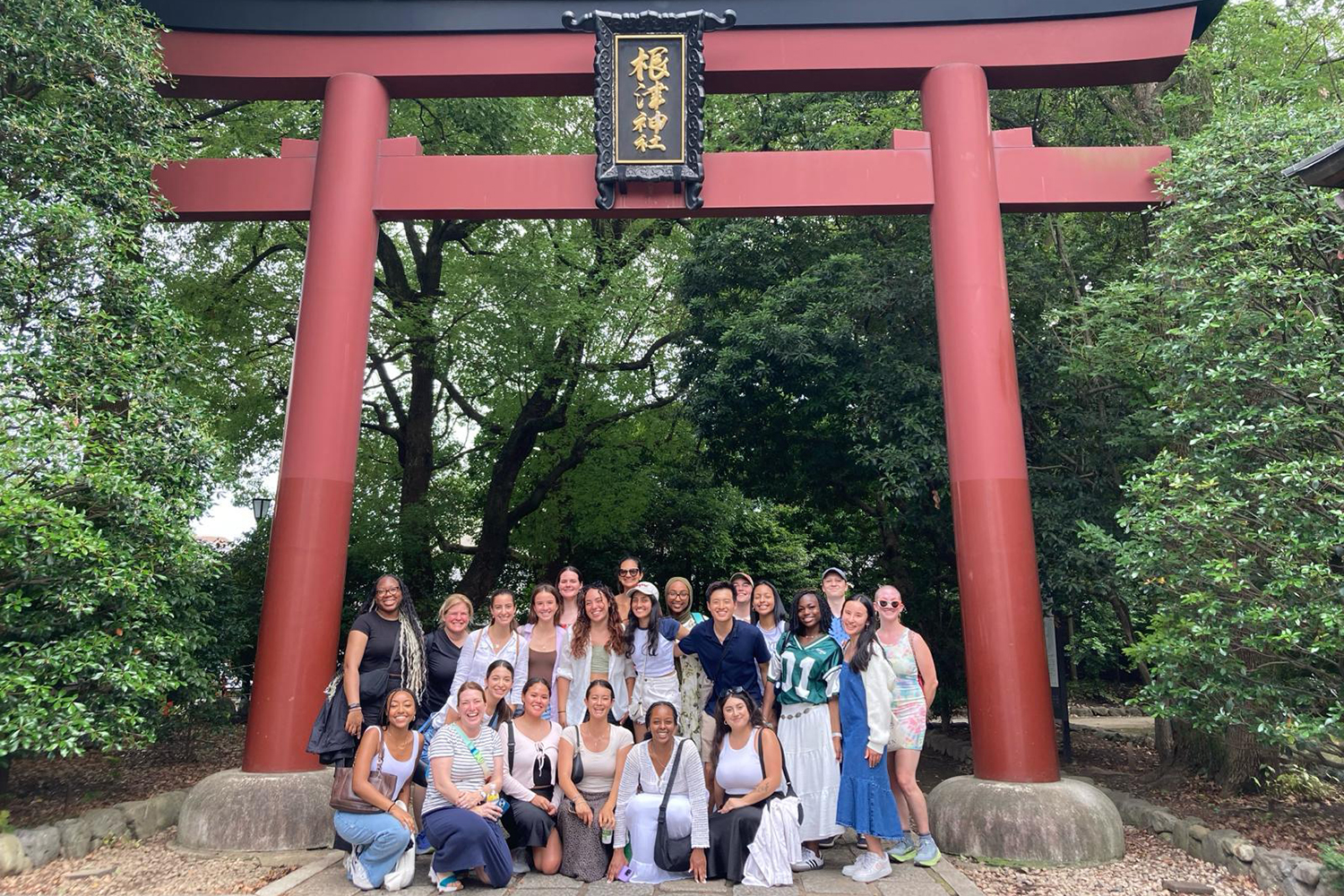
These seminars are designed to encourage students to think critically about society and its challenges on a global scale. In Shades of Grey Between Life and Death: Neuro-Ethics Across the Pacific, led by Holly Tabor, professor of medicine and director of the Stanford Center for Biomedical Ethics, and Karen Hirsch, professor of neurology and neurological sciences, students explore issues related to medicine, life, and death in Japan and America.
In summer 2024, students visited a Japanese hospital and met with critical care physicians who discussed perspectives on brain death and end-of-life care in Japan. They also engaged with Japanese anthropologists and ethicists, who shared their expertise on cultural understandings of life and death, as well as the role of medical life- and organ-sustaining technologies in Japanese society.
Seminars are also designed to foster meaningful connections between students and Stanford faculty. Mykel Kochenderfer, associate professor of aeronautics and astronautics, has led Global Seminars in Morocco, Edinburgh, India, and, most recently, in Argentina.
“Many of the highlights of my time at Stanford have been part of Bing Overseas Studies Programs, where I have gotten to know small groups of undergraduates extremely well in some amazing areas of the world,” Kochenderfer said.
Explore the 2025-26 Summer Seminars
Community-Based Global Health in India
Desert to Digital: UAE and the Arabian Peninsula’s Transition to an Innovation-Based Society
Freedom Is Not Free: The History and Memory of Estonia and Latvia
History, Urbanity, and Landscape in the Contemporary Middle East
Interdisciplinary African Urban Studies
Kangnam Style: Exploring Art and Popular Culture in Seoul
Shades of Grey Between Life and Death: Neuro-Ethics Across the Pacific
Shenzhen: From Fishing Village to Tech Powerhouse
Morocco: Contemporary Arts and Culture
This past summer, he led Technology and Society in Argentina, which immersed students in the country’s technological landscape and culture – once a symbol of economic power in South America and now emerging as a hub of sustainable growth.
“We had many visits to government, industry, and academia and got a taste of the engineering and societal challenges they are facing,” he said. “Reflecting on the similarities and differences between what we are familiar with and what we experienced in Argentina allows us to be more empathetic and creative in the ways we approach our challenges at home.”
Global Seminar offerings and locations change each year, providing a range of academic themes and giving students the chance to study in places they might not otherwise experience. Senior Wade'a Tadros, a sustainable architecture + engineering and art history major, embraced that opportunity by participating in History, Urbanity, and Performance in the Middle East, based in Jordan, in summer 2024.
“From the Northern Ajloun forest to the southern coral reefs of the Red Sea, Jordan never failed to surprise me,” Tadros said. “My peers and I frequented a local cafe to do Arabic homework every day and met new locals and travelers. We got to share delicious meals with government officials and knowledgeable guides, who shared facets of Jordan’s urban life hidden to the average eye.”
For other students, Global Seminars offer a rare opportunity to delve more deeply into their family history. Last summer, economics major Solange Adenike Sylvain participated in the Interdisciplinary Introduction to African Urban Studies seminar in Ghana.
“Most memorably, we spent a week in Cape Coast, where we visited old slave castles. One day, we explored a castle where I was able to decipher the way my own family story of movement, from Haiti and Sierra Leone to the United States, is painfully and powerfully tethered to these castles. After the heavy day, the whole cohort circled around a massive bonfire, each person releasing their own reflections on the day.”
Sylvain, now a senior, says her time in Accra, Ghana, was filled with learning about the richness of Ghanaian culture, forming reciprocal and meaningful relationships, and exploring her own place in the world. As graduation approaches, she described studying away in Ghana as a once-in-a-lifetime opportunity.
“There are few experiences that offer such an intimate chance to explore and to grow.”
For more information
Larry Diamond is the Mosbacher Senior Fellow of Global Democracy at the Freeman Spogli Institute for International Studies, a senior fellow at the Hoover Institution, and a professor, by courtesy, of sociology and of political science in the School of Humanities and Sciences.
Writer
Diana Aguilera