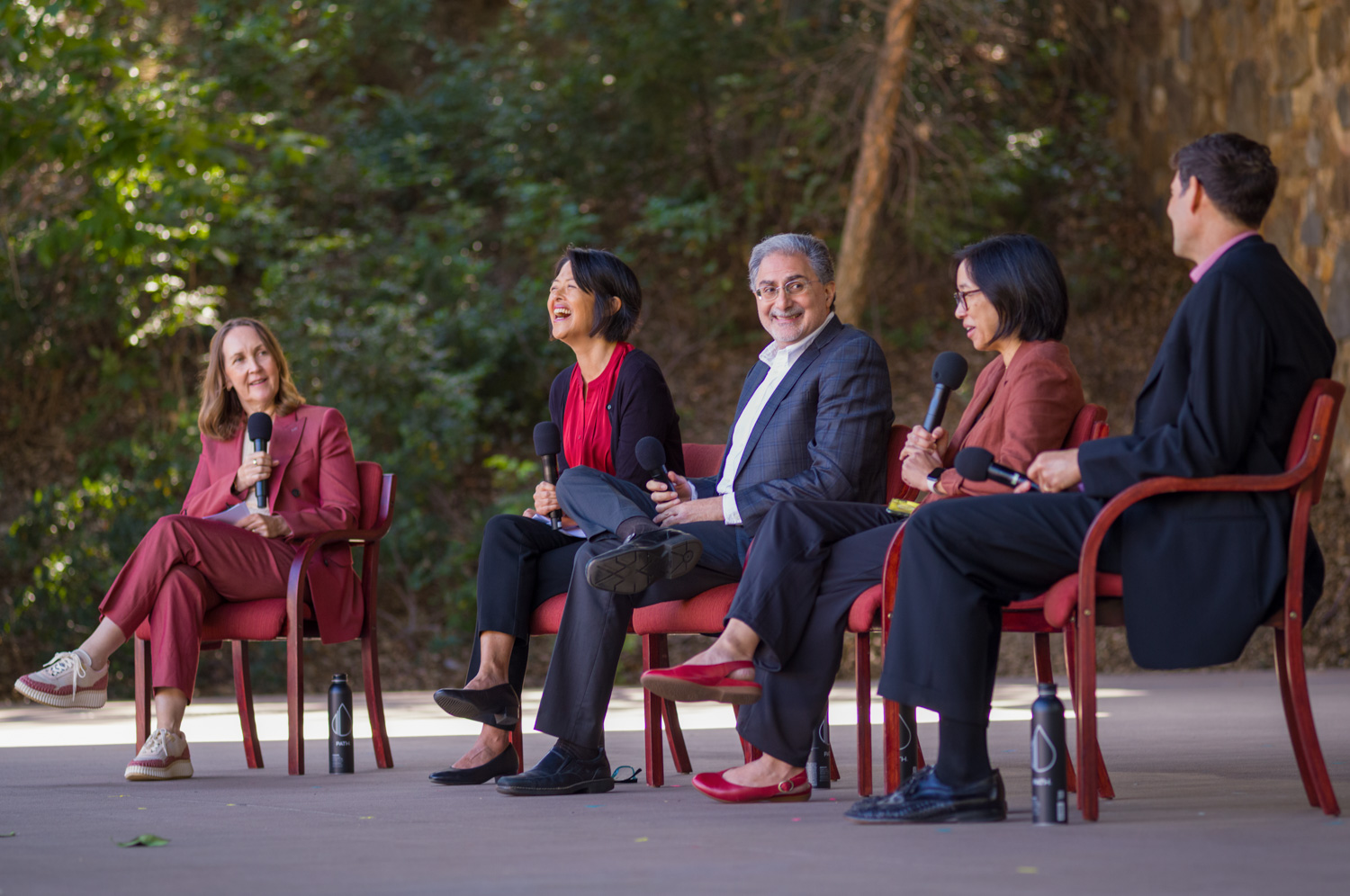
At a recent event held at Stanford Law School, Justice Anthony Kennedy, ’58, offered a simple but profound lesson in decision-making: Start with why.
“It’s your duty as a judge in each and every case to ask yourself again, ‘Why am I about to do this?’” said Kennedy to a packed audience gathered to hear the former Supreme Court justice speak on Oct. 30. “You owe that to the litigants. You owe that to the judiciary. You owe that to yourself.”
Kennedy’s remarks came during a wide-ranging conversation with Stanford Provost Jenny Martinez, hosted by the McCoy Family Center for Ethics in Society, with additional support from the Stanford Civics Initiative, ePluribus Stanford, and the Civic, Liberal, and Global Education (COLLEGE) program.
For nearly an hour, Kennedy talked with Martinez about his life and distinguished career, drawing on some of the reflections from his new memoir, Life, Law & Liberty (Simon & Schuster, 2025).
Kennedy grew up in Sacramento, California, and received a degree in political science from Stanford in 1958 and his LLB from Harvard Law School in 1961. During his 30-year tenure on the Supreme Court, he authored landmark opinions that profoundly shaped American law and society, most notably in the areas of gay rights, free speech, and capital punishment.
Known for his commitment to decency, civility, and ethics, Kennedy often emphasized the human consequences of judicial decisions. That awareness, he said, began in childhood.
He recalled playing with a Japanese American friend before World War II – a boy whose favorite toy was a samurai figurine in a glass case. After the attack on Pearl Harbor, Kennedy’s friend and his family were incarcerated under the 1942 executive order that forced more than 120,000 people of Japanese descent into camps.
Before leaving, the boy gave Kennedy his toy. “I never saw him again,” Kennedy recalled.
Decades later, Kennedy said he thought again about protecting the lives of children and their families when writing the majority opinion in Obergefell v. Hodges, which ruled that the 14th Amendment requires all states to license and recognize marriages between same-sex couples. The decision legalized gay marriage nationwide.
He noted that many children were being adopted by same-sex couples, but in many states, only one parent was legally recognized. He argued that being able to acknowledge both parents was essential to ensuring stability and well-being throughout their children’s lives. “It seemed to me that a great importance to the children to recognize the marriage,” Kennedy said.
Kennedy reflected how concepts such as marriage evolve over time – from property-based arrangements to relationships founded on equality and mutual respect.
Judges, he said, must be willing to revisit past views, including their own.
“Were there motives, impulses, biases, social considerations, historic precedents, future predictions that I did not see or that I misunderstood?” Kennedy reflected. “That’s part of the fascination of judging.”
In a fast-paced world, it’s easy to slip into autopilot. Instead, stop and reflect on the decision before you, Kennedy said, adding that this is crucial in any profession.
Kennedy also emphasized the importance of self-respect. “A lawyer has the duty not only to be a practitioner who is respected for his practice, but he should have respect for himself,” he said.
He noted that articulating the court’s reasoning through opinions is important, not only for lawyers but also for the public. Even if people disagree with the result, understanding the reasoning behind it is vital for accountability and public trust.
He cited another landmark case, Texas v. Johnson, that ruled burning the American flag was a protected form of First Amendment expression.
While there was initial outcry over the court’s decision – including a denouncement from the U.S. Senate, which wanted to reverse it – public opinion gradually shifted, thanks in part to the judges’ careful explanations.
Kennedy, long recognized for his commitment to broad First Amendment protections, linked free speech to civility.
“Free speech allows, encourages, protects, hopes for debate that’s civil, that’s rational, that’s thoughtful, and that respects the dignity of the other person,” Kennedy said, emphasizing this is especially important when encountering opposing viewpoints.
Kennedy modeled that approach when working with his colleagues on the bench. While there were areas of deep disagreement at times, collegiality was a constant.
There were certainly tensions Kennedy had to navigate, including when reading early drafts of statements his colleagues authored. Sometimes they were, as he described, “a little too confrontational or a little too personal.” Kennedy and Justice John Paul Stevens used to joke that they served on a “two-justice civility committee” as they each urged their colleagues to temper language.
For Kennedy, upholding the rule of law depends on civility.
“Dialogue, debate, and thoughtful discourse work,” Kennedy said. “The rest of the world is watching the United States. We set the example of what a democracy ought to look like.”

The McCoy Family Center for Ethics in Society is in the School of Humanities and Sciences .
The McCoy Family Center for Ethics in Society is in the School of Humanities and Sciences.
Writer
Melissa De Witte